 Tüylüm
Boston Terrier
A lively, intelligent little American dog with white markings on brindle or black. Among flat-faced breeds it breathes relatively better, but BOAS, eye injuries and cataracts, spinal problems linked to the screw tail and the need for C-sections still matter in this breed.

 Lifespan≈ 11.8 yearsmedian, 2024 UK study; mixed breeds 12.0
 WeightUp to 25 lb (11.5 kg)RKC: three weight classes; AKC 12–25 lb
 OriginUSA (Boston)Bulldog × English White Terrier cross
 SheddingYesshort coat; brush once a week
 ExerciseUp to 1 hour a dayRoyal Kennel Club guidance
 Heat toleranceLowflat-faced; cool hours in summer
 EyesDelicatelarge and prominent; cataract screening matters
 TrainingDeterminedstandard: lively, intelligent, strong-willed
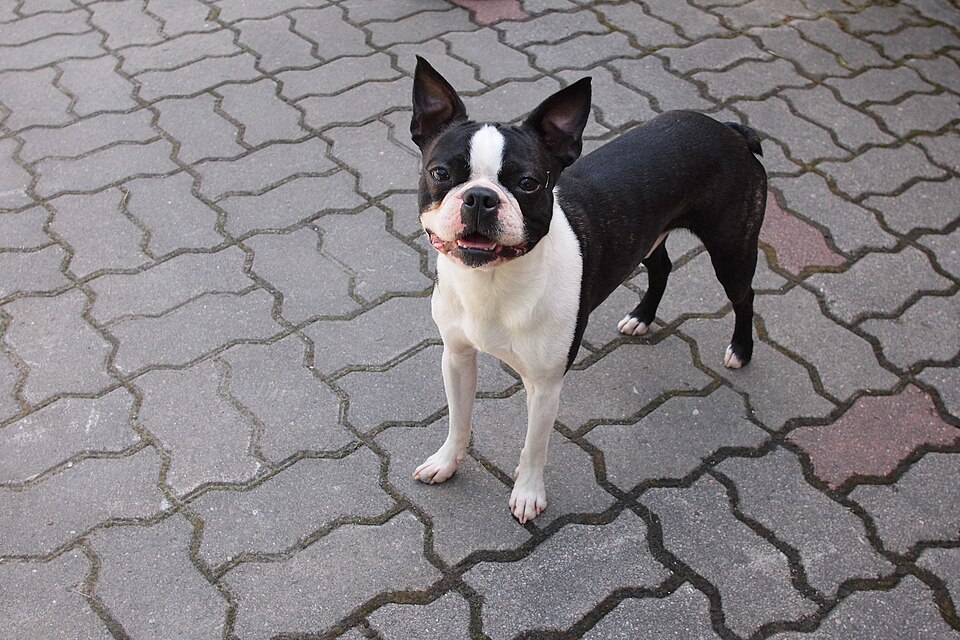
The Boston Terrier is a lively, intelligent little dog, instantly recognized by the white blaze on its face and its white collar and chest. It takes its name from the US city where it was developed, and the Royal Kennel Club describes it as the smallest of the "bull breeds," those carrying Bulldog blood. Because it shares ancestors with the French Bulldog and the Bulldog, it shares some of their health problems, but research at Cambridge shows it's in relatively better shape when it comes to breathing. On this page we've pulled together its temperament, care needs and health issues from breed registry standards, animal welfare resources and scientific studies.
- Temperament: According to the breed standard, lively, intelligent, determined and strong-willed.
- Breathing: Flat-faced; in a Cambridge study about 37% of Boston Terriers had no signs of BOAS at all, markedly better than French Bulldogs and Bulldogs.
- Eyes: Its large, prominent eyes injure easily, and the breed has hereditary cataracts, for which a DNA test exists.
- Tail and birth: Vertebral defects linked to the screw tail and the need for C-sections are common.
- Choosing a pup: Ask for the parents' eye exams, cataract DNA test and breathing grades (RFGS).
- Lifespan: A large 2024 UK study found a median lifespan of 11.8 years.
What to know
 What is the Boston Terrier like?
The Royal Kennel Club's breed standard describes the Boston Terrier as lively, intelligent, determined and strong-willed. According to the standard, it should give an impression of strength and activity without heaviness, with an easy, graceful carriage. The Royal Kennel Club writes that its white markings on black or brindle make it a very "dandy" dog.
Despite the "terrier" in its name, the Royal Kennel Club places it not in the Terrier group but in the Utility group, which brings together breeds of varied origins, and the FCI lists it among companion and toy dogs. Its determined, strong-willed nature can call for patience and consistency in training.
Every dog is an individual. Breed traits describe general tendencies; the parents' temperament, how a puppy was socialized and its health shape its personality as much as its breed.
 Who is it a good fit for?
According to the Royal Kennel Club's breed profile, the Boston Terrier is a small dog that suits apartment living, can live in town or country and needs up to an hour of exercise a day.
| Situation | Good fit? |
|---|---|
| Apartment | Good, as long as the home can be kept cool in summer |
| Town or country | Either works |
| Daily walks and play | Up to an hour a day, in the cool hours |
| Hot climate, home that can't be cooled | Not suitable; as a flat-faced breed it struggles in heat |
| Rough play | Its prominent eyes are prone to knocks; supervise play |
In homes with children, play should be supervised and the dog's face and eyes left alone. Our article on kids and dogs at home has more.
Where does it come from?
FCI records list the United States as the breed's country of origin. According to the Royal Kennel Club, the breed's founding father is said to be "Hooper's Judge," a dog born in Liverpool from a cross between a Bulldog and an English White Terrier and taken to America. He got his brindle from the Bulldog and his white markings from the terrier, and brindle and white is still the breed's accepted coloring today.
The first breed club was founded in Boston in the 1890s, and at first only Bostonians could join. According to the Royal Kennel Club, the breed's fame soon spread across the US, and by the 1950s the Boston Terrier was the country's most popular breed. Cambridge researchers note that the Boston Terrier is one of the "screw-tailed" breeds that share common ancestors with the French Bulldog and the Bulldog, and that the genetic change behind the screw tail is fixed or nearly fixed in all three.
 Appearance and colors
The Royal Kennel Club standard describes a small, smooth-coated, square-headed, compactly built, short-tailed and well-balanced dog. Body length equals height at the shoulder, so the dog looks square, and the muzzle is about one-third the length of the skull.
- Weight: According to the Royal Kennel Club standard, not more than 25 lb (11.5 kg), divided into three classes: under 15 lb (6.8 kg) lightweight, 15–20 lb (6.8–9.1 kg) middleweight and 20–25 lb (9.1–11.4 kg) heavyweight. The AKC gives 12–25 lb (about 5.4–11.3 kg). In the 104-dog Cambridge study, the average weight was 7.8 kg (about 17 lb).
- Eyes: Set wide apart, relatively large, round and dark.
- Ears: Small, thin, triangular and erect.
- Tail: Short, fine, straight or curled, and never carried above the horizontal.
- Colors: White markings on brindle, black or "seal" (black with a red cast in bright light); the standard prefers brindle and white. Ideal markings include a white muzzle, a white blaze between the eyes and a white collar and chest.
 Daily care
According to the Royal Kennel Club, the short coat needs a weekly brush; the breed does shed.
- Eyes: Check every day for redness, watering, cloudiness or squinting. According to a veterinary article published by the Royal Kennel Club, the eye surface is less sensitive in flat-faced dogs, so an ulcer may show few signs; when in doubt, see your vet right away.
- Face: If there's a nose fold, clean and dry it gently.
- Teeth: Teeth can be crowded in a short jaw; start tooth brushing early.
- Nails and ears: Check them regularly.
- Home: A cool room, shade and fresh water at all times are a must in summer.
Our dog grooming guide covers brushing and nail care.
Training and exercise
The Royal Kennel Club recommends up to an hour of exercise a day for the Boston Terrier. Short walks, ball and toy games and sniffing games suit it well. For its determined, strong-willed nature, short, rewarding and consistent training works best.
- Harness: A veterinary article published by the Royal Kennel Club recommends a harness instead of a collar for dogs with BOAS, to avoid pressure on the airway.
- Leash training: Teach loose-leash walking early; our loose-leash training guide walks you through it.
- Brain games: Hidden treats and sniffing games burn energy without straining its breathing.
A UK study of 2016 data found that flat-faced dogs had about twice the odds of heatstroke compared with dogs with medium-length muzzles. In summer, move walks to early morning and late evening, don't go out in the midday heat and never leave your dog in a car. According to the Royal Kennel Club's article, very heavy panting, glazed eyes, vomiting, excessive drooling, a dark red tongue and staggering are signs of overheating; if you see them, move your dog into the shade right away, soak it with water, offer small sips of water and call your vet at the same time. See our article on dogs in hot weather for details.
 Diet and weight
Boston Terriers don't need a special food; a complete, balanced dog food that suits their age is enough. Weight matters: in a 2026 Cambridge study of 14 flat-faced breeds, body condition (how heavy a dog is) was one of the risk factors for BOAS. A veterinary article published by the Royal Kennel Club also recommends keeping flat-faced dogs lean.
- Measure food; decide the daily amount with your vet based on your dog's ideal weight.
- Count treats as part of the daily food, and don't feed from the table.
- Being able to feel the ribs under a thin layer of fat and seeing a waist from above are good signs.
- Weigh your dog once a month.
Some human foods are toxic to dogs; see our list of foods dogs should never eat.
 Health issues to know about
On the Royal Kennel Club's Breed Watch list for show judges, the Boston Terrier is in category 2; the points needing special attention are a missing, screw, inverted or tight tail and hind-leg structure. The information below is for awareness only; ask your vet about diagnosis and treatment.
Airway obstruction (BOAS)
According to UFAW, like all flat-faced breeds the Boston Terrier can be affected by BOAS to some degree: narrow nostrils and a long soft palate. In a study published by the Cambridge group in 2024, 37.5% of 104 Boston Terriers showed no signs, 35.6% had mild (grade 1) and 26% moderate (grade 2) signs, and only one dog was graded severe (grade 3). That's far better than French Bulldogs and Bulldogs, where only about 10–15% show no signs. The same study linked narrow nostrils, a shorter muzzle, visible eye whites and a thick neck relative to the chest with BOAS. In August 2026, the Royal Kennel Club recognized RFGS breathing grading for the Boston Terrier and will add it to its recommended screening from January 2027.
Eye problems
According to UFAW, the breed has two separate forms of hereditary cataract (clouding of the lens): one starts early and is visible by 15 months, the other begins between 3 and 6 years of age. The gene for the early form (HSF4) is known and there's a DNA test; the gene for the late form isn't known yet. In a North American study, 11% of Boston Terriers had cataracts. Large, prominent eyes are also exposed to knocks and ulcers, and in a 2022 VetCompass study, prolapse of the third-eyelid gland ("cherry eye") was about 3.7 times more common in Boston Terriers than in mixed-breed dogs.
Spine (hemivertebrae)
According to UFAW, the wedge-shaped vertebrae that form the screw tail can also occur elsewhere in the spine and, by pressing on the spinal cord, cause pain, wobbliness in the hind legs and loss of bladder or bowel control. Only an X-ray can show whether the spine is sound.
Giving birth
In a 2010 UK survey, the Boston Terrier had the highest cesarean rate of any breed; UFAW cites a figure of 92%. Because the puppies have large heads and some mothers have a flattened pelvis, a natural birth often isn't possible.
- Struggling to breathe, bluish or gray tongue and gums, collapse
- Signs of overheating: very heavy panting, staggering, vomiting
- Sudden cloudiness, squinting, watering or redness in an eye
- Sudden back pain or weakness in the hind legs
How long does it live?
A 2024 study using data on about 585,000 dogs from 18 UK sources found a median lifespan of 11.8 years for Boston Terriers; for mixed-breed dogs it was 12.0 years. That means Boston Terriers live noticeably longer than French Bulldogs and Bulldogs, which both came in at 9.8 years in the same study. The Royal Kennel Club gives the breed's lifespan as "over 10 years," and the AKC as 11–13 years. Eye checks, a healthy weight and a cool lifestyle are the most practical ways to extend a Boston's life.
 Before you get one
- Consider a shelter: Purebred dogs end up in shelters too. Our article on adopting a dog from a shelter covers the first steps.
- Eye screening: The Royal Kennel Club recommends that breeders at a minimum have eye exams done, plus the hereditary cataract (HC-HSF4) DNA test. Ask for both parents' results.
- Breathing grade: In the RFGS scheme, a trained vet listens to the dog's breathing before and after a brisk three-minute walk and gives a grade from 0 to 3. OFA, which runs the scheme in North America, has also added the Boston Terrier to the breeds eligible for certification. Try to buy from graded parents.
- Look for yourself: The parents' nostrils should be open; avoid parents that snore or wheeze while awake. In the Cambridge study, BOAS was more common in Boston Terriers with shorter muzzles, so favor parents with slightly longer muzzles.
- Registration: Rules vary by country. In Türkiye, owned dogs must be microchipped and registered in the PETVET system.
Frequently asked questions
Do Boston Terriers have breathing problems too?
Yes, but less than French Bulldogs and Bulldogs. In the Cambridge study, more than a third of Boston Terriers showed no signs of BOAS at all. Still, talk to your vet if you notice snoring, snorting or tiring quickly on walks.
Is the Boston Terrier really a terrier?
That's its name, but its roots lie in a Bulldog and terrier cross. The Royal Kennel Club places it in the Utility group, and the FCI among companion and toy dogs.
How big do Boston Terriers get?
According to the Royal Kennel Club standard, they shouldn't exceed 25 lb (11.5 kg); the standard divides them into three classes: under 15 lb, 15–20 lb and 20–25 lb.
Do Boston Terriers shed?
Yes. The Royal Kennel Club notes that this short-coated breed sheds and that a weekly brush is enough.
What's the difference between a Boston Terrier and a French Bulldog?
Both are small and flat-faced, but the Boston Terrier is more square in build, has white markings on black or brindle and, according to research, is less affected by BOAS. See our French Bulldog page for details.
Sources
- The Royal Kennel Club (UK) · Boston Terrier: breed profile and health screening
- The Royal Kennel Club · Boston Terrier breed standard
- The Royal Kennel Club · Breed Watch: Boston Terrier (category 2)
- The Royal Kennel Club and University of Cambridge · Respiratory Function Grading Scheme (RFGS)
- The Royal Kennel Club (author: Dr. Rowena Packer, RVC) · Brachycephalic obstructive airway syndrome (BOAS)
- The Royal Kennel Club (author: Dr. Rowena Packer, RVC) · Eye problems in brachycephalic dogs
- AKC (American Kennel Club) · Boston Terrier breed profile
- FCI · Boston Terrier (140) breed nomenclature
- OFA (Orthopedic Foundation for Animals) · Respiratory Function Grading Scheme
- Science for Animal Welfare (UFAW) · Boston Terrier: Brachycephalic airway obstruction syndrome
- Science for Animal Welfare (UFAW) · Boston Terrier: Dystocia
- Science for Animal Welfare (UFAW) · Boston Terrier: Hemivertebrae
- Science for Animal Welfare (UFAW) · Boston Terrier: Hereditary cataract
- Tomlinson et al. · BOAS in the Boston Terrier: A healthier screw-tailed breed?, PLOS One (2024)
- Tomlinson et al. · A cross-sectional study into the prevalence and conformational risk factors of BOAS across fourteen brachycephalic dog breeds, PLOS One (2026)
- O'Neill et al. · Breed and conformational predispositions for prolapsed nictitating membrane gland (PNMG) in dogs in the UK: A VetCompass study, PLOS One (2022)
- Hall et al. · Incidence and risk factors for heat-related illness (heatstroke) in UK dogs under primary veterinary care in 2016, Scientific Reports (2020)
- Evans and Adams · Proportion of litters of purebred dogs born by caesarean section, Journal of Small Animal Practice (2010)
- McMillan et al. · Longevity of companion dog breeds: those at risk from early death, Scientific Reports (2024)
- Resmî Gazete (Türkiye) · Regulation on the identification and registration of cats, dogs and ferrets (February 26, 2018)
By Tüylüm · Last checked: November 3, 2026. Compiled from the sources above and written in our own words. Spotted a mistake? Write to [email protected] and we'll fix it right away. Photo from Wikimedia Commons, used under the license shown below it.