 Tüylüm
Boxer
A cheerful, playful dog developed in Germany from old hunting dogs and deeply devoted to its family. Known for being good with kids, it has energy to spare. Its short muzzle makes it sensitive to heat; a heart rhythm disease (ARVC), aortic stenosis and skin tumors are key concerns.

 Lifespan≈ 10–11 yearsUK: 10.0 (2022) and 11.3 years (2024)
 Weight55–80 lb (25–36 kg)FCI females ≈55 lb; AKC males 65–80 lb
 Height at shoulder21–25 in (53–63 cm)FCI: males 22.5–25 in, females 21–23 in
 OriginGermanydescended from Bullenbeisser hunting dogs
 CoatShort, glossybrush once or twice a week
 Exercise2+ hours a dayRoyal Kennel Club guidance
 With kidsPatient, playfulbouncy; can knock over a small child
 TrainingSmart, bores easilyshort, varied, reward-based sessions
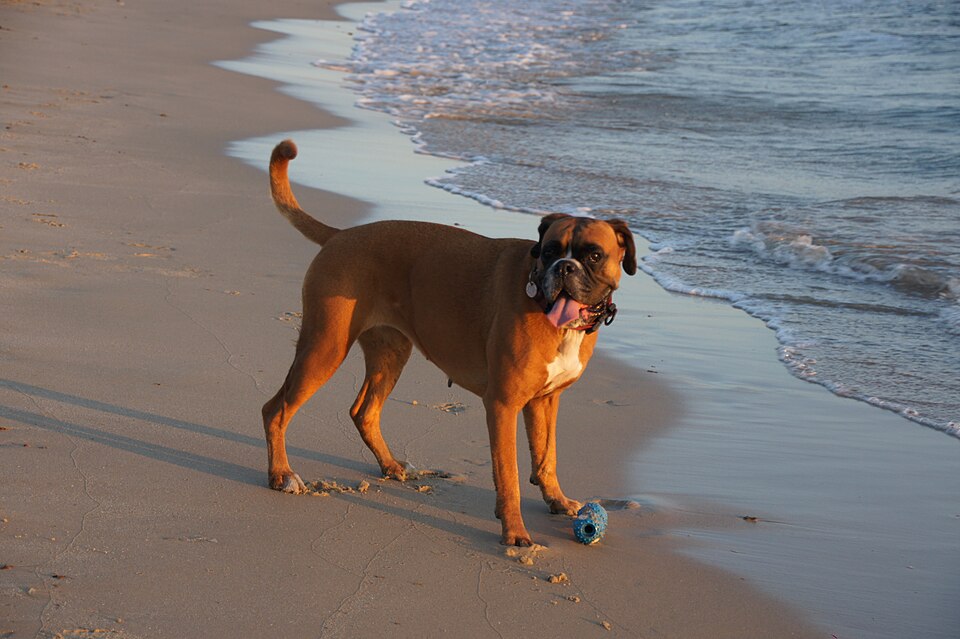
The Boxer is a cheerful dog with a square, muscular body, a wrinkled forehead and a black mask, and it often seems to have energy that never runs out. It's deeply devoted to its family, patient and playful with kids, and an alert watchdog too. All that enthusiasm calls for plenty of exercise and patient training, and its short muzzle makes it sensitive to heat. We built this page from breed registry standards, animal welfare resources and scientific studies.
- Temperament: Cheerful, playful and devoted to its family; alert with strangers and fearless when it counts.
- Exercise: The Royal Kennel Club recommends more than two hours a day, and its smart brain needs work too.
- Heat: A short-muzzled breed; according to the AKC it doesn't tolerate extreme heat or cold well. In summer, exercise during the cooler hours.
- Health: A heart rhythm disease (ARVC), aortic stenosis and mast cell skin tumors matter in this breed; ask for the parents' heart screening.
- Lifespan: Around 10–11 years in UK data, a little shorter than for mixed-breed dogs.
What to know
 What is the Boxer like?
The FCI standard describes the Boxer as fearless, self-confident, calm and even-tempered, and it stresses that temperament is of the utmost importance. According to the standard, its devotion and loyalty to its owner and the whole household, its watchfulness and its courage are famous; it is harmless with its family and wary of strangers. It's happy and friendly at play and fearless in a serious situation. The standard says the Boxer's character remains trustworthy, without guile, even in old age.
The AKC likewise describes the Boxer as upbeat and playful, sometimes a little silly, but always brave. Its patience and protective nature have earned it a reputation as a great dog with children. According to the AKC, Boxers do best when they meet lots of people and other animals in early puppyhood.
Every dog is an individual. Breed traits describe general tendencies; the parents' temperament, how a puppy was socialized and the training it gets shape its personality as much as its breed.
 Who is it a good fit for?
The Boxer suits active people who have time to play with and train their dog and will keep it indoors as part of the family. The Royal Kennel Club recommends a large house and a large yard. The AKC also points out that this strong, active, jumpy dog may not be the best choice for a very frail adult, or for a small child who could be overwhelmed by a well-meaning but bouncy puppy.
| Situation | Good fit? |
|---|---|
| Apartment | Possible, but long daily walks and play are a must |
| Family with kids | Usually excellent; bouncy as a youngster, so supervise small kids |
| Other dogs | Average; the AKC says not always tolerant of dogs of the same sex |
| Hot climate | Take care; short-muzzled and doesn't handle heat well |
| House with a yard | Good, but the AKC says it should live indoors and never run loose |
| First-time dog owners | Possible, if you can give it the exercise and training it needs |
In homes with kids, it's important that nobody bothers the dog while it eats or sleeps and that the dog has a quiet spot to rest; our article on kids and dogs at home covers the ground rules.
Where does it come from?
According to the FCI, the Boxer's direct ancestor is the small Brabant Bullenbeisser ("bull biter"), a dog that worked alongside hunters. Its job was to seize the game flushed by the hounds and hold it firmly until the hunter arrived, which called for wide jaws. Over time, that selection produced a dog with a broad muzzle and a slightly upturned nose. According to the Royal Kennel Club, crossing the Bullenbeisser, used to hunt bear, boar and deer in the 19th century, with the Bulldog laid the foundation of today's Boxer.
The AKC explains that the Bullenbeisser lost its job when the great hunting estates of the German nobility were broken up, and that crosses with a smaller English mastiff-type breed shaped the sleeker modern Boxer by the late 1800s. The English name comes from the way the dog spars with its front paws, like a prizefighter, when playing or defending itself. Over the years Boxers have worked as police dogs, war dogs in both world wars, watchdogs and guide dogs; according to the AKC, it was one of the first breeds chosen for police training in Germany.
Appearance and colors
According to the FCI, the Boxer is a medium-sized, short-coated, sturdy dog with a square build and strong bone. Chest depth is half the height at the shoulder, and the ratio of the bridge of the nose to the skull is 1 to 2. The lower jaw extends beyond the upper jaw and curves slightly upward, a feature the breed standard calls for.
- Height: 22.5–25 in (57–63 cm) for males and 21–23 in (53–59 cm) for females (FCI).
- Weight: The FCI gives over 66 lb (30 kg) for males about 24 in (60 cm) tall and about 55 lb (25 kg) for females about 22 in (56 cm) tall. According to the AKC, males weigh 65–80 lb (29–36 kg) and females about 15 lb (7 kg) less.
- Color: Shades of fawn from light to dark deer red, or brindle (dark stripes on a fawn background), with a black mask. White markings are accepted, but under the FCI standard white covering more than a third of the base color is a fault.
- Coat: Short, hard, glossy and close-fitting.
- Ears and tail: The FCI standard describes natural ears and a natural tail. In Türkiye, cutting the ears or tail for looks is banned under article 8 of Animal Protection Law no. 5199.
Daily care
The Boxer's short, glossy coat needs very little care. The AKC considers a once-over with a rubber curry brush or hound glove once or twice a week enough; Boxers tend to be clean dogs and only need an occasional bath. See our dog grooming guide for details.
- Nails: Trim at least once a month unless they wear down naturally on hard ground.
- Teeth: The AKC recommends brushing often, daily if possible, to prevent tartar.
- Heat and cold: According to the AKC, the Boxer doesn't tolerate extreme heat or cold well and should live indoors with its family. In summer, shade, water and walks in the cooler hours are a must; our article on dogs in hot weather covers the signs of heatstroke.
- Skin: Run your hands over the skin while brushing; if you find a new lump or a changing spot, show your vet (see mast cell tumors below).
Training and exercise
The AKC calls early socialization and puppy classes vital for channeling the Boxer's energy and exuberance in a positive direction. Boxers are very smart and excellent problem solvers, but they also like to make up their own minds and get bored with repetition. That's why short, fun, varied, reward-based sessions work best. They do well in obedience, agility and herding, and they also work as service, therapy and search and rescue dogs.
According to the AKC, the Boxer is a very playful, high-energy dog that needs plenty of exercise every day, on leash or in a securely fenced area, and should never be allowed to run loose. The Royal Kennel Club recommends more than two hours of exercise a day.
- Teach it not to jump: According to the AKC, young Boxers jump constantly and need frequent reminders to stay "down." Reward sitting instead of jumping on people.
- Early socialization: Give it positive experiences with different people, children and calm dogs; take introductions to dogs of the same sex especially slowly.
- Mental work: Sniffing games, hidden treats and learning new tricks tire out this smart dog.
- Go easy in the heat: In summer, save running and ball games for early morning or evening, and stop when its breathing speeds up.
 Diet and weight
Boxers don't need a special food; a complete, balanced dog food suited to their age and activity level is enough. The AKC notes that some Boxers gain weight easily. Weight also matters for heat: in a 2020 UK study (Hall et al.), dogs heavier than the average for their breed and sex had a higher risk of heatstroke.
- Controlled growth in puppyhood: The Merck Veterinary Manual notes that too much calcium (for example, from unnecessary supplements) can harm bone and joint development in fast-growing large-breed puppies. Make a growth plan with your vet covering the type of food, the amount and weight checks.
- Measure meals: Count treats as part of the daily amount.
- Ideal weight: If you can feel the ribs under a thin layer of fat and see a waist from above, the weight is about right.
Some human foods are toxic to dogs; check our list of foods that are dangerous for dogs.
 Health issues to know about
Some heart diseases and tumors are more common in Boxers. The information below is for awareness only; ask your vet about diagnosis and treatment.
Arrhythmogenic right ventricular cardiomyopathy (ARVC)
An inherited disease of the heart muscle that causes rhythm problems; it's sometimes called "Boxer cardiomyopathy." According to UFAW, these rhythm problems can lead to fainting, heart failure or sudden death, and in one study about half of the Boxers tested carried the gene linked to the disease. A DNA test is available, and the screenings the AKC lists include this test and a yearly 24-hour ECG (Holter) recording.
Aortic stenosis
A narrowing where blood leaves the heart for the main artery to the body. According to UFAW, it can cause exercise intolerance, fainting, weakness, shortness of breath and coughing, and severe cases can lead to death in early adulthood. The Royal Kennel Club notes that the breed club runs a health scheme for the breed. Ask for the parents' heart exam results when choosing a puppy.
Mast cell tumors
A type of cancer that develops from a cell of the immune system; according to UFAW, Boxers are predisposed. These tumors can be benign or malignant, are often noticed as a lump in or under the skin and can be itchy. Show your vet every new or growing lump on the skin.
Heatstroke
In a 2020 UK study, short-muzzled (brachycephalic) dogs had more than twice the odds of heat-related illness of dogs with medium-length muzzles; the Boxer's risk also looked higher, though not to a statistically certain degree. Fast, noisy breathing, stumbling and heavy drooling in the heat are emergency signs.
Other screening
The AKC also lists screening for hip dysplasia, low thyroid function and degenerative myelopathy, a nervous system disease (a DNA test is available); the Royal Kennel Club recommends hip, elbow and eye screening.
- Fainting, sudden weakness or tiring quickly during exercise
- Coughing, or fast or labored breathing
- Fast breathing that won't settle, stumbling or heavy drooling in the heat
- A skin lump that grows quickly, turns red or itches
How long does it live?
The Boxer appears in both of the big UK studies on lifespan. In a 2022 VetCompass life-table study (Teng et al.), life expectancy at birth was 10.04 years for the 800-plus Boxers that died between 2016 and 2020, compared with 11.82 years for mixed-breed dogs. In a 2024 study (McMillan et al.), the median lifespan of more than 17,000 Boxers was 11.3 years, against 12 years for mixed-breed dogs. The AKC gives 10–12 years.
The two figures come from different methods, so they don't match, but they say the same thing: the Boxer lives a little shorter than the average mixed-breed dog. Regular heart checks, a healthy weight, heat precautions and getting new lumps checked early are the most concrete steps.
 Before you get one
- Consider a shelter: Purebred dogs end up in shelters and rescues too. Our guide to adopting a dog from a shelter walks you through it.
- If you buy from a breeder: Meet the parents in person. Ask for heart exam and Holter results, the ARVC and degenerative myelopathy DNA tests, and hip and elbow X-rays.
- Cropped ears and docked tails: In Türkiye, cutting the ears or tail for looks is banned; avoid sellers offering puppies with cropped ears or docked tails. Rules vary by country.
- Red flags: Sellers who won't show you the mother, always have puppies available, can't provide paperwork or rush you to "buy now."
- Registration: Rules vary by country. In Türkiye, owned dogs must be microchipped and registered in the PETVET system.
- The first days: See our guide to the first week with a new puppy.
Frequently asked questions
Are Boxers good with kids?
Usually, yes: according to the AKC, their patience and protective nature have earned them a reputation as great dogs with children. Still, a young Boxer is very bouncy and loves to jump, so always supervise small kids.
Can a Boxer stay outside in hot weather?
That's not recommended. It's a short-muzzled breed, and according to the AKC it doesn't tolerate extreme heat or cold well. In summer it should rest somewhere cool and shaded; move exercise to early morning or evening.
Should a Boxer's ears and tail be cut?
No. The FCI standard describes natural ears and a natural tail, and in Türkiye cutting the ears or tail for looks is against the law. If there's a medical reason, that's a decision for a veterinarian.
Are there white Boxers?
White markings are accepted in Boxers, but under the FCI standard white covering more than a third of the base color is a fault. Color alone says nothing about health or temperament; when choosing a puppy, look at the parents' health screening and temperament.
Why is it called a Boxer?
According to the AKC, the name comes from the way the dog spars with its front paws, like a boxer, when it plays or defends itself.
Sources
- FCI · Deutscher Boxer breed standard (No. 144, 2008)
- The Royal Kennel Club · Boxer: breed profile and health screening
- AKC (American Kennel Club) · Boxer breed profile
- Science for Animal Welfare (UFAW) · Boxer: Arrhythmogenic right ventricular cardiomyopathy
- Science for Animal Welfare (UFAW) · Boxer: Aortic stenosis
- Science for Animal Welfare (UFAW) · Boxer: Mast cell tumour
- Teng et al. · Life tables of annual life expectancy and mortality for companion dogs in the United Kingdom, Scientific Reports (2022)
- McMillan et al. · Longevity of companion dog breeds: those at risk from early death, Scientific Reports (2024)
- Hall et al. · Incidence and risk factors for heat-related illness (heatstroke) in UK dogs under primary veterinary care in 2016, Scientific Reports (2020)
- Merck Veterinary Manual · Nutritional requirements of small animals
- Türkiye legislation database · Animal Protection Law no. 5199, current text (in Turkish)
- Resmî Gazete (Türkiye) · Regulation on the identification and registration of cats, dogs and ferrets (February 26, 2018)
By Tüylüm · Last checked: November 3, 2026. Compiled from the sources above and written in our own words. Spotted a mistake? Write to [email protected] and we'll fix it right away. Photo from Wikimedia Commons, used under the license shown below it.