 Tüylüm
Gouldian Finch
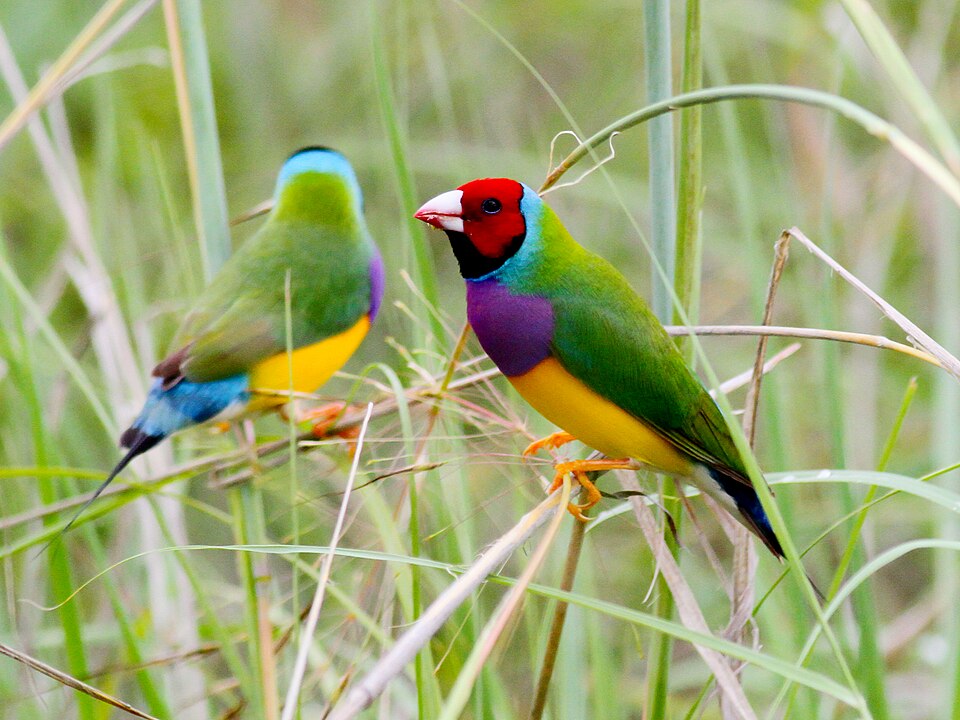
One of the most colorful small birds in the world, with a red, black or yellow head and a purple breast. For all its flash it is delicate: stress, mites and an unbalanced diet wear it down quickly. It is not a hand-held bird; it is a bird to watch in a calm, roomy, temperature-steady setting.

 Lifespan≈ 5–10 yearsMerck's finch range
 SizeVery smallsmaller than a sparrow
 OriginNorthern Australiatropical savanna and woodland
 VoiceSoft chirpsnot loud
 Social lifeGroup birdcrowding or newcomers cause stress
 CageLarge aviaryflight room and a calm corner
 DietSeed + insectsan unbalanced diet causes trouble
 DifficultyMedium-highstress, mites, warmth and fume sensitivity
The Gouldian finch is among the most spectacular birds in terms of plumage, but that is exactly why it is fragile both in the wild and at home. It is threatened in the wild, and in captivity it is sensitive to stress, mites and air quality. On this page we've pulled together its needs from museum, veterinary and animal welfare sources.
- Showy but delicate: Veterinary sources describe the Gouldian finch as quick to fall ill with stress, crowding and an unbalanced diet.
- Not for handling: Merck says finches are groups of birds that don't interact much with people.
- Air quality: Its tiny body is very sensitive to gas and smoke; nonstick pan fumes and sprays can be deadly.
- Airway mites: A mite that occurs even in wild birds can cause problems in finches during stressful periods.
- Never wild-caught: The Australian Museum lists illegal trapping for the bird trade among the causes of the species' decline.
What to know
 What is the Gouldian Finch like?
The Gouldian finch is social and cautious. According to the Australian Museum, in the wild it breeds in small social colonies, several pairs may share one tree hollow, and it comes to drink several times a day. At home that means a bird living in a calm group that is bothered by sudden movement and noise.
Merck describes finches as quiet but frequently chirping birds that are usually kept in groups and are not much interested in people. The Gouldian finch fits that description: not a companion to carry on your hand but a flock bird to watch in an aviary. The chapter on passerines in Dorrestein's avian medicine handbook says aggression rises with overcrowding and when new birds are added to an established group, and that a bird that drops to the bottom of the pecking order can suffer feather loss and greater disease risk from stress.
The Gouldian finch is not a "starter ornamental bird." The color is tempting, but the care is sensitive. Getting to know hardier finches first, such as the zebra finch or the society finch, may be a safer start.
Who is it a good fit for?
It suits people who enjoy watching a colorful, quiet bird, who set up the cage carefully, have access to a bird vet and can be meticulous about stress, air quality and diet.
| Situation | A good fit? |
|---|---|
| Apartment | Yes; quiet, but a large cage or aviary and clean air are essential |
| Family with kids | Watching only; touching the bird and shaking the cage cause stress |
| Home with a cat or dog | Cage out of reach, in a calm, safe place |
| Wanting a pet to cuddle | Not a good fit; a budgie or cockatiel may suit better |
| First-time bird owners | Careful; a delicate species, and hardier finches are easier |
Where does it come from?
According to the Australian Museum, the Gouldian finch is native to northern Australia, with a patchy range from Derby in Western Australia to the Gulf of Carpentaria and thinly across central Cape York. It lives at the edges of mangroves and thickets near water and in savannas with scattered trees. It is partly migratory: flocks move toward the coast outside the breeding season and return inland when the rains arrive.
The species is listed as Endangered at the Australian federal level. The museum lists illegal trapping for the bird trade, habitat change, fire, predators and a respiratory mite that also occurs in the wild among the causes of its decline. So only get a bird from documented captive breeding and don't support wild-caught birds.
Appearance and colors
The Gouldian finch is known for its green back, yellow belly and purple breast; the male is brighter than the female. Young birds are gray-headed, olive on the back and duller. The Australian Museum says black-headed birds make up about 75% of the population, red-headed birds about 25%, and yellow-headed birds are rare.
 Daily care
- No handling: Merck says finches don't interact much with people; don't pick the bird up unnecessarily.
- Observation: Sick birds hide it (Merck). Quietly check droppings, feathers and eating every day; learn what normal looks like.
- Calm setting: Avoid noise, sudden movement and frequent moves. See the cage placement guide.
- Cleaning: Dorrestein's chapter says control of external and internal parasites needs constant attention in aviaries. See cage cleaning.
- Warmth and humidity: The same chapter describes keeping tropical and arid-zone finches indoors in temperature-controlled rooms; keep the bird away from cold and sudden changes.
- Breeding: Breeding and chick-rearing are a specialty of their own; if you're thinking about it, talk to an experienced breeder and a bird vet first.
 Cage and living space
RSPCA Australia says a cage should be at least three times the combined wingspan of a pair wide, leave room for two wing beats between perches, and be long rather than tall. The Gouldian finch falls into the 20 to 80 g small-bird group, for which RSPCA lists 12 × 12 mm mesh and 0.7 to 0.8 mm wire for outdoor aviaries. Finches exercise by flying, so keeping them permanently in a small cage is not enough; an aviary or a very large cage is ideal.
- Perches: Natural branches of different thicknesses; metal pipe and sandpaper-covered perches aren't recommended (RSPCA).
- Nesting material: Dorrestein says synthetic fibers can tangle around toes; natural materials such as hessian, cotton, wool or coconut fiber are safe.
- Quiet corner: Away from traffic, the kitchen and sprays, with no drafts.
- Number of birds: Overcrowding and adding birds to an established group increase aggression (Dorrestein). Start with a small, compatible group and introduce new birds all together.
Diet
The Australian Museum says that in the wild they eat ripe or half-ripe grass seeds for most of the year and almost entirely insects during breeding (protein for the chicks). Dorrestein says an unbalanced diet is the main cause of many problems in tropical finches and that correcting the diet is the first step. Merck says a diet heavy in seeds and nuts is high in fat and low in vitamins and minerals. Work out the full diet plan with a bird-savvy veterinarian. Don't offer moldy seed.
Keep water clean every day and keep dishes free of droppings; Birdhealth's veterinarian author notes that crowding and shared drinking water can help spread mites. See foods that are harmful to birds.
 Health issues to know about
Merck says birds hide illness. What follows is for information; talk to a veterinarian who sees birds for diagnosis and treatment.
- Airway mite: The mite Sternostoma tracheacolum lives in the airways. The Australian Museum lists it among factors in the species' decline. Veterinarian Dr. Rob Marshall's Birdhealth page describes signs such as open-beak breathing and clicking sounds and says the risk rises during stressful periods like the molt and the breeding season. Female mites move up the windpipe and spread to other birds; crowding and shared water dishes help it spread.
- Social stress: Dorrestein says social stress may be linked to a disease called amyloidosis in Gouldian finches, and that the species may carry a hereditary predisposition.
- Viral diseases: The same chapter says Gouldian finches are very sensitive to herpesvirus, which can come in with newly imported wild-caught birds, and describes a circovirus outbreak in an aviary of about 100 Gouldian finches with roughly 50% mortality. Have a new bird checked by a vet before adding it to others.
- Fume and gas poisoning: Overheated nonstick coatings and some sprays can kill small birds very quickly (Merck).
- General hygiene and zoonoses: Merck says the chlamydia bacterium can pass from birds to people, and Dorrestein lists chlamydia, salmonella and Campylobacter as occurring in finches. Wash your hands after handling the cage, keep the cage and dishes clean, and if you get flu-like symptoms tell your doctor you keep birds.
- Open-mouth breathing, wheezing, clicking or tail bobbing with each breath
- Fluffed up and slumped on the cage floor, looking sleepy
- Falling off the perch, loss of balance
- Loss of appetite, vomiting or a clear change in droppings
- Exposure to smoke, spray or nonstick fumes (move to fresh air first, then go to the vet right away)
How long does it live?
Merck gives 5 to 10 years for finches. We could not find a sourced home lifespan figure specific to the Gouldian finch, so read this as a general finch range. Stress, illness and diet are the factors that affect lifespan directly.
 Before you get one
- Shelters and rescues: Bird rescue groups exist.
- Never wild-caught: The Australian Museum lists illegal trapping for the bird trade among the causes of decline. Ask for the documented breeding source and confirm the bird has been captive-bred from the start.
- Judge the seller: RSPCA Australia recommends sellers who are honest, knowledgeable, tell you the bird's history and diet and offer a refund or replacement for health problems; it advises staying away from crowded, dirty places and those feeding only dry seed.
- Vet check: Have a bird vet see it right after you bring it home, and keep it apart from other birds first.
- Access to avian vets: Because this is a delicate species, find the nearest bird vet ahead of time.
Frequently asked questions
Will a Gouldian finch sit on my hand?
Merck says finches generally don't interact much with people. Keep your expectations low for this species too; handling can cause stress.
Can it live alone?
It is a group-living bird; keeping one alone isn't recommended. Ask a bird vet or an experienced breeder how many birds can live together compatibly.
Why is it called delicate?
Dorrestein and Birdhealth describe stress, social pressure, mites and an unbalanced diet as the root of the problems seen most often in this species.
What do the different head colors mean?
The Australian Museum describes black, red and rare yellow head color forms; these are natural color forms of the same species.
How long does it live?
Merck gives 5 to 10 years for finches; there is no sourced species-specific figure.
Sources
- Australian Museum · Gouldian Finch
- Dorrestein · Passerines, Handbook of Avian Medicine (Elsevier, 2009)
- Birdhealth (Dr. Rob Marshall, veterinarian) · Airsac mite
- Merck Veterinary Manual · Choosing a Pet Bird
- Merck Veterinary Manual · Nutritional Disorders of Pet Birds
- Merck Veterinary Manual · Disorders Affecting Multiple Body Systems of Pet Birds (psittacosis, fume and gas poisoning)
- Merck Veterinary Manual · Illness in Pet Birds
- RSPCA Australia Knowledgebase · What kind of enclosure does my bird need?
- RSPCA Australia Knowledgebase · Where should I get my bird from?
By Tüylüm · Last checked: November 10, 2026. Compiled from the sources above and written in our own words. Spotted a mistake? Write to [email protected] and we'll fix it right away. Photo from Wikimedia Commons, used under the license shown below it.