 Tüylüm
Bourke's Parrot
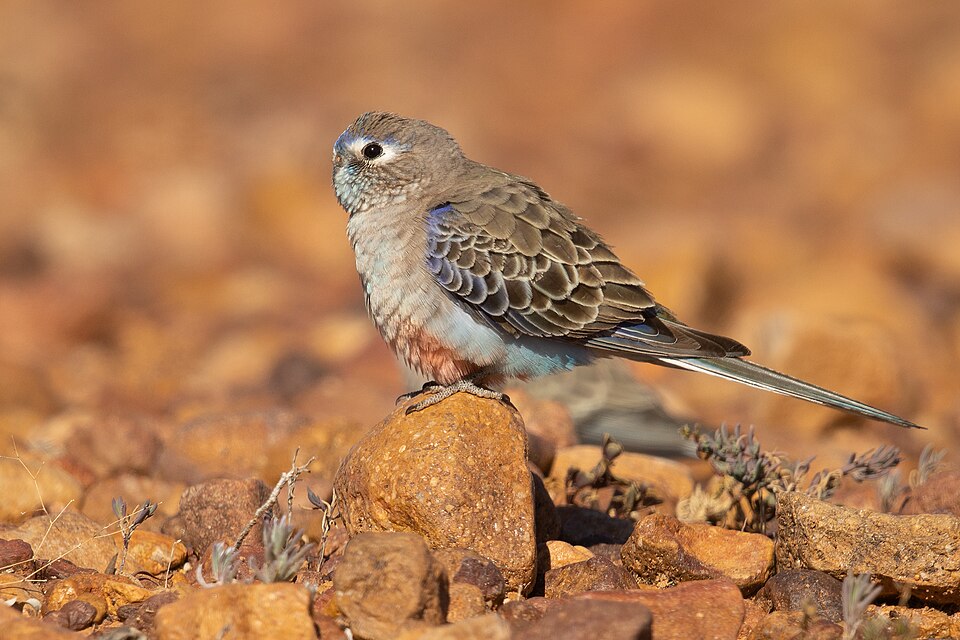
A calm, small, pink-bellied parrot from the dry interior of Australia. It is quiet and usually not aggressive, but it is nervous, generally does not talk, and is most active at dawn and dusk. It needs a roomy cage, daily flight and, ideally, a companion.

 Lifespan≈ 8–13 yearsMerck's range; records run longer
 Length7–9 in (18–23 cm)adult, including the tail
 OriginAustraliadry interior, scrubland
 VoiceQuietmost birds do not talk
 Social lifeSmall groupgroups of 4–6 in the wild
 CageWide and longneeds horizontal flight room
 DietPellets + freshseed alone is not enough
 LegalCITES Appendix IIask for origin and papers
Think of Bourke's parrot as a quieter, rarer cousin of the budgie. It lives on scrubby, semi-arid plains in the Australian interior, rests in the shade during the hottest hours, and looks for food and water in the morning and evening. At home it is a low-key bird that does not make a racket. On this page we've pulled together its needs from veterinary and animal welfare sources.
- Quiet and nervous: Merck describes it as a small, quiet, usually non-aggressive but nervous parrot that generally does not talk.
- Active morning and evening: Animal Diversity Web says it feeds and drinks around dawn and dusk and avoids the midday heat in the wild.
- Space: It flies horizontally, so the cage should be long rather than tall, and it needs safe flight every day.
- Legal status: Like most of the parrot order, it is in CITES Appendix II; ask the seller for origin and papers.
- Fumes and smoke: Nonstick pan fumes and sprays can kill small birds very quickly.
What to know
 What is the Bourke's Parrot like?
Bourke's parrot is calm, but that does not make it a bird to carry around on your hand. Merck calls the species calm, usually non-aggressive but nervous, and notes it generally does not talk. So skip the talking-bird fantasy and think of quiet companionship.
Animal Diversity Web says wild birds are usually found in groups of four to six, may gather in flocks of about 100 during drought, and are monogamous. Leaving a single bird alone for long hours goes against its nature. RSPCA Australia says in general that birds are flock animals, that a bird's companion is either another bird or you, and that if you are the only companion you must give it real time.
Every bird is an individual. A Bourke's parrot may be easily startled: sudden movement, loud noise or reaching toward it with your hands can frighten it. Approach patiently, at the bird's pace.
Who is it a good fit for?
It suits people who want a quiet, calm bird, enjoy watching and sitting near it, and can add safe out-of-cage flight in a bird-proofed room every day. Merck calls the species small and quiet, but RSPCA Australia reminds us that birds are not "easy care," that finding an avian vet can be hard, and that they are a long-term commitment.
| Situation | A good fit? |
|---|---|
| Apartment | Yes; quiet, but you need room for a cage and a flight room |
| Family with kids | Careful; a nervous bird, and children shouldn't try to catch it |
| Home with a cat or dog | Careful; never leave birds and cats or dogs alone together |
| Wanting a hand-tame bird | Not a good fit; a budgie or cockatiel may suit better |
| First-time bird owners | Possible; learn both its nervousness and its space needs first |
Where does it come from?
According to Animal Diversity Web, Bourke's parrot is native to the Australian interior: from southwestern Queensland to the west of New South Wales, northern South Australia and eastern and central Western Australia. It lives on sandy plains and savannas covered in scrub, acacia and mulga, and may visit town gardens for water.
In the wild it eats grass seeds, acacia seeds and green shoots. It is listed as Least Concern by the IUCN, though its numbers fluctuate with sheep farming and grazing in its habitat. This is a bird that is comfortable in a wide, quiet landscape, and offering a calm corner at home reflects that.
Appearance and colors
ADW gives the adult length as 18 to 23 cm (about 9 cm of it tail) and the weight as 42 to 49 g (about 1.5 to 1.7 oz); males are a little larger than females. It is a gray-brown bird with a pinkish belly and blue wing coverts.
 Daily care
- Morning and evening activity: ADW says wild birds rest in the middle of the day and feed at dawn and dusk. At home, give it calm and space during its livelier hours; see birds and sleep and light.
- Respect its nervousness: Merck calls the species nervous. Avoid grabbing it; sitting in the same room and talking quietly builds trust better. Our bonding with your bird article works on the same principle.
- Daily flight: RSPCA says cages are usually too small for flight and that birds need either a flight aviary or regular, safe chances to fly indoors. Close off windows, glass, fans and open flames in the flight room.
- Enrichment: Natural branches and simple foraging games. See bird toys.
- Cleaning: Cage cleaning guide.
- Smoke and sprays: Keep it away from the kitchen and nonstick fumes; see hidden dangers for birds at home.
 Cage and living space
According to RSPCA Australia, a cage should be at least three times the combined wingspan of a pair wide, leave room for two wing beats between perches, and be long rather than tall. Bourke's parrot is a small bird (RSPCA's small group is 20 to 80 g), and for outdoor aviaries it suggests 12 × 12 mm mesh and 0.7 to 0.8 mm wire. It also says a cage should always be as large as possible.
- Perches: Natural, non-toxic branches of different thicknesses. RSPCA advises against metal pipe and sandpaper covers.
- Material: Stainless steel or powder-coated wire. Merck says zinc (galvanized wire) and lead from old paint can poison birds.
- Location: In a corner, away from foot traffic, in a spot with at least two secure approaches (RSPCA). See the cage placement guide.
- Day and night cages: RSPCA says a separate night cage can help birds settle at dusk.
- Number of birds: If you are thinking about a pair or small group, check compatibility with an avian vet or an experienced keeper first and introduce birds slowly.
Diet
ADW says wild birds eat mainly grass seeds, acacia seeds and green shoots. For a pet bird, Merck says a diet heavy in seeds and nuts is high in fat and low in vitamins and minerals and is linked to liver, kidney, respiratory and bone problems. Birds pick out the tastier seeds and leave the pellets, so mixing the two does not guarantee balance. Merck's goal is a balanced pelleted diet with a smaller share of fresh vegetables and fruits; work out the proportions with a bird-savvy veterinarian.
- Provide clean water every day and check the water dish through the day; ADW notes the species lives near water in the wild.
- Don't offer moldy or damp-stored seed; Merck says mold can damage the liver.
- Move from seed to pellets slowly and with a veterinarian's guidance.
- Find harmful foods in foods that are harmful to birds.
 Health issues to know about
Merck says birds hide illness so they don't look weak to predators; by the time you notice, it may be advanced. Know what is normal for your bird. What follows is for information; talk to a veterinarian who sees birds for diagnosis and treatment.
- Signs of illness: Merck lists fluffed feathers, sleeping more than usual, less interest, singing less, sitting low on the perch or cage floor, loss of balance, breathing trouble (wheezing, tail bobbing), changed droppings and changed eating or drinking.
- Fume and gas poisoning: Overheated nonstick coatings, self-cleaning ovens and some aerosol sprays can release invisible, odorless gases. Merck says they can kill birds very quickly and recommends keeping birds away from cooking areas, in well-ventilated rooms.
- Heavy metals: Merck says zinc and lead can come from cage wire and paint, and signs may start with regurgitation, extreme thirst and weakness.
- Chlamydia (psittacosis): The bacterium Chlamydia psittaci can cause respiratory and digestive signs in birds and can pass to people. Merck says it spreads through nasal discharge and droppings, that dried droppings and feather dust can carry it for months, and recommends gloves and handwashing when dealing with a sick bird and daily cleaning of cages and dishes. Merck lists pigeons, budgies and cockatiels as resistant but able to carry it; Bourke's parrot isn't named, so be careful with hygiene. If you get flu-like symptoms, tell your doctor you keep birds.
- Nutrition problems: Seed-heavy diets are linked to vitamin A and calcium deficiency (Merck).
- Open-mouth breathing, wheezing or tail bobbing with each breath
- Fluffed up and slumped on the cage floor or low on the perch
- Loss of appetite, vomiting or a clear change in droppings
- Loss of balance or weakness
- Exposure to smoke, spray or nonstick fumes (move to fresh air first, then go to the vet right away)
Merck and RSPCA recommend having the bird seen by a bird vet soon after you get it. Ask your bird vet how often routine checkups should be.
How long does it live?
Merck gives 8 to 13 years for Bourke's parakeets. ADW's page carries two different figures: an average of 12.6 years from a database and, in the text, an estimate of 5 to 8 years based on the budgie. The mismatch shows how thin the data is. The practical takeaway: be ready for a commitment of a decade or more and set up the conditions that keep your bird healthy from the start.
 Before you get one
- Shelters and rescues: Bird rescue groups exist; look there first.
- Origin and papers: ADW lists the species in CITES Appendix II. In Türkiye a CITES permit is required for the export, import and re-export of Appendix I and II species, and people and businesses that trade in these species must register with the Management Authority and keep stock records (Mevzuat Bilgi Sistemi, the CITES implementation regulation). Ask the seller where the bird came from and for the papers; for rules about keeping the bird at home, you can also ask your local Nature Conservation and National Parks provincial directorate. Never buy a wild-caught bird.
- Judge the seller: RSPCA Australia recommends sellers who are honest, knowledgeable, tell you the bird's history and diet and offer a refund or replacement for health problems; it advises staying away from crowded, dirty places and those feeding only seed. Prefer sellers who don't sell unweaned chicks to beginners.
- Vet check: Have a bird vet see it right after you bring it home.
- Access to avian vets: RSPCA says avian vets may not be available everywhere, so check how far the nearest one is and what they charge.
Frequently asked questions
Does Bourke's parrot talk?
Merck says it generally does not. If you want a talker, a budgie or another species may suit better.
Can it live alone?
RSPCA says birds are flock animals and that the companion will be either another bird or you. If you keep a single bird, you must give it real time every day.
Is it a night or a day bird?
ADW says wild birds feed and drink around dawn and dusk and hide in the middle of the day, but it does not call it truly crepuscular or nocturnal. At home it may be most active in the morning and evening.
How big should the cage be?
RSPCA's rule: width at least three times the combined wingspan of a pair, height at least three times the head-to-tail length of the largest bird, and two wing beats between perches. Bigger is always better.
Does it need CITES papers?
ADW lists the species in CITES Appendix II. In Türkiye a permit is required for international trade; ask the seller for origin and papers.
Sources
- Animal Diversity Web (University of Michigan) · Neopsephotus bourkii
- Merck Veterinary Manual · Choosing a Pet Bird
- Merck Veterinary Manual · Nutritional Disorders of Pet Birds
- Merck Veterinary Manual · Disorders Affecting Multiple Body Systems of Pet Birds (psittacosis, fume and gas poisoning)
- Merck Veterinary Manual · Illness in Pet Birds
- RSPCA Australia Knowledgebase · What kind of enclosure does my bird need?
- RSPCA Australia Knowledgebase · Are birds the right companion animals for me?
- RSPCA Australia Knowledgebase · Where should I get my bird from?
- Mevzuat Bilgi Sistemi (Türkiye) · Regulation on implementing the CITES convention
By Tüylüm · Last checked: November 10, 2026. Compiled from the sources above and written in our own words. Spotted a mistake? Write to [email protected] and we'll fix it right away. Photo from Wikimedia Commons, used under the license shown below it.