 Tüylüm
Zebra Finch
A tiny, social, chirpy finch known for its striped throat and orange beak. It doesn't like to be held; it lives as a pair or in a group and gets its exercise by flying. Care is simple but it needs a wide, long cage and a home that is very careful about air quality.

 Lifespan≈ 5–10 yearsin captivity; 2–5 in the wild
 DifficultyLow-moderatehands-off, but space and air matter
 OriginAustraliaarid inland regions
 VoiceChirpyonly males sing
 Social lifePair or grouplifelong pairs in the wild
 CageWide and longexercises by flying
 DietSeed + freshbalanced plan with a vet
 LegalCaptive-bred speciesnever wild-caught
The zebra finch is one of the most commonly kept small birds. It isn't a bird to hold in your hand; it's a flock bird to watch, listen to and build an enriched cage for. On this page we've pulled together its needs from scientific studies, veterinary sources and animal welfare organizations.
- Hands-off: Merck says canaries and finches generally don't enjoy being held.
- Social: In the wild it lives in lifelong pairs and large flocks; sources recommend a pair or a group.
- Space: A long, wide cage or an aviary; the bird exercises by flying.
- Air quality: Fumes and gases such as nonstick pan smoke and sprays can be deadly for small birds.
- Voice: Only males sing; both sexes make chirps and "tang" calls.
What to know
 What is the Zebra Finch like?
The zebra finch is extremely social. Animal Diversity Web describes flocks of about 100 birds that split into groups of about 50 during breeding. According to the eLife review, wild zebra finches gather around food and water, nest in loose colonies and stay close to their partners, and they duet. Pairs stay together for life; ADW adds that DNA fingerprinting has shown extra-pair mating in both sexes.
Merck says finches are quiet but chirp often, are usually kept in groups and don't interact much with people. Being held or cuddled doesn't appeal to them; that isn't a flaw, it's their nature.
Every bird is an individual. Temperament, sociability and voice vary from bird to bird.
Who is it a good fit for?
It suits people who enjoy watching and listening to a bird, don't expect hand contact and can set up a good cage or aviary.
| Situation | Good fit? |
|---|---|
| Apartment | Yes; Merck describes quiet birds that chirp often |
| Family with kids | Yes, but no handling, just watching |
| Home with a cat or dog | The cage must be out of reach and secure |
| Someone who wants a cuddly bird | No; a cockatiel or budgie may suit better |
| First-time bird owners | Yes; just mind air quality and space |
Where does it come from?
The zebra finch is native to Australia and lives in most regions. The eLife article describes its natural habitat as "arid Australia" and notes a subspecies on the Lesser Sunda Islands. It breeds opportunistically: when conditions are right, it nests all year. Wild birds can tolerate temperatures above 104 °F (40 °C).
It eats seeds, and insects matter too during the breeding season (ADW). It lives near water sources, which at home means clean water every day.
 Appearance and colors
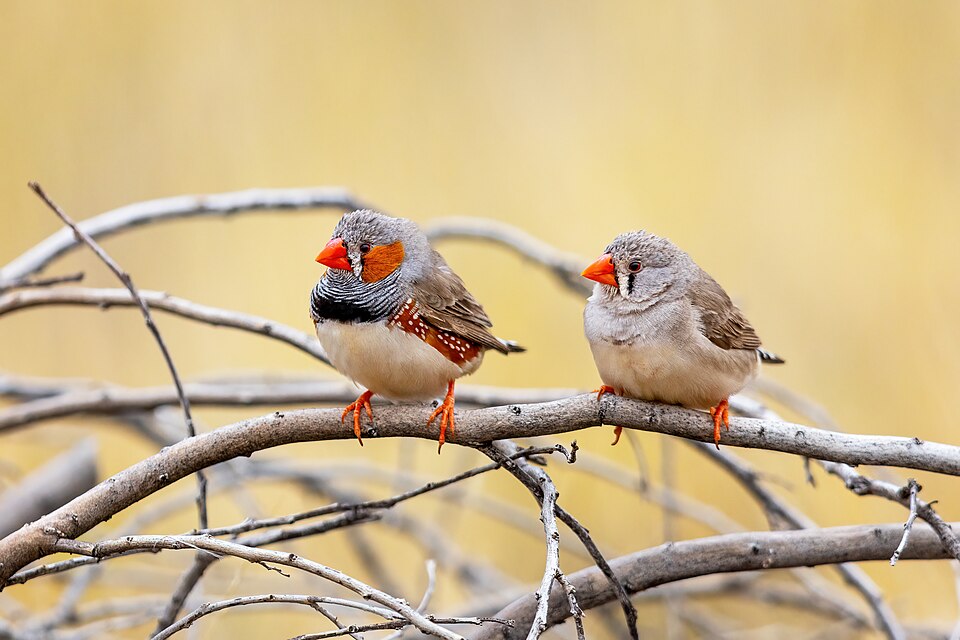
The male has orange cheeks, a black-and-white striped throat, a black band on the chest and orange flanks with white spots; the female is plainer gray. Pet forms include white and various patterned birds.
The zebra finch is very tiny, so both cage and health problems (especially smoke and gases) hit its small body quickly. Telling the sexes apart by sight is easy; Animal Diversity Web adds that only males sing, though both sexes make a nasal "tang" call.
 Daily care
- No hand contact: Merck says finches don't like being held; avoid it unless necessary.
- Enrichment: RSPCA Australia recommends natural branches, pinecones and other safe toys and foraging games. See toys for birds.
- Bathing: A shallow dish or a spray; see bird baths.
- Cleaning: RSPCA suggests cleaning the cage at least weekly, ideally every 1 to 2 days, and replacing the floor paper at least twice a week. See cage cleaning.
- Check daily: Look at your bird every day; sick birds hide it (Merck).
 Cage and living space
RSPCA Australia writes that birds fly horizontally, so a cage should be long rather than tall. For two birds the width should be at least three times their combined wingspan, with at least two wingbeats between perches. Constant confinement in a small cage can cause obesity, arthritis and boredom-related behavior, so an aviary or safe flying opportunities matter. The zebra finch exercises by flying, so length is critical.
- Wire mesh: For small birds (20 to 80 g), RSPCA recommends 12 × 12 mm mesh with 0.7 to 0.8 mm wire in outdoor aviaries (see its mesh-by-bird-size table).
- Perches: Natural branches in varied thicknesses; metal pipe and sandpaper-covered perches aren't recommended.
- Floor: Newspaper or paper towel.
- Location: In a corner, away from foot traffic, the kitchen and drafts. See the cage placement guide.
- Number of birds: RSPCA recommends groups or compatible pairs. Talk to a bird vet or an experienced breeder about who can share a cage.
Diet
According to eLife, the zebra finch eats seed, and in captivity it can even breed on a mostly seed diet if it has water, a nest site and nesting material. But Merck says diets based on seeds and nuts are high in fat and lacking in many vitamins and minerals, and that they are linked to many health problems. Ask a bird vet about feed made for finches and about adding fresh foods such as greens for variety.
ADW notes that insects matter during breeding. Water should be clean every day. See foods that are harmful to birds.
 Health issues to know about
Birds hide illness; Merck therefore stresses knowing your bird's normal behavior. The information below is for general knowledge; see a vet who treats birds for diagnosis and treatment.
- Signs of illness: Merck lists fluffed feathers, sleeping more than usual, less interest, singing less, sitting low on the perch, loss of balance, labored breathing, changes in droppings and changes in eating or drinking.
- Fumes and gases: Overheated nonstick pans and some sprays can kill small birds very quickly; Merck says to keep birds far from cooking areas and other fume sources.
- Diet problems: Seed-heavy diets are linked to vitamin A and calcium deficiency and obesity (Merck).
- A healthy bird: RSPCA says a healthy bird's breast muscles are neither very fat nor very thin, the abdomen is flat or slightly curved in and the feathers are in good condition.
- Open-mouth, wheezy or tail-bobbing breathing
- Fluffed feathers while sitting motionless on the cage floor
- Watery eyes, sneezing or discharge staining above the nostrils
- Loss of appetite or a clear change in droppings (very watery, shapeless or a different color)
- Exposure to smoke, sprays or nonstick pan fumes (get the bird into fresh air first, then go to the vet right away)
How long does it live?
Merck says finches live 5 to 10 years. Animal Diversity Web gives 2 to 3 years in the wild (listed average 4.5) and 5 to 7 in captivity (listed average 12), and eLife says wild adults live 3 to 5 years. The differences between sources may come from how lifespan was measured; 5 to 10 years is a reasonable range.
 Before you get one
- More than one bird: A single finch is deprived of a social life; consider a pair or a small group.
- Check the seller: RSPCA recommends sellers who share the bird's parentage, history and diet and offer a refund. Avoid crowded, dirty places that feed dry seed only.
- Vet check: Have the bird examined by a bird vet right after purchase.
- No wild-caught birds: The zebra finch is a captive-bred species. In Türkiye, Article 18 of the Land Hunting Law (No. 4915) restricts the sale and transport of wildlife taken against the rules, and catching and selling native wild birds (such as the goldfinch) is prohibited.
Frequently asked questions
Will a zebra finch sit on my hand?
Merck says canaries and finches generally don't enjoy being held. If you want a bird to cuddle, a budgie or cockatiel may suit you better.
Can it live alone?
Sources recommend a pair or a group: Merck says finches are usually kept in groups, and RSPCA says birds should be housed in pairs or groups.
Do females sing?
ADW says only males sing; both sexes have a "tang"-like call.
Is it quiet?
Merck describes finches as quiet but chirping often.
How long does it live?
Merck says 5 to 10 years.
Sources
- Hauber, Louder and Griffith · Neurogenomic insights into the behavioral and vocal development of the zebra finch, eLife (2021)
- Animal Diversity Web (University of Michigan) · Taeniopygia guttata
- Merck Veterinary Manual · Choosing a Pet Bird
- Merck Veterinary Manual · Nutritional Disorders of Pet Birds
- Merck Veterinary Manual · Disorders Affecting Multiple Body Systems of Pet Birds (fume and gas poisoning)
- Merck Veterinary Manual · Illness in Pet Birds
- RSPCA Australia Knowledgebase · What kind of enclosure does my bird need?
- RSPCA Australia Knowledgebase · How should I house my bird?
- RSPCA Australia Knowledgebase · Where should I get my bird from?
By Tüylüm · Last checked: November 10, 2026. Compiled from the sources above and written in our own words. Spotted a mistake? Write to [email protected] and we'll fix it right away. Photo from Wikimedia Commons, used under the license shown below it.