 Tüylüm
Society Finch (Bengalese Finch)
A calm, chirpy finch that has been domesticated in Japan for well over two centuries; it is a domestic form, not a wild species. It dislikes being handled and lives as a pair or in a group. Care is simple but calls for a roomy cage, clean air and a balanced diet.

 Lifespan≈ 5–10 yearsMerck's finch range
 SizeVery smallsmaller than a sparrow
 OriginDomestic formfrom munias brought from China to Japan
 VoiceChirpyonly males sing the complex song
 Social lifePair or groupnever kept alone
 CageWide and longexercises by flying
 DietSeed + freshplan it with a vet
 LegalDomestic speciesnever wild-caught
The society finch (often called the Bengalese finch) is not a species found in the wild but a domestic form that people shaped over centuries. Its ancestor is the white-rumped munia that was brought from China to Japan. On this page we've pulled together its traits from scientific studies, veterinary sources and animal welfare organizations.
- A domestic form: According to Tobari and colleagues, it has been domesticated for more than 250 years, with selection against aggressive individuals.
- Not for handling: Merck says finches are groups of birds that don't interact much with people.
- Social: Not left alone; a pair or a small, compatible group.
- Air quality: Nonstick pan fumes and sprays can be deadly for small birds.
- Lifespan: Merck gives 5 to 10 years for finches.
What to know
 What is the Society Finch (Bengalese Finch) like?
According to a 2022 study by Tobari and colleagues, the society finch is less aggressive and less fearful of novelty than its wild ancestor, the white-rumped munia. The paper explains that these birds were first kept to raise the chicks of exotic birds, which required a calm temperament and tolerance of birds from other species. Only males sing the complex song, and the society finch's song is structurally more complex than the munia's.
Merck describes finches as quiet but frequently chirping birds that are usually kept in groups and are not much interested in people. So even though the society finch is calm, don't think of it as a companion to carry on your hand: the real pleasure is watching, listening and building a good cage.
A calm temperament doesn't mean few needs. Space, companions and clean air are still essential.
Who is it a good fit for?
It suits people who enjoy watching and listening to a bird, don't expect touch, can build a roomy cage or aviary and can watch air quality. Merck counts finches as quiet, which makes apartment life easier.
| Situation | A good fit? |
|---|---|
| Apartment | Yes; Merck describes finches as quiet but frequently chirping |
| Family with kids | Watching only; no handling the bird |
| Home with a cat or dog | Cage out of reach, in a safe place |
| Wanting a pet to cuddle | Not a good fit; a budgie or cockatiel may suit better |
| First-time bird owners | Yes; but watch space and air quality |
Where does it come from?
Tobari and colleagues write that the white-rumped munia was brought from China to Japan around 1762 and kept in captivity, and that the society finch was domesticated more than 250 years ago. According to the paper, the first use was to raise the chicks of exotic birds, and aggressive individuals were weeded out to select calm birds. Dorrestein also describes society and Bengalese finches being used as foster parents for Australian finches.
All of that points one way: there is no such thing as a "wild-caught" society finch; every bird living in homes has been bred in captivity.
Appearance and colors
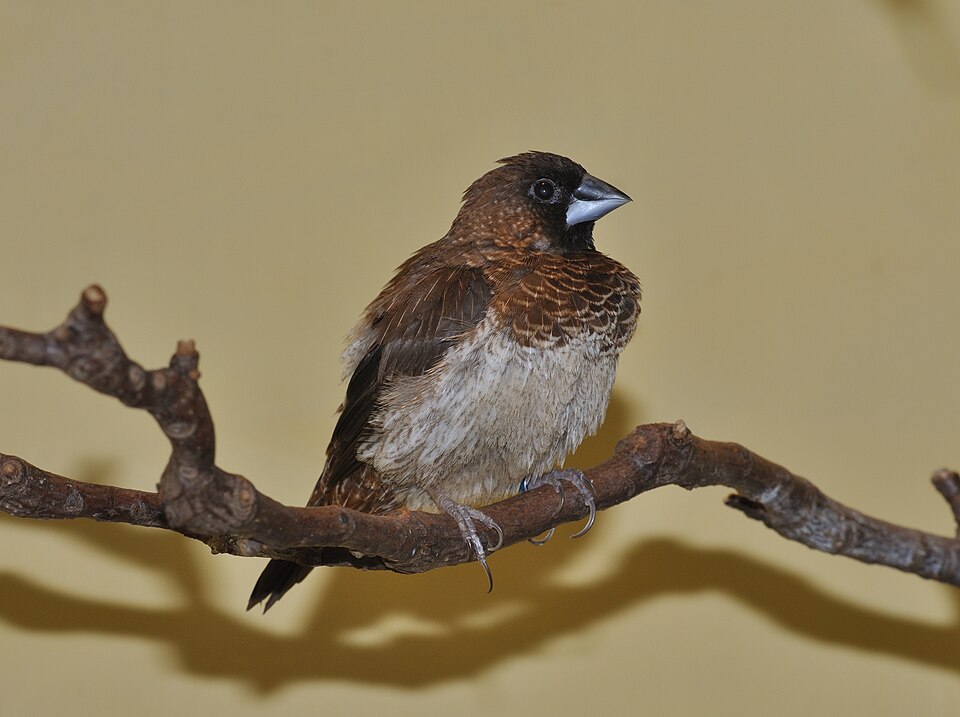
The society finch is a very small bird; its plumage can be brown and white mixed, nearly white or pied. Tobari and colleagues say the domestic form's plumage is mostly white, while the ancestral munia has a brown body with just a small white rump patch. Only the male sings the complex song.
 Daily care
- No handling: Merck says finches don't like to be held.
- Observation: Sick birds hide it (Merck). Check droppings, feathers, eating and behavior every day.
- Enrichment: Natural branches, safe toys and simple foraging games. See bird toys.
- Bathing: A shallow water dish or a spray; see bird baths.
- Cleaning: Cage cleaning guide.
- Nesting material: Dorrestein says synthetic fibers can tangle around toes; natural materials such as hessian, cotton, wool or coconut fiber are safe.
 Cage and living space
RSPCA Australia suggests a cage at least three times the combined wingspan of a pair wide, with room for two wing beats between perches, and long rather than tall. The society finch falls into the 20 to 80 g small-bird group; for outdoor aviaries, 12 × 12 mm mesh and 0.7 to 0.8 mm wire are listed. Birds exercise by flying, so being kept permanently in a small cage is not enough.
- Perches: Natural branches of different thicknesses; metal pipe and sandpaper-covered perches aren't recommended.
- Number of birds: Dorrestein says overcrowding and adding birds to an established group raise aggression; start with a small, compatible group.
- Location: Away from the kitchen and sprays, no drafts, a calm corner. See the cage placement guide.
Diet
Merck says a diet heavy in seeds and nuts is high in fat and low in vitamins and minerals and is linked to liver, kidney, respiratory and bone problems. Birds can pick out the tastier seeds and leave pellets, so mixing doesn't guarantee balance. Merck's goal is a balanced pelleted diet with a smaller share of fresh vegetables and fruits; set the proportions with a bird-savvy veterinarian. Don't offer moldy seed and keep water clean every day. See foods that are harmful to birds.
 Health issues to know about
Merck says birds hide illness so they don't look weak to predators. What follows is for information; talk to a veterinarian who sees birds for diagnosis and treatment.
- Signs of illness: Dorrestein lists apathy, ruffled feathers, diarrhea, weight loss, regurgitation, breathing trouble, nasal discharge, eye inflammation, a twisted neck and sudden death in finches. Merck also lists fluffed feathers, sleeping a lot, singing less and sitting low on the perch.
- Germs: Dorrestein says society and Bengalese finches can carry germs that can harm the chicks they foster (an infection called cochlosomosis and Campylobacter); quarantine new birds.
- General hygiene and zoonoses: Merck says the chlamydia bacterium can pass from birds to people; wash your hands after handling the cage and keep the cage and dishes clean. If you get flu-like symptoms, tell your doctor you keep birds.
- Fume and gas poisoning: Overheated nonstick coatings and some sprays can kill small birds very quickly (Merck).
- Nutrition problems: Seed-heavy diets are linked to vitamin A and calcium deficiency and obesity (Merck).
- Open-mouth, wheezing or tail-bobbing breathing
- Fluffed up and slumped on the cage floor
- Loss of appetite, vomiting or a clear change in droppings
- Loss of balance or weakness
- Exposure to smoke, spray or nonstick fumes (move to fresh air first, then go to the vet right away)
How long does it live?
Merck gives 5 to 10 years for finches. We could not find a sourced lifespan figure specific to the society finch, so read this as a general finch range. Noticing the signs of illness that Merck and Dorrestein describe early, a balanced diet, clean air and a compatible group are what will most affect how healthy your bird stays. Ask a bird vet how often routine checkups should be.
 Before you get one
- Shelters and rescues: Bird rescue groups exist.
- A pair or group: A single finch is deprived of social life; think of a pair or small group.
- Judge the seller: RSPCA Australia recommends sellers who are honest, knowledgeable, tell you the bird's history and diet and offer a refund or replacement for health problems. Stay away from crowded, dirty places and those feeding only dry seed.
- Vet check: Have a bird vet see it right after you bring it home.
- Never wild-caught: The society finch is a domestic form bred in captivity. In Türkiye, capturing and selling native wild birds (such as the Eurasian goldfinch or the Eurasian siskin) goes against Article 18 of Land Hunting Law No. 4915; buy only from a seller whose breeding source is clear.
Frequently asked questions
Will a society finch sit on my hand?
Merck says finches generally don't like to be held. If you want a bird to cuddle, another species may suit better.
Can it live alone?
Merck says finches are generally kept in groups; keeping a single bird alone isn't recommended.
How is it different from a zebra finch?
Both are finches; the society finch is a domestic form whose ancestor is the white-rumped munia from Asia, while the zebra finch is from Australia.
Does the female sing?
Tobari and colleagues say only males sing the complex song.
How long does it live?
Merck gives 5 to 10 years for finches.
Sources
- Tobari et al. · Oxytocin variation and brain region-specific gene expression in a domesticated avian species, Genes, Brain and Behavior (2022)
- Dorrestein · Passerines, Handbook of Avian Medicine (Elsevier, 2009)
- Merck Veterinary Manual · Choosing a Pet Bird
- Merck Veterinary Manual · Nutritional Disorders of Pet Birds
- Merck Veterinary Manual · Disorders Affecting Multiple Body Systems of Pet Birds (psittacosis, fume and gas poisoning)
- Merck Veterinary Manual · Illness in Pet Birds
- RSPCA Australia Knowledgebase · What kind of enclosure does my bird need?
- RSPCA Australia Knowledgebase · Where should I get my bird from?
By Tüylüm · Last checked: November 10, 2026. Compiled from the sources above and written in our own words. Spotted a mistake? Write to [email protected] and we'll fix it right away. Photo from Wikimedia Commons, used under the license shown below it.