 Tüylüm
Kurilian Bobtail
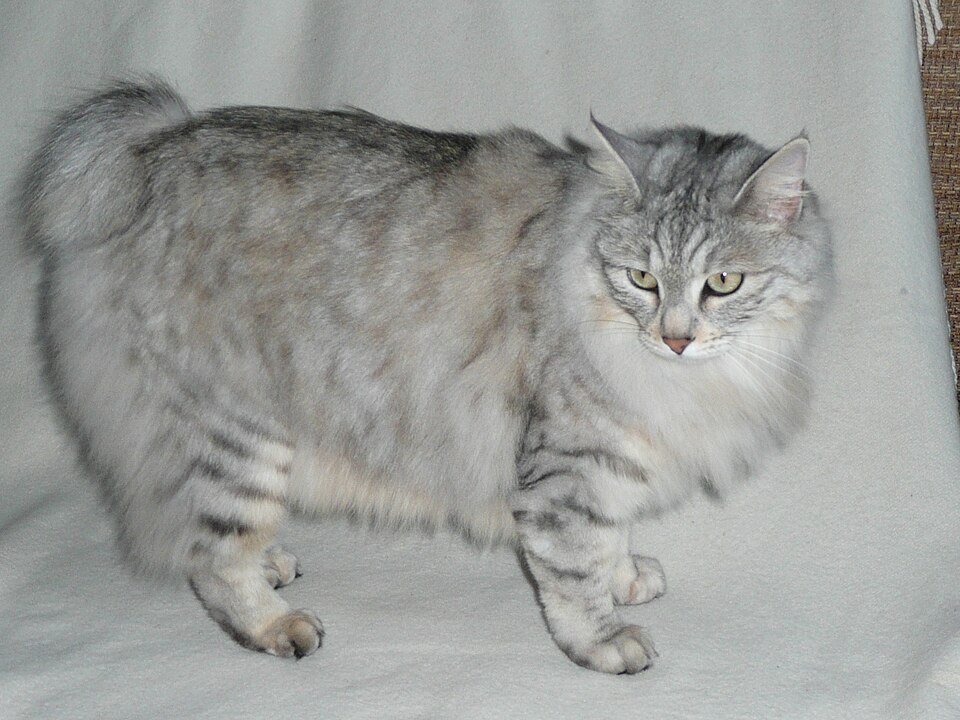
A compact, muscular cat from the Kuril Islands, known for a short, kinked "pom-pom" tail. It comes in shorthaired and medium-haired varieties. Registry standards say very little about temperament and health, so breeder and veterinary checks matter.

 LifespanNo datano breed-specific lifespan study found
 WeightNo datano weights in the standards we opened
 OriginKuril IslandsFIFe: certified imports only
 CoatShort or mediumlonger "pom-pom" fur on the tail
 EnergyNo datatemperament not described in standards
 SheddingNo datano breed-specific measurement found
 With childrenNo dataregistries do not say
 Other petsNo dataregistries do not say
The Kurilian Bobtail is one of the rarer cat breeds. Its most striking feature is the tail: short, kinked, and surrounded by long fur so that it looks like a small pom-pom. This page tells you what registries actually write about the breed. The sources we opened say very little about temperament, lifespan and health, and rather than invent anything to fill those gaps, we say so openly.
- Looks: Compact, muscular body, slightly arched back, short kinked tail; the fur on the tail is longer than on the body (the "pom-pom" effect).
- Coat: A shorthaired (KBS) and a medium-haired (KBL) variety exist.
- Origin: The Kuril Islands; according to FIFe, new cats can join the breed only as certified imports from the islands.
- Temperament and lifespan: Not in the standards we opened; we give no numbers.
- Health: We found no breed-specific study. How the short tail relates to the spine is not described for this breed in our sources; ask the breeder and your veterinarian.
- Registration: In Türkiye, microchipping and PETVET registration are mandatory for cats.
What to know
 What is the Kurilian Bobtail like?
The registry documents we opened, the WCF standards and FIFe's registration rules, do not describe the Kurilian Bobtail's temperament; the standards describe the body, head, coat and tail. So we are not writing phrases like "very affectionate" or "very calm" on this page. Instead, here is what to look at: when you visit a kitten, watch how its mother and father relate to people, how they react to household noise, and how curious the kitten is during play. Temperament is largely individual; the environment a cat grows up in, and meeting people and household sounds as a kitten, shape character at least as much as breed does.
Every cat is an individual. Breed traits describe general tendencies; for the Kurilian Bobtail, the sources we have say nothing about temperament tendencies.
 Who is it a good fit for?
Because temperament information is limited, instead of saying "this household suits it," decide based on what you want in a cat: calm or active, lap-loving or independent, able to stay alone? Ask the breeder and the kitten's family about these. For coat and tail care, see the sections below.
| Situation | Note |
|---|---|
| Apartment | Any cat can live in one; climbing spaces and play are essential |
| Family with children | Shy or calm temperament shows in the individual kitten; introduce slowly |
| Other pets | No breed-specific information found; introduce gradually |
| Alone at home | No breed-specific information found; provide play and attention |
| First-time cat owners | The breed is rare; breeder choice and verifying the pedigree matter |
Where does it come from?
The breed takes its name from the Kuril Islands, a chain of islands east of Russia and close to Japan. According to FIFe's registration rules, the only way to add a new cat to the breed is for a cat brought in from the Kuril Islands, with certification, to be recognized in the "novice" class; crossbreeding with other breeds is not allowed. The WCF standards also forbid crossbreeding and accept no new cats other than documented imports from the islands.
Here is where the registries stand:
- WCF: It publishes separate standards for the shorthaired (KBS) and medium-haired (KBL) varieties, both dated 2010.
- FIFe: KBL and KBS are registered separately. Chocolate, lilac, cinnamon and fawn, as well as the pointed (dark extremities) pattern, are not accepted, and cats in those colors are registered under a general category.
- GCCF: The Kurilian Bobtail is not among its breed pages. On the unrecognised breeds page, it appears as an "alternative" to other bobtail breeds, and the GCCF publishes a registration policy document dated 2025. We could not open and read that document, so we write no sentences based on it.
We also tried to find more detail on the breed's history (the first records on the islands, the year the standard was written and so on), but we could not verify it in a reliable, independent source, so we leave it out.
 Appearance and colors
According to the WCF standard, the body is compact and muscular, with a slightly arched back and a somewhat raised rump. The legs are solid, the hind legs are longer than the front, and the paws are round.
- Tail: The breed's signature. The tail is kinked and/or curved, with one or more kinks in any combination. Without the fur, it measures 3 to 8 cm (about 1.2 to 3.1 in); the fur on the tail is longer than on the body, giving a "pom-pom" effect. In the standard, a tail of 8–12 cm or shorter than 3 cm is a fault; a missing tail vertebra, a short tail that is not kinked or curved, or a tail longer than 12 cm is grounds for disqualification.
- Head: Large, shaped like a trapezium with gently rounded contours; the profile is slightly curved, the cheekbones broad, the muzzle medium in length and fairly broad, and the chin well developed.
- Ears and eyes: The ears are medium-sized, broad and open at the base, set relatively high and tilted slightly forward, with rounded tips. The eyes are round, broad and slightly slanted; eye color should be even and match the coat color.
- Coat: The KBS has a short coat with a well-developed top coat and little undercoat. The KBL has a medium-length coat; a frill, front bib, breeches, ear furnishings and lynx-like ear tufts are desirable.
- Colors: Chocolate and cinnamon and their dilutions (lilac and fawn), and the pointed pattern, are not recognized. All other colors and patterns are accepted, and any amount of white is allowed.
Daily care
We found no care guide specific to the Kurilian Bobtail; general cat care applies. For the shorthaired variety, weekly combing is usually enough; the medium-haired variety generally needs it more often. Check whether the long fur on the tail tangles. Do nail, ear and dental care the way your veterinarian shows you. Turning combing into a game while the cat is a kitten makes it easier; for more, see cat grooming.
- Mind and movement: Like every cat, it needs hunting-style play, places to climb and puzzle feeders.
- Home safety: Check hazards such as windows, balconies and cables: a cat-safe home.
 Diet and weight
We found no breed-specific diet advice for the Kurilian Bobtail. A balanced, complete cat food suited to age and lifestyle is enough. Measure the food, subtract treats from the daily amount, set the daily amount with your veterinarian, and weigh your cat monthly. For choosing, placing and cleaning bowls, see our food and water bowl guide; always keep clean, fresh water within reach. If you want to mix wet and dry food or switch foods, talk to your veterinarian and make the change gradually.
 Health issues to know about
The following is for information only; ask your veterinarian for diagnosis and treatment.
We found no known breed-specific disease or health study for the Kurilian Bobtail; the WCF standards and FIFe rules do not mention health problems. That does not mean there are none, only that there is no reliable data. One point matters especially in short-tailed breeds: the GCCF writes that in the Manx, the gene that causes taillessness can shorten the spine too much, affecting the spinal cord and nerves and leading to bowel, bladder and digestive problems. The documents we opened say nothing about whether the Kurilian Bobtail's tail depends on the same mechanism, so we say neither "it does" nor "it does not." In practice:
- Ask the breeder about the parents' veterinary checks and whether the tail and spine have been examined.
- After the kitten comes home, have your veterinarian look at the tail and back area.
- Ask whether the pedigree shows close inbreeding; because the breed is small, the gene pool may be narrow.
- Keep track of bowel and urination habits.
As with any cat, regular veterinary checks of the heart, kidneys and teeth are a good starting point.
- Unable to pass stool or urine, straining a lot or constipation
- Weakness in the hind legs, dragging, or an odd gait
- Fast or open-mouth breathing
- Loss of appetite, weight loss or drinking a lot
- Hiding and reacting when touched (cats hide pain)
How long does it live?
We found no breed-specific lifespan study for the Kurilian Bobtail, so we do not write a number. The lack of a number does not mean a cat will live a short or long life; there is simply no reliable figure for the breed. Lifespan is most affected by an ideal weight, regular veterinary checks, spaying or neutering, and a safe home. Asking about the parents' age and health history when you get a kitten fills this gap a little. Regular checks, vaccinations, parasite prevention and dental care are the foundation of care; ask your veterinarian which checks they recommend as your cat ages.
 Before you get one
- Think about shelters too: Cats with short or bobtail-like tails also turn up in shelters; a loving companion could be waiting there even without a pedigree.
- If you buy from a breeder: The breed is rare. According to FIFe, new cats can come only as certified imports from the Kuril Islands, so ask for pedigree papers, the registry of the mother and father, and which registry recognizes the breed. Stay away from sellers who say "any short-tailed cat is a Kurilian Bobtail." The standard sets detailed rules for the length and kinks of the tail.
- Red flags: Sellers who will not show the mother, who always have kittens for sale, who offer no paperwork, or who rush you to "buy now."
- Legal registration: In Türkiye, microchipping and PETVET registration are mandatory for cats. Details are in our article on PETVET registration and microchips.
- The first days: International Cat Care recommends starting a new cat in a single room, leaving a place to hide, and waiting for the cat to come out on its own rather than forcing it. Our first week with a new cat article walks through it step by step.
Frequently asked questions
How long is the Kurilian Bobtail's tail?
According to the WCF standard the tail is kinked and/or curved and, without the fur, measures 3 to 8 cm (about 1.2 to 3.1 in); because the fur is longer than on the body, the end looks like a pom-pom.
Is it the same as the Japanese Bobtail?
No, it is a separate breed. Both have short tails; the Japanese Bobtail has its own page: Japanese Bobtail.
What colors does it come in?
According to the WCF, all colors and patterns are accepted except chocolate, cinnamon, lilac, fawn and the pointed pattern; the amount of white is free.
Is there a shorthaired and a longhaired variety?
Yes. The WCF publishes separate standards for the shorthaired (KBS) and medium-haired (KBL) varieties; FIFe registers both.
Can the tail cause health problems?
We could not verify this for the breed in a source. In the Manx, the taillessness gene is known to cause spinal problems (GCCF). Having a kitten checked by a veterinarian and asking the breeder about the parents' examinations is the safest route.
How much does it weigh and how long does it live?
The standards we opened give no weight or lifespan. Work out your own cat's ideal weight with your veterinarian.
Sources
- WCF (World Cat Federation) · Breed Standard Kurilian Bobtail Shorthair (KBS), 2010
- WCF (World Cat Federation) · Breed Standard Kurilian Bobtail Longhair (KBL), 2010
- FIFe (Fédération Internationale Féline) · Breeding and Registration Rules, 2026 edition (KBL/KBS section)
- GCCF (Governing Council of the Cat Fancy) · Unrecognised breeds page
- GCCF (Governing Council of the Cat Fancy) · Manx (the taillessness gene and spinal problems)
- International Cat Care · Helping your new cat or kitten settle in
- Resmî Gazete (Official Gazette of Türkiye) · Regulation on Identification and Registration of Cats, Dogs and Ferrets (February 26, 2018)
By Tüylüm · Last checked: November 10, 2026. Compiled from the sources above and written in our own words. Spotted a mistake? Write to [email protected] and we'll fix it right away. Photo from Wikimedia Commons, used under the license shown below it.