 Tüylüm
Lovebird (Agapornis)
A small, colorful and very social parrot. The myth that it "dies if kept alone" isn't backed up, but pairs bond for life in the wild and a lone bird needs a lot from you. Whether to keep one bird or two depends on your time and attention; either way it needs plenty of space and daily flight.

 Lifespan≈ 15–25 yearsin captivity; Merck says up to 20
 DifficultyModerateneeds attention and time
 OriginAfricathe peach-faced is from southwestern Africa
 VoiceSweet-voicedcan get moody in breeding season
 Social lifePair or youa single bird needs lots of time
 CageWide and longdaily out-of-cage flight is a must
 DietPellets + freshseed alone leaves vitamin gaps
 LegalVaries by speciesask the seller for species and source
The lovebird, or Agapornis, is a small parrot that wants a big commitment. With a name like "love parrot," a strong rumor goes around that a lovebird kept alone will die of grief. On this page we look at that rumor and at the bird's real needs, using veterinary and animal welfare sources.
- A social bird: RSPCA Australia describes birds as flock animals; a bird's companion can be another bird or you.
- The myth: We couldn't find a veterinary source backing up "dies when kept alone," but loneliness is linked to boredom, screaming and feather plucking.
- Two birds: In the wild, pairs bond very early and are monogamous; two birds double the workload.
- Space: A wide, long cage and safe out-of-cage flight every day.
- Lifespan: 15 to 25 years in captivity (Animal Diversity Web); a long commitment.
What to know
 What is the Lovebird (Agapornis) like?
Merck writes that lovebirds have sweet voices and are not usually loud, though they can get moody during breeding season. Animal Diversity Web calls the peach-faced lovebird "a very social bird": in the wild it moves in flocks of 5 to 20 and forms groups of about 100 when grass seeds ripen. In cold weather, pairs or small groups huddle together to stay warm.
The same source notes that females are dominant, that pairs form very early (sometimes by two months of age), that sibling pairs aren't unusual, and that the species is monogamous. Merck says that bored, under-stimulated birds can develop biting, screaming and feather plucking, and that birds can become lonely without enough attention.
Every bird is an individual. Temperament, hand-tameness and how well a pair gets along vary from bird to bird.
Who is it a good fit for?
A lovebird suits people who can spend time with it every day, or who can keep two birds and give both room. Merck says to think realistically about how much time you can spend with a bird.
| Situation | Good fit? |
|---|---|
| Apartment | Yes; its voice is sweet and often not loud |
| Family with kids | Yes, but no handling or squeezing, and supervise |
| Home with a cat or dog | Be careful; never leave a bird alone with another pet |
| Long hours alone | Hard; a single bird will struggle, and even a pair needs attention |
| First-time bird owners | Possible, but don't buy on impulse; it lives 15 to 25 years |
Where does it come from?
The genus Agapornis includes several species; the most common pet is the peach-faced lovebird (A. roseicollis). Animal Diversity Web writes that it lives in southwestern Africa (northwestern South Africa, western Namibia and southwestern Angola) in dry areas near permanent water, such as desert edges and sparsely wooded land. It roosts at night in the nests of sociable weavers and sparrow-weavers.
In the wild it feeds mostly on seeds and drinks water several times a day in its hot, dry habitat. At home that means fresh, clean water every day and a varied, balanced diet.
 Appearance and colors
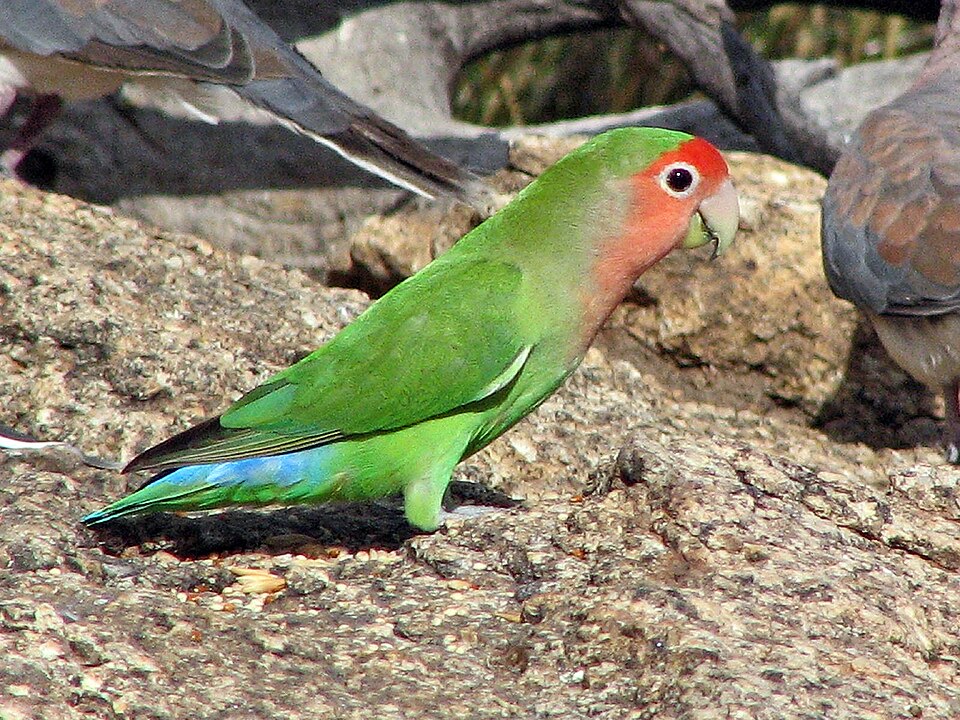
The peach-faced lovebird has a green body and an orange-red face and throat; pet forms include yellow, blue and many other color mutations. Other Agapornis species differ in face color and size, so find out the exact species when you buy.
In many parrot species the sexes look alike. RSPCA Australia writes that some species need surgical or DNA sexing for a valid sexing certificate. Sex matters when choosing a companion: two birds of the same sex aren't guaranteed to get along. Ask a bird vet if you want to know your bird's sex for sure.
 Daily care
- Time: If you keep a single bird, RSPCA says you must give it enough time to stand in for a flock mate; talk, play and spend time together every day.
- Enrichment: Merck lists boredom as a main cause of biting, screaming and feather plucking. Rotate toys and set up foraging games. Agriculture Victoria suggests safe materials such as branch pieces, cardboard rolls and paper. See toys for birds for more.
- Out-of-cage flight: Agriculture Victoria recommends supervised free-flying time outside the cage, after you've bird-proofed the home.
- Water: Fresh water every day.
- Glass, fans and flames: Merck notes that birds fly into windows, spinning ceiling fans and open flames; close them off before flight time.
More in lovebird care.
 Cage and living space
RSPCA Australia writes that a cage should be long rather than tall, and that as a minimum the bird must be able to stretch its wings without touching the sides and sit on a perch with its tail clear of the floor. For a pair, the width should be at least three times their combined wingspan, with at least two wingbeats between perches. Birds kept permanently in a cage need a flight aviary or regular safe indoor flying; confinement alone can cause obesity, arthritis, soft bones and boredom-related behavior.
- Perches: Natural branches in varied thicknesses; avoid metal pipe and sandpaper-covered perches (RSPCA).
- Bowls: Stainless steel, glass or glazed ceramic.
- Floor: Newspaper or paper towel; avoid sand and shavings.
- Location: In a corner, away from foot traffic and the kitchen. See the cage placement guide.
- Nest box: RSPCA says nest boxes are debated: they offer privacy but can encourage egg laying; remove them if laying becomes excessive.
Diet
Merck writes that diets based on seeds and nuts are high in fat and lacking in many vitamins and minerals, that vitamin A deficiency is common but often goes unnoticed, and that birds can pick out the tasty seeds and leave the pellets. The recommended setup is a base of a complete formulated pellet diet with a smaller portion of fresh vegetables and fruit. Agriculture Victoria likewise says seed mixes shouldn't be fed daily and should be offered in small amounts as treats.
Work out your bird's diet plan with a vet who treats birds. See foods that are harmful to birds.
 Health issues to know about
Birds hide illness (Merck). The information below is for general knowledge; see a vet who treats birds for diagnosis and treatment.
- Diet-related problems: Seed-heavy diets are linked to vitamin A and calcium deficiency, obesity and liver problems (Merck).
- Behavior-related problems: Feather plucking, biting and screaming; Merck links these to boredom. Feather plucking can also have medical causes, so have a vet look at it.
- Psittacosis (chlamydia): Merck writes that the bacterium spreads from carrier birds through nasal discharge and droppings, can survive for months in dried droppings and can pass to people; gloves, hand washing and daily disinfection are recommended when handling a sick bird. If you get flu-like symptoms, tell your doctor you keep birds.
- Fumes and gas: Overheated nonstick pans and some sprays can be fatal to birds very quickly (Merck).
- Open-mouth, wheezy or tail-bobbing breathing
- Fluffed feathers while sitting motionless, or falling off the perch
- Loss of appetite or a clear change in droppings
- Plucking its own feathers, or a wound on the skin
- Exposure to smoke, sprays or nonstick pan fumes (get the bird into fresh air first, then go to the vet right away)
How long does it live?
Animal Diversity Web says 15 to 25 years in captivity, and Merck up to 20; the wild lifespan is unknown. Diet, air quality, out-of-cage flight and regular vet checks matter most.
Long life also changes how you plan: think ahead about who will care for the bird during travel, illness or a move (RSPCA Australia). Treating the bird's care and costs as a budget that stretches over years makes it less likely you'll have to give it up later.
 Before you get one
- One bird or two? As RSPCA Australia puts it, a bird's companion can be another bird or you. If you take one bird, be sure you have enough time every day; if you take two, choose compatible birds and introduce them slowly. Incompatible birds can fight.
- Check the seller: RSPCA recommends sellers who share the bird's parentage, history and diet and offer a refund or replacement for health problems.
- Legal status: Some Agapornis species may fall under international trade rules (CITES); this varies by species. Ask the seller for the species name and whether the bird was captive-bred.
- No wild-caught birds: In Türkiye, Article 18 of the Land Hunting Law (No. 4915) restricts the sale and transport of wildlife taken against the rules, and catching and selling native wild birds (such as the goldfinch) is prohibited.
- Vet check: Have the bird examined by a bird vet right after purchase.
Frequently asked questions
Will a lovebird die if kept alone?
We couldn't find a veterinary source backing up this claim. What we do know: birds are flock animals (RSPCA), the peach-faced lovebird is very social in the wild and pairs are monogamous (Animal Diversity Web), and bored birds that get too little attention can develop biting, screaming and feather plucking (Merck). So "struggles and develops problems" is closer to the truth than "dies."
Should I get two?
RSPCA says a bird's companion can be another bird or a person. Two birds meet the social need, but cost and space double, and incompatible pairs can fight.
Does it talk?
Merck says lovebirds have sweet voices and are not usually loud; we couldn't find information on talking ability in these sources.
Is it moody in breeding season?
Merck says it can be. On nest boxes, RSPCA notes they can encourage egg laying.
Should I cover the cage at night?
Merck says covering can stress many birds; RSPCA suggests a separate night cage rather than a cover. Watch your bird, and ask your vet if there's a problem.
Sources
- Animal Diversity Web (University of Michigan) · Agapornis roseicollis
- Merck Veterinary Manual · Choosing a Pet Bird
- Merck Veterinary Manual · Behavior of Pet Birds
- Merck Veterinary Manual · Nutritional Disorders of Pet Birds
- Merck Veterinary Manual · Disorders Affecting Multiple Body Systems of Pet Birds (psittacosis, fume and gas poisoning)
- RSPCA Australia Knowledgebase · Are birds the right companion animals for me?
- RSPCA Australia Knowledgebase · How should I house my bird?
- RSPCA Australia Knowledgebase · What kind of enclosure does my bird need?
- Agriculture Victoria · Your bird's welfare needs
By Tüylüm · Last checked: November 10, 2026. Compiled from the sources above and written in our own words. Spotted a mistake? Write to [email protected] and we'll fix it right away. Photo from Wikimedia Commons, used under the license shown below it.