 Tüylüm
Budgerigar (Budgie)
The most commonly kept pet bird in Türkiye: small, cheerful and a flock animal. The real challenge is that it needs far more attention and space than its size suggests: a roomy cage, safe out-of-cage flying every day, a balanced diet instead of seed alone and, ideally, a companion.

 Lifespan≈ 5–15 yearssources give different ranges
 Weight1–2 oz (30–60 g)adult bird
 OriginAustraliaflocks on semi-arid plains
 VoiceChirpysome learn words
 Social lifeFlock birdideally at least one companion
 CageWide and longdaily out-of-cage flight is a must
 DietPellets + veggiesseed only as a treat
 LegalCaptive-bred speciesnever wild-caught
Despite its size, the budgerigar evolved to live as part of a huge flock. That is why "small bird, small cage, small effort" is the most common mistake people make with it. On this page we've pulled together its needs from veterinary sources, animal welfare organizations and ecological data.
- Flock bird: Veterinary sources recommend a companion of the same species if possible; if you keep a single bird, you need to give it real time every day.
- Space: The bigger the cage, the better. It must let the bird spread its wings in every direction, and it needs to fly in a safe room every day.
- Diet: A seed-only mix leaves vitamin and mineral gaps; vets recommend a base of pellets and fresh vegetables.
- Invisible hazards: Fumes from nonstick pans, sprays and cigarette smoke can be deadly for small birds.
- Lifespan: Roughly 5 to 15 years depending on the source; a long companionship with good care.
What to know
 What is the Budgerigar (Budgie) like?
The budgie is curious, active and chatty. In the wild it lives in huge flocks; Animal Diversity Web describes the species as strongly social and notes that flocking helps with finding food and protects against predators. At home that sociability shows up as treating you and your family as part of its flock: it calls to you, lands on your shoulder and gets involved in whatever you're doing.
Set your expectations about talking carefully. The Royal Veterinary College (RVC) writes that some individuals can learn more than 500 words, that the best time to start training is from about 6 weeks old, and that teaching a bird older than 6 months is often unsuccessful. Unusual Pet Vets says most budgies chirp but only a few learn to produce words we can understand. Think of talking as a possibility, not a guarantee.
Every bird is an individual. Its personality is shaped as much by how it was raised, how much contact it had with people as a chick and its health as by its species.
Who is it a good fit for?
A budgie suits people who can spend time with their bird every day, set aside a safe room for out-of-cage flight and take on a long commitment. The Merck Veterinary Manual considers the species suitable for apartment living because of its size and quiet nature, but RSPCA Australia reminds readers that birds are not "low maintenance," may need specialized avian veterinary care and require a long-term commitment.
| Situation | Good fit? |
|---|---|
| Apartment | Yes; it's fairly quiet, but needs room for a cage and a flight room |
| Family with kids | Yes, if children are gentle and supervised |
| Home with a cat or dog | Be careful; never leave a bird alone with a cat or dog |
| Long hours alone | Hard; a lonely bird gets bored and can develop screaming and feather plucking |
| First-time bird owners | Yes, but learn its needs first |
Where does it come from?
The budgerigar is native to Australia. RVC writes that in its native range large flocks roam the semi-arid plains, and Animal Diversity Web describes the flocks as nomadic, moving with the seasons. Wild birds forage on the ground for grass seeds and stay near water.
Today's pet budgies descend from birds bred in captivity for generations; ADW notes that captive forms show far more color varieties than wild ones. A pet budgie does best when its life resembles its wild ancestors': plenty of space, a flock, foraging on the ground and flapping its wings every day.
 Appearance and colors
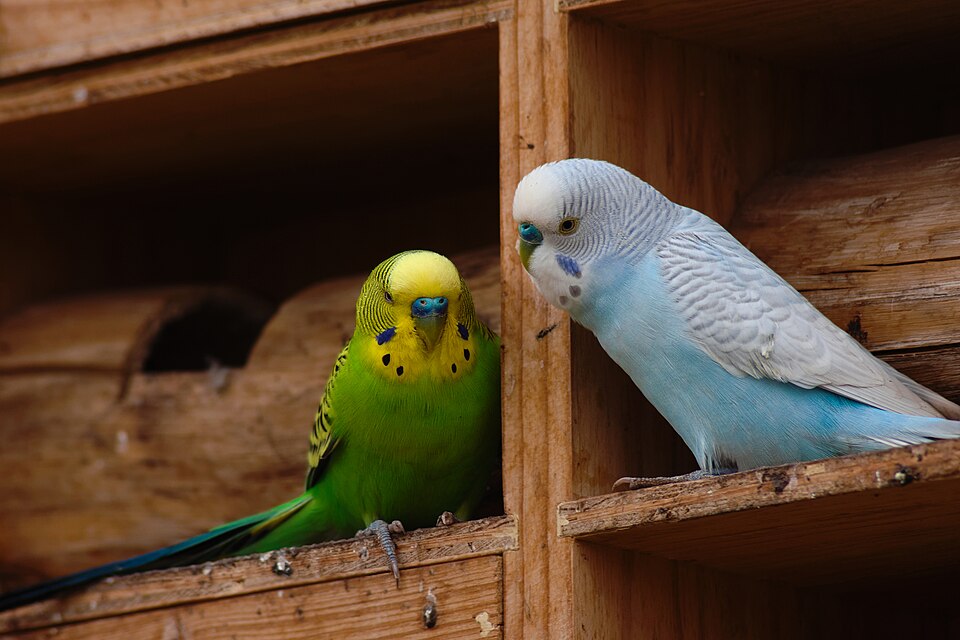
An adult budgie weighs about 1 to 2 ounces (30 to 60 g), according to Unusual Pet Vets. The wild type is green with a yellow head; captive forms come in blue, yellow, white and many other colors. You can often tell males from females by the cere, the skin around the nostrils above the beak: RVC says it is blue in adult males and pink-brown in adult females, although this can vary in some color types and in young birds.
 Daily care
- Daily flight: RVC calls free flight an essential requirement. The room must be secure: windows, doors and chimneys blocked off, fans and heaters off, poisonous plants removed.
- Ceiling fans, glass, open flames: Merck and RSPCA note that birds fly into windows and spinning fans and into open flames; draw the curtains and turn off the fan before flight time.
- Nails: RVC recommends natural tree-branch perches and says sandpaper perch covers don't shorten nails; they just wear down the feet.
- Enrichment: Rotate toys often and set up simple foraging games (food hidden in a cardboard roll, for example). Unusual Pet Vets warns against string and rope toys: swallowed fibers can cause a gut blockage.
- Water and bathing: Keep a clean shallow dish of water available every day; RVC recommends changing the water daily.
- Sleep: Unusual Pet Vets suggests keeping to natural day length and moving the bird to a dark, quiet room in the evening; long days can trigger excessive molting and breeding behavior. Merck notes that covering the cage can stress many birds. Watch what works for your bird and ask your vet.
For more, see our posts on where to put a bird cage and bonding with your bird.
 Cage and living space
RVC writes that budgies naturally live in large flocks and are happiest in a spacious aviary. If an aviary isn't an option, a cage can work, but it should be as large as possible, let the bird stretch its wings in every direction, and ideally be used only at night or when the bird is unsupervised.
According to RSPCA Australia, birds fly horizontally, so a cage should be long rather than tall. For two birds the width should be at least three times their combined wingspan, with at least two wingbeats of distance between perches. Merck recommends a space at least 1.5 times the wingspan in every direction.
- Materials: RVC and Unusual Pet Vets recommend powder-coated or stainless steel cages without zinc or lead; some painted and galvanized cages can be toxic.
- Perches: Natural branches in varied thicknesses; RSPCA says to avoid metal pipe, sandpaper-covered and cotton-fiber perches.
- Bowls: Stainless steel, glass or glazed ceramic; don't hang bowls under perches.
- Floor: Newspaper or paper towel; avoid sand, wood shavings, corn cob and crushed nut shells.
- Location: In a corner, away from foot traffic, the kitchen, drafts and direct sun. See our cage placement guide.
- Cleaning: RVC says a full clean at least weekly; RSPCA suggests ideally every 1 to 2 days. See cage cleaning.
Diet
According to the Merck Veterinary Manual, diets based on seeds and nuts are high in fat and lacking in many vitamins and minerals, and are linked to liver, kidney, respiratory, bone and reproductive problems. Vitamin A deficiency is common in birds eating mostly seed and often goes unnoticed; seeds are also low in calcium. Because birds pick out the tasty seeds and leave the pellets, simply mixing the two half and half often doesn't work.
Veterinary sources recommend a base of pellets (a complete formulated bird food) plus fresh vegetables. Proportions differ by source: RVC describes a pellet-heavy plan, while Unusual Pet Vets recommends pellets, vegetables and a quality seed mix together. Work out the right mix for your bird with an avian vet. Use seed as a treat, and switch foods gradually.
- Fresh, clean water every day; RVC suggests a separate shallow dish for bathing.
- Harmful foods: Merck and RSPCA list avocado; RSPCA adds onion, garlic, chocolate, coffee, tea, salty foods and alcohol. See foods that are harmful to birds.
- Don't feed moldy or stale seed: Merck notes that mold in improperly stored seed can damage the liver.
 Health issues to know about
Birds are experts at hiding illness; Merck says they do it so they don't look weak to predators. That means that by the time you notice a sign, the problem may be advanced. The information below is for general knowledge; see a vet who treats birds for diagnosis and treatment.
- Digestive problems: Unusual Pet Vets reports that an upset digestive tract (regurgitation, vomiting, diarrhea) is one of the most common problems it sees in budgies.
- Obesity and fatty lumps: Linked to seed-heavy diets; fatty lumps can make movement hard. Have any new lump or swelling checked.
- Scaly face mites: An external parasite that causes crusty lesions on the beak and feet.
- Respiratory infections: Sneezing and eye discharge are common in young birds.
- Chlamydia (psittacosis): The bacterium Chlamydia psittaci can cause respiratory and digestive signs in birds and can spread to people. Merck writes that it spreads through nasal discharge and droppings, including dried droppings dust and feather dust; gloves, hand washing and daily disinfection of cages and dishes are recommended when handling a sick bird. Merck lists budgies and cockatiels among species that resist infection but can still be carriers. If you develop flu-like symptoms, tell your doctor you keep birds.
- Fume and gas poisoning: Overheated nonstick (Teflon) pans, some air fresheners and cigarette smoke can cause sudden death in birds. Merck says to keep birds well away from cooking areas and other fume sources; RVC also lists nonstick pans, air fresheners and smoke.
- Open-mouth breathing, wheezing or tail bobbing with each breath
- Fluffed feathers while sitting low on the cage floor or perch
- Loss of appetite, vomiting or a clear change in droppings
- Loss of balance or weakness
- Exposure to smoke, sprays or nonstick pan fumes (get the bird into fresh air first, then go to the vet right away)
RVC recommends a health check at least once a year; Unusual Pet Vets suggests every 6 to 12 months. See taking your bird to the vet for help getting your bird used to a carrier.
How long does it live?
Sources give different ranges: Merck says 5 to 10 years, while RVC says 10 to 15 years in captivity. Animal Diversity Web gives an even higher captive average, but that figure may rest on limited data. In practice, diet, daily flight, freedom from toxins and parasites and regular vet checks shape a bird's life. So rather than fixing on "5 years" or "15 years," be prepared for a long one.
 Before you get one
- Look at rescues: Look for bird rescue groups too.
- Check the seller: RSPCA Australia recommends sellers who are honest, know their species, share information on the bird's parentage and diet and offer a refund or replacement for health problems. Avoid crowded, dirty places or those feeding only dry seed.
- Vet check: RSPCA and Merck recommend having a new bird examined by a bird vet soon after purchase.
- No wild-caught birds: The budgie is a captive-bred species. In Türkiye, Article 18 of the Land Hunting Law (No. 4915) restricts the sale and transport of wildlife taken against the rules, and catching and selling native wild birds (such as the goldfinch) is prohibited. Buy your budgie from a seller whose breeding source is clear.
- Companions: If you want two birds instead of one, introduce them slowly; Unusual Pet Vets reminds readers that some birds may never get along.
Frequently asked questions
Can a budgie live alone?
RVC says most birds are social and ideally should live with at least one bird of the same species. Unusual Pet Vets says they can be kept singly. RSPCA Australia sums it up: birds are flock animals, and their companion is either a bird or you; if you are the only companion, you must give the bird enough time.
Does a budgie talk?
Some do, but most chirp. RVC writes that some individuals learn over 500 words, though it's no guarantee. The best training window starts at about 6 weeks of age.
Should I cover the cage at night?
Sources differ: Unusual Pet Vets recommends moving the bird to a dark, quiet room in the evening; Merck says covering the cage can stress many birds; RSPCA suggests using a separate night cage rather than a cover. Watch your bird, and ask your vet if there's a problem.
Should I give it a mirror toy?
Merck says mirror toys can confuse and stress birds, so for a single bird, natural branches, foraging games and your time are better choices than a mirror.
How often should I take it to the vet?
RVC recommends an annual health check, and Unusual Pet Vets every 6 to 12 months. If your bird looks sick, don't wait.
Sources
- Royal Veterinary College (RVC) · Budgerigar care (Beaumont Sainsbury Animal Hospital, November 2023)
- Unusual Pet Vets · Budgerigar Care Sheet
- Merck Veterinary Manual · Choosing a Pet Bird
- Merck Veterinary Manual · Nutritional Disorders of Pet Birds
- Merck Veterinary Manual · Disorders Affecting Multiple Body Systems of Pet Birds (psittacosis, fume and gas poisoning)
- Merck Veterinary Manual · Illness in Pet Birds
- RSPCA Australia Knowledgebase · What kind of enclosure does my bird need?
- RSPCA Australia Knowledgebase · Are birds the right companion animals for me?
- Animal Diversity Web (University of Michigan) · Melopsittacus undulatus
By Tüylüm · Last checked: November 10, 2026. Compiled from the sources above and written in our own words. Spotted a mistake? Write to [email protected] and we'll fix it right away. Photo from Wikimedia Commons, used under the license shown below it.