 Tüylüm
Pomeranian
The smallest of the spitz breeds, with a fluffy coat, fox-like face and big-dog attitude. Lively, alert and devoted to its owner, but its tiny body is fragile. Luxating kneecaps, collapsing trachea and alopecia X are worth knowing about, and avoid extra-small puppies sold as "mini" or "teacup."

 Lifespan≈ 12.2 yearsmedian, UK 2024 data
 Weight3–7 lb (1.4–3.2 kg)AKC; UK standard 4–5.5 lb (1.8–2.5 kg)
 Height7–9.5 in (18–24 cm)FCI: 21 cm (±3)
 OriginGermany, Pomeraniathe smallest of the German Spitz
 CoatLong, fluffybrush down to the skin at least weekly
 ExerciseAbout 30 min a dayRKC; short walks and indoor play
 With kidsNeeds carebest with kids old enough to know it isn't a toy
 TrainingEasy to moderateeager to learn; housetraining takes patience
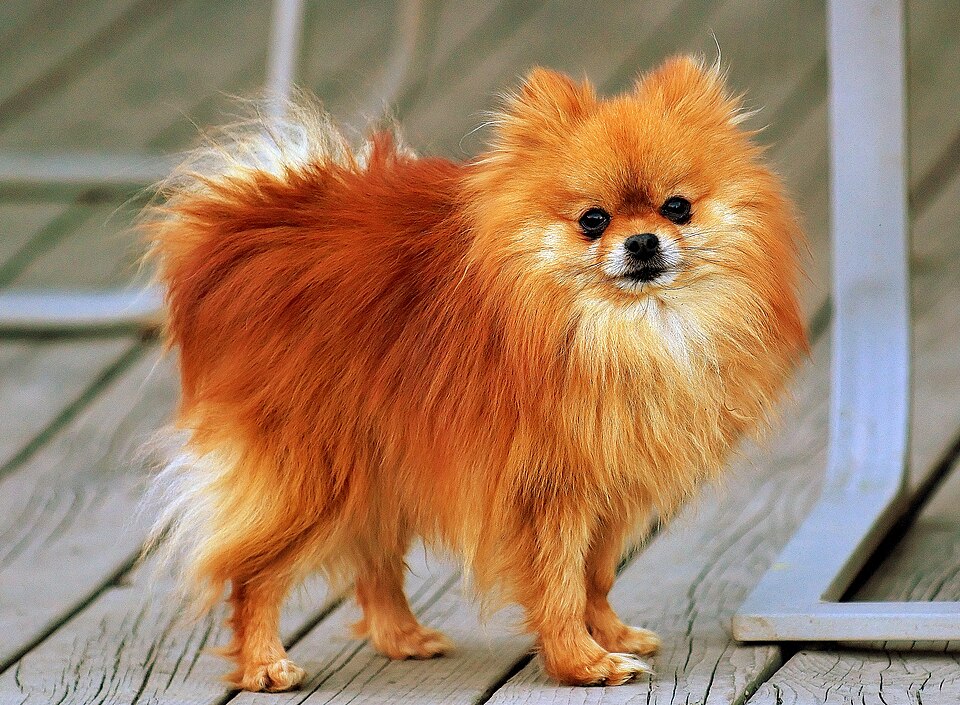
The Pomeranian is the smallest member of the spitz family: a fluffy ruff, a fox-like face and a plumed tail curled over the back, all in a body weighing a few pounds. It's a lively, alert companion that's deeply attached to its owner and seems to think it's much bigger than it is. It adapts easily to apartment life, but its tiny body is fragile, and there are some health issues to know about in this breed. Extra-small puppies sold as "mini," "teacup" or "pocket" Pomeranians are a serious welfare concern. We've put this page together from breed registry standards, animal welfare resources and scientific studies.
- Temperament: Per the FCI, always attentive, lively and extraordinarily attached to its owner; neither timid nor aggressive.
- Fragility: According to UFAW, toy breeds can break the lower foreleg in minor accidents, most often when jumping from a height or falling from someone's arms.
- Knees: In a 2016 UK study, luxating kneecaps were most common in Pomeranians (6.5%).
- Coat: Needs brushing down to the skin at least once a week; the hair-loss condition alopecia X is common in this breed.
- "Teacup" warning: The Royal Kennel Club doesn't recognize any "teacup" breed; extremely small dogs are more likely to have breathing, bone, joint and heart problems.
- Lifespan: A large 2024 UK study found a median lifespan of 12.2 years.
What to know
 What is the Pomeranian like?
The FCI standard describes the Pomeranian as always attentive, lively and extraordinarily attached to its owner, very teachable and easy to train. Its companionable, cheerful character makes it an ideal companion and watchdog for houses and apartments, and it should be neither timid nor aggressive. The AKC also presents it as an alert, intelligent dog with a "commanding big-dog demeanor" in a tiny body.
- Voice: In the AKC's breed trait chart, barking level is on the high side, and so is watchdog instinct. It likes to announce the doorbell and passersby; to understand why, see our article on why dogs bark.
- Courage: It may challenge dogs many times its size. The AKC warns that uncontrolled dogs can easily hurt a Pomeranian.
- Escaping: According to the AKC, Pomeranians are notorious for squeezing through small gaps in fencing or climbing over short fences.
Every dog is an individual. Breed traits describe general tendencies; how well a puppy was socialized, its training, its daily life and its health shape its personality as much as its breed.
 Who is it a good fit for?
The Pomeranian suits people and families who live in apartments, spend lots of time with their dog and can keep a small dog's fragility in mind. According to the Royal Kennel Club, it's suited to flat life and needs up to 30 minutes of exercise a day.
| Situation | Good fit? |
|---|---|
| Apartment | Excellent; the RKC considers it suited to flat life |
| Family with young kids | Needs care; the AKC suggests children old enough to know the difference between a toy dog and a toy |
| Family with older kids | Good, as long as it's petted on the floor and not carried around |
| Homes with big dogs | Needs care; it can get hurt during play |
| Long hours alone | Hard; it's very attached to its owner |
| Seniors and quiet homes | Good; short walks and indoor play are enough |
One of the biggest risks for a small dog is falling. Teach children not to carry a Pomeranian while standing and to pet it while sitting on the floor; our article on kids and dogs has detailed rules.
Where does it come from?
The FCI groups the Pomeranian as the smallest size in a single German Spitz standard and calls the German Spitz the oldest dog breed in Central Europe. According to the AKC, the breed is named after Pomerania, a region now split between Poland and Germany, where the Pom's ancestors were bred down from much larger northern spitz dogs.
According to the Royal Kennel Club, the breed was first seen in the UK in 1870 and became a great favorite of Queen Victoria; royal patronage played a big part in its popularity. The AKC credits Victoria with helping reduce the breed's size from about 30 pounds (about 13.5 kg) to today's toy stature. Today the FCI places the breed in Group 5 among the European spitz breeds.
Appearance and colors
According to the FCI, spitz dogs stand out for their beautiful coats made to stand off by a plentiful undercoat, a strong, mane-like ruff around the neck and a bushy tail carried boldly over the back. The fox-like head, alert eyes and small, pointed, closely set ears give the breed its "cheeky" look. The body is as long as the dog is tall.
- Height: Per the FCI, 8.5 in (21 cm) at the shoulder, with about 1 in (3 cm) of tolerance (7–9.5 in, 18–24 cm); weight should match size.
- Weight: The AKC lists 3–7 pounds (about 1.4–3.2 kg). According to UFAW, the UK standard gives an ideal of 4–4.5 lb (1.8–2 kg) for males and 4.5–5.5 lb (2–2.5 kg) for females.
- Coat: A long, straight, stand-off outer coat over a short, thick, cotton-like undercoat. The FCI says the coat must not look sculpted.
- Colors: White, black, brown, orange, grey-shaded and other colors (such as orange-sable, cream and black-and-tan). The AKC says orange or red is most common.
Why doesn't the standard want extreme smallness?
The FCI standard published in 2024 explicitly penalizes several features linked to extreme miniaturization: an open fontanel (a soft spot left open on top of the skull) is a disqualifying fault, while an apple-shaped head and overly large, protruding eyes are severe faults. Inward- or outward-rolling eyelids are disqualifying too. In other words, the breed standard does not support the idea that "smaller is better."
Daily care
According to the AKC, the Pomeranian's profuse double coat is its most distinctive feature and needs frequent brushing: to prevent mats, brush down to the skin once a week with a pin brush and a slicker brush. The Royal Kennel Club recommends grooming more than once a week. If you prefer, a groomer can handle a full groom (bath, brushing, ears and nails) every four to six weeks.
- Teeth: The AKC recommends paying close attention to the teeth and brushing them during the weekly grooming session.
- Nails: Since Poms are active, keep their nails short.
- Jumping: To prevent knee problems and broken bones, the AKC recommends keeping Poms from jumping on and off couches and beds.
- Outdoors: The AKC reminds owners to keep a close eye on a Pom outside; small gaps in fences and uncontrolled dogs are real risks.
For a brushing routine, see our article on dog grooming.
Training and exercise
The Royal Kennel Club recommends up to 30 minutes of exercise a day for the Pomeranian. According to the AKC, even though Poms enjoy being lapdogs, they also like to run, play and go for walks; with indoor play and short walks, they're content in the city or the suburbs.
The AKC recommends teaching a Pom to walk on a leash and come when called early on. Alert and highly intelligent, Poms can excel at agility, rally and obedience, and as therapy dogs. Housetraining, however, can be a challenge according to the AKC, so consistency and patience are key.
- According to PDSA, a harness puts less pressure on a dog's throat than a collar; in a breed prone to windpipe problems, discuss the choice with your vet.
- When you set your Pom down, crouch to the floor rather than letting go while standing.
- As the AKC suggests, keep it from jumping on and off furniture; pet steps can help it get up and down.
 Diet and weight
According to the AKC, a Pomeranian does well on a high-quality food suited to its life stage (puppy, adult or senior); some are prone to weight gain, so calories and weight should be watched. Weight matters even more in this breed: according to the MSD Veterinary Manual, tracheal collapse is more common in obese dogs, and weight loss is a critical part of managing it.
- Set the daily amount with your vet based on your dog's ideal weight, and count treats as part of it.
- In a dog weighing about 4.5 lb (2 kg), even 7 oz (200 g) is 10% of its body weight; weighing it once a month shows changes early.
- A fluffy coat hides extra weight, so check the ribs with your hands.
- Clean, fresh water should always be available.
 Health issues to know about
According to the AKC, responsible breeders screen Pomeranians for luxating kneecaps, an underactive thyroid, collapsing trachea, congestive heart failure, seizures and alopecia X. The Royal Kennel Club places the breed in Category 2 of its Breed Watch list and recommends an eye exam. The information below is for awareness only; ask your vet about diagnosis and treatment.
Luxating kneecap (patellar luxation)
This means the kneecap slips out of place. In a 2016 UK study by O'Neill and colleagues, patellar luxation was most common in Pomeranians: it was recorded in 6.5% of them, and their odds were about 6.5 times those of mixed-breed dogs. In the same study, dogs lighter than their breed average were at higher risk. The condition can lead to lameness, osteoarthritis and pain.
Collapsing trachea
In this condition the windpipe flattens and narrows. According to the MSD Veterinary Manual, it's most common in toy and miniature breeds, and its cause is unknown. Typical signs are a dry, honking, chronic cough and labored breathing. In a 2024 study of 110 small-breed dogs in Korea, about 23% of the cases were Pomeranians. Obesity and heart or lung disease make it worse.
Alopecia X (hair cycle arrest)
According to the University of Minnesota's dermatology handbook, this is a hair-loss condition of unknown cause seen in Nordic breeds, and Pomeranians are over-represented. It usually starts between 1 and 3 years of age with a dull, dry coat and loss of guard hairs, followed by hair loss on the neck, rear, tail and backs of the thighs and darkening of the skin. The head and legs are usually spared. It isn't itchy and the dog is otherwise healthy; the handbook describes it mainly as a cosmetic concern. Still, have your vet check it, because thyroid and hormone disorders can look similar.
Foreleg fractures
According to UFAW, toy breeds including the Pomeranian can fracture the lower foreleg (the radius and ulna) in minor accidents, most often when jumping from a height or falling from their owner's arms; these fractures are very painful, heal slowly and sometimes fail to heal at all. UFAW stresses that this risk is tied to small body size.
- A honking cough or labored breathing
- Suddenly not putting weight on a leg, swelling or deformity (especially after a fall or jump)
- Limping on a hind leg or avoiding using it
- Seizures
- Symmetrical hair loss with darkening skin
How long does it live?
In a 2024 study by McMillan and colleagues that analyzed records of more than 584,000 dogs in the UK, the Pomeranian had a median lifespan of 12.2 years (confidence interval 12.0–12.5), based on 1,170 deaths. In the same study, mixed-breed dogs had a median of 12 years and small breeds 12.7 years. The AKC gives 12–16 years, and the Royal Kennel Club says "over 12 years."
According to the Royal Kennel Club, "teacup" dogs are more likely to live significantly shorter lives. A standard-sized puppy from health-screened parents, an ideal weight and a home that guards against falls are the most concrete ways to a long life in this breed.
 Before you get one
- Consider a shelter: Purebred dogs end up in shelters and rescues too. If you're set on a breed, follow breed groups and adoption listings.
- Beware of "teacup," "mini" and "pocket" ads: The Royal Kennel Club doesn't recognize any teacup breed and notes that these dogs are often produced by breeding the smallest, weakest puppies of a litter, and that some sellers sell puppies younger than 8 weeks to make them seem smaller. The RSPCA also says words like "miniature" and "teacup" in ads can be a sign of dealers cashing in on popular terms.
- Price: According to the Royal Kennel Club, you shouldn't pay more for small size than for other puppies of the breed.
- If you buy from a breeder: See the puppy at home with its mother. Ask about knee, eye and heart exams, and make sure the parents are standard-sized. The RSPCA advises avoiding the smallest individuals of very small breeds.
- Registration: Rules vary by country; many places require or recommend microchipping. In Türkiye, owned dogs must be microchipped and registered in the PETVET system. For the first days, see our guide to a new puppy's first week.
Frequently asked questions
Is a "teacup Pomeranian" a separate type?
No. The Royal Kennel Club doesn't recognize any teacup breed and won't register dogs under that name; "teacup" simply means a dog that's smaller than average. According to the Royal Kennel Club, these dogs are more likely to have breathing, bone, joint, heart and stomach problems and may live significantly shorter lives. The FCI standard also penalizes features linked to extreme smallness, such as an open fontanel, an apple head and protruding eyes.
Is a Pomeranian good for a family with children?
It can be a good fit with older children. The AKC recommends families with children old enough to know the difference between a toy dog and a toy. Young children can drop a dog, and according to UFAW, falls from someone's arms are one of the most common causes of foreleg fractures in toy breeds.
My Pomeranian makes a honking sound when it coughs. Is that normal?
According to the MSD Veterinary Manual, that sound can be a typical sign of tracheal collapse. Have your vet check it rather than giving anything on your own; if your dog is overweight, losing weight is an important part of managing the condition.
Why is my Pomeranian losing its coat?
Seasonal shedding is normal. But if the coat turns dull, symmetrical bald patches appear on the body and the skin darkens, it may be alopecia X; have your vet rule out similar-looking hormone disorders.
Can I shave my Pomeranian?
The FCI standard says the coat must not look sculpted. According to the University of Minnesota's dermatology handbook, hair failing to grow back for months after clipping is more common in dense-coated breeds. Talk to your vet before shaving.
Sources
- FCI · German Spitz (Toy Spitz / Pomeranian dahil) ırk standardı No. 97 (2024)
- AKC (American Kennel Club) · Pomeranian ırk tanıtımı
- The Royal Kennel Club · Pomeranian ırk sayfası
- The Royal Kennel Club · Buying a teacup dog
- RSPCA · Buying a puppy: how to avoid puppy farms
- RSPCA · Choosing a puppy
- PDSA · Heatstroke in dogs (göğüs tasması önerisi)
- UFAW Genetic Welfare Problems · Pomeranian: Distal fractures of the radius and ulna
- O'Neill ve ark. · The epidemiology of patellar luxation in dogs attending primary-care veterinary practices in England, Canine Genetics and Epidemiology (2016)
- MSD Veterinary Manual · Tracheal collapse in dogs
- Kim ve ark. · A retrospective study of tracheal collapse in small-breed dogs: 110 cases (2022–2024), Frontiers in Veterinary Science (2024)
- University of Minnesota · Small and Large Animal Dermatology Handbook: Alopecia X
- University of Minnesota · Small and Large Animal Dermatology Handbook: Canine post-clipping alopecia
- McMillan ve ark. · Longevity of companion dog breeds: those at risk from early death, Scientific Reports (2024)
- Resmî Gazete · Kedi, Köpek ve Gelinciklerin Kimliklendirilmesi ve Kayıt Altına Alınmasına Dair Yönetmelik (26 Şubat 2018)
By Tüylüm · Last checked: November 3, 2026. Compiled from the sources above and written in our own words. Spotted a mistake? Write to [email protected] and we'll fix it right away. Photo from Wikimedia Commons, used under the license shown below it.