 Tüylüm
Chihuahua
A bold, lively companion dog from Mexico, considered the smallest dog breed in the world. Its tiny body is fragile: dental problems, slipping kneecaps, an open soft spot on the skull and accidental falls are what you most need to know about. Avoid extra-tiny puppies sold as "teacup."

 Lifespan≈ 11.8 yearsmedian, UK 2024; early deaths are common
 Weight3.3–6.6 lb (1.5–3 kg)FCI ideal 1.5–2.5 kg; RKC max 2.7 kg
 Height5–8 in (13–20 cm)AKC; standards only judge weight
 OriginMexiconamed after the state of Chihuahua
 CoatShort or longbrush weekly; both coats shed
 Exercise~30 minutes a dayRoyal Kennel Club guidance
 With kidsNeeds carevery fragile; better with older kids
 TrainingModeratelearns with rewards; socialize early
The Chihuahua is a companion dog named after Mexico's largest state and, according to the FCI, regarded as the smallest purebred dog in the world. The Royal Kennel Club sums it up as "a huge personality in a tiny frame." It comes in two coat types, smooth and long. On this page we've pulled together its temperament, care needs and health issues from breed registry standards, animal welfare resources and scientific studies.
- Temperament: According to the FCI, quick, alert, lively and very courageous. Early socialization is especially important in this breed.
- Size: Standards call for under 3 kg (6.6 lb), but the median weight of real adult Chihuahuas in a UK study was 3.4 kg (7.5 lb). Smaller is not better.
- Health: Gum disease, retained baby teeth, slipping kneecaps and heart disease are common; an open soft spot on the skull and hydrocephalus are especially associated with this breed.
- Safety: Falls from arms or furniture can cause serious fractures; in one UK study, accidents were the third most common cause of death.
- Lifespan: A 2024 study found a median lifespan of 11.8 years; early deaths are common, but plenty of Chihuahuas live past 15.
What to know
 What is the Chihuahua like?
The FCI standard describes the Chihuahua as quick, alert, lively and very courageous, and the Royal Kennel Club calls it bold, outgoing and confident. The standard asks that it be neither snappy nor withdrawn. Thanks to its alert nature, it notices every sound in the house and keeps a close eye on what's going on.
Being picked up suddenly, squeezed or petted when it doesn't want to be bothers it just as it would any dog. In a study of more than 11,000 Chihuahuas seen at UK veterinary clinics in 2016, aggression appeared in the records of 4.2% of the dogs, more often in males. That doesn't mean the breed is aggressive; it shows how much early socialization and reading a dog's signs of discomfort matter. Our article on dog body language explains those signs.
Every dog is an individual. Breed traits describe general tendencies; the parents' temperament, how a puppy was socialized and the training it gets shape its personality as much as its breed.
 Who is it a good fit for?
The Chihuahua suits adults and families with older children who live in a fairly calm home, will walk their dog every day and can protect it as the fragile animal it is.
| Situation | Good fit? |
|---|---|
| Apartment | Excellent; the Royal Kennel Club says a small home and garden are enough |
| Family with kids | Needs care; falls and squeezing are a real risk with young children |
| Other dogs and cats | Introduce slowly; it can get hurt playing with big dogs |
| Long hours alone | May struggle; being alone needs to be taught gradually |
| First-time dog owners | Possible, but you need to be well informed about health and safety |
The authors of the UK study warn that as the Chihuahua's popularity soars, impulse purchases by people with little experience of dog care could lead to welfare problems. Choose this breed because you understand its needs, not because it seems small and easy. For families with kids, see our article on kids and dogs at home.
Where does it come from?
The breed is named after the Mexican state of Chihuahua. According to the FCI, these dogs are thought to have once lived in the wild and to have been captured and domesticated by local people during the Toltec civilization; in the city of Tula, buildings are decorated with statues of a small dog called the "Techichi" that look very much like today's Chihuahua. The AKC also notes that the breed's lineage goes back to the pre-Columbian kingdoms and that it ranks among the oldest breeds of the Americas.
According to the Royal Kennel Club, the Chihuahua became fashionable in Mexico in the late 19th century, spread from there to the United States and became a sensation as the dog of celebrities and film stars. That fame continues today: in UK veterinary records, the Chihuahua's share of all dogs born each year rose from about 1% in 2005 to 5.35% in 2016.
Appearance and colors
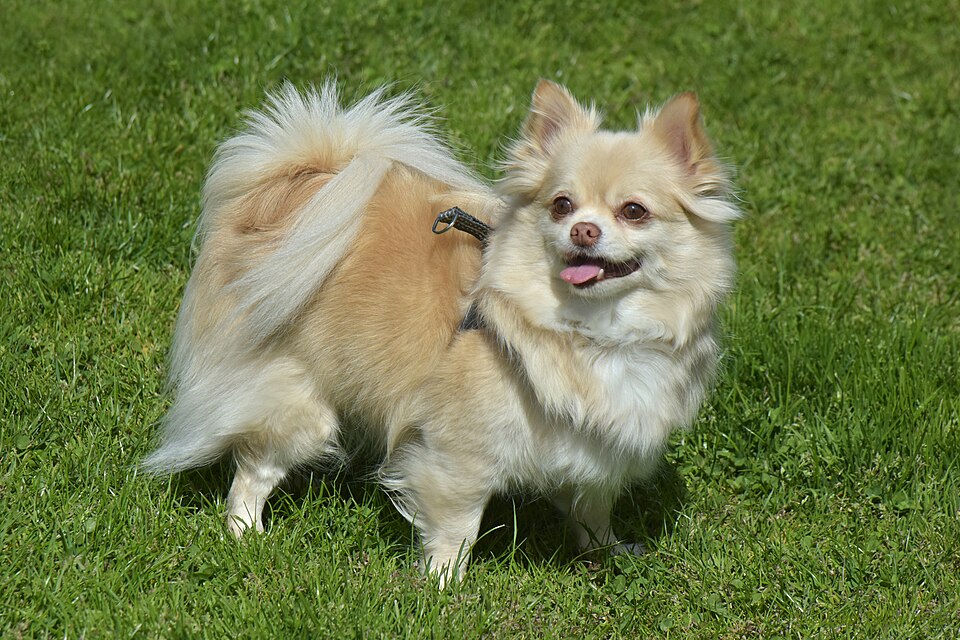
A small, compact and dainty dog. Its best-known feature is the rounded, dome-shaped "apple head"; the muzzle is moderately short and slightly pointed, the ears large and upright, the eyes big and round.
- Weight: Standards judge weight only, not height. The FCI accepts 1–3 kg (2.2–6.6 lb), ideally 1.5–2.5 kg; the Royal Kennel Club asks for no more than 2.7 kg. The AKC says it should not exceed 6 pounds and stands 5–8 inches tall.
- Real life: In the UK study, the median weight of adult Chihuahuas was 3.4 kg (7.5 lb), ranging from 0.8 to 9.8 kg. A Chihuahua that's a little bigger than the standard is perfectly fine.
- Coat: According to the FCI, there are two types: a short, glossy, soft coat that lies close to the body, and a fine, silky, slightly wavy long coat. The Royal Kennel Club registers them separately, and smooth-coated parents can produce long-coated puppies.
- Color: The FCI accepts every color except merle (a marbled, patchy pattern). The Royal Kennel Club has also refused to register merle puppies since 2007, because the merle gene raises the risk of hearing and sight problems in this breed.
Daily care
Coat care is easy: the Royal Kennel Club considers weekly grooming enough for both coat types. But don't assume it doesn't shed; both the smooth and the long coat do. Use your weekly brushing session to check the skin, ears and nails too.
- Teeth: This is the part of care that needs the most attention in this breed. Get your puppy used to tooth brushing early. While the adult teeth come in, have your vet check that the baby teeth fall out.
- Eyes: Large, prominent eyes can get irritated easily. If you see squinting, watering or cloudiness, take your dog to the vet right away.
- Cold: Dogs Trust notes that shorter-haired breeds and puppies may need extra help staying warm and should wear a coat when it gets chilly. A coat is a good idea for a smooth-coated Chihuahua on winter walks; see our article on dogs in cold weather.
- Anal glands: In the UK study, impacted anal sacs were among the five most common problems. If your dog scoots or licks that area a lot, tell your vet.
Training and exercise
The Royal Kennel Club recommends up to 30 minutes of exercise a day for the Chihuahua. Short walks, new smells and indoor games work both its body and its mind. Being carried in arms or a bag is no substitute for walking.
- Reward-based training: Short, rewarding, patient sessions work best. Punishment frightens such a small dog and damages its trust.
- Early socialization: Give your puppy positive experiences with calm dogs, different people, sounds and being picked up.
- Harness: Use a harness that holds the chest rather than a collar that pulls on the neck. Our loose-leash training guide teaches walking without pulling.
- Fewer jumps: Put a ramp or steps by the sofa and bed. Hold the dog securely with both hands, and don't let anyone hold it while standing up and let it slip.
 Diet and weight
A Chihuahua doesn't need a special food; a complete, balanced dog food suited to its age and size is enough. In the UK study, being overweight was the second most common problem after gum disease (5.9%). In a dog this size, even a few bites make a difference.
- Measure food with a kitchen scale and count treats as part of the daily amount.
- If you can feel the ribs under a thin layer of fat, the weight is about right.
- According to the Merck Veterinary Manual, toy breed puppies can have drops in blood sugar during their first six months, usually managed with frequent meals. Plan your puppy's meal schedule with your vet, and contact your vet right away if you see weakness, trembling or fainting.
- Some human foods are toxic to dogs; check our list of foods dogs should never eat.
 Health issues to know about
The Chihuahua's tiny body comes with some health concerns. The information below is for awareness only; ask your vet about diagnosis and treatment.
Teeth
In the UK Chihuahua study, gum disease was the most common problem (13.5%), and dental problems overall affected 19% of the dogs. Baby teeth that don't fall out after the adult teeth come in were also common at 5.7%; these trap food and bacteria and make gum disease more likely. In a large 2021 study, Chihuahuas had about twice the odds of gum disease compared with crossbred dogs. Regular brushing and yearly dental checkups are very important in this breed.
Slipping kneecaps
In patellar luxation, the kneecap slides out of place; it can cause lameness, pain and arthritis over time. In a 2016 English study, Chihuahuas had about 6 times the odds of this diagnosis compared with crossbred dogs. The FCI standard also lists an unstable knee joint as a severe fault. If you see your dog skipping a hind leg now and then or limping, see your vet.
Heart
In the UK study, heart disease was the most common cause of death in Chihuahuas. According to sources cited in the same study, the breed is predisposed to mitral valve disease, in which a heart valve wears out with age. Heart murmurs were recorded more often in males. Ask your vet to listen to the heart at the yearly checkup, and mention any coughing, tiring quickly or shortness of breath.
Soft spot and hydrocephalus
A fontanelle (soft spot) is a place between the skull bones where there's no bone; it's normal in puppies and usually closes as they grow. A 2025 study showed that a persistent fontanelle is common in adult Chihuahuas and is linked to lower body weight and a rounder, shorter skull. The FCI standard lists an open fontanelle as a disqualifying fault.
According to UFAW, the Chihuahua is predisposed to hydrocephalus, a buildup of excess fluid in and around the brain. Signs usually appear in the first weeks or months: a very domed head, slow learning or trouble with house training, pressing the head against walls, aimless walking, seizures, and eyes that look down and outward. UFAW points out that open fontanelles can also be seen in Chihuahuas without hydrocephalus, and highlights a study finding higher risk in puppies born to the smallest mothers. If your puppy has a soft spot, show it to your vet and protect its head from knocks.
Breathing, eyes and registration rules
According to sources cited in the UK study, the Chihuahua is also among the breeds predisposed to tracheal collapse, corneal ulcers and difficult births. The Royal Kennel Club recommends the eye examination scheme to breeders. In August 2026 it also recognized the Respiratory Function Grading test for this breed, which assesses breathing problems linked to a short skull (BOAS); the test will be formally added to the breed's health standard from January 2027. The Royal Kennel Club also keeps the breed in Breed Watch category 2, which flags breeds with particular points of concern that show judges are asked to watch for.
Fractures and accidents
According to UFAW, all toy breeds are prone to fractures of the lower foreleg bones, most commonly from falling out of the owner's arms or jumping down from a height. These fractures can heal poorly in toy breeds. In the UK study, accidents were the third most common cause of death in Chihuahuas (13.8%).
- Limping or not putting weight on a leg after a fall or a jump
- Seizures, head pressing, aimless walking or a sudden change in behavior
- A honking cough, trouble breathing or bluish gums
- Weakness, trembling or fainting in a puppy
- Holding an eye shut, cloudiness in the eye or heavy watering
How long does it live?
Sources give different figures for the Chihuahua's lifespan, because each one looks at different dogs and uses different measures.
- A 2024 UK study using data from about 585,000 dogs found a median lifespan of 11.8 years; the figure for crossbred dogs was 12.0 years.
- In 2022 life tables built from dogs that died between 2016 and 2020, the Chihuahua's life expectancy at birth was 7.91 years. In the same study, Chihuahuas were the breed that reached the latest age at which remaining life expectancy dropped below 1.5 years (15–16 years). In other words, many Chihuahuas are lost young, but many also reach old age.
- In the 2016 veterinary clinic study, the median age at death of Chihuahuas was 8.2 years; females (10.2 years) outlived males (6.9 years). The authors note that this population was very young, which may have affected the figure.
The AKC gives 14–16 years. Accidents, heart disease and dental problems are among the main causes of early loss; a safe home, a healthy weight, dental care and regular vet checkups are the most practical steps.
 Before you get one
- Consider a shelter: Purebred dogs end up in shelters and rescues too. Our article on adopting a shelter dog covers the first steps.
- If you buy from a breeder: See the mother with her puppies at home. Ask for the parents' eye examination results and have your vet check whether the puppy has an open soft spot. Steer clear of anyone breeding merle puppies.
- "Teacup," "mini" or "pocket" ads: The Royal Kennel Club doesn't recognize any teacup breed and names the Chihuahua among the breeds often used to produce such dogs. It notes that these dogs are often bred from the smallest, weakest puppies of litters, and that some sellers let puppies go before 8 weeks to make them look smaller; breathing, bone, joint, heart and stomach problems are more likely, and their lives can be significantly shorter. Being below the standard weight is a risk, not a bonus.
- Red flags: Steer clear of sellers who won't show you the mother, always have puppies available, can't provide paperwork or rush you to "buy now."
- Registration: Rules vary by country; many places require or recommend microchipping. In Türkiye, owned dogs must be microchipped and registered in the PETVET system.
- The first days: Our guide to bringing a puppy home walks you through the first night and first week.
Frequently asked questions
Is the soft spot on a Chihuahua's head dangerous?
A soft spot is normal in puppies and often closes. It's also common for it to stay open in adult Chihuahuas, and that doesn't always mean disease, but it can occur together with hydrocephalus. Show the soft spot to your vet, protect the head from knocks and keep an eye on any change in behavior.
Is a "teacup Chihuahua" a separate breed?
No. The Royal Kennel Club doesn't recognize any teacup breed; the word just describes a dog that's smaller than average. Health problems are more likely in extremely small dogs and their lives can be shorter, so choose based on the parents' health, not size.
Are smooth and long coat Chihuahuas different breeds?
According to the FCI, they are two coat varieties of the same breed. The Royal Kennel Club registers them separately but notes that smooth-coated parents can produce long-coated puppies. Coat type doesn't determine temperament or health.
Is a Chihuahua good for a family with kids?
It can do well with older, calm children. Young children carrying it or holding it increases the risk of falls; teach kids to pet the dog while sitting on the floor, and always supervise.
Sources
- The Royal Kennel Club · Chihuahua (Smooth Coat): ırk tanıtımı, sağlık taramaları ve kayıt kısıtlamaları
- The Royal Kennel Club · Chihuahua (Smooth Coat) ırk standardı
- FCI · Chihuahua ırk standardı No. 218
- AKC (American Kennel Club) · Chihuahua ırk tanıtımı
- O'Neill ve ark. · Demography and commonly recorded clinical conditions of Chihuahuas under primary veterinary care in the UK in 2016, BMC Veterinary Research (2020)
- McMillan ve ark. · Longevity of companion dog breeds: those at risk from early death, Scientific Reports (2024)
- Teng ve ark. · Life tables of annual life expectancy and mortality for companion dogs in the United Kingdom, Scientific Reports (2022)
- Science for Animal Welfare (UFAW) · Chihuahua: Hidrosefali
- Rautala ve ark. · Association of extreme brachycephaly with persistent fontanelles in adult Chihuahuas, Journal of Veterinary Internal Medicine (2025)
- O'Neill ve ark. · The epidemiology of patellar luxation in dogs attending primary-care veterinary practices in England, Canine Genetics and Epidemiology (2016)
- O'Neill ve ark. · Epidemiology of periodontal disease in dogs in the UK primary-care veterinary setting, Journal of Small Animal Practice (2021)
- Science for Animal Welfare (UFAW) · Oyuncak ırklarda ön bacak (radius ve ulna) kırıkları
- Merck Veterinary Manual · Congenital and inherited disorders of the nervous system in dogs
- The Royal Kennel Club · Buying a teacup dog
- Dogs Trust · How to keep your dog safe and warm in cold weather
- Resmî Gazete · Kedi, Köpek ve Gelinciklerin Kimliklendirilmesi ve Kayıt Altına Alınmasına Dair Yönetmelik (26 Şubat 2018)
By Tüylüm · Last checked: November 3, 2026. Compiled from the sources above and written in our own words. Spotted a mistake? Write to [email protected] and we'll fix it right away. Photo from Wikimedia Commons, used under the license shown below it.