 Tüylüm
Papillon
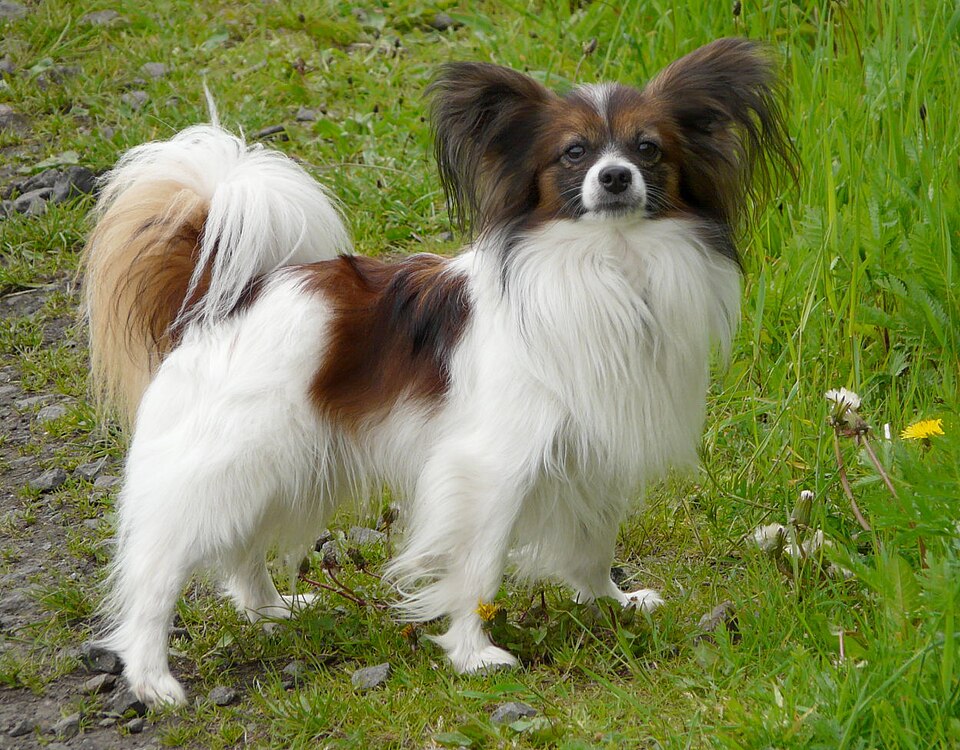
The elegant dwarf spaniel of Europe's royal courts, known for its large, fringed ears shaped like butterfly wings. Small but sturdy, smart and active; a star of obedience and agility. Its fine bones need protecting from falls; ask breeders about DNA tests for inherited eye and nerve disease.

 Lifespan≈ 14.5 yearsmedian, UK 2024; among the longest-lived
 Weight5–10 lb (2.3–4.5 kg)AKC; FCI: at least 1.5 kg
 Height8–11 in (20–28 cm)Royal Kennel Club; FCI: about 28 cm
 OriginFrance and Belgiumthe dwarf spaniel of European courts
 CoatLong, silkyno undercoat; brush a few times a week; sheds
 Exercise~30 minutes a dayRoyal Kennel Club; loves play and agility
 With kidsWith supervisionfine-boned; watch for falls from arms
 TrainingLearns easilya breed that excels in obedience and agility
"Papillon" is French for butterfly. The breed takes its name from the large, fringed ears that stand out on either side of its head like open wings. The variety with drop ears is called the Phalène, because with its folded "wings" it resembles a moth. The FCI recognizes both varieties together as a single breed, the Continental Toy Spaniel. On this page we've pulled together its temperament, care needs and health issues from breed registry standards, animal welfare resources and scientific studies.
- Temperament: According to the Royal Kennel Club standard, lively, intelligent, friendly, free of aggression and always alert.
- Activity and brains: A small dog, but according to the Royal Kennel Club very successful in obedience and agility. It needs games that work its mind and body.
- Coat: Long and silky with no undercoat; the Royal Kennel Club recommends grooming more than once a week. It sheds.
- Health: Generally a long-lived breed. Breeders are advised to DNA test for PRA (inherited blindness) and NAD, a nerve disease seen in puppies; its fine bones are vulnerable to falls.
- Lifespan: A 2024 UK study found a median lifespan of 14.5 years; it's among the breeds at lowest risk of early death.
What to know
 What is the Papillon like?
The Royal Kennel Club standard describes the Papillon as lively, intelligent and friendly, with no aggression and always alert. The club stresses that this elegant, fine-boned breed is highly intelligent and competes in obedience and agility with great success. The AKC also describes the Papillon as curious, quick, happy and friendly; despite its refined looks, it's a hardy "doggy dog."
So it would be a mistake to think of the Papillon as just a lap dog. It's a small dog that loves to run, play and learn new things, and enjoys doing things together with its people.
Every dog is an individual. Breed traits describe general tendencies; the parents' temperament, how a puppy was socialized and the training it gets shape its personality as much as its breed.
 Who is it a good fit for?
The Papillon is a good choice for people who want to do things like walks, games and training together with a small dog, and who spend a good amount of time at home.
| Situation | Good fit? |
|---|---|
| Apartment | Excellent; the Royal Kennel Club says even a home without a garden is enough |
| Family with kids | With supervision; it's small and fine-boned, and a fall from someone's arms is a serious accident |
| Other dogs and cats | Early, calm introductions matter; take care with rough play with big dogs |
| Long hours alone | May struggle; being alone needs to be taught gradually |
| First-time dog owners | Good; training is fun, as long as its need for activity and play is met |
According to UFAW, all toy breeds are prone to fractures of the lower foreleg bones, most commonly from falling out of the owner's arms or jumping down from a height. Teach children to pet the dog while sitting on the floor. Our article on kids and dogs at home has more tips.
Where does it come from?
The Royal Kennel Club introduces the Papillon as the dainty "butterfly dog" of France and Belgium, a breed known in Europe as a dwarf spaniel. According to the club, the name "épagneul nain continental" (continental dwarf spaniel) suggests that the earliest dogs had drop ears, so the first examples may have looked like today's drop-eared Phalène. The FCI also lists France and Belgium together as the breed's origin.
The Papillon and Phalène were hugely popular in Europe's royal courts; according to the Royal Kennel Club, Madame de Pompadour and Queen Marie Antoinette were among their owners. Today in the UK, both varieties are registered as one breed, and puppies can be recorded as Phalène on registration.
Appearance and colors
A dainty, well-balanced, fine-boned little dog with an alert bearing and an intelligent expression. Its most distinctive feature is its ears: according to the Royal Kennel Club standard, they are very large, mobile, round-tipped and heavily fringed; when erect, each forms an angle of about 45 degrees to the head, like the spread wings of a butterfly. In the Phalène, the ears hang down completely.
- Height: According to the Royal Kennel Club, 20–28 cm (8–11 in) at the shoulder; the FCI gives about 28 cm.
- Weight: The AKC gives 5–10 pounds (2.3–4.5 kg). The FCI defines two categories: under 2.5 kg, and 2.5–4.5 kg (up to 5 kg in females), with a minimum of 1.5 kg.
- Coat: According to the standards, there's no undercoat; the coat is long, fine, silky and wavy (not curly). There's an abundant frill on the chest and long fringes on the backs of the legs, the thighs and the tail; the hair on the face and the fronts of the legs is short.
- Color: Colored patches on a white base. The Royal Kennel Club accepts any color except liver, and tricolors too; a narrow white blaze down the middle of the head, representing the butterfly's body, is desirable but not essential.
Daily care
The Royal Kennel Club recommends grooming the Papillon more than once a week, which is less than the daily grooming many long-coated small breeds need. According to the club, the Papillon does shed.
- Brushing: A few times a week, working through the ear fringes, behind the ears, the chest frill and the long hair on the backs of the legs before knots form.
- Ears: Check the fringed ears weekly and see your vet about any redness, odor or discharge.
- Teeth: In a large 2021 UK study, the risk of gum disease rose as body weight fell. Get your puppy used to tooth brushing early.
- Nails: The nails of small indoor dogs don't wear down enough on their own; trim them regularly.
- Cold: A coat may be needed in cold, wet weather; our article on dogs in cold weather explains how to choose one.
Our dog grooming guide walks you through a brushing and bathing routine step by step.
Training and exercise
The Royal Kennel Club recommends up to 30 minutes of exercise a day for the Papillon. But with this breed, the kind of exercise matters too: thanks to its intelligence and agility, it gets a lot of joy out of learning and play.
- Reward-based training: Short, rewarding and varied sessions work best. Trick training, obedience and agility suit it well.
- Care in agility: High jumps and hard landings are risky for fine bones; keep jumps low, especially in puppyhood and while it's still growing.
- Sniffing games: Hunting for hidden treats tires out its mind; our article on sniffing games has ideas.
- Early socialization: Give your puppy positive experiences with different people, sounds and calm dogs.
- Harness: With a small dog, choose a harness that holds the chest and doesn't press on the neck. Our loose-leash training guide teaches walking without pulling.
- Fewer jumps: Put a ramp or steps by the sofa and bed, and hold the dog securely with both hands when you carry it.
 Diet and weight
A Papillon doesn't need a special food; a complete, balanced dog food suited to its age, size and activity is enough. In such a small dog, even a few extra treats change its weight quickly, so count training treats as part of the daily amount.
- Measure food, and weigh your dog once a month to see changes.
- If you can feel the ribs under a thin layer of fat and see a waist from above, the weight is about right.
- Don't leave a puppy without food for long; plan its meal schedule with your vet.
- Some human foods are toxic to dogs; check our list of foods dogs should never eat.
 Health issues to know about
In the 2024 UK study, the Papillon was among the breeds at lowest risk of early death. The Royal Kennel Club asks breeders to prioritize genetic diversity and to carry out the tests below. The information below is for awareness only; ask your vet about diagnosis and treatment.
Inherited blindness (PRA)
According to Cornell University, the Papillon is among the breeds at risk for progressive retinal atrophy (PRA). The disease is painless, usually starts with weaker night vision and slowly progresses to blindness; because dogs adapt to vision loss, signs can be noticed late. The Royal Kennel Club lists the Papillon-specific PRA DNA test (pap-PRA) among the minimum tests breeders should do. If you notice reluctance to enter a dark room, hesitation on stairs or bumping into door frames, tell your vet.
Neuroaxonal dystrophy (NAD)
An inherited nerve disease of puppies that progresses quickly. According to a 2020 study, signs begin at 1–3 months of age: poor coordination, head tremor, trouble getting up, an abnormal gait, difficulty eating and drinking, and blindness. Of 660 Papillons tested in North America and Europe in 2015–2017, 17.5% were carriers without signs; although the gene seems to have become less common in later years, the researchers still recommend testing dogs intended for breeding. The Royal Kennel Club also recommends this DNA test. Because the disease is recessive, an affected puppy can only be born if both parents carry the gene, which is why asking for the parents' results is so important.
Bleeding disorder and eyes
The Royal Kennel Club also recommends a DNA test for von Willebrand disease type 1, which affects blood clotting, and the eye examination scheme. If you notice prolonged bleeding or unexplained bruising, tell your vet.
Problems common to small breeds
According to UFAW, all toy breeds are prone to fractures of the lower foreleg bones, and these fractures can heal poorly in small breeds. In UK studies from 2016 and 2021, gum disease and slipping kneecaps were also more common in small, light dogs. Regular dental care and a home that's safe from falls matter with this breed too.
- Poor coordination, head tremor, or trouble getting up or eating in a puppy
- Limping or not putting weight on a leg after a fall or a jump
- Bleeding that won't stop, or unexplained bruising
- A change in vision, reluctance in the dark or bumping into things
How long does it live?
A 2024 UK study using data from about 585,000 dogs from 18 sources found a median lifespan of 14.5 years (confidence interval 14.1–14.9) for the Papillon; for crossbred dogs, the figure was 12.0 years. The Papillon was counted among the breeds at lowest risk of early death in this study. The AKC gives a life expectancy of 14–16 years for the breed.
A median lifespan means half of the dogs died before that age and half after it, so many Papillons live past 15. Dental care, a healthy weight, a safe home and regular vet checkups are the most practical ways to help a Papillon enjoy that long life in comfort.
 Before you get one
- Consider a shelter: Purebred dogs end up in shelters and rescues too. Our article on adopting a shelter dog covers the first steps.
- If you buy from a breeder: See the mother with her puppies at home. Ask for the parents' pap-PRA, NAD and von Willebrand DNA test results and eye examination results. As the Royal Kennel Club stresses, choose breeders who avoid mating close relatives and care about genetic diversity.
- Extreme smallness: The FCI standard sets a minimum weight of 1.5 kg. Be wary of ads selling especially tiny puppies as "mini," "teacup" or "pocket": the Royal Kennel Club doesn't recognize any teacup breed and notes that breathing, bone, joint, heart and stomach problems are more likely in dogs bred to be extra small.
- Red flags: Steer clear of sellers who won't show you the mother, always have puppies available, can't provide paperwork or rush you to "buy now."
- Registration: Rules vary by country; many places require or recommend microchipping. In Türkiye, owned dogs must be microchipped and registered in the PETVET system.
- The first days: Our guide to bringing a puppy home walks you through the first night and first week.
Frequently asked questions
Are the Papillon and the Phalène different breeds?
No. They are two varieties of the same breed: the Papillon's ears are erect and spread like butterfly wings, while the Phalène's hang down. The FCI recognizes them as a single breed called the Continental Toy Spaniel, and the Royal Kennel Club also registers them as one breed.
Do Papillons shed?
Yes; according to the Royal Kennel Club, they do. But with no undercoat, a few brushing sessions a week is usually enough.
Can a Papillon live in an apartment?
Yes; the Royal Kennel Club considers it suitable for apartments and says even a home without a garden is enough. But daily walks, play and mental work are a must.
Can a Papillon do agility?
According to the Royal Kennel Club, the Papillon is very successful in obedience and agility. Still, because of its fine bones, avoid high jumps, keep jump training limited in puppyhood and start with an instructor.
What tests should I ask the breeder about?
According to the Royal Kennel Club, at a minimum the Papillon-specific PRA DNA test, plus DNA tests for NAD and von Willebrand disease and an eye examination. Test results help prevent two carriers from being mated and affected puppies from being born.
Sources
- The Royal Kennel Club · Papillon: ırk tanıtımı ve sağlık taramaları
- The Royal Kennel Club · Papillon ırk standardı
- FCI · Continental Toy Spaniel (Papillon ve Phalène) ırk standardı No. 77
- AKC (American Kennel Club) · Papillon ırk tanıtımı
- McMillan ve ark. · Longevity of companion dog breeds: those at risk from early death, Scientific Reports (2024)
- Raj ve ark. · Initial survey of PLA2G6 missense variant causing neuroaxonal dystrophy in Papillon dogs in North America and Europe, Canine Medicine and Genetics (2020)
- Cornell Riney Canine Health Center · Progressive retinal atrophy
- Science for Animal Welfare (UFAW) · Oyuncak ırklarda ön bacak (radius ve ulna) kırıkları
- O'Neill ve ark. · Epidemiology of periodontal disease in dogs in the UK primary-care veterinary setting, Journal of Small Animal Practice (2021)
- O'Neill ve ark. · The epidemiology of patellar luxation in dogs attending primary-care veterinary practices in England, Canine Genetics and Epidemiology (2016)
- The Royal Kennel Club · Buying a teacup dog
- Resmî Gazete · Kedi, Köpek ve Gelinciklerin Kimliklendirilmesi ve Kayıt Altına Alınmasına Dair Yönetmelik (26 Şubat 2018)
By Tüylüm · Last checked: November 3, 2026. Compiled from the sources above and written in our own words. Spotted a mistake? Write to [email protected] and we'll fix it right away. Photo from Wikimedia Commons, used under the license shown below it.