 Tüylüm
Turkish Angora
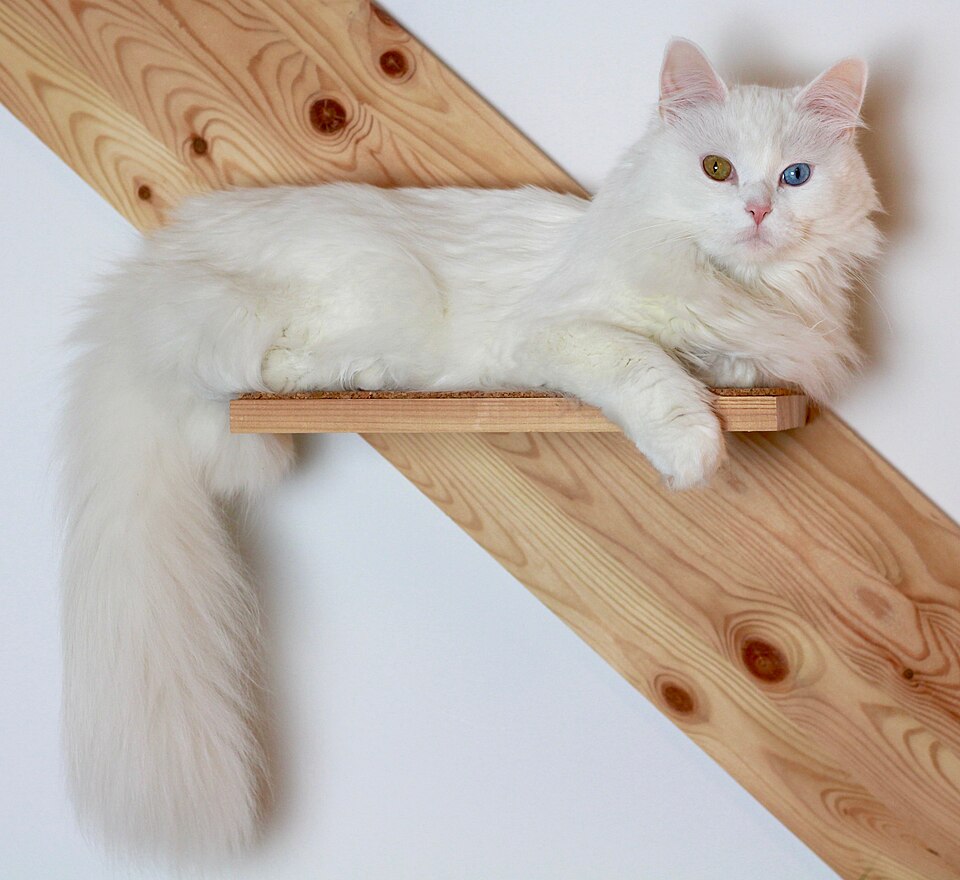
With its silky coat, long body and often odd eyes, it is Türkiye's best-known cat. Curious, active and people-oriented; white, blue-eyed cats carry a risk of congenital deafness, so ask about a hearing test when you get a kitten.

 LifespanNo breed datano reliable breed-specific study found
 Weight8–15 lb (3.6–6.8 kg)males larger; Turkish study ≈ 8.4 lb
 OriginTürkiye (Ankara)
 CoatSilky, singlenot prone to matting
 EnergyHighloves the highest shelf
 SheddingSeasonalcoat gets shorter in summer
 With kidsGoodplayful; sets limits on holding
 Blood typeType B is common46% in a Turkish study
The Turkish Angora is the cat Türkiye gave the world: silky coat, long, elegant body and a plumed tail. In Türkiye, the name usually brings to mind a pure white cat with one blue eye and one amber eye, while cat registries around the world recognize the breed in almost every color. On this page we've pulled together its temperament, care needs and the hearing issue that matters so much in white cats, drawing on breed registry standards, Turkish academic studies and veterinary sources.
- Temperament: Curious, active and very attached to its people; it wants to "help" with everything you do.
- Climber: It loves the highest point in the house, so a cat tree and shelves are a must.
- Easy care: Its single, silky coat mats less than most longhaired breeds.
- Hearing in white cats: White coat and blue eyes come with a risk of congenital deafness; ask for a hearing test (BAER) when you get a kitten.
- Blood type: In a Turkish study, nearly half of Turkish Angoras were type B; ask your vet to record it.
What to know
 What is the Turkish Angora like?
The Turkish Angora is a cat that can't sit still and wants to know about everything. According to the CFA's breed profile, it is one of the most interactive and affectionate breeds: whatever you're doing, it will be right there to "help," and it greets you at the door when you get home. That's why it is sometimes called doglike. It can handle being home alone during the day, but expects attention when you come back.
Its best-known habit is a love of heights. The CFA notes that Turkish Angoras are more likely to be found on top of a cabinet than on the floor, so if you lose track of yours, look up. It is playful enough to try chasing a laser dot straight up a wall.
It enjoys physical contact, but according to PetMD's vet-reviewed profile, most don't like being held for long; a short cuddle is enough before it goes back to its own business. If there are other pets at home, it may want to be the one in charge. Intelligence varies a lot from cat to cat: the CFA says some are remarkably bright, while others can be scatterbrained enough to forget where the food bowl is.
Every cat is an individual. Breed traits describe general tendencies; how a cat was raised, how much contact it had with people as a kitten and its health shape its personality as much as its breed.
 Who is it a good fit for?
The Turkish Angora suits households with time to play with and entertain their cat, and a willingness to give it access to high spots around the home. It may be too lively for someone looking for a calm, decorative cat.
| Situation | Good fit? |
|---|---|
| Apartment | Good, but a cat tree, shelves and play are essential |
| Family with kids | Good; the CFA says it does well with children, but teach kids to be gentle |
| Other cats and dogs | Usually gets along; introduce slowly, it may want to be the boss |
| Long hours alone | Copes during the day, but needs play and attention in the evening |
| First-time cat owners | Possible, if you're ready for its energy and the hearing issue |
If you have a white, deaf Turkish Angora, teach children not to startle it by approaching from behind. Tapping the floor lightly or flicking a light on and off lets a deaf cat know you're coming.
Where does it come from?
The Turkish Angora is an old, naturally occurring breed from the area around Ankara, the city that gave it its name. The CFA describes it as the oldest known longhaired breed and a likely ancestor of other longhaired breeds. Its written history goes back to the 1600s, when cats were taken from the Middle East to Europe, and it is said to have been especially popular in France. A large 2008 genetic study also found that the Turkish Angora and Turkish Van are two distinct breeds, and that most breeds descend from the local cats of the regions they're said to come from.
As cat shows took off in England, Turkish Angoras were bred so heavily with Persians that the breed nearly disappeared in Europe. According to the CFA, Türkiye responded by starting preservation breeding at zoos, especially the Ankara Zoo, where only white cats were considered "true" Angoras. Sources give different start dates for the program: the CFA mentions the 1930s, while PetMD mentions 1962. The first Turkish Angoras reached the United States in 1954.
There is academic work on the breed in Türkiye as well. A doctoral study looked at body measurements, coat, growth and reproduction in 103 cats at the Ankara Atatürk Forest Farm Zoo and 34 cats living in homes. According to a 2025 review, a center set up to protect, breed and promote the breed also operates in Ankara's Pursaklar district.
 Appearance and colors
A medium-sized cat with a long body and fine bones, but firm muscles. According to the CFA standard, the head is a medium-long wedge, and the large, upright ears sit high and close together. The legs are long, with the hind legs slightly longer than the front ones. The tail is long and full, like a plume.
- Weight: PetMD puts adults at about 8–15 pounds (roughly 3.6–6.8 kg). In the doctoral study of cats at the Ankara Zoo, males averaged about 8.4 lb (3.8 kg), and females a little less.
- Coat: Single-layered, fine and silky with a sheen; longer on the tail and around the neck. PetMD says it gets shorter in summer and longer and fuller in winter.
- Colors: White is the best known in Türkiye. According to the CFA, almost every color and pattern is accepted today except chocolate, lilac and the Siamese-style pointed pattern: black, blue, red, cream, smoke, tabby, tortoiseshell, bicolor and more.
- Eye color: Blue, green, green-gold, amber or odd-eyed. The CFA notes that odd eyes (one blue, the other green or amber) are common and especially prized.
Daily care
Even though it is a longhaired cat, it is considered easy to groom. According to the CFA, its single coat with no undercoat doesn't mat easily; combing two or three times a month is usually enough to manage shedding in younger cats, while older cats may need it more often. During shedding season, combing a few times a week cuts down the hair around your home and the hair your cat swallows.
- Climbing and vertical space: A cat tree, wall shelves and a high perch by the window aren't luxuries for this breed; they're needs. See our article on why cats love high places.
- Play: A few sessions a day with a wand toy, a ball or a food-hiding game. Our guide to playing with an indoor cat has ideas.
- Curious about water: The CFA says many are fascinated by dripping faucets and usually tolerate a bath well when one is needed. Still, bathe only when necessary.
- Sun: International Cat Care notes that white cats are more prone to sunburn and to skin cancer on the ear tips and nose. Don't leave a white cat in strong midday sun on a balcony for long, and show your vet any sore on the ear tip that won't heal.
- Ears, eyes and claws: Check weekly; ask your vet about any redness, odor or discharge.
 Diet
Turkish Angoras don't need a special food; a complete, balanced cat food suited to their age is enough. Weight problems are less common in such an active breed, but cats that live indoors, play less or have been spayed or neutered can gain weight.
- Measure food instead of eyeballing it; decide the daily amount with your vet based on your cat's ideal weight.
- Serving part of the dry food in a puzzle feeder, or hiding it around the house, supports both hunting instincts and activity.
- Count treats as part of the daily food.
- Always have fresh water available; a water fountain can work well for this water-curious breed.
 Health issues to know about
The CFA says the Turkish Angora isn't known for any specific inherited problems, and that the main concern is deafness in white cats. The information below is for awareness only; ask your vet about diagnosis and treatment.
White coat, blue eyes and congenital deafness
The dominant gene that produces a solid white coat in cats is called the "W gene." It affects how pigment cells develop in the skin and the inner ear, and because those inner-ear cells are needed for hearing, white cats carrying the W gene are more likely to be born deaf. According to a review by George Strain of Louisiana State University, the risk rises with the number of blue eyes: in older studies of mixed-breed white cats, 65–85% of cats with two blue eyes, about 40% with one blue eye and about 17–22% with no blue eyes were deaf in one or both ears. The same review lists the white Turkish Angora among breeds at risk. The Cornell Feline Health Center also notes that in most white cats with two blue eyes, inner-ear degeneration begins a few days after birth.
A 2019 UK study found congenital deafness in 30% of purebred white kittens, with higher rates in blue-eyed kittens. The same study points out that deafness in Turkish Angoras had been reported at about 11% from earlier records, but those figures weren't always based on hearing tests and may have missed cats deaf in one ear.
What does this mean in practice? In odd-eyed cats, deafness is often in the ear on the same side as the blue eye, and a cat deaf in one ear may seem perfectly normal day to day. The CFA advises breeding white cats to colored cats and notes that in some countries white kittens undergo a hearing test called BAER; the UK registry GCCF has required this test since 2016 for white cats to be used for breeding. Choosing a colored Turkish Angora removes the concern altogether.
A deaf cat can still live a long, happy life. Cornell recommends keeping deaf cats indoors or in a secure catio, since they can't hear dangers like traffic, and communicating with hand signals and vibration.
Blood type
Cats have A, B and AB blood types, and they are born with antibodies against the other type. In a 2003 study of 28 Turkish Angoras in Türkiye, 53.6% were type A and 46.4% type B, a high share of type B compared with many cat populations worldwide. The researchers recommend blood typing before transfusions and breeding: type A kittens born to a type B mother can have a serious reaction while nursing. It's a good idea to ask your vet about your cat's blood type and keep it on record.
- A cat that doesn't react to sounds at all, or suddenly reacts less
- A crusty sore on the ear tip or nose that won't heal
- Fast or open-mouth breathing
- Loss of appetite and hiding (cats hide pain)
How long does it live?
We couldn't find a reliable lifespan study specific to the Turkish Angora; the large UK VetCompass study didn't look at the breed separately. In that study, mixed-breed cats had a life expectancy at birth of 11.89 years, and some cats lived past 20.
Whatever the breed, the study's message is clear: spayed or neutered cats and cats at their ideal weight live longer. Regular vet checkups, weight tracking, a safe indoor life and sun protection for white cats are the most concrete ways to help your Turkish Angora live longer.
 Before you get one
- Consider a shelter: White, longhaired cats turn up in shelters too. You can't tell for sure from looks alone whether a cat is a Turkish Angora, but its need for love is the same. Follow adoption listings and rescue groups.
- If you buy from a breeder: Ask to meet the parents, and ask for hearing test (BAER) results for white kittens, the parents' blood types and vaccination records.
- Red flags: Steer clear of people selling street cats as "purebred Angoras," sellers who won't show you the mother, can't provide paperwork or rush you to "buy now."
- Registration: Rules vary by country; many places require or recommend microchipping. In Türkiye, owned cats must be microchipped and registered in the PETVET system.
- The first days: Prepare a quiet room with a litter box, water, a hiding place and a spot to climb right away. To get a kitten used to grooming early, see our cat grooming guide.
Frequently asked questions
Is every white Turkish Angora deaf?
No. Deafness is a risk linked to a white coat, but not every white cat is deaf, and the risk goes up with the number of blue eyes. Talk to your vet to find out whether your cat can hear; a definitive answer comes from a hearing test called BAER.
Are the Turkish Angora and the Turkish Van the same breed?
No. Both are native Turkish breeds, and both include white, odd-eyed cats, which is why they're often confused. Genetic studies show they are separate breeds. The Van is larger and more solidly built, while the Angora is finer and more elegant. See our Turkish Van page for details.
Do Turkish Angoras only come in white?
Preservation programs in Türkiye focused on white cats, but registries today accept almost every color except chocolate, lilac and pointed. Colored Turkish Angoras are the same breed.
Do they shed a lot?
Even though they're longhaired, their single coat doesn't mat much. They shed noticeably during shedding season; combing a few times a week then is usually enough.
Do they like being held?
They are very attached to their people and enjoy contact, but most don't like being held for long. Sitting beside you, following you around and playing are how they show affection; let your cat come to you without forcing it.
Sources
- CFA (Cat Fanciers' Association) · Turkish Angora ırk tanıtımı ve standardı
- Karadağ S. · Türkiye'nin Yerel Irklarından Ankara ve Van Kedilerinin Irk Özellikleri, Manas Journal of Agriculture Veterinary and Life Sciences (2025)
- Yılmaz O. ve ark. · Çanakkale İlinde Yetiştirilen Kısa Tüylü Türk Kedisi'nin Tanımlanması (Ankara kedisi doktora çalışmasının özeti dahil), Türk Tarım ve Doğa Bilimleri Dergisi (2014)
- Arıkan S. ve ark. · Blood type A and B frequencies in Turkish Van and Angora cats in Turkey, Journal of Veterinary Medicine A (2003)
- LSU School of Veterinary Medicine (G. M. Strain) · Cat Breeds With Congenital Deafness
- Cornell Feline Health Center · Deafness
- Mari L. ve ark. · Prevalence of congenital sensorineural deafness in a population of client-owned purebred kittens in the United Kingdom, Journal of Veterinary Internal Medicine (2019)
- International Cat Care · Should I use sunscreen on my cat?
- PetMD (veteriner onaylı) · Turkish Angora
- Lipinski M. J. ve ark. · The ascent of cat breeds: genetic evaluations of breeds and worldwide random-bred populations, Genomics (2008)
- Teng ve ark. · Life tables of annual life expectancy and risk factors for mortality in cats in the UK, Journal of Feline Medicine and Surgery (2024)
- Resmî Gazete · Kedi, Köpek ve Gelinciklerin Kimliklendirilmesi ve Kayıt Altına Alınmasına Dair Yönetmelik (26 Şubat 2018)
By Tüylüm · Last checked: November 3, 2026. Compiled from the sources above and written in our own words. Spotted a mistake? Write to [email protected] and we'll fix it right away. Photo from Wikimedia Commons, used under the license shown below it.