 Tüylüm
Turkish Van
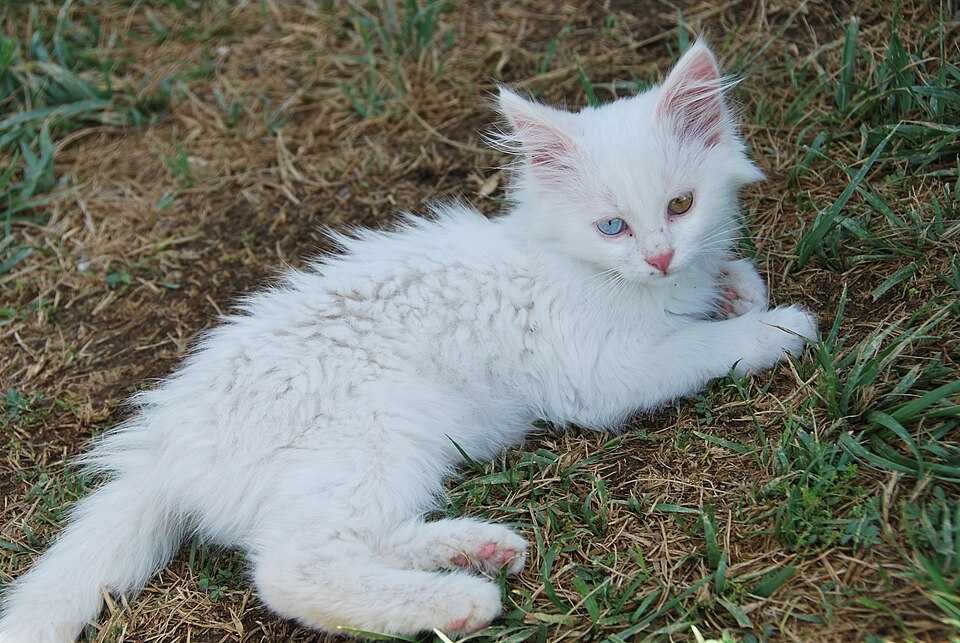
A large, strong, playful cat from the Lake Van region. In Türkiye the name means a pure white cat, often with odd eyes; the Western "Turkish Van" is known for color on the head and tail. Watch for deafness in white cats and know the blood type.

 Lifespan12–14 yearsGCCF's range; no breed-specific study
 Weightup to 20 lb (9 kg)big Western males; Van avg ≈ 7.5 lb
 OriginTürkiye (Van)
 CoatSemi-long, silkyno undercoat; shorter in summer
 EnergyHighneeds play and room to move
 Maturity3–5 yearsslow to mature
 With kidsOlder kidsdislikes being carried or tail-pulled
 Blood typeOften type B60% in a Turkish study
The Van cat comes from the shores of Lake Van in eastern Türkiye: large, strong, playful and deeply attached to its people. In Türkiye, the name describes a pure white, silky-coated cat that often has one blue eye and one amber eye. The "Turkish Van" recognized by cat registries around the world, on the other hand, is a white-bodied cat with color on its head and tail. On this page we explain the difference between the two, along with temperament, care and health, drawing on registry standards, studies from Van Yuzuncu Yil University and veterinary sources.
- Two definitions: In Türkiye, "Van cat" means a pure white cat; the Western "Turkish Van" is a "Van-patterned" cat with a colored head and tail.
- Temperament: Playful, smart and devoted; it loves being close to you but doesn't like being carried.
- Water: Famous for playing in water, though this rests more on observation than measurement and isn't true of every cat.
- Hearing: In a study of 300 cats in Van, 14.33% were deaf; the risk was highest in cats with two blue eyes.
- Blood type: In a Turkish study, 60% of Van cats were type B.
What to know
 What is the Turkish Van like?
The Turkish Van is an active, intelligent cat that likes solving problems. According to the CFA's breed profile, it is a loyal companion that loves a game of fetch and is clever enough to work out how to open the cupboard where the cat food lives. It especially likes toys made of natural materials like feathers or fur, but if none are around, it will invent its own from a crumpled piece of paper.
The breed is best known for wanting closeness but not liking to be carried. The CFA says Vans don't enjoy being picked up and carried, but still want to be physically close to their owners, curling up next to you on the couch when playtime is over or even climbing into your lap on their own. The standard also notes that Vans feel more secure with all four feet on a solid surface.
Its voice isn't loud, but it is chatty; you'll hear it "talking" whenever it's nearby. According to Türkiye's official culture portal, people in the Van region treat the Van cat not just as a mouser but as a member of the family.
Every cat is an individual. Breed traits describe general tendencies; how a cat was raised, how much contact it had with people as a kitten and its health shape its personality as much as its breed.
 Who is it a good fit for?
The Turkish Van suits households that have time to play, can give their cat room to move, and don't expect a lap cat around the clock.
| Situation | Good fit? |
|---|---|
| Apartment | Possible, with plenty of climbing space and daily play |
| Family with kids | Better with older children; it dislikes being carried or having its tail pulled |
| Other cats and dogs | Gets along well with dogs when properly introduced |
| Long hours alone | Hard; it gets bored if it can't burn off energy |
| First-time cat owners | Possible, if you're ready for its energy and the deafness issue |
The CFA says the breed does best with older children who understand that it doesn't like to be carried around and can be trusted not to pull its tail. In homes with young children, make sure the cat has a high spot to retreat to.
Where does it come from?
The Van cat is an old, naturally occurring cat from the Lake Van region of eastern Anatolia. According to a legend retold by the GCCF, Van cats were aboard Noah's Ark and swam ashore at Mount Ararat, not far from Lake Van. Türkiye's culture portal says Van cats were once said to spend summers hunting in the mountains and winters at home, something rarely seen today. A large 2008 genetic study showed that the Turkish Van and the Turkish Angora are two distinct breeds.
The breed's modern history in the West began in the mid-1950s, when two British travelers touring Türkiye took a pair of Van cats back to England. The GCCF granted it championship status in 1969; in the United States, the CFA recognized the breed in 1988 and advanced it to championship status in 1994.
In Türkiye, the best-known place working to protect the breed is the Van Cat Research and Application Center, popularly called the "Van Cat House," on Van Yuzuncu Yil University's Zeve Campus. Featured on the Ministry of Culture and Tourism's culture portal, the center has been the base for many studies on hearing, genetics and coloring. A 2023 study notes that Van cat numbers have been declining and that the breed is under protection, and a 2026 study looks at the genetic makeup of the protected population at the center.
Van cat or Turkish Van?
The two names are often used as if they meant the same thing, but the sources describe different cats:
- The Van cat in Türkiye: In Van Yuzuncu Yil University's studies, the cats are white and silky-coated, and fall into three eye-color groups: two blue eyes, two amber eyes, or one of each. Of 300 cats at the center, 119 were longhaired and 181 shorthaired. Some have small colored spots on the head; according to an LSU review, these head spots in cats carrying the white gene can fade with age. A review of Turkish measurements reports average weights of about 7.5 lb (3.4 kg) for males and 6.9 lb (3.1 kg) for females.
- The Western Turkish Van: The breed recognized by the CFA and GCCF is defined by the "Van pattern": a white body with color on the head and tail. Under the CFA standard, no more than 15% of the body may be colored. These cats are large and muscular; the CFA says mature males can reach 20 pounds (about 9 kg).
- Turkish Vankedisi: The GCCF recognizes all-white cats separately as the "Turkish Vankedisi," noting that their temperament is the same as their Van-patterned cousins.
So a pure white cat doesn't fit the Western Turkish Van standard, and a Turkish Van with a colored head and tail doesn't look like the Van cat most people in Türkiye picture. Both come from cats of the same region, but they've been selected in different directions.
 Appearance and colors
According to the CFA standard, the Turkish Van is a solidly built, broad-chested cat with a semi-long coat. The head is a broad wedge with prominent cheekbones, and the ears are fairly large and set well apart. The eyes are large and expressive.
- Eye color: Amber, blue or odd-eyed. Türkiye's culture portal and the university's studies group Van cats into these three categories.
- Coat: No undercoat, with a texture often compared to cashmere. According to the GCCF, it's shorter in summer and fuller in winter, and the ruff on the neck and chest becomes more noticeable with maturity.
- Pattern: In the Western standard, a white body with a colored head and tail. According to a Turkish review, the color on the head and tail can be red, cream, black, blue, or tabby and tortoiseshell versions of these.
- Weight: According to the GCCF, mature males weigh about 10–20 lb (4.5–9 kg) and females 7–12 lb (3.2–5.4 kg). Measurements in Türkiye are lighter on average.
- Maturity: It develops slowly; the CFA says it reaches full maturity at 3 to 5 years and keeps growing until age five.
Daily care
The Turkish Van is one of the easiest longhaired breeds to groom. With no undercoat, it doesn't mat easily. The CFA says an occasional run-through with a steel comb, or weekly combing for the summer coat, is enough, while the heavier winter coat may need a bit more attention. Vans are very clean cats, so baths usually aren't needed.
- Exercise: The CFA stresses that as a large, active breed it needs plenty of space and regular play, or it can easily become obese. Several hunting games a day, a cat tree and a window perch are musts. Our guide to playing with an indoor cat has ideas.
- Safe water play: Welcome its curiosity about running faucets and water bowls safely. Don't leave full bathtubs, buckets or pools uncovered; our cat-safe home checklist covers this.
- Sun: White cats are more prone to sunburn and skin problems on the ear tips, so don't leave them on a sunny balcony for long at midday.
- Ears, eyes and claws: Check weekly; ask your vet about any redness, odor or discharge.
Do they really swim?
The Van cat's love of water, and even swimming, is a big part of its reputation; in the West it's nicknamed the "swimming cat." The CFA says some of the breed's founding breeders reported that even kittens would play and swim in pools or lakes on their own. The GCCF notes that the breed generally enjoys water, drinking from taps and playing in water bowls and sinks. Turkish reviews also describe interest in water as a known trait of the breed, adding that the coat dries quickly after getting wet.
That said, we couldn't find any systematic scientific measurement of this; the accounts rest mostly on what breeders and owners have observed. Not every Van cat likes water. Never force your cat into water or try to make it swim; if it wants to play with water, let it do so in a shallow container, on its own terms and under supervision.
 Diet and weight
Turkish Vans don't need a special food; a complete, balanced cat food suited to their age is enough. The real issue is balancing food and exercise: a large, energetic cat that can't move enough indoors can put on weight.
- Measure food instead of eyeballing it; decide the daily amount with your vet based on your cat's ideal weight.
- Serving part of the dry food in a puzzle feeder keeps it busy and moving.
- Count treats as part of the daily food.
- You should be able to feel the ribs under a thin layer of fat.
- Always have fresh water available; a water fountain may appeal to this breed.
 Health issues to know about
The CFA and GCCF describe the Turkish Van as a natural, robust breed and don't list any known breed-specific inherited diseases. Hearing in white cats and blood type are the two things to know about. The information below is for awareness only; ask your vet about diagnosis and treatment.
White coat and deafness
The dominant "W gene" that produces a solid white coat in cats also affects how pigment cells develop in the inner ear, which is why congenital deafness is more common in white cats and why the risk rises with the number of blue eyes. A 2022 genetic study of 48 Van cats at Van Yuzuncu Yil University found that most of them carry this gene.
A study of 300 cats at the Van center, published in 2023, was the first to measure deafness in Van cats with hearing tests:
| Eye color | Deafness rate |
|---|---|
| Two blue eyes | 25% |
| One blue, one amber | 14% |
| Two amber eyes | 6% |
| All 300 cats | 14.33% |
The same study found no link between deafness and sex or coat length; none of the 30 cats with spots on their heads were deaf, and deafness in only one ear was much less common than in other white breeds. The researchers expect the rate to fall over time as cats found to be deaf are kept out of breeding. In a 2019 UK study, 7 of 15 white Turkish Vankedisi kittens tested were deaf; since 2016 the GCCF has required a BAER hearing test before white cats can be used for breeding.
A deaf cat can still have a happy life, but since it can't hear traffic, it should live indoors or in a secure catio. Don't startle it by approaching from behind; let it know you're coming by tapping the floor lightly or using a light.
Blood type B
In a 2003 study of 85 Van cats in Türkiye, 40% were type A and 60% type B; no type AB cats were found, and blood type wasn't linked to eye color. That's a very high share of type B compared with most cat populations in the world. The researchers recommend blood typing before transfusions and breeding, since type A kittens born to a type B mother can have a serious reaction while nursing. Ask your vet about your cat's blood type and keep it on record.
- A cat that doesn't react to sounds at all, or suddenly reacts less
- Fast or open-mouth breathing
- A crusty sore on the ear tip that won't heal
- Loss of appetite and hiding (cats hide pain)
How long does it live?
We couldn't find a lifespan study specific to the Turkish Van. The GCCF says Turkish Vans live about 12–14 years; that's a registry estimate, not a scientific measurement. For comparison, in the large UK VetCompass study, mixed-breed cats had a life expectancy at birth of 11.89 years.
For a large, active cat, keeping a healthy weight, regular vet checkups and a safe indoor life are the most concrete ways to help it live longer.
 Before you get one
- Consider a shelter: White, odd-eyed cats turn up in shelters too. You can't tell from looks whether a cat is truly a Van cat, but its need for love is the same.
- The Van Cat House: Ask the center directly whether it rehomes cats and on what terms.
- If you buy from a breeder: Ask to meet the parents, and ask for hearing test (BAER) results for white kittens, the parents' blood types and vaccination records.
- Red flags: Steer clear of people selling white street cats as "purebred Van cats," and of sellers who won't show you the mother or can't provide paperwork.
- Registration: Rules vary by country; many places require or recommend microchipping. In Türkiye, owned cats must be microchipped and registered in the PETVET system.
- Grooming: Get your kitten used to combing early; our cat grooming guide walks you through it.
Frequently asked questions
Does every Van cat have odd eyes?
No. Van cats come in three eye-color groups: two blue eyes, two amber eyes, or one blue and one amber. Odd eyes are the best known, but not the only look.
Do Van cats really swim?
Many stories describe them playing in water and some swimming, but this rests more on observation than on scientific measurement, and not every Van cat does it. Never force your cat into water.
What's the difference between a Turkish Van and a Turkish Angora?
Both are native Turkish breeds, and genetic studies show they are separate breeds. The Van is larger, broader-headed and more solidly built; the Angora is finer, longer and more elegant. See our Turkish Angora page for details.
How can I tell if my white Van cat is deaf?
If it doesn't seem to respond to sounds, show it to your vet. Cats deaf in one ear may not seem any different; a hearing test called BAER gives a definite answer.
Will a Turkish Van sit in my lap?
Most don't like being carried, but they want to be close to you: sitting beside you, following you around and sometimes climbing into your lap on their own. Letting your cat come to you without forcing it works best.
Sources
- CFA (Cat Fanciers' Association) · Turkish Van ırk tanıtımı ve standardı
- GCCF (Governing Council of the Cat Fancy) · Turkish Van & Turkish Vankedisi
- Almaç Çelik F., Kaya A. · Investigations on the incidence of deafness in Van cats and its distribution by eye color, Ankara Üniversitesi Veteriner Fakültesi Dergisi (2023)
- Arslan M. ve ark. · Van Kedilerinde KIT Geninin W Lokus Allelleri ve Bazı Fenotiplerle İlişkileri, Van Sağlık Bilimleri Dergisi (2022)
- Koyun H. ve ark. · Detection of Microsatellite Polymorphisms in Van Cats on Some Phenotype Characteristics, Van Veterinary Journal (2026)
- Karadağ S. · Türkiye'nin Yerel Irklarından Ankara ve Van Kedilerinin Irk Özellikleri, Manas Journal of Agriculture Veterinary and Life Sciences (2025)
- T.C. Kültür ve Turizm Bakanlığı, Kültür Portalı · Van Kedisi Evi
- Arıkan S. ve ark. · Blood type A and B frequencies in Turkish Van and Angora cats in Turkey, Journal of Veterinary Medicine A (2003)
- Mari L. ve ark. · Prevalence of congenital sensorineural deafness in a population of client-owned purebred kittens in the United Kingdom, Journal of Veterinary Internal Medicine (2019)
- LSU School of Veterinary Medicine (G. M. Strain) · Cat Breeds With Congenital Deafness
- Lipinski M. J. ve ark. · The ascent of cat breeds: genetic evaluations of breeds and worldwide random-bred populations, Genomics (2008)
- Resmî Gazete · Kedi, Köpek ve Gelinciklerin Kimliklendirilmesi ve Kayıt Altına Alınmasına Dair Yönetmelik (26 Şubat 2018)
By Tüylüm · Last checked: November 3, 2026. Compiled from the sources above and written in our own words. Spotted a mistake? Write to [email protected] and we'll fix it right away. Photo from Wikimedia Commons, used under the license shown below it.