 Tüylüm
Macaw
The largest parrots in the world: nearly a meter long, with a very loud voice, a powerful beak and a lifespan of decades. They need lots of time, a huge living space and a long-term plan. Not a fit for first-time bird owners; feather plucking and loneliness come up in this group too.

 Lifespan≈ 30–60 yearsMerck; may outlive its owner
 Length32–36 in (81–91 cm)blue-and-yellow (A. ararauna), with tail
 OriginCentral, South Americarainforests and swampy edges
 VoiceVery loudscreams can bother neighbors
 Social lifePair / flockvery social, wants heavy attention
 CageVery largebeyond most homes
 DietPellets + veggiesprone to obesity
 LegalCITES App. II / Idepends on species; ask for papers
Macaws are the large, long-tailed, vividly colored members of the genus Ara. The species most often met in homes is the blue-and-yellow macaw (Ara ararauna). Their color and size catch the eye, but they bring matching size in care and responsibility. This is a genus page; species differ, and most of the information is for the blue-and-yellow macaw.
- The largest parrots in the world: Merck calls macaws the largest parrots; ADW gives the blue-and-yellow macaw a length of 81 to 91 cm and a weight of 0.9 to 1.8 kg (2 to 4 lb).
- Very long life: Merck gives 30 to 60 years; ADW says typically 30 to 35 years and up to 50 for the blue-and-yellow macaw. It may outlive you.
- Very loud: Merck says the screams are very loud and may bother neighbors.
- Lots of room, time and attention: Merck notes macaws need lots of exercise, time and attention.
- Feather plucking and loneliness: Both social isolation and feather damage come up often in parrot welfare research.
What to know
 What is the Macaw like?
Macaws are smart, social and strong. ADW describes the blue-and-yellow macaw as mostly found in pairs, bonded for life, flying so close together that their wings almost touch, joining small, noisy flocks in the early morning and seeking shade by midday. Its noisy flock calls and loud screech when alarmed are its natural communication; at home this shows up as screaming.
Merck says macaws can talk but usually learn fewer words than Amazons or African grays. The 2021 study by Mellor and colleagues reports that species with relatively large brains show more oral and whole-body repetitive behaviors, and the paper discusses the blue-and-yellow macaw as an example prone to this kind of intelligence-linked repetitive behavior. So boredom is a serious risk for this bird.
Every bird is an individual and species differ. This page is no substitute for a bird vet or a behavior specialist.
Who is it a good fit for?
A macaw may suit experienced people who can provide a very large living space, spend long hours with the bird every day, are ready for a loud voice, have access to a bird vet and can plan for what happens after them. Merck says macaws need lots of exercise, time and attention and that their screams can bother neighbors.
| Situation | A good fit? |
|---|---|
| Apartment | Close to unworkable; the screaming and the space |
| Family with kids | Careful; a very strong beak, always supervised |
| Home with a cat or dog | Careful; never leave them alone together |
| Long hours away from home | Not a good fit; social isolation is a main welfare issue |
| First-time bird owners | Not a good fit; gain experience first with a smaller, less demanding species |
Where does it come from?
ADW describes the blue-and-yellow macaw as living in South America, from Venezuela to Brazil, Bolivia, Colombia and Paraguay, mainly in swampy and riverside rainforest, nesting high in trees. In the wild it eats seeds, nuts and fruit and cracks hard shells with its strong beak. It also eats clay from riverbanks, which is thought to help it digest toxins in unripe seeds.
It is Least Concern on the IUCN list with a population of more than 10,000 adults, but it is declining. ADW says wild capture often kills the parents to get the chicks and destroys important nesting trees, and that illegal trade does serious damage. That is why choosing a documented, captive-bred bird matters for both the bird and nature.
Appearance and colors
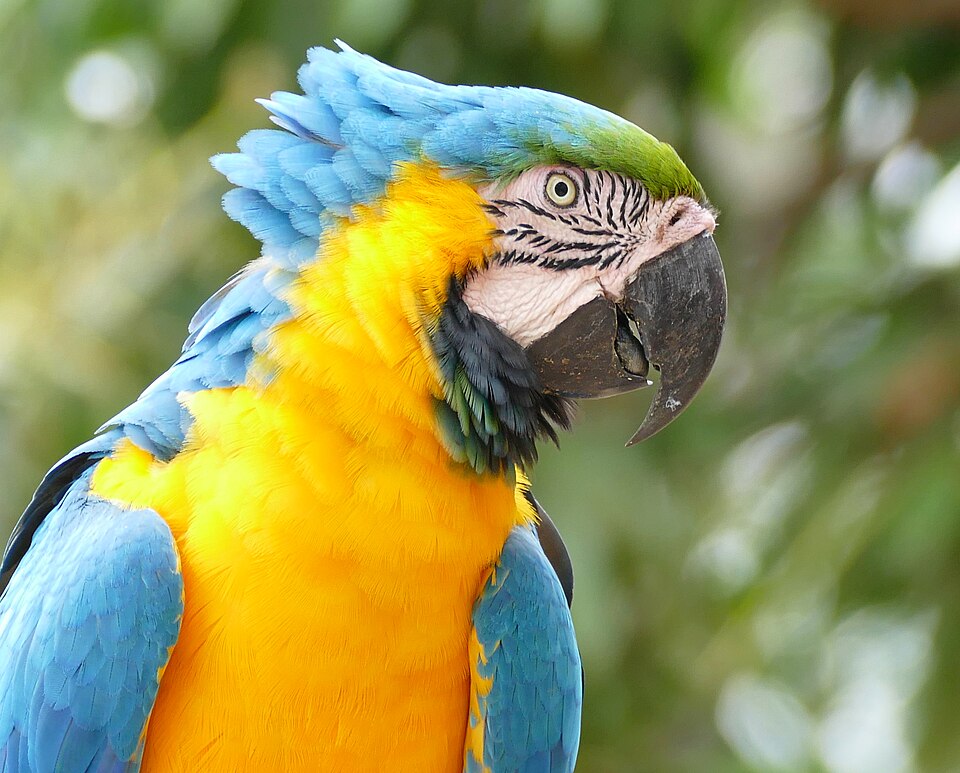
ADW gives the blue-and-yellow macaw a length of about 81 to 91 cm (32 to 36 in), a weight of 900 to 1,814 g (2 to 4 lb) and a wingspan of 104 to 114 cm (41 to 45 in). It has a blue back and yellow belly, and a bare whitish face with black lines. Other macaws differ in color and size: the scarlet macaw (Ara macao), for example, is a separate species.
 Daily care
- Time and attention: The review by Piseddu and colleagues says feather damage is more common in parrots left alone more than six hours a day. Chalmers and colleagues rank social isolation throughout life as the second most important welfare issue.
- Enrichment: Chalmers and colleagues list limited ability to express behaviors (enrichment and flight) as the fourth issue. Offer chewable, sturdy safe toys and foraging games. See bird toys.
- Feather plucking: Merck separates causes into medical (skin inflammation, malnutrition, toxins, cancer, organ disease), behavioral (stress, boredom, sexual frustration) and environmental (seed diet, lack of sunlight, disrupted sleep); medical causes need to be ruled out first.
- Sleep: Uninterrupted night sleep and daily sunlight (Merck). See birds and sleep and light.
- Bonding: Bonding with your bird.
 Cage and living space
RSPCA Australia's rules aren't genus-specific: width at least three times the combined wingspan of a pair; at least two wing beats between perches; height at least three times the head-to-tail length of the largest bird. For the blue-and-yellow macaw ADW gives a wingspan of about 104 to 114 cm; apply that rule to a pair and the width is over six meters (about 20 feet). We worked that out ourselves; RSPCA doesn't give the figure for macaws. Most homes can't provide that; the realistic path is then to offer the bird regular safe flight and a very large living space, or to accept that macaws aren't a fit for you.
- Wire: For parrots over 500 g, RSPCA lists strong wire with 25 to 75 mm by 25 to 50 mm mesh and 1.24 to 2.0 mm thickness; chicken wire is easily chewed and can lead to heavy metal poisoning.
- Perches: Chewable natural branches; metal pipe and sandpaper-covered perches aren't recommended.
- Metal: Merck says zinc and lead can come from cages and toys.
- Location: Cage placement guide.
Diet
ADW says wild macaws eat seeds, nuts and fruit. Merck says a diet heavy in seeds and nuts is high in fat and low in vitamins and minerals and is linked to liver, kidney, respiratory and bone problems. The same page lists macaws among the species most prone to obesity and recommends measured pellet portions, a large cage and chances to fly. It also says excess vitamin D can be a problem in sensitive species, macaws among them; ask your veterinarian before giving any supplement. See foods that are harmful to birds.
 Health issues to know about
Merck says birds hide illness. What follows is for information; talk to a veterinarian who sees birds for diagnosis and treatment.
- Signs of illness: Fluffed feathers, sleeping a lot, less interest and talking, sitting low on the perch, loss of balance, breathing trouble, changes in droppings and eating or drinking (Merck).
- Feather damage and repetitive behaviors: Mellor and colleagues reported feather-damaging behavior in about one in five surveyed birds. Work with a veterinarian and a behavior specialist.
- Obesity: Merck counts macaws among species prone to obesity.
- Chlamydia (psittacosis): The bacterium Chlamydia psittaci can pass to people; Merck says dried droppings and feather dust can carry it for months and recommends gloves and handwashing when dealing with a sick bird. If you get flu-like symptoms, tell your doctor you keep birds.
- Fume and gas poisoning: Overheated nonstick coatings, self-cleaning ovens and some sprays can kill birds very quickly (Merck). See hidden dangers for birds at home.
- Heavy metals: Zinc and lead can come from cages and toys (Merck).
- Open-mouth, wheezing or tail-bobbing breathing
- Fluffed up and slumped on the cage floor
- Loss of appetite, vomiting or a clear change in droppings
- Loss of balance, weakness, tremors
- Exposure to smoke, spray or nonstick fumes (move to fresh air first, then go to the vet right away)
How long does it live?
Merck gives 30 to 60 years for macaws. For the blue-and-yellow macaw ADW says a maximum of about 50 years both in the wild and in captivity, with 30 to 35 typical. The practical takeaway: your bird is likely to outlive you. Chalmers and colleagues list the care of elderly birds and the lack of a "life plan" (end of life, a new home) among the priority issues. Plan ahead with family, in a will or with a rescue organization.
 Before you get one
- Shelters and rescues: Parrot rescue groups exist, and birds needing new homes are often available.
- CITES and papers: ADW lists the blue-and-yellow macaw in CITES Appendix II, but some species in the genus are in Appendix I. In the European Union's wildlife trade annexes (Appendix I species marked "(I)"), Ara ambiguus, A. glaucogularis, A. macao, A. militaris and A. rubrogenys appear. It varies by species: when buying, ask for the full scientific name of the species and its papers. In Türkiye a CITES permit is required for the export, import and re-export of Appendix I and II species; people and businesses that trade in them must register and keep stock records, and specimens obtained against the rules can be seized (Mevzuat Bilgi Sistemi). For details on keeping at home, ask your local Nature Conservation and National Parks provincial directorate.
- Never wild-caught: ADW says illegal capture kills parents and destroys nesting trees. Ask for the documented breeding source.
- Judge the seller: RSPCA Australia recommends sellers who are honest, knowledgeable, tell you the bird's history and offer a refund or replacement for health problems; Chalmers and colleagues treat selling unweaned chicks to inexperienced owners as a welfare issue.
- Access to avian vets: RSPCA says specialist avian vets may not be available everywhere, so check how far the nearest one is and what they charge.
Frequently asked questions
Can a macaw be my first bird?
The sources don't support that: Merck says they need lots of time, space and exercise and that their screams may bother neighbors; the expert study ranks owners' lack of knowledge as the number one problem.
Does it talk?
Merck says they can talk but usually learn fewer words than Amazons and African grays.
Can it live in an apartment?
Merck says the screams may bother neighbors; it isn't suitable for most apartments.
How long does it live?
Merck gives 30 to 60 years; ADW gives typically 30 to 35 years for the blue-and-yellow macaw.
Why shouldn't it be left alone?
Parrot welfare studies count social isolation among the most important issues and link being alone more than six hours a day to feather damage.
Sources
- Animal Diversity Web (University of Michigan) · Ara ararauna
- Merck Veterinary Manual · Choosing a Pet Bird
- Merck Veterinary Manual · Skin and Feather Disorders of Pet Birds
- Merck Veterinary Manual · Nutritional Disorders of Pet Birds
- Merck Veterinary Manual · Disorders Affecting Multiple Body Systems of Pet Birds (psittacosis, fume and gas poisoning)
- Chalmers, Cooper and Ventura · What are the priority welfare issues facing parrots in captivity?, Animal Welfare (2024)
- Mellor et al. · Nature calls: intelligence and natural foraging style predict poor welfare in captive parrots, Proc R Soc B (2021)
- Piseddu, van Zeeland and Rault · What we (don't) know about parrot welfare, Animal Welfare (2024)
- RSPCA Australia Knowledgebase · What kind of enclosure does my bird need?
- RSPCA Australia Knowledgebase · Are birds the right companion animals for me?
- European Union · Commission Regulation (EU) 2023/966 (wildlife trade annexes; CITES Appendix I species marked "(I)")
- Mevzuat Bilgi Sistemi (Türkiye) · Regulation on implementing the CITES convention
By Tüylüm · Last checked: November 10, 2026. Compiled from the sources above and written in our own words. Spotted a mistake? Write to [email protected] and we'll fix it right away. Photo from Wikimedia Commons, used under the license shown below it.