 Tüylüm
Aksaray Malaklı
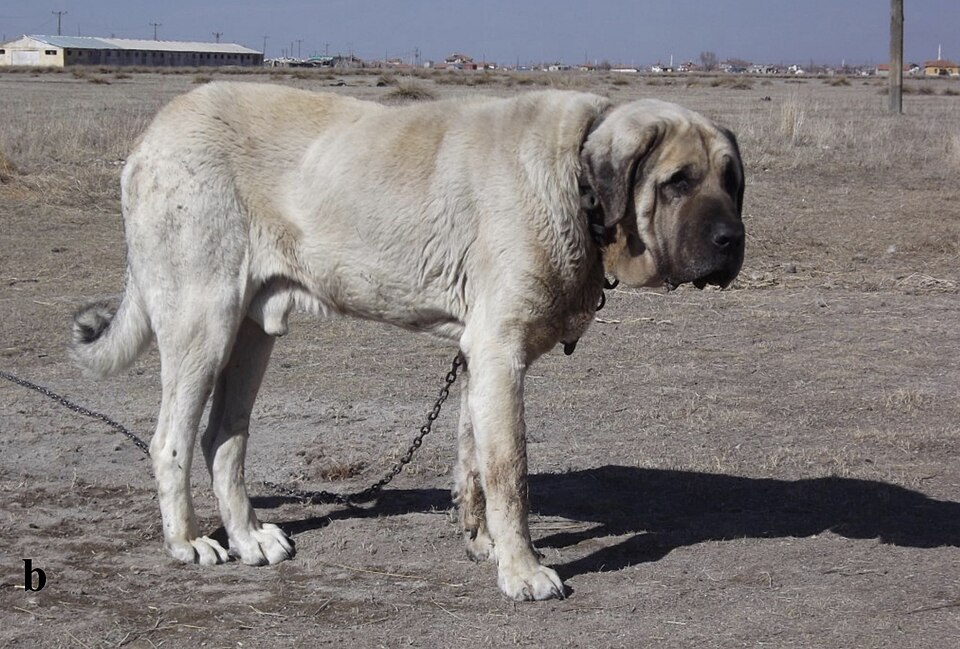
The big-headed, heavy-lipped and very powerful shepherd dog of the Aksaray region, among the heaviest of Türkiye's shepherd dogs. Its temperament is reported to depend largely on how it is raised; it needs a large space, early socialization and an experienced owner. It is not an apartment dog.

 LifespanNo datawe found no breed-specific lifespan study
 Weight117–137 lb (53–62 kg)averages: females 117 lb, males 137 lb (277 dogs)
 Height at shoulder29–31 in (73–78 cm)averages: females 29 in, males 31 in
 OriginAksaray, Türkiyealso around Sereflikochisar and Nevsehir
 CoatShort, densemostly fawn-gray shades, black mask
 ActivityNeeds spacefenced yard and long walks
 With kidsBe cautiousvery large and strong; always supervise
 TrainingNeeds experiencegrowing up around people matters
The Aksaray Malaklı is a big-headed, heavy-lipped and very powerful shepherd dog bred to guard flocks in and around Aksaray in central Anatolia. Its name comes from "malak," the local word for drooping lips and jowls. It resembles the Kangal but is larger and heavier, and researchers regard it as a distinct type of dog, possibly a separate breed. On this page we've brought together research from Turkish veterinary schools and information gathered from breeders in the region.
- Temperament: Protective, devoted to its owner and reserved with strangers; according to breeders, its temperament depends largely on whether it grows up around people.
- Size: Among the heaviest Turkish shepherd dogs; males averaged 137 lb (62 kg) in one study.
- Living space: Not suited to apartments; it needs a large area with a solid fence and an experienced owner.
- Health: There's very little breed-specific health research; learn the signs of bloat, which affects large, deep-chested dogs.
- Legal: In Türkiye, microchipping and PETVET registration are mandatory, and ear cropping and dogfighting are banned.
What to know
 What is the Aksaray Malaklı like?
We couldn't find a study that systematically examines the Malaklı's temperament. According to a 2017 study by researchers from Aksaray and Erciyes universities who interviewed 50 breeders and owners (Aslim and Sinmez), a Malaklı's temperament depends largely on how it's raised: dogs that grow up away from people are tougher, while those raised among people are calmer. Breeders say these dogs usually obey only their owner and can be harsh toward other people.
Locals sort Malaklıs by temperament into those that are hard on people, those that go after wolves and those that are not hard on people. According to the same accounts, a Malaklı on guard duty may not tolerate another dog of its own sex nearby. A 2018 study comparing the Malaklı with the Kangal (Ograk et al.) also notes that in the region the Malaklı is known for its heavier body, larger head and harsher temperament.
This information isn't meant as a warning but as a guide: a well-socialized Malaklı can be a devoted, protective family dog, but it is so large and strong that its temperament shouldn't be left to chance.
Every dog is an individual. Breed traits describe general tendencies; how a puppy is raised, how well it gets to know people and its health shape its temperament at least as much as its breed. For the Malaklı, that's exactly what breeders themselves say.
 Who is it a good fit for?
The Aksaray Malaklı suits owners who live in the countryside, on a farm or in a house with a large yard, have experience with very large, protective dogs and can give their dog time every day. Being able to handle a dog that can weigh more than 130 lb (60 kg) safely on a leash is an important test.
| Situation | Good fit? |
|---|---|
| Apartment | No; it's a very large livestock dog |
| House with a yard, farm | Yes; the fence must be tall, solid and dig-proof |
| Family with kids | Be cautious; very large and strong, so children always need supervision |
| Other dogs | May have trouble especially with dogs of the same sex; introduce them slowly |
| Busy home with many visitors | Can be challenging; reserved with strangers |
| First-time dog owners | Not recommended; it needs experience and consistent handling |
The dog should have a quiet, separate place to go when visitors come. To spot early signs that your dog is uncomfortable, take a look at our article on dog body language.
Where does it come from?
The Aksaray Malaklı is bred in the province of Aksaray in central Anatolia and is named after it. According to a 2016 Aksaray University study, the dogs are found mainly around Aksaray, Sereflikochisar and Nevsehir, and they are counted, along with the Kangal and the Karayaka dog, among the "karabash" (black-headed) dogs. A 2023 study shows that Malaklıs are also bred in Sivas.
As reported in the same 2016 study, a 2011 study by Atasoy and colleagues found that Malaklıs form a group genetically distinct from Kangal, Akbash and Kars dogs and may be a separate breed. The authors of the 2018 study comparing the Malaklı and the Kangal also write that the two come from the same gene pool but differ clearly in body measurements.
The breed's path to official recognition is still underway. As of 2016 there was no breed standard for the Malaklı, and according to the 2017 folklore study, no application had been made for international breed registration. According to a 2023 study, the Aksaray Governor's Office obtained a trademark registration for the name "Aksaray Malaklısı" in 2017; that's different from registering a breed. According to the 2018 study, the governor's office, the municipality, several universities and Türkiye's kennel federation (KIF) were working together to define and register the breed. Aksaray University also set up a gene bank with blood and hair samples from 155 dogs.
Appearance and colors
The Malaklı's most striking features are its big head, drooping lips and massive body. According to a 2014 Ankara University study of 277 dogs over 18 months old (Atasoy et al.), the averages were:
| Measurement | Female | Male |
|---|---|---|
| Body weight | 117 lb (53.2 kg) | 137 lb (62.3 kg) |
| Height at shoulder | 28.7 in (73.0 cm) | 30.9 in (78.4 cm) |
| Body length | 31.1 in (79.0 cm) | 32.6 in (82.7 cm) |
| Chest girth | 33.3 in (84.5 cm) | 35.4 in (89.9 cm) |
| Tail length | 20.2 in (51.4 cm) | 21.6 in (54.8 cm) |
A 2018 study comparing Malaklıs in Aksaray with Kangals in Sivas (Ograk et al.) found that the Malaklıs were larger, with bigger heads and bodies, and that every Malaklı examined had an extra toe on the hind feet (a "sixth nail").
According to accounts gathered from breeders (Aslim and Sinmez):
- Head: Large, with a broad forehead and a black mask. There are two types, a long-muzzled one and a short-muzzled one. The lips and jowls droop, and the lower eyelids look droopy as well.
- Body: A broad, long chest, a long body, thick legs and strong muscles.
- Coat and color: Short and dense. The color is usually a shade of fawn-gray, and locals use names such as "boz karabaş" (gray with a black head), "ala" (spotted), "sarı" (yellow) and "göğ" (bluish gray) Malaklı.
- Tail: Not tightly curled; locals describe tails as whip-like, L-shaped or curled.
- Extra toes: The hind feet carry an extra toe (dewclaw), and a double dewclaw is considered especially valuable.
Traditional practices in the region include cropping Malaklı puppies' ears. Yet in Türkiye, the Animal Protection Law (no. 5199, article 8) bans cropping the ears or docking the tail of pets to change their appearance; if there is a medical reason, the decision belongs to a veterinarian. Cropped ears are not a breed trait, and the procedure is painful for the puppy.
Daily care
Thanks to its short, dense coat, the Malaklı is easy to groom; brushing once or twice a week, and more often during shedding seasons, is enough. The areas that need the most attention are the face and feet.
- Lips and facial folds: Drooping lips can trap drool and food; wipe the lip edges regularly with a damp cloth, and show your vet any redness or odor.
- Eyes: In dogs whose lower eyelids look droopy, check the eyes every day; show your vet any constant discharge, redness or pawing at the eyes.
- Dewclaws: The nails on the extra toes of the hind feet don't touch the ground and can overgrow; check them once a month.
- Shade and water: In summer it needs shade, a cool place to lie and fresh water at all times. Our article on dogs in hot weather covers the signs of heatstroke.
- Shelter: If it stays outdoors, provide a dry, insulated, windproof doghouse and a raised bed.
Training and exercise
The Malaklı isn't a running dog; it's a large, heavy guardian. It still needs to move: long, steady walks, time to roam in a large fenced area and sniffing games all suit it. Don't let it off leash in an unfenced area. Because it's so heavily built, move walks to the cooler morning and evening hours in hot weather.
Breeders say a Malaklı is calmer when it grows up among people, so with this breed socialization isn't optional; it's essential.
- Early socialization: As a puppy, give it positive experiences with every member of the family, different people, sounds and calm dogs. Keeping a puppy shut in a dark place or raising it away from people can make its temperament harsher.
- Leash control: A dog that may grow past 130 lb (60 kg) needs to learn loose-leash walking while it's small. Our guide to loose-leash walking walks you through it.
- Vet prep: While it's young, use rewards to get it used to being touched, having its mouth and paws handled and, if needed, wearing a muzzle.
- Visitor routine: Teach it a separate, quiet place to go when the doorbell rings.
The authors of the 2016 gene bank study write that dogs of this type are used in illegal dogfights and that careless crossbreeding to produce "stronger" dogs threatens the breed's future. In Türkiye, making animals fight is a crime under the Animal Protection Law (article 28/A). Provoking the dog or setting it against other dogs is dangerous and wrong; if you run into behavior problems, get help from your vet and a trainer who uses positive methods.
 Diet and weight
The Malaklı doesn't need a special food; a complete, balanced dog food suited to its age and activity level is enough. There are foods made for large-breed puppies; decide on the type and amount with your vet. In such a heavy dog, extra weight puts more strain on the joints; being able to feel the ribs under a thin layer of fat is a good guide.
The Merck Veterinary Manual lists feeding once a day and eating quickly among the risk factors for bloat, and recommends limiting exercise before and after meals and avoiding raised food bowls for high-risk dogs. In practice: split the daily food into at least two meals, use a slow-feeder bowl if it gulps, and don't let it run right after eating.
Be careful with table scraps and bones; take a look at our list of foods that are dangerous for dogs. Fresh water should always be available.
 Health issues to know about
There's very little health research specific to the Aksaray Malaklı. A 2023 study of 32 healthy Malaklıs in Sivas established the first breed-specific reference values for a hearing test (BAER), which can serve as a comparison in future hearing exams. The issues below are known problems in large, deep-chested dogs; ask your vet about diagnosis and treatment.
Bloat (gastric dilatation-volvulus)
According to the Merck Veterinary Manual, this is mainly a problem of large, deep-chested dogs: the stomach fills with gas and twists on itself. It is life-threatening and needs immediate treatment. The main signs are retching without bringing anything up, drooling, restlessness and a swollen belly.
Joints
We couldn't find a study showing how common hip or elbow problems are in the Malaklı. Still, in such a heavy dog, take signs like limping, trouble getting up or avoiding stairs seriously and show your vet.
Eyelids
Breeder accounts describe the Malaklı's eyes as droopy, with sagging lower lids. If you notice a problem related to the eyelids (constant discharge, redness, squinting or pawing at the eye), show your vet.
- Retching without bringing anything up, a swollen belly, heavy drooling
- Sudden limping, being unable to get up, or weakness in the hind legs
- Sudden redness or cloudiness in the eye, or being unable to open it
- Fast, labored breathing in the heat, staggering or collapse
How long does it live?
We couldn't find a study of the Aksaray Malaklı's lifespan, so we're not giving a number. A 2024 UK study using data on about 585,000 dogs (McMillan et al.) shows that larger breeds generally live shorter lives; in that study, a small group of dogs registered as "Anatolian Shepherd" had a median lifespan of 10.1 years.
The most practical tools you have for a longer life: regular vet checkups, a healthy weight, staying on top of vaccines and parasite prevention, and knowing the signs of emergencies such as bloat ahead of time.
 Before you get one
- Consider a shelter: Large shepherd dogs and their mixes also turn up in shelters. Seeing an adult dog's temperament up front is a real advantage with a breed this large. Our guide to adopting a shelter dog explains the process.
- If you buy from a breeder: Meet the parents on site; look for calm, manageable temperaments and puppies that are being raised among people.
- Red flags: Avoid dogs sold as "tough," "man-biter" or "fighter," puppies with cropped ears, and sellers who won't show you the mother. Dogs bred for fighting are also one of the biggest threats to the breed itself.
- Preparation: A fence, a doghouse, and a sturdy collar and leash made for a large dog. Food and care costs are noticeably higher than for a small dog.
- Registration: Rules vary by country. In Türkiye, owned cats and dogs must be microchipped and registered in the PETVET system; see our article on PETVET registration and microchips.
- With kids: It's a very large, strong dog; the rules in our article on kids and dogs at home matter even more with this breed.
Frequently asked questions
What's the difference between the Aksaray Malaklı and the Kangal?
Both are related shepherd dogs from the "karabash" group. A 2018 comparison found that Malaklıs were larger, with bigger heads and bodies and drooping lips. The Kangal is lighter in build, a single color from fawn to wolf sable, with a black mask. A genetic study also suggests that Malaklıs form a group distinct from the Kangal.
Is the Aksaray Malaklı a registered breed?
It is not recognized by the FCI; the Kangal is the only Turkish breed the FCI recognizes. The Aksaray Governor's Office obtained a trademark registration for the name in 2017, while local institutions, universities and Türkiye's kennel federation were working toward breed registration.
What does "Malaklı" mean?
In the region, drooping lips and jowls are called "malak." These dogs are called Malaklı because, compared with the Kangal, they have bigger heads and noticeably droopier lips.
Can a Malaklı live in an apartment?
No. It's a protective livestock dog that averages 117–137 lb (53–62 kg) and needs a large fenced area and time outdoors.
Is the Malaklı an aggressive dog?
According to local breeders, its temperament depends largely on how it's raised: dogs that grow up among people are calmer, while those raised away from people are tougher. Because it's so large, it needs good socialization, consistent handling and should never be provoked.
Sources
- Atasoy ve ark. · Malaklı Karabaş köpeklerde bazı morfolojik ve genetik özellikler, Ankara Üniversitesi Veteriner Fakültesi Dergisi (2014)
- Ün ve ark. · Malaklı köpeği bölgesel gen bankası kurulması, Bahri Dağdaş Hayvancılık Araştırma Dergisi (2016)
- Aslım ve Sinmez · Aksaray ili folklorunda Aksaray Malaklısı yetiştiriciliği, Eurasian Journal of Veterinary Sciences (2017)
- Oğrak ve ark. · Comparison various body measurements of Aksaray Malakli and Kangal Dogs, Journal of Istanbul Veterinary Sciences (2018)
- Özşensoy ve Koçkaya · Sivas ilinde yetiştirilen Aksaray Malaklısı çoban köpeklerinde işitme duyusuna ait normatif datalar, Erciyes Üniversitesi Veteriner Fakültesi Dergisi (2023)
- McMillan ve ark. · Longevity of companion dog breeds: those at risk from early death, Scientific Reports (2024)
- Merck Veterinary Manual · Gastric dilation and volvulus in small animals
- Mevzuat Bilgi Sistemi · 5199 sayılı Hayvanları Koruma Kanunu, güncel metin
By Tüylüm · Last checked: November 3, 2026. Compiled from the sources above and written in our own words. Spotted a mistake? Write to [email protected] and we'll fix it right away. Photo from Wikimedia Commons, used under the license shown below it.