 Tüylüm
Kars Dog
A large, bear-headed livestock guardian with a long, dense coat, shaped by the harsh winters of northeastern Anatolia. It is reported to be protective and reserved with strangers, and it needs plenty of space, early socialization and an experienced owner. It is not an apartment dog.

 LifespanNo datawe found no breed-specific lifespan study
 Weight≈ 95–100 lb (43–45 kg)adult averages measured in Türkiye
 Height at shoulder≈ 28.5 in (72 cm)adult average; males slightly larger
 OriginNortheastern Anatoliaaround Kars, Ardahan, Erzurum and Igdir
 CoatLong, double coatshort-coated types exist; neck ruff
 ActivityNeeds spacefenced yard and long walks
 With kidsBe cautiousreported to bond with one person
 TrainingNeeds experiencean independent, tough-natured breed
The Kars Dog is a large, heavy-headed shepherd dog with a long, dense coat that guards flocks and villages on the high plateaus of northeastern Anatolia. It's known for its resemblance to the Caucasian Shepherd Dog, and locally it goes by names that all mean "hairy" or "shaggy." It is far less known than the Kangal or the Akbash, and little scientific research has been done on it. On this page we've brought together a 2025 study from Kafkas University, other Turkish academic research and official regulations.
- Temperament: Protective and reserved with strangers; Turkish reviews describe it as tending to bond with one person and as tough-natured.
- Living space: Not suited to apartments; it needs a large area with a solid fence and an experienced owner.
- Coat: Long, thick and double; it can mat if not brushed regularly, and it needs shade and a cool spot in hot weather.
- Health: There are no breed-specific health studies; learn the signs of bloat, which affects large, deep-chested dogs.
- Legal: In Türkiye, microchipping and PETVET registration are mandatory, and taking a Kars Dog out of the country requires prior approval from the Ministry.
What to know
 What is the Kars Dog like?
We couldn't find a study that systematically examines the Kars Dog's behavior; what is known comes from local breeders and field observations. According to a 2012 review by researchers at Igdir and Ankara universities, these dogs usually bond with a single person, are not especially friendly toward people around them and are quite tough by nature. Because of the mane-like long hair on the neck, the head looks large and intimidating from the front.
The 2025 Kafkas University study describes the dogs' expression as serious, stern and attentive. That's what you'd want in a livestock guardian: a dog that notices strangers, is territorial and will stand its ground if needed. At home, this temperament may show up as caution around visitors and unfamiliar dogs.
Every dog is an individual. Breed traits describe general tendencies; how a puppy is raised, how well it gets to know people and its health shape its temperament at least as much as its breed.
 Who is it a good fit for?
The Kars Dog suits owners who live in the countryside, on a farm or in a house with a large yard and have experience with large, protective dogs. Because it was bred for a harsh climate and has a thick coat, it needs extra care to stay cool in hot, humid places.
| Situation | Good fit? |
|---|---|
| Apartment | No; it needs space and time outdoors |
| House with a yard, farm | Yes; the fence must be tall, solid and dig-proof |
| Family with kids | Be cautious; it's reported to bond with one person, and its size means constant supervision |
| Busy home with many visitors | Can be challenging; the breed is reserved with strangers |
| First-time dog owners | Not recommended; it needs experience and consistent handling |
| Cold climates | A good match; it works through the harsh winters of northeastern Anatolia |
The dog should have a quiet, separate place to go when visitors come. If neighbors are close by, plan for a protective dog's barking too; our article on why dogs bark can help.
Where does it come from?
The breed is named after the province of Kars. According to the review by Yilmaz and Ertugrul, the Kars Dog is most common in the provinces of Artvin, Agri, Ardahan, Erzurum, Igdir, Kars and Van. It goes by different local names: "kıllı" (hairy) around Kars, Erzurum, Igdir and Agri, "saçaklı" (fringed) in Ardahan and "tüylü" (furry) in Artvin.
According to the 2025 Kafkas University study, the breed shares similarities with the Caucasian Shepherd Dog and was first presented by American researcher David Nelson at the International Shepherd Dog Symposium in Konya in 1996. The same study says the breed was registered in 2002 as the "Kars Turkish Shepherd Dog," following an application to the Turkish Patent and Trademark Office by the Military Veterinary School and Training Center Command in Gemlik, Bursa. Yilmaz and Ertugrul also report that the Turkish Standards Institution published a standard for the breed in 2002.
The Kars Dog is not recognized by the FCI; according to a 2018 study, the Kangal is the only Turkish breed the FCI recognizes. The authors of the 2025 study stress that despite its historical and genetic importance, the breed's key traits have not been well documented, and they present their work as a contribution to its conservation.
Appearance and colors
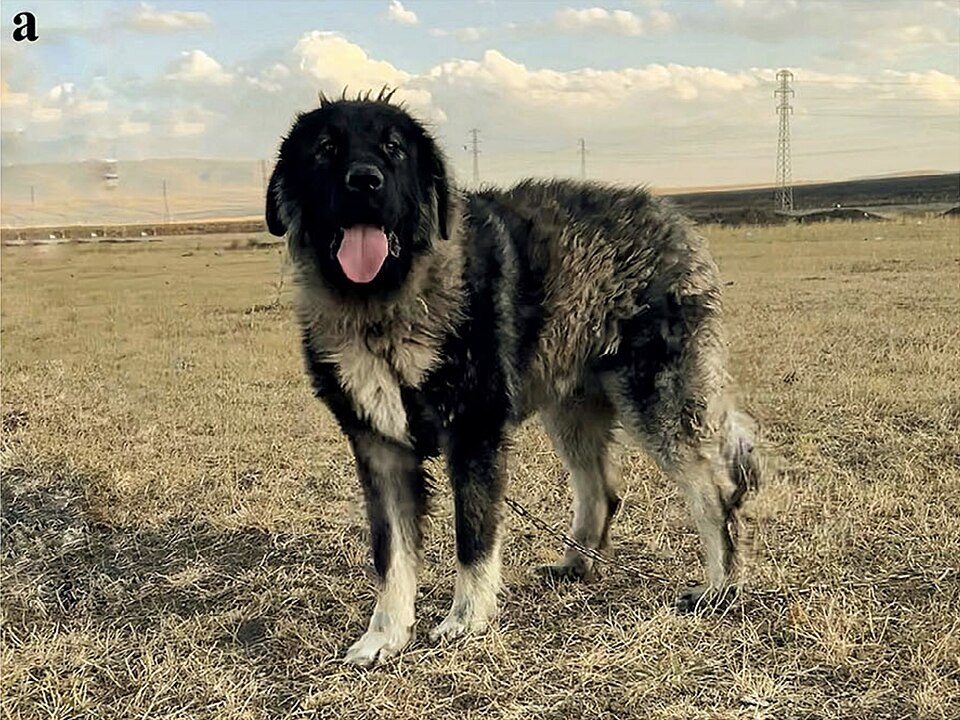
The Kars Dog is large, heavy-boned and thick-coated. The 2025 Kafkas University study compares the shape of its head to a bear's. The ears are broad, medium-length, triangular and drop down; the bridge of the nose is broad and blunt, and the lips are thick and black. The eyes are medium-sized, round and in shades of brown, framed by lighter fur that stands out around them.
- Height and weight: According to the review by Yilmaz and Ertugrul, adult males average 100 lb (45.3 kg) and 28.6 in (72.6 cm), and females 95 lb (43.3 kg) and 28.3 in (71.9 cm). In a 2004 study (Kirmizibayrak) that measured 33 adult males and 27 adult females in villages around Kars, males were larger than females on every measurement except the distance between the ears.
- Color: According to the 2025 study, mostly gray, with lighter white or yellowish areas on the tail, legs, belly and face. There is usually a black mask on the face, and the ears are dark gray or black. Yilmaz and Ertugrul, on the other hand, report many colors, including solid black, solid white, grizzled, red, yellow and brown, as well as two- and three-colored dogs. A 2012 Selcuk University study measured "white Kars" and "black Kars" dogs as separate groups; according to the same study, the Kars shows the most variation in coat color and length of the three native shepherd breeds, with some dogs resembling the Caucasian Shepherd Dog and others the Akbash.
- Coat: Usually long, though short-coated types exist too. There is mane-like long hair on the neck and noticeably longer hair on the back of the hind legs.
How does a puppy grow?
In the 2025 study, which followed 57 puppies on the Kafkas University farm, the average birth weight was 1.1 lb (0.51 kg); the puppies reached 27 lb (12.1 kg) at 3 months, 48 lb (21.9 kg) at 6 months and 90 lb (40.6 kg) at 12 months. At one year, the average height at the shoulder was 27.3 in (69.3 cm), and the hair on the neck was about 4.3 in (11 cm) long. In other words, a Kars puppy grows very fast and becomes a heavy dog within a year, so plan its diet and exercise with your vet during this period.
In Türkiye, the Animal Protection Law (no. 5199, article 8) bans cropping the ears or docking the tail of pets to change their appearance; if there is a medical reason, the decision belongs to a veterinarian. Cropped ears are not a breed trait.
Daily care
The long, dense coat is the most demanding part of caring for a Kars Dog. Brushing at least two or three times a week, and every day during shedding seasons, prevents mats. The neck ruff, the area behind the ears and the long hair on the back of the hind legs tangle the most, so work the comb all the way down to the skin there. See our article on dog grooming for more.
- Hot weather: A thick coat protects against cold but can be a burden in the heat. In summer it needs shade, a cool place to lie, fresh water at all times and walks during the cooler hours. Our article on dogs in hot weather covers the signs of heatstroke. If you're thinking about having the coat shaved down, talk to your vet first.
- Shelter: If it stays outdoors, provide a dry, insulated, windproof doghouse and a raised bed.
- Skin checks: A thick coat can hide wounds, ticks and skin problems; look over the skin while you brush.
- Nails and ears: Check the nails once a month and the drop ears once a week, and show your vet any odor or redness.
Training and exercise
The Kars Dog isn't a running dog; it's a guardian. Still, it's a large working dog that needs activity: long, steady walks, time to roam in a large fenced area and sniffing games all suit it. Don't let it off leash in an unfenced area.
With an independent, tough-natured breed, the goal of training isn't to make the dog "tougher" but to make it calm and manageable. Short, consistent, reward-based sessions work best.
- Early socialization: As a puppy, give it positive experiences with every member of the family, different people, sounds and calm dogs. Since it's reported to bond with one person, have several people in the household share its care and training.
- Basic cues: Coming when called, waiting and walking without pulling are the foundation of living safely with a large dog. Our guide to loose-leash walking walks you through it.
- Vet prep: While it's young, use rewards to get it used to being touched and brushed, having its mouth and paws handled and, if needed, wearing a muzzle.
- Visitor routine: Teach it a separate, quiet place to go when the doorbell rings.
Harsh punishment breaks trust. Provoking the dog, keeping it shut in a dark place or setting it against other dogs is dangerous and wrong; in Türkiye, making animals fight is a crime under the Animal Protection Law (article 28/A). If you run into behavior problems, get help from your vet and a trainer who uses positive methods.
 Diet and weight
The Kars Dog doesn't need a special food; a complete, balanced dog food suited to its age and activity level is enough. Given that puppies in the 2025 study reached about 90 lb (40 kg) within a year, a food made for large-breed puppies and an amount set with your vet matter during growth.
The Merck Veterinary Manual lists feeding once a day and eating quickly among the risk factors for bloat, and recommends limiting exercise before and after meals and avoiding raised food bowls for high-risk dogs. In practice: split the daily food into at least two meals, use a slow-feeder bowl if it gulps, and don't let it run right after eating.
A thick coat hides weight, so check with your hands, not your eyes. If you can feel the ribs under a thin layer of fat, its weight is good. Be careful with table scraps and bones; take a look at our list of foods that are dangerous for dogs. Fresh water should always be available.
 Health issues to know about
We couldn't find published health studies specific to the Kars Dog. The issues below are known problems in large, deep-chested, thick-coated dogs; ask your vet about diagnosis and treatment.
Bloat (gastric dilatation-volvulus)
According to the Merck Veterinary Manual, this is mainly a problem of large, deep-chested dogs: the stomach fills with gas and twists on itself. It is life-threatening and needs immediate treatment. The main signs are retching without bringing anything up, drooling, restlessness and a swollen belly.
Joint problems
No study shows how common hip dysplasia (abnormal development of the hip joint), which can occur in large breeds, is in the Kars Dog. When buying a puppy, ask whether the parents have had hip X-rays, and show your vet any limping or trouble getting up.
Heatstroke and skin problems
This is a thick-coated dog bred for a cold climate, so shade, water and a cool place are essential in hot weather. Mats make it hard to see the skin; if you notice redness, wounds or a bad smell while brushing, show your vet.
- Retching without bringing anything up, a swollen belly, heavy drooling
- Fast, labored breathing in the heat, staggering or collapse
- Sudden limping, being unable to get up, or weakness in the hind legs
- A deep, bleeding or swelling bite wound
How long does it live?
We couldn't find a study of the Kars Dog's lifespan, so we're not giving a number. Scientific knowledge about the breed is still limited, and the authors of the 2025 study also stress that its key traits haven't been well documented.
A 2024 UK study using data on about 585,000 dogs (McMillan et al.) shows that larger breeds generally live shorter lives. The most practical tools you have for a longer life are regular vet checkups, a healthy weight, staying on top of vaccines and parasite prevention, and knowing the signs of emergencies such as bloat ahead of time.
 Before you get one
- Consider a shelter: Large shepherd dogs and their mixes also turn up in shelters. Seeing an adult dog's temperament up front is a real advantage with a protective breed. Our guide to adopting a shelter dog explains the process.
- If you buy from a breeder: Meet the parents on site; look for calm, manageable temperaments and puppies that are being raised around people.
- Red flags: Avoid dogs sold as "tough," "man-stopper" or "fighter," puppies with cropped ears, and sellers who won't show you the mother.
- Preparation: A fence, a doghouse, a collar and leash made for a large dog, and a good comb. Food and care costs are noticeably higher than for a small dog.
- Registration: Rules vary by country. In Türkiye, owned cats and dogs must be microchipped and registered in the PETVET system; see our article on PETVET registration and microchips.
The Kars Dog is one of the native breeds that Türkiye's Ministry of Agriculture and Forestry protects as a genetic resource. Under a 2012 regulation, native domestic animal genetic resources cannot be taken out of the country without the Ministry's permission, and the Ministry's 2022 instructions make this breed's departure subject to prior approval. Applications go to the provincial directorate, and a commission assesses the dog's breed. Rules can change, so check with the provincial or district directorate of agriculture well before you travel.
Frequently asked questions
Is the Kars Dog the same as the Caucasian Shepherd Dog?
No, but they are similar. According to the 2025 Kafkas University study, the Kars Dog shares similarities with the Caucasian Shepherd Dog; in Türkiye it is treated as a separate native breed and was registered in 2002 as the "Kars Turkish Shepherd Dog."
What colors does the Kars Dog come in?
According to the 2025 study, mostly gray, with lighter areas and a black mask. Turkish reviews report many colors, including solid black, white, grizzle, red, yellow and brown.
Can it live in an apartment?
It isn't recommended. It's a large, protective, thick-coated livestock guardian that needs a large fenced area and time outdoors.
Does it shed a lot?
It has a long, dense coat and sheds heavily during shedding seasons. It needs brushing several times a week, and daily during the shed.
Can I take a Kars Dog out of Türkiye?
This breed's departure requires prior approval from the Ministry, along with a microchip, PETVET registration, a pet passport and the destination country's rules. Get the current requirements from the provincial or district directorate of agriculture.
Sources
- Bektaşoğlu ve Kırmızıbayrak · Fertility and growth traits, some body measurements, and morphological characteristics of Kars Shepherd dogs, Veterinary Medicine and Science (2025)
- Kırmızıbayrak · Some morphological characteristics of Kars dogs, Turkish Journal of Veterinary and Animal Sciences (2004)
- Yılmaz ve Ertuğrul · Türkiye yerli köpek ırk ve tipleri, Iğdır Üniversitesi Fen Bilimleri Enstitüsü Dergisi (2012)
- Erdoğan ve ark. · Türkiye yerli köpek ırklarının bazı morfolojik özelliklerinin karşılaştırılması, Eurasian Journal of Veterinary Sciences (2012)
- McMillan ve ark. · Longevity of companion dog breeds: those at risk from early death, Scientific Reports (2024)
- Oğrak ve ark. · Comparison various body measurements of Aksaray Malakli and Kangal Dogs, Journal of Istanbul Veterinary Sciences (2018)
- Merck Veterinary Manual · Gastric dilation and volvulus in small animals
- Tarım ve Orman Bakanlığı · Kedi ve köpeklerin yurt dışına yolcu beraberi ve ticari sevklerine ilişkin uygulama talimatı (2022)
- Mevzuat Bilgi Sistemi · Yerli Evcil Hayvan Genetik Kaynaklarının Kullanılması ve Yurt Dışına Çıkarılması Hakkında Yönetmelik (2012)
- Mevzuat Bilgi Sistemi · 5199 sayılı Hayvanları Koruma Kanunu, güncel metin
By Tüylüm · Last checked: November 3, 2026. Compiled from the sources above and written in our own words. Spotted a mistake? Write to [email protected] and we'll fix it right away. Photo from Wikimedia Commons, used under the license shown below it.