 Tüylüm
Labradoodle
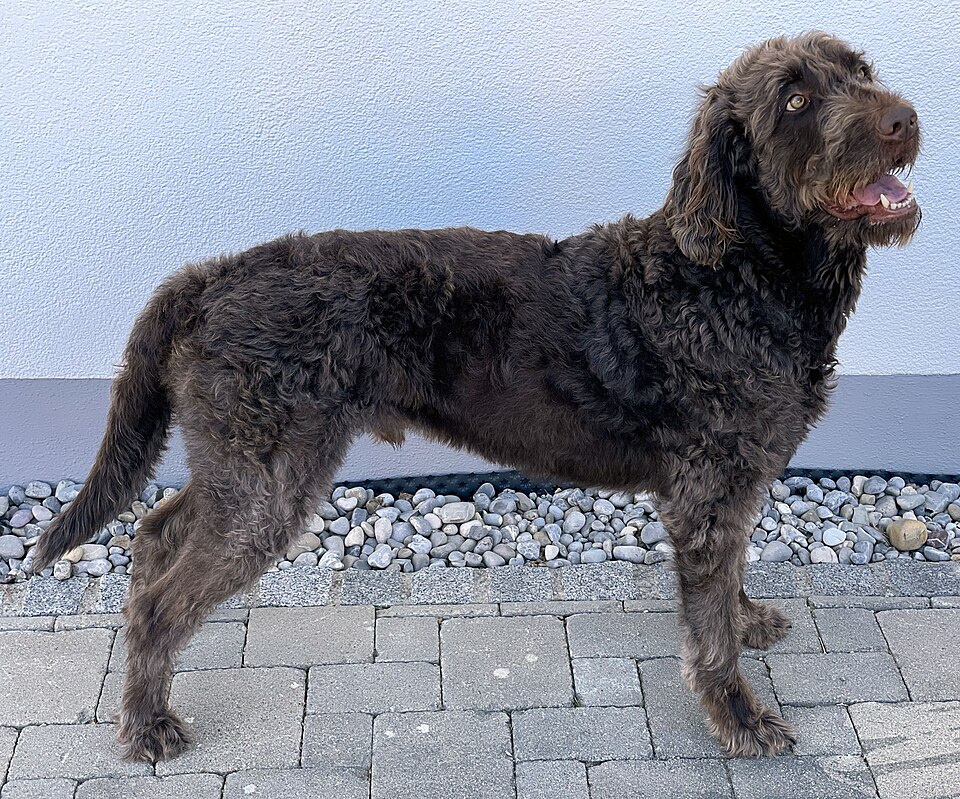
A cross between a Labrador Retriever and a Poodle (usually a Standard), an energetic, sociable family dog. There's no official breed standard, so size, coat and health depend on the parents. There's no scientific evidence that it's "hypoallergenic."

 LifespanDepends on parentsLabrador KC: 10+ years; Standard Poodle: 12+
 WeightVariesdepends on Poodle size and on the Labrador side
 HeightVariesStandard Poodle 18–24 in, Labrador 21–22 in (FCI)
 OriginCrossbreedbegan in Australia; no standard
 CoatRegular groomingPoodle: daily (KC); varies in the cross
 Exercise1–2 hours+Poodle up to 1 hour, Labrador 2+ hours (KC)
 With kidsSupervisedlike any dog; being a cross is no guarantee
 TrainingLikes to workboth parents trainable (FCI)
The Labradoodle is the offspring of a Labrador Retriever and a Poodle. The idea of a sociable Labrador combined with a Poodle said to shed less was very appealing, and the cross has become hugely popular in recent years. But there is no breed standard: kennel clubs don't recognize the "Labradoodle" as a breed of its own. So on this page we cover both parent breeds, what's known about this cross, the "hypoallergenic" myth and choosing a puppy responsibly.
- A cross, not a breed: Size, weight, coat and temperament depend on the parents; even puppies from the same litter can turn out different.
- Not hypoallergenic: Scientific studies don't show that any dog breed is guaranteed safe for allergies.
- Health: In a UK study the Labradoodle's health problems largely resembled those of its parent breeds; ear infections, allergies and digestive upsets stood out.
- Parent screening: There are screening tests for inherited diseases on both the Labrador and Poodle sides; ask the breeder for the results.
- Lots of exercise: Considering both parents, it needs 1 to 2 hours a day plus mental games.
What to know
 What is the Labradoodle like?
There's no separate temperament standard for the Labradoodle; the best information is the description of the two parents. The FCI standard describes the Labrador as good-tempered, agile, adaptable and a devoted companion: intelligent, keen and biddable, with a strong will to please and no trace of aggression or undue shyness. For the Poodle, the FCI says a dog renowned for its loyalty, capable of learning and being trained, a particularly pleasant companion. What the two share is a people focus and a willingness to learn.
There's data showing this is no guarantee in a cross: in a 2026 UK study (Bryson et al.), owners of Labradoodles rated their dogs' behavior with a questionnaire. Labradoodles differed from Labradors and Poodles in 11 of 24 behavior comparisons; in five they scored worse than their parent breeds and in six better. The researchers point out that common beliefs, such as that these crosses are "easy to train" or "always good with children," aren't backed by the evidence.
The best clue to temperament is the behavior of the mother and father and the environment the puppy is raised in. Both parents are energetic and intelligent, so a bored Labradoodle can develop destructive habits.
 Who is it a good fit for?
The Labradoodle can suit people who can give plenty of daily exercise and mental games, who have time for regular grooming and who enjoy an energetic dog. Because size varies so much, the Poodle size used is the best clue to a puppy's adult size.
| Situation | A good fit? |
|---|---|
| Apartment | Possible with smaller crosses; larger ones need daily exercise and space |
| Family with children | With supervision; being a cross doesn't guarantee a good match with children, and an energetic big dog can knock a child over |
| Other dogs | Introduce early and calmly; supervise play |
| Long stretches alone | A people-oriented type; teach alone time gradually |
| First-time dog owners | Possible; but energy, grooming and training take time |
| People with allergies | There's no "hypoallergenic" guarantee; spend time with the dog before you commit |
For help with being alone, see our post on separation anxiety in dogs.
Where does it come from?
The name "Labradoodle" covers two different things. According to a 2020 PLOS Genetics study, the first is the first-generation (F1) cross of a Labrador and a Standard Poodle. The second is the Australian Labradoodle, which began in 1989: it also started with Labrador × Standard Poodle crosses, but was later propagated by planned crosses into a true-breeding population meant to meet an established standard. The goal was a low-shedding service dog. When the study was written (2020), Australian Labradoodle breeders were seeking recognition of the breed by an international registry; there was no official recognition.
The same study showed that the Australian Labradoodle is genetically predominantly Poodle, with contributions from all Poodle sizes, and that breeds other than the Labrador and Poodle also contributed. The article also reports that Wally Conron, one of the developers of the Australian Labradoodle, said on a podcast that he wished he hadn't created the breed, citing the health problems caused by unscrupulous breeding. This page is about crosses in general; when you talk to a seller who says they breed Australian Labradoodles, asking "what does that mean, which standard, which registry" is fair.
Appearance and colors
There's no single standard for the Labradoodle's appearance. Looking at the parents' standards shows the range:
- Labrador (FCI): Height at the withers 22–22.5 in (56–57 cm) for males, 21–22 in (54–56 cm) for females.
- Poodle (FCI): Standard Poodle over 18 in (45 cm) up to 24 in (60 cm); Medium Poodle 14–18 in (35–45 cm); Miniature 11–14 in (28–35 cm); Toy 9.5–11 in (24–28 cm).
- In the cross: Height depends on the Poodle size and on the puppy; the coat may be straight, wavy or curly. Puppies in the same litter may not look alike. The Australian Labradoodle study found an excess of Poodle-like coat variants in that breed; in an F1 cross that isn't guaranteed.
When you buy a puppy you can't know the adult size and coat type for sure. Seeing the mother and father is the best clue.
Daily care
The Royal Kennel Club marks the Poodle's grooming as "every day" and classes the Standard Poodle as non-shedding; for the Labrador it says "once a week," and it sheds. In the cross, coat care depends on which parent it takes after more; but it's a good assumption to prepare for daily brushing and regular clipping.
- Brushing: Catch tangles early in friction zones such as behind the ears, under the armpits and on the belly.
- Clipping: Choose a groomer who is gentle with dogs; see our dog grooming post for details.
- Ears: A UK study found the Labradoodle at higher risk of ear infection than the Labrador (see below); check drooping, hairy ears weekly.
- Teeth and nails: Get your dog used to tooth brushing from puppyhood.
Training and exercise
The Royal Kennel Club recommends more than 2 hours of exercise a day for the Labrador and up to an hour for the Standard Poodle. For the cross, somewhere in between makes sense: at least 1 to 2 hours a day plus mental games.
- Reward-based training: The FCI describes both parents as trainable. Short, consistent, rewarding sessions work best.
- Mental games: Sniffing games satisfy both the Labrador and the Poodle side.
- Alone time: A bored dog that hasn't burned off its energy can be destructive; teach alone time gradually.
- Walking: Our post on leash and walking training is useful to start early.
 Diet and weight
The Labradoodle doesn't need a special food; a complete, balanced food that suits its age, size and activity level is enough.
- Weight: Work out the ideal weight with your vet. If you can feel the ribs under a thin layer of fat and see a waist from above, the weight is good.
- Digestion: In the study described below, Labradoodles had more reports of eating things they shouldn't, vomiting and diarrhea than Poodles; introduce new foods slowly and ask your vet when needed.
- Harmful foods: See our post on foods dogs shouldn't eat.
 Health issues to know about
What follows is for information only; for diagnosis and treatment, talk to your veterinarian.
The best data on crossbreed health
A UK study published in PLOS ONE in 2024 (Bryson et al.) surveyed the owners of 9,402 dogs (up to age 5) about health. It compared Labradoodles, Cockapoos and Cavapoos with their parent breeds. Overall result: there was no difference in 86.6% of comparisons; some disorders were more common in the crosses and some less. So the belief that "crosses are healthier" wasn't supported by this data, but crosses weren't shown to be worse either. Keep in mind that these are owner-reported data.
For the Labradoodle specifically:
- Compared with Poodles: There was no difference for 50 of 57 disorders. Allergies, eating things they shouldn't, wounds, diarrhea and vomiting were reported more often in the cross, while kneecap luxation was reported less often.
- Compared with Labradors: Hip and/or elbow dysplasia and wounds were reported less often, while outer ear infection (otitis externa) was reported more often (odds ratio 1.80). The study also notes that in VetCompass data the Labradoodle is among the ten breeds with the highest prevalence of otitis externa.
Known issues on the Labrador side
The Royal Kennel Club lists hip, elbow and eye screening for the Labrador, plus DNA tests for centronuclear myopathy (CNM), exercise-induced collapse (EIC), macular corneal dystrophy (MCD), prcd-PRA (a retinal disease), skeletal dysplasia (SD2) and Stargardt disease. Science for Animal Welfare (UFAW) lists elbow dysplasia, kneecap luxation, cruciate ligament rupture, atopic dermatitis and more for the Labrador.
Known issues on the Poodle side
The Royal Kennel Club lists DNA tests for prcd-PRA and von Willebrand disease (vWD1), plus eye and hip screening, for the Standard Poodle. UFAW names hyperadrenocorticism and hypoadrenocorticism (adrenal gland diseases) in the Standard Poodle. In a 2026 US study in JAVMA (the Dog Aging Project), Poodles and Poodle mixes were found to be at higher risk of bloat (GDV); the study also found body weight over 88 lb (40 kg), male sex and low body condition to be risk factors. The study doesn't look at Labradoodles separately; but in a dog that's a Poodle mix, especially a large one, it makes sense to talk with your vet about it.
- Sudden belly swelling, unproductive retching, restlessness
- Trouble breathing, blue-tinged gums or fainting
- Severe ear scratching, head shaking, odor, discharge or crying out in pain
- Limping or crying out in pain
- Refusing food, repeated vomiting or diarrhea
How long does it live?
We couldn't find a separate lifespan figure for the Labradoodle. The Royal Kennel Club lists "over 10 years" for the Labrador and "over 12 years" for the Standard Poodle. In a large UK study (McMillan et al. 2024) the median lifespan of all crossbreds was 12.0 years and the Labrador Retriever's was 13.1. So being a cross doesn't extend life by itself; the individual dog's parents, weight, care and luck decide.
 Before you get one
- Consider a shelter: Labradoodles and similar crosses also end up in shelters. Our post on adopting a dog from a shelter explains the first steps.
- If buying from a breeder: Ask to see the mother and father; ask which Poodle size was used, and about both parents' hip, elbow and eye exams and DNA test results. See that the puppies are raised with their mother in a home.
- Advert traps: In a 2022 UK study (Burnett et al.), almost half (47.1%) of owners of designer crossbred puppies cited the dog being "hypoallergenic" as a reason for their choice, roughly six times the share of purebred puppy owners. Crossbred puppies were less likely to be seen with their mother when bought (73.1% versus 79.8%) and cost more. A "hypoallergenic" promise and pressure to pay a deposit are red flags.
- Time and budget: Be prepared for regular grooming, daily exercise and mental games.
- Legal registration: In Türkiye, owned dogs must be microchipped and registered in the PETVET system; rules vary by country. Details are in our post on PETVET registration and microchips.
- First days: Our post on bringing a puppy home: the first week can help.
Frequently asked questions
Is a Labradoodle hypoallergenic?
No, you can't say that. In a 2012 study of allergens, hair and coat samples from dogs marketed as "hypoallergenic" (Labradoodle, Poodle, Spanish Water Dog, Airedale Terrier) had higher levels of the main dog allergen, Can f 1, than other dogs. For environmental levels the differences were small: settled floor dust was lower for Labradoodles, but airborne allergen levels were the same across breeds. Differences between breeds were smaller than differences within a breed. The researchers concluded that no breed can be called hypoallergenic. If you have allergies, spend time with the dog before you buy and talk to your doctor.
Do Labradoodles shed?
The coat type depends on the parents. Even if Poodle hair counts as non-shedding, it tangles and needs regular care; the Labrador side sheds a lot. Promising "no shedding" at all wouldn't be right.
How big does a Labradoodle get?
It depends on the parents and the Poodle size. According to the FCI, the Labrador is 21–22.5 in (54–57 cm) and the Standard Poodle 18–24 in (45–60 cm). It's hard to say the adult size exactly from a puppy; look at the height and weight of the mother and father.
Are Australian Labradoodles and Labradoodles the same?
No. The Australian Labradoodle is a population begun in 1989 and built through planned breeding; a Labradoodle is often a first-generation cross of a Labrador and a Poodle. The two come with different definitions and expectations; ask the seller which one they're selling and for the registration papers.
Why do the parents' health screenings matter?
Because inherited problems from both parents can pass to the puppy. The parents' exams and DNA tests are the most concrete way to check those risks.
Sources
- The Royal Kennel Club (UK) · Labrador Retriever: breed profile and health screening
- The Royal Kennel Club · Poodle (Standard): breed profile and health screening
- FCI · Labrador Retriever breed standard No. 122
- FCI · Poodle (Caniche) breed standard No. 172
- Ali et al. · Genetic analysis of the modern Australian labradoodle dog breed reveals an excess of the poodle genome, PLOS Genetics (2020)
- Bryson et al. · The doodle dilemma: How the physical health of 'Designer-crossbreed' Cockapoo, Labradoodle and Cavapoo dogs' compares to their purebred progenitor breeds, PLOS ONE (2024)
- Bryson et al. · Comparing undesirable behaviours between 'designer' Poodle-cross dogs and their purebred progenitor breeds, PLOS ONE (2026)
- Burnett et al. · How much is that doodle in the window? Exploring motivations and behaviours of UK owners acquiring designer crossbreed dogs, Canine Medicine and Genetics (2022)
- Vredegoor et al. · Can f 1 levels in hair and homes of different dog breeds: lack of evidence to describe any dog breed as hypoallergenic, Journal of Allergy and Clinical Immunology (2012)
- McMillan et al. · Longevity of companion dog breeds: those at risk from early death, Scientific Reports (2024)
- Science for Animal Welfare (UFAW) · Labrador Retriever: list of inherited conditions
- Resmî Gazete (Türkiye) · Regulation on the identification and registration of cats, dogs and ferrets (February 26, 2018)
By Tüylüm · Last checked: November 10, 2026. Compiled from the sources above and written in our own words. Spotted a mistake? Write to [email protected] and we'll fix it right away. Photo from Wikimedia Commons, used under the license shown below it.