 Tüylüm
Poodle
A smart, eager-to-learn breed descended from a water dog that retrieved ducks for hunters, in toy, miniature and standard sizes. Its curly coat sheds little but needs frequent care. No breed is truly "hypoallergenic," and Poodle crosses are not separate breeds.

 Lifespan≈ 14 yearsmedian, UK 2024; sizes combined
 Weight≈ 4–70 lb (2–32 kg)AKC: toy 4–6, mini 10–15, standard 40–70 lb
 Height9.5–23.5 in24–60 cm; four sizes at FCI, three at RKC/AKC
 OriginFrance / Germanya water dog used for duck hunting
 SheddingLowthe curly coat needs daily care
 Exercise~1 hour a dayRoyal Kennel Club; for all three sizes
 With kidsWith supervisionthe toy size is fragile; watch for falls
 TrainingLearns easilyFCI: very capable of learning and training
With its curly coat and showy clips, the Poodle can look like a pampered salon dog, but it actually descends from a smart, athletic working dog bred to retrieve game from the water. The same breed comes in different sizes: the Royal Kennel Club and the AKC recognize three (toy, miniature and standard), while the FCI adds a fourth, medium size in between. On this page we've pulled together what the sizes share and how they differ, coat care, health issues, and common beliefs about Poodle crosses, from breed registry standards, animal welfare resources and scientific studies.
- Temperament: According to the FCI, a companion dog known for its loyalty and very capable of learning and being trained; the Royal Kennel Club describes it as cheerful and good-tempered.
- Sizes: All sizes are judged against the same standard; size is the difference. Toys weigh roughly 2–3 kg (4–6 lb), standards around 18–32 kg (40–70 lb).
- Coat: It sheds little, but the curly coat needs daily care and regular clipping so it doesn't mat.
- Health: The toy size has a very high risk of gum disease; Addison's disease in standards and the inherited eye disease PRA in all sizes are worth knowing about.
- Myths: No breed is "hypoallergenic." Poodle crosses such as the Cockapoo or Labradoodle are not separate breeds with a standard.
What to know
 What is the Poodle like?
The FCI standard describes the Poodle as a dog renowned for its loyalty, very capable of learning and being trained, which makes it a particularly pleasant companion. The Royal Kennel Club calls it a glamorous, intelligent breed, and its standard asks for a cheerful, good-tempered dog. The AKC likewise stresses that an elegant athlete lies beneath the curly coat.
For a dog this ready to learn, mental work matters as much as physical exercise. Alongside daily walks, activities that use its brain, such as sniffing games, learning tricks or agility, keep it happy. Because all three sizes are judged against the same standard, the temperament it describes is the same; but a toy Poodle's small body calls for more care around falls, and a standard Poodle needs more space.
Every dog is an individual. Breed traits describe general tendencies; the parents' temperament, how a puppy was socialized and the training it gets shape its personality as much as its breed.
 Who is it a good fit for?
The Poodle is a good choice for people who enjoy doing things together with their dog and can set aside time and money for coat care and regular trips to the groomer. Choose the size that fits your home and lifestyle.
| Situation | Good fit? |
|---|---|
| Apartment | Toys and miniatures are excellent; the Royal Kennel Club suggests a large house and garden for standards |
| Family with kids | With supervision; the toy size is vulnerable to falls from arms |
| Other dogs and cats | Early, calm introductions matter |
| Long hours alone | Teach being alone gradually; leave it something to do |
| First-time dog owners | Good; training is enjoyable, as long as you're ready for coat care |
With small dogs like the toy Poodle, kids carrying the dog or holding it while standing up raise the risk of falls; teach children to pet the dog while sitting on the floor. Our article on kids and dogs at home has more tips.
Where does it come from?
Breed registries point to different countries as the Poodle's homeland. The FCI lists France: the French name "caniche" comes from "cane," the word for a female duck; the dog was once used for hunting waterfowl and descends from a water dog called the Barbet. According to the FCI, in 1743 "caniche" was the name for the female Barbet, and the two breeds then gradually separated. The Royal Kennel Club, on the other hand, says the breed developed in Germany as a water retriever used by duck hunters. Both stories meet at the same point: the Poodle is a hunting dog descended from Europe's water dogs.
The famous Poodle clip comes from that past too. According to the Royal Kennel Club, the traditional trim wasn't decoration but something practical: clipping the hindquarters made swimming easier, while the bands of hair left on the joints and the tip of the tail protected them from the cold. The miniature and toy sizes were created by scaling the same features down into a smaller mold.
Appearance and colors
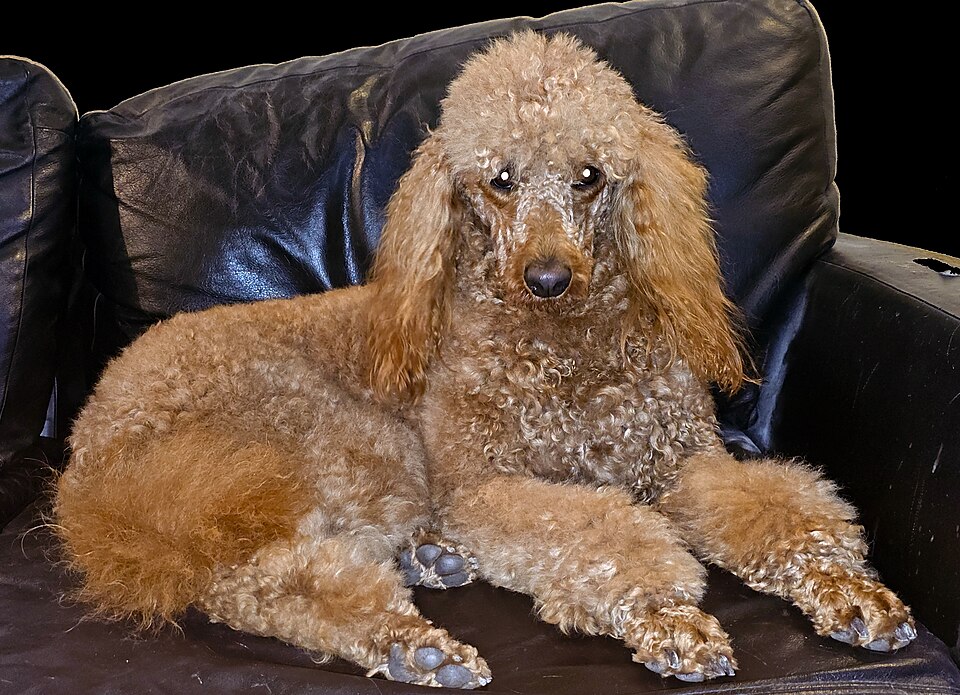
The Poodle is a balanced, elegant dog with a proud carriage. Its head is long and fine, its ears hang down, and its coat is curly. The FCI also accepts a "corded" coat that hangs in rope-like strands.
| Size | Height at the shoulder | Weight (AKC) |
|---|---|---|
| Toy | FCI: 24–28 cm (9.5–11 in) · RKC: under 28 cm (11 in) | 4–6 lb (1.8–2.7 kg) |
| Miniature | FCI: 28–35 cm (11–14 in) · RKC: 28–38 cm (11–15 in) | 10–15 lb (4.5–6.8 kg) |
| Medium (FCI only) | 35–45 cm (14–18 in) | not specified |
| Standard | FCI: 45–60 cm (18–23.5 in) · RKC: over 38 cm (15 in) | females 40–50 lb, males 60–70 lb (18–32 kg) |
The FCI asks that the miniature Poodle show no sign of dwarfism and that the toy keep the proportions of the miniature. In other words, smaller should never come at the cost of proportions.
- Colors: The Royal Kennel Club's standard colors are apricot, black, blue, brown, cream, red, silver and white. Two-tone and particolor patterns are non-standard in the UK.
- Clip: According to the Royal Kennel Club, the traditional "lion" clip used to be recommended for the show ring; today other clips are accepted too. For a pet Poodle, a short, even clip makes care easier.
 Daily care
According to the Royal Kennel Club, the Poodle's coat doesn't shed noticeably, and all three sizes need daily care. If it isn't combed, the curly coat mats easily close to the skin, and those mats pull at and irritate the skin.
- Combing: Comb down to the skin a few times a week if the coat is kept short, every day if it's long.
- Groomer: Because the coat doesn't shed, regular clipping is needed. Have it done by an experienced groomer who uses rewards, and get your puppy used to the grooming table, clipper noise and handling while it's young.
- Ears: UFAW notes that hanging ears and hair growing in the ear canal are among the reasons miniature Poodles are prone to outer ear infections, and that allergic skin disease also plays a role. Check the ears weekly, and see your vet about scratching, head shaking, odor or discharge. Decide with your vet whether hair in the ear canal should be removed; don't try plucking it at home.
- Teeth: Start tooth brushing in puppyhood, especially with a toy Poodle.
- Cold: Dogs Trust suggests letting the coat grow a little longer in cold weather; if it's clipped very short, a coat may be needed in winter. Our article on dogs in cold weather explains how to choose one.
Our dog grooming guide walks you through a combing and bathing routine step by step.
Training and exercise
The Royal Kennel Club recommends up to an hour of exercise a day for all three sizes, which shows that even the toy Poodle isn't just a lap dog. The learning ability the FCI highlights turns training into an enjoyable shared activity with this breed.
- Reward-based training: Short, rewarding and varied sessions work best. Teaching new things keeps its interest up better than endless repetition.
- Mental work: Sniffing games, hunting for hidden treats, learning tricks and agility tire out its mind.
- Leash: Our loose-leash training guide teaches walking without pulling; for the toy size, choose a harness that doesn't press on the neck.
 Diet and weight
A Poodle doesn't need a special food; a complete, balanced dog food suited to its size, age and activity is enough. Needs vary a lot between sizes: a 2 kg (4 lb) toy and a 30 kg (66 lb) standard can't eat the same amount or even the same kind of food. Decide the amount with your vet based on your dog's ideal weight.
- Measure food and count training treats as part of the daily amount.
- If you can feel the ribs under a thin layer of fat, the weight is about right.
- Don't leave a toy Poodle puppy without food for long; plan its meal schedule with your vet.
- Some human foods are toxic to dogs; check our list of foods dogs should never eat.
 Health issues to know about
The Poodle is a long-lived breed, but the problems that stand out depend on size. The information below is for awareness only; ask your vet about diagnosis and treatment.
Gum disease (especially toys)
In a 2021 UK study of more than 22,000 dogs, the toy Poodle had the highest risk of gum disease of any breed: about 4 times that of crossbred dogs. About a quarter of toy Poodles were diagnosed within a year. If you notice bad breath, red gums or tartar, see your vet; regular tooth brushing is the most effective prevention.
Addison's disease (especially standards)
A disease in which the adrenal glands don't produce enough hormones. According to UFAW, the standard Poodle is predisposed: in a study of 1,722 standard Poodles, 8.6% were affected, and the disease was estimated to be largely inherited. Signs can be vague and come and go: lethargy, poor appetite, vomiting, weakness and weight loss. That makes it easy to miss, so if these signs keep coming back, ask your vet about Addison's. According to UFAW, the genes responsible haven't been found yet, so there is no genetic test; it matters whether the breeder knows of the disease in the family.
Inherited eye disease (PRA)
According to Cornell University, Poodles are among the breeds at risk for progressive retinal atrophy (PRA). The disease is painless, usually starts with weaker night vision and slowly progresses to blindness. The Royal Kennel Club lists a PRA DNA test among the minimum tests for toy Poodles; for standards it recommends two separate PRA DNA tests, and since January 2025 it registers imported standard Poodles only if they test clear or carrier for both. If you notice reluctance in the dark, hesitation on stairs or bumping into things, tell your vet.
Ears
UFAW notes that outer ear infections are common in miniature Poodles and keep coming back in most dogs once they start. Long-lasting or frequent infections can thicken and narrow the ear canal, so see your vet at the first signs.
Other conditions
For standards, the Royal Kennel Club recommends a DNA test for von Willebrand disease type 1, which affects blood clotting, plus hip and eye screening; for toys, it recommends hip and eye screening. UFAW's genetic welfare resource also lists diabetes, inherited cataracts, Cushing's syndrome and extra eyelashes that rub on the eye (distichiasis) for the toy Poodle.
- Repeated vomiting, lethargy, loss of appetite or sudden collapse
- Drinking and urinating much more than usual
- Intense ear itching, pain or a foul-smelling discharge
- Bleeding that won't stop, or unexplained bruising
- A sudden change in vision or cloudiness in the eye
How long does it live?
A 2024 UK study using data from about 585,000 dogs from 18 sources found a median lifespan of 14.0 years (confidence interval 13.8–14.1) for the Poodle, clearly above the 12.0-year median for crossbred dogs. In this study, Poodles were analyzed as a single group without separating sizes. The AKC gives a range of 10–18 years for the three sizes.
Many Poodles live past 15. Dental care, a healthy weight, regular ear checks and yearly vet visits are the most practical ways to help a Poodle enjoy that long life in comfort.
 Before you get one
- Consider a shelter: Purebred Poodles and Poodle crosses both end up in shelters and rescues. Our article on adopting a shelter dog covers the first steps.
- If you buy from a breeder: See the mother with her puppies at home. Ask about the tests recommended for that size: PRA DNA tests, eye examinations, hip screening; for standards, the von Willebrand test and whether Addison's has occurred in the family.
- The "hypoallergenic" promise: In a 2012 study, dogs sold as "hypoallergenic," such as Poodles and Labradoodles, had higher, not lower, levels of the main dog allergen in their coats than other dogs, and there was no difference between breeds in airborne allergen levels at home. A 2024 review also stresses that differences between individual dogs within a breed are much larger than differences between breeds. Even though the AKC describes the Poodle coat as "low-allergen," if you have allergies, talk to your doctor and spend time with the dog before deciding.
- Poodle crosses: Dogs sold under names like Cockapoo, Cavapoo, Labradoodle or Maltipoo are "designer crossbreeds," produced by deliberately crossing two purebreds. The authors of the 2024 lifespan study note that first-generation crosses may benefit from hybrid vigor, but in later generations inbreeding tends to rise again and that advantage can be lost. In a 2026 Royal Veterinary College study, Cockapoos and Cavapoos showed more undesirable behaviors than their parent breeds. So a cross is no automatic guarantee of better health, easier training or fewer allergies.
- "Teacup Poodle" ads: The Royal Kennel Club doesn't recognize any teacup breed; it notes that such dogs are often bred from the smallest, weakest puppies and that breathing, bone, joint, heart and stomach problems are more likely. The toy is already the smallest official size.
- Registration: Rules vary by country; many places require or recommend microchipping. In Türkiye, owned dogs must be microchipped and registered in the PETVET system.
Frequently asked questions
Do Poodles shed, and are they good for people with allergies?
According to the Royal Kennel Club, they don't shed noticeably. But research has found no evidence for calling the Poodle, or any other breed, "hypoallergenic"; allergens aren't only on shed hair but on the dog itself and in household dust. If you have allergies, talk to your doctor and spend time with the dog before deciding.
Are toy, miniature and standard Poodles different breeds?
No, they are different sizes of the same breed. According to the Royal Kennel Club, all three are judged against the same standard; the miniature and toy were created by keeping the same features in a smaller mold. The FCI recognizes four sizes.
Is a Labradoodle, Cockapoo or Maltipoo a breed?
No. They are designer crossbreeds produced by deliberately crossing two purebreds; in the 2024 lifespan study, they were counted in the crossbred group rather than among the purebreds. With no breed standard, there's no guarantee about a puppy's coat, size or temperament. If you love a cross, check shelters too; if you buy from a breeder, ask for health screening on both parents.
How often should a Poodle see a groomer?
Because the coat doesn't shed, regular clipping is a must; how often depends on how short you keep it and how much you comb at home. Work out a routine that suits your dog with your groomer, and keep up the combing in between.
Which size should I choose?
Choose based on your home, lifestyle and time. A toy Poodle fits easily into a small home but is fragile and needs careful dental care; a standard needs more space and has its own risks, such as Addison's disease. Remember that all three sizes need up to an hour of activity a day.
Sources
- The Royal Kennel Club · Poodle (Toy): ırk tanıtımı ve sağlık taramaları
- The Royal Kennel Club · Poodle (Miniature): ırk tanıtımı
- The Royal Kennel Club · Poodle (Standard): ırk tanıtımı, sağlık taramaları ve ithalat kuralı
- FCI · Poodle ırk standardı No. 172
- AKC (American Kennel Club) · Poodle (Standard, Miniature, Toy) ırk tanıtımları
- McMillan ve ark. · Longevity of companion dog breeds: those at risk from early death, Scientific Reports (2024)
- Science for Animal Welfare (UFAW) · Standard Poodle: Hipoadrenokortisizm (Addison hastalığı)
- Science for Animal Welfare (UFAW) · Miniature Poodle: Dış kulak iltihabı
- Science for Animal Welfare (UFAW) · Toy Poodle: kalıtsal sorunlar listesi
- Cornell Riney Canine Health Center · Progressive retinal atrophy
- O'Neill ve ark. · Epidemiology of periodontal disease in dogs in the UK primary-care veterinary setting, Journal of Small Animal Practice (2021)
- Vredegoor ve ark. · Can f 1 levels in hair and homes of different dog breeds: lack of evidence to describe any dog breed as hypoallergenic, Journal of Allergy and Clinical Immunology (2012)
- Hilger ve ark. · Hypoallergenic animals: A promise of hope for allergic patients?, Allergologie Select (2024)
- Bryson ve ark. · Comparing undesirable behaviours between 'designer' Poodle-cross dogs and their purebred progenitor breeds, PLOS ONE (2026)
- Science for Animal Welfare (UFAW) · Oyuncak ırklarda ön bacak (radius ve ulna) kırıkları
- Dogs Trust · How to keep your dog safe and warm in cold weather
- The Royal Kennel Club · Buying a teacup dog
- Resmî Gazete · Kedi, Köpek ve Gelinciklerin Kimliklendirilmesi ve Kayıt Altına Alınmasına Dair Yönetmelik (26 Şubat 2018)
By Tüylüm · Last checked: November 3, 2026. Compiled from the sources above and written in our own words. Spotted a mistake? Write to [email protected] and we'll fix it right away. Photo from Wikimedia Commons, used under the license shown below it.