 Tüylüm
Maltipoo
A small, affectionate companion dog, a cross between a Maltese and a Poodle (usually Toy or Miniature). It isn't a recognized breed, so size, coat and health depend on the parents; and there's no evidence behind "hypoallergenic" or "never sheds" promises.

 LifespanDepends on parentsKC: 12+ years for Maltese and Poodle
 WeightVariesMaltese: 6.6–8.8 lb (3–4 kg, FCI); Poodle by size
 HeightVariesMaltese 8–10 in, Toy Poodle 9.5–11 in
 OriginCrossbreedno official breed standard
 CoatDaily groomingRoyal Kennel Club: daily for both parents
 Exercise30–60 minMaltese 30 min, Poodle 1 hour (KC)
 With kidsNeeds carevery small; supervision a must
 Dental healthWatch closelygum disease common in Toy Poodles
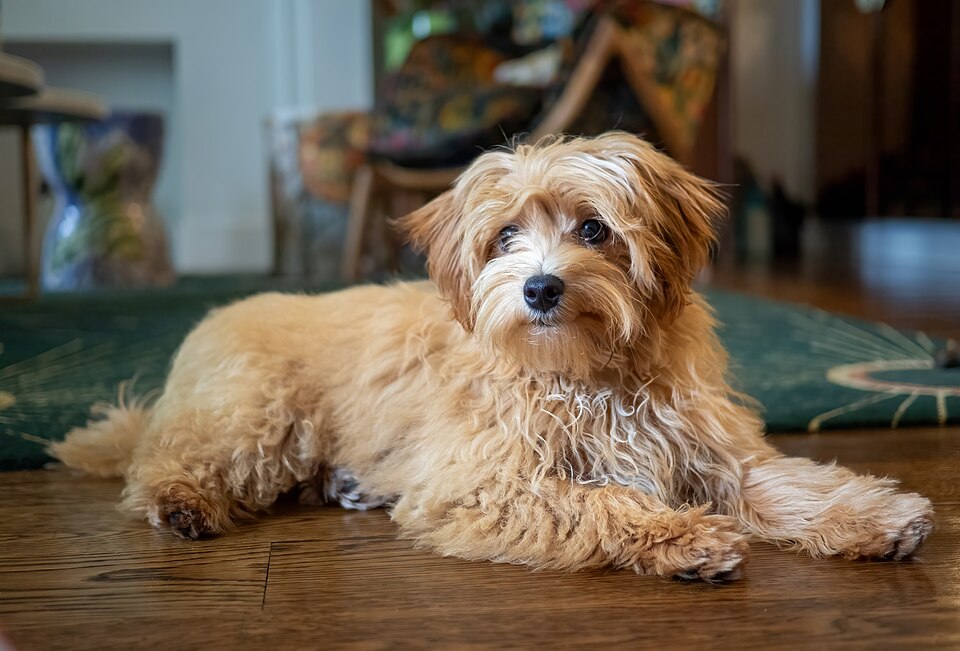
The Maltipoo is a small crossbreed dog from a Maltese and a Poodle. With its soft, curly or wavy coat and teddy-bear face, it has become very popular in recent years. But there is no breed standard: kennel clubs don't recognize the Maltipoo as a breed of its own. So on this page we cover both parent breeds (the Maltese and the Poodle) and the issues specific to crosses, namely choosing a puppy and the "hypoallergenic" myth.
- A cross, not a breed: Size, weight, coat and health depend on the parents; even two puppies from the same litter can turn out different.
- Parent information matters: Ask which Poodle (Toy or Miniature) and which Maltese were used, and about the parents' health screening.
- Grooming: For both parent breeds the Royal Kennel Club recommends daily grooming; the coat mats and needs regular trims.
- Not hypoallergenic: Scientific studies don't show that any breed is guaranteed safe for allergies.
- Health: Dental disease, kneecaps, tracheal collapse and inherited heart and eye disease occur in the parent breeds.
What to know
 What is the Maltipoo like?
There is no breed standard for the Maltipoo's temperament; the soundest information we have is how the two parent breeds are described. The FCI standard describes the Maltese as lively, affectionate, very calm and very intelligent, while the Royal Kennel Club's standard calls it sweet-tempered. For the Poodle, the FCI says it is renowned for its loyalty, capable of learning and being trained, and a particularly pleasant companion; the Royal Kennel Club standard calls it gay-spirited and good-tempered. What the two parents share is closeness to people, so a Maltipoo is usually expected to be a "companion dog".
That expectation has limits. In a 2026 UK study (Bryson et al.), owners of 9,402 dogs completed a behavior questionnaire, and Poodle crosses (Cockapoos, Labradoodles and Cavapoos) scored worse than their parent breeds on some undesirable behaviors. The study didn't include Maltipoos, but it is a reminder that the assumption "it's a cross, so it's easy to train and always good with kids" isn't backed by evidence.
In crosses you can't know ahead of time how the parents' traits will mix. The best clue to temperament is the parents' behavior and the environment the puppy grew up in; the same goes for coat, size and health.
 Who is it a good fit for?
A Maltipoo can suit people who want a small, affectionate dog and can commit to regular grooming. The Royal Kennel Club considers both the Maltese and the Toy Poodle suitable for flats and for homes with a small or medium garden.
| Situation | A good fit? |
|---|---|
| Apartment | Usually yes; for the parent breeds, daily exercise is 30–60 minutes |
| Family with kids | Needs care; very small dogs are easily injured and shouldn't be carried unsupervised |
| Other dogs and cats | Early, calm introductions; play with large dogs should be supervised |
| Long hours alone | A people-oriented type; teach alone time gradually |
| First-time dog owners | Possible, but set aside time for coat and dental care |
| People with allergies | No "hypoallergenic" guarantee; spend time with the dog before you commit |
For being left alone, see our article on separation anxiety in dogs.
Where does it come from?
The Maltipoo is a crossbreed, so its story is the story of its two parent breeds. According to the Royal Kennel Club, the Maltese's ancestors are thought to be small, white, luxuriously coated dogs that were pampered pets in Mediterranean countries for centuries; in 1805 a Knight of Malta wrote about these long, silky-haired dogs. The Poodle was bred in Germany as a water retriever for duck hunters, descended from various European water dogs. The club notes that the Toy and Miniature sizes are scaled-down versions with the same features.
We couldn't find a reliable record of exactly when and where the Maltipoo first appeared; there's no breed standard and no official pedigree register. That means each puppy's mother and father need to be asked about individually.
Appearance and colors
There's no single standard for how a Maltipoo looks. The parent breed standards show the range:
- Maltese (FCI): 21–25 cm (8–10 in) for males and 20–23 cm for females; weight 3–4 kg (6.6–8.8 lb). A long, silky, flowing coat with no undercoat.
- Toy Poodle (FCI): Over 24 cm up to 28 cm (9.5–11 in), ideal 25 cm. The Miniature Poodle is 28–35 cm (11–14 in). A frizzy coat, either curly or corded.
- In the cross: The coat may be straight, wavy or curly, and the color ranges from white to cream, apricot and black. Puppies in the same litter may not look alike.
When you pick up a puppy you can't know its adult size or coat type for sure. Seeing the parents is the best clue. Don't trust labels like "mini", "micro" or "teacup" (see the health section below).
Daily care
For both the Maltese and the Toy Poodle, the Royal Kennel Club rates grooming as "every day" and says neither sheds. In a cross, coat care depends on which parent the dog takes after more, but planning for daily brushing and regular trims is a safe assumption.
- Brushing: Catch tangles early in friction areas such as behind the ears, under the legs and on the belly. Mats can irritate the skin.
- Trims: Longer coats need frequent trims and shorter ones less often. Choose a groomer who is gentle with dogs; see our article on dog coat care.
- Eyes: Keep the hair around the eyes short and show your vet if you see redness or heavy discharge.
- Teeth: Tartar builds up fast in a small mouth. Get your dog used to tooth brushing from puppyhood.
- Ears: Check drooping, hairy ears once a week.
- Cold weather: A small dog gets cold quickly; see our article on dogs in cold weather.
 Training and exercise
The Royal Kennel Club recommends up to 30 minutes of exercise a day for the Maltese and up to an hour for the Toy Poodle. For a Maltipoo, something between the two makes sense; a few short walks and play sessions are enough.
- Reward-based work: Positive, rewarded and consistent training works best in small dogs, too. Sniffing games tire the mind: sniffing games.
- Being alone: Small dogs raised with constant attention may be prone to separation anxiety; teach alone time gradually.
- Barking: Small dogs may bark at doorbells and outside sounds; early socialization helps.
- Leash: Choose a harness to avoid straining the neck.
 Diet and weight
A Maltipoo doesn't need a special food; a complete and balanced small-breed food suited to its age and size is enough. Two things stand out:
- Weight: In a study of tracheal collapse (below), the degree of collapse was mostly related to a high body condition score, and signs improved in most dogs with measures such as weight loss. So keeping portions measured really matters.
- Treats: Even one piece is a big percentage for a small dog; subtract treats from the daily amount.
- Very small puppies: Going too long without food can be a problem in very small puppies; ask your vet about a meal plan.
If you can feel the ribs under a thin layer of fat and see a waist from above, the weight is good. For harmful foods, see foods dogs should never eat.
 Health issues to know about
We couldn't find a separate health study on the Maltipoo. So we're passing on the known issues of the two parent breeds and general information on crosses. The following is for information only; ask your veterinarian for diagnosis and treatment.
Being a cross is not a health guarantee
VetCompass studies from the Royal Veterinary College show that crossbred dogs live on average 1.2 years longer than purebreds, but have lower rates in only three of the 20 most commonly recorded disorders. So crosses may get a "hybrid vigor" effect, but it doesn't make every problem go away. Inherited problems carried by the two parent breeds can be passed to the puppy; staying healthy depends on whether the parents were screened.
Dental disease
In a 2021 UK study, the Toy Poodle was among the highest-risk breeds for gum disease (about four times the odds compared with crossbreds). Risk is higher in dogs with a small body weight and falls as weight rises. Tooth brushing and regular dental checks are the key steps.
Tracheal collapse
Flattening and collapse of the windpipe (tracheal collapse) occurs in small breeds and can cause coughing. In a 2022–2024 study of 110 dogs, the four most common breeds were the Maltese, Pomeranian, Poodle and Chihuahua; the degree of collapse was mostly related to a high body condition score, and in 86.6% of the dogs signs improved with measures such as weight loss, environmental changes and medication. If you notice a persistent cough or trouble with exercise, show your vet; they will decide which measures are appropriate.
An inherited heart problem (PDA)
According to UFAW, Maltese are predisposed to patent ductus arteriosus (PDA), a congenital heart problem in which a vessel that lets blood bypass the lungs before birth doesn't close afterward. Mild cases may show no signs; severe cases lead to heart failure. UFAW writes that it can often be treated if found early, and that some puppies show signs as early as eight weeks old. Have a vet listen to the heart at the first checkup.
Eyes and other issues
The Royal Kennel Club recommends a prcd-PRA DNA test (a form of progressive retinal atrophy) for the Toy Poodle and eye examinations for both the Maltese and the Poodle. UFAW's Toy Poodle list also includes diabetes, extra eyelashes (distichiasis), hereditary cataract and hyperadrenocorticism (Cushing's). There's no data on how often these occur in the Maltipoo, so ask the breeder for the parents' eye exam and DNA test results.
The "teacup" and "mini" myth
The Royal Kennel Club does not recognize "teacup" as a breed; it says these dogs are often bred from the smallest of a litter, may live shorter lives and can have breathing problems, fragile bones, joint, heart and stomach problems. The RSPCA also says "miniature" and "teacup" can be signs that puppy dealers use to attract attention.
- Trouble breathing, bluish gums or fainting
- A constant cough, wheezing or tiring quickly on exercise
- In a puppy: weakness, trembling, wobbling or a seizure
- Limping or crying out in pain
- Refusing food, repeated vomiting or diarrhea
How long does it live?
We couldn't find a separate lifespan figure for the Maltipoo. The Royal Kennel Club lists the lifespan as "over 12 years" for both the Maltese and the Toy Poodle. In a large UK study, small, long-nosed breeds were the longest-lived group (median 13.3 years); but that figure is for dogs with a breed standard, and a crossbred Maltipoo's lifespan depends on its parents, its care and luck.
Regular vet checks, dental care, a healthy weight and having the heart listened to regularly are the most concrete ways to help.
 Before you get one
- Consider a shelter too: Small crosses also end up in shelters. Our article on adopting a dog from a shelter covers the first steps.
- If you buy from a breeder: Ask to see the mother and father; ask which Poodle size they used and for both parents' eye exams, heart exams and DNA test results. See the puppies raised with their mother in a home environment.
- Be careful with "hypoallergenic" promises: A seller who says "it never sheds and won't cause allergies" is making a claim science doesn't support (see the questions below).
- Red flags: Stay away from sellers who sell many "mini" or "teacup" puppies at once, won't show the mother or demand an instant deposit. The RSPCA also treats the same phone number appearing in several adverts as a warning sign.
- Time and budget: Be ready for regular grooming, dental care and possible heart or kneecap checks later on.
- Legal registration: In Türkiye, owned dogs must be microchipped and registered in the PETVET system. See our article on PETVET registration and microchips.
- First days: Our article a new puppy at home: the first week helps.
Frequently asked questions
Is the Maltipoo hypoallergenic?
No, it can't be called that. In a 2012 study of allergens, hair samples from dogs marketed as "hypoallergenic" (Labradoodles, Poodles, Spanish Water Dogs and Airedale Terriers) had higher levels of the main dog allergen, Can f 1, than those from other dogs. Allergen levels in the dust of the dogs' homes weren't clearly different, and differences between breeds were smaller than differences within a breed. The researchers concluded that no breed can be called hypoallergenic. If you have allergies, spend time with the actual dog before buying and talk to your doctor.
Does the Maltipoo shed?
The Royal Kennel Club says neither the Maltese nor the Toy Poodle sheds. In a cross the coat type depends on the parents, and loose hair can get caught in the coat and form mats, so regular brushing is needed. A promise of "completely no shedding" wouldn't be accurate.
How big does a Maltipoo get?
It depends on the parents. The FCI gives 3–4 kg (6.6–8.8 lb) and 20–25 cm for the Maltese; Toy Poodles are 24–28 cm and Miniature Poodles 28–35 cm. It's hard to know an adult size for sure from a puppy; look at the parents' height and weight.
Is it OK with kids?
With care. A very small dog is easily injured; teach children to pet it on the floor and supervise play.
Why does parent health screening matter?
Because congenital heart problems like PDA in the Maltese, and eye diseases (PRA, cataract, extra eyelashes) in the Poodle are known issues. The parents' exams and DNA tests are the most concrete way to check those risks.
Sources
- The Royal Kennel Club (UK) · Maltese: breed profile and health screening
- The Royal Kennel Club · Poodle (Toy): breed profile and health screening
- FCI · Maltese breed standard No. 65
- FCI · Poodle breed standard No. 172
- Science for Animal Welfare (UFAW) · Maltese: Patent ductus arteriosus (PDA)
- Science for Animal Welfare (UFAW) · Toy Poodle: list of inherited conditions
- O'Neill et al. · Epidemiology of periodontal disease in dogs in the UK primary-care veterinary setting, Journal of Small Animal Practice (2021)
- Kim et al. · A retrospective study of tracheal collapse in small-breed dogs: 110 cases (2022–2024), Frontiers in Veterinary Science (2024)
- Vredegoor et al. · Can f 1 levels in hair and homes of different dog breeds: lack of evidence to describe any dog breed as hypoallergenic, Journal of Allergy and Clinical Immunology (2012)
- Royal Veterinary College VetCompass · So, are crossbred dogs healthier than purebred dogs?
- Bryson et al. · Comparing undesirable behaviours between 'designer' Poodle-cross dogs and their purebred progenitor breeds, PLOS ONE (2026)
- The Royal Kennel Club · Buying a teacup dog
- RSPCA · Buying a puppy: puppy sales
- Resmî Gazete (Türkiye) · Regulation on the identification and registration of cats, dogs and ferrets (February 26, 2018)
By Tüylüm · Last checked: November 10, 2026. Compiled from the sources above and written in our own words. Spotted a mistake? Write to [email protected] and we'll fix it right away. Photo from Wikimedia Commons, used under the license shown below it.