 Tüylüm
Miniature Schnauzer
A small, smart and alert family dog from Germany, known for its bushy eyebrows and beard. It sheds very little but needs regular grooming, and it likes to bark. High blood fats, pancreatitis and bladder stones are the health issues to know most about in this breed.

 Lifespan≈ 13.3 yearsmedian, 2024 UK study
 Weight9–18 lb (4–8 kg)FCI; UK average measured at 22 lb (9.9 kg)
 Height12–14 in (30–35 cm)FCI standard
 OriginGermanyFrankfurt area, late 1800s
 CoatWiry, doublesheds little; needs regular grooming
 Exercise~1 hour a dayPDSA guidance
 With kidsGood with kidsdoes well if introduced early
 TrainingLearns fastbored by repetition; keep it short and fun
With its bushy eyebrows, long beard and mustache, the Miniature Schnauzer always looks a little serious, but it's actually a cheerful, curious little dog. It was developed in Germany as the small cousin of the bigger Schnauzer, a farm dog that hunted rats and stood guard. Today it's a much-loved family dog in many parts of the world. On this page we've pulled together its temperament, care needs and health issues from breed registry standards, animal welfare charities' guides and scientific studies.
- Temperament: According to the FCI standard, intelligent, fearless, hardy and alert; a house dog, watchdog and companion all in one.
- Coat: Sheds very little, but its wiry coat needs brushing a few times a week and a groomer every few weeks. No dog breed is truly "hypoallergenic."
- Voice: An alert watchdog; its barking level gets the top score in the AKC's breed traits.
- Health: About a third of healthy Miniature Schnauzers were found to have high blood fats; the breed is prone to pancreatitis and calcium oxalate bladder stones.
- Lifespan: A 2024 UK study found a median lifespan of 13.3 years.
What to know
 What is the Miniature Schnauzer like?
The FCI breed standard highlights the Miniature Schnauzer's intelligence, fearlessness, endurance and alertness, the traits that make it a pleasant house dog as well as a good watchdog and companion. The Royal Kennel Club also stresses that while the size went down, the spirit didn't.
According to the AKC, the Miniature Schnauzer is friendly, lively and eager to please, and its greatest joy is doing things with its family. PDSA describes it as playful and inquisitive, but adds that it can be stubborn at times. In the AKC's breed traits, affection for family, adaptability and trainability get the top score, while openness to strangers is moderate, so it may be a little reserved with new people at first.
Barking is a defining trait. A dog bred as a watchdog considers it its job to announce every sound at the door and every passerby at the window. Early socialization and reward-based training keep this habit from getting out of hand.
Every dog is an individual. Breed traits describe general tendencies; the parents' temperament, how a puppy is socialized and the training it gets shape its personality as much as its breed.
 Who is it a good fit for?
The Miniature Schnauzer suits homes that love spending time with their dog, want a moderately active companion and can set aside time for coat care or a grooming budget.
| Situation | Good fit? |
|---|---|
| Apartment | Good; the FCI standard says it can live even in a small apartment without problems, but mind the barking |
| Family with kids | Good; according to PDSA it gets on well with children if introduced early |
| Other dogs | Well-socialized dogs get along; the AKC recommends supervision |
| Cats, rabbits, rodents | Use care; the AKC notes a strong prey drive |
| Long hours alone | Struggles; being with its family is its greatest joy |
| People with allergies | Sheds little, but no breed is guaranteed not to trigger allergies |
Teaching children not to touch the dog's food, bed or sleep, and giving the dog a spot to retreat to, matters in every home. For more, see our article on kids and dogs at home.
Where does it come from?
According to the Royal Kennel Club, the Schnauzer has been known in Germany since at least the 14th century. The smaller size is thought to have come from adding Affenpinscher blood, and the miniature variety was first officially recorded in 1888.
The FCI standard tells a similar story: around the turn of the 20th century, small Schnauzers from the Frankfurt area were still being described as "rough-haired Miniature Pinschers." Starting from a mix of sizes, types and coat textures, it wasn't easy to create a small dog with the look and character of its bigger cousin. Today the FCI classifies the breed as a "house and companion dog." According to the AKC, the Miniature is the smallest of the three Schnauzer breeds (Miniature, Standard and Giant).
Appearance and colors
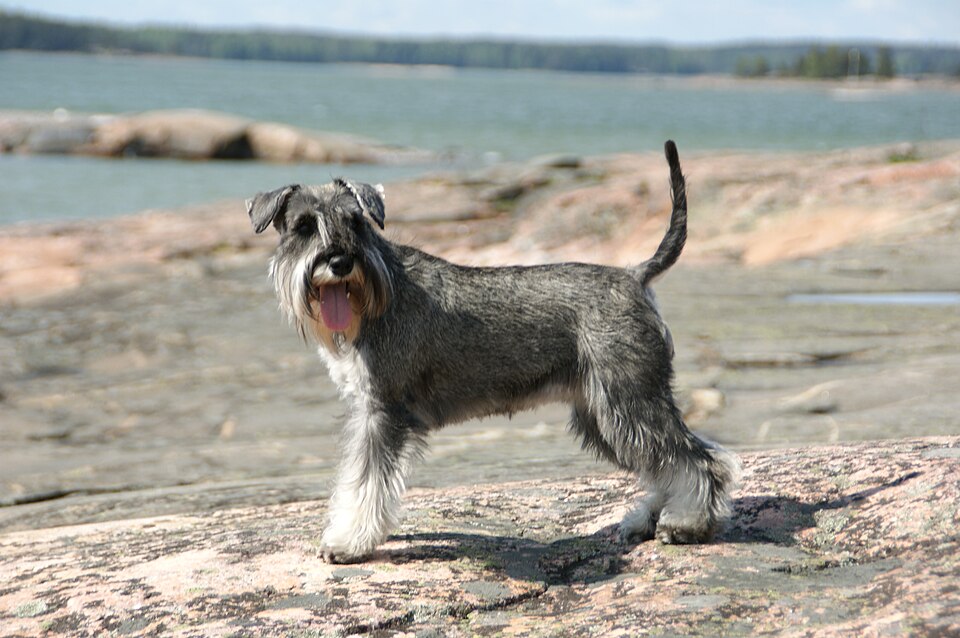
The Miniature Schnauzer is small, strong and stocky rather than slim. According to the FCI, it has a square build: its height at the withers is nearly equal to its body length. Bushy eyebrows, a beard and a mustache are its best-known features.
- Height: According to the FCI, 12–14 inches (30–35 cm) at the withers.
- Weight: The FCI gives about 9–18 pounds (4–8 kg), the AKC 11–20 pounds (5–9 kg). A study based on the veterinary records of 3,857 Miniature Schnauzers in the UK measured an average adult weight of 22 pounds (9.9 kg), so pet dogs tend to be heavier than the standard.
- Coat: A harsh, wiry, dense outer coat over a thick undercoat.
- Color: According to the FCI, four colors: solid black, pepper and salt (from silver gray to dark iron gray), black and silver, and solid white.
- Ears and tail: The FCI standard describes natural, V-shaped ears that fold forward and a natural tail.
In some countries you may see photos of Schnauzers whose ears have been cropped to stand up. In Türkiye, Article 8 of Animal Protection Law No. 5199 bans cutting the ears or tail of a pet to change its appearance; the exception is when a veterinarian considers it medically necessary. Rules vary by country.
Daily care
According to the AKC, the breed sheds very little, but that doesn't mean it's low-maintenance. PDSA recommends brushing 2–3 times a week plus professional clipping or stripping from time to time.
- Groomer: According to the AKC, show dogs have their dead hair plucked out by hand (hand-stripping), while most pet dogs are clipped every 5–8 weeks.
- Baths: The AKC suggests a bath about once a month, depending on the dog's surroundings.
- Teeth: The AKC recommends brushing the teeth often. In a 2019 UK study, periodontal disease was the most commonly recorded problem in this breed.
- Ears and nails: The AKC recommends checking the ears weekly and trimming the nails monthly.
For a step-by-step routine, see our guide to dog grooming.
Training and exercise
PDSA recommends about an hour of exercise a day, and the Royal Kennel Club also considers up to an hour enough. According to the AKC, it's a dog with medium energy that adapts easily to city or country life; chasing a ball in a fenced yard is one of its favorite games.
- Reward-based training: According to the AKC, it learns quickly but is smart enough to get bored with repetition, so keep sessions short, fun and varied. PDSA notes it can be stubborn and needs patience and commitment.
- Early socialization: The AKC considers puppy training classes valuable for both dog and owner.
- Leash: According to the AKC, it has a strong prey drive and should never be off-leash outside a fenced area, because it may not resist the urge to chase a small animal. Our recall training guide can help.
- Barking: To understand the cause and calm it without punishment, read why is your dog barking?
- Dog sports: According to the AKC, it does well at agility, obedience, rally and earthdog events. Sniffing games tire out its brain at home.
 Diet and weight
Diet matters especially in this breed because of its tendencies around blood fats and the pancreas. A complete, balanced dog food that suits its age and activity level is the base, but don't decide on your own which food is right for this breed; talk to your vet.
- Weight: The AKC notes that some Miniature Schnauzers are prone to gaining weight; in the 2019 study, more than 8% of dogs had overweight or obesity recorded. UFAW lists being overweight among the factors that raise the risk of bladder stones.
- Fatty foods: UFAW lists a high-fat diet and being overweight among the factors that can trigger acute pancreatitis. Table scraps and fatty treats count too; ask your vet what's appropriate for your dog.
- Water: According to UFAW, Miniature Schnauzers tend to urinate less often and produce a smaller, more concentrated amount of urine, which can make stones form more easily. Keep fresh water available at all times and take your dog out often for bathroom breaks.
- Treats: Measure food and subtract training treats from the daily amount.
Some human foods are toxic to dogs; check our list of foods you should never give your dog.
 Health issues to know about
The AKC considers the breed generally healthy and long-lived, but some problems are clearly more common in it. The information below is for awareness only; ask your vet about diagnosis and treatment.
High blood fats (hyperlipidemia)
In a 2007 US study of 192 healthy-looking Miniature Schnauzers, about a third had blood triglyceride (a type of fat) levels above the normal range, compared with about 5% of control dogs of other breeds. The problem becomes both more common and more severe with age. It usually causes no signs on its own, but it's thought to be linked to the risk of pancreatitis. Talk to your vet about checking blood fats once your dog reaches middle age.
Pancreatitis
According to UFAW, the Miniature Schnauzer is the breed in which this disease is most common, with an estimated lifetime risk of about 5%. The pancreas's digestive enzymes damage its own tissue. The sudden (acute) form is very painful and can be life-threatening; the more common long-term (chronic) form can progress silently for a long time and eventually lead to diabetes or digestive insufficiency. The most common signs are loss of appetite, vomiting and diarrhea.
Bladder stones
According to UFAW, Miniature Schnauzers have a higher risk of forming calcium oxalate stones than other breeds; the risk is higher in males, overweight dogs and older dogs, and stones often come back. PDSA lists bladder stones and the AKC urinary stones among the breed's predispositions. If a stone blocks the urinary tract, the dog squats again and again but passes very little or no urine; this is an emergency.
Eyes
The AKC mentions cataracts (clouding of the lens), and PDSA mentions progressive retinal atrophy (PRA, a retinal disease that starts with poor night vision and progresses to blindness) and dry eye. The Royal Kennel Club recommends an eye screening scheme for breeders that includes examining the puppies.
Others
PDSA also lists Cushing's disease (in which the body makes too much cortisol), Schnauzer comedo syndrome (blackhead-like plugged hair follicles on the skin), allergic skin disease and intervertebral disc disease. The AKC adds liver shunts (abnormal blood vessels around the liver).
- Repeated vomiting, loss of appetite, diarrhea, weakness or fever
- Squatting again and again and passing little or no urine, or blood in the urine
- Drinking a lot and urinating often (possible sign of diabetes)
- Sudden cloudiness in the eyes, or bumping into things at night
How long does it live?
A 2024 study using data on about 585,000 UK dogs found a median lifespan of 13.3 years for the Miniature Schnauzer (confidence interval 13.2–13.5), based on about 2,000 dogs that had died. In the same study, crossbreed dogs had a median lifespan of 12.0 years.
A smaller study using UK veterinary records from 2013 found a median of 11.6 years, but that figure was based on only 86 deaths. The larger study's result looks more reliable. The AKC gives 12–15 years. Dental care, a healthy weight, a diet planned with your vet and yearly checkups are the most concrete ways to protect this breed's lifespan.
 Before you get one
- Consider a shelter: Purebred dogs end up in shelters and rescues too. Our guide to adopting a shelter dog covers the first steps.
- If you buy from a breeder: Ask to meet the parents and ask for eye screening results. PDSA recommends discussing the health history of the parents and grandparents and thinking very carefully if any of the conditions above run in the family.
- Cropped ears: In Türkiye, cosmetic ear and tail cropping is illegal; steer clear of anyone selling cropped puppies.
- The "hypoallergenic" promise: In a 2012 study, breeds marketed as "hypoallergenic" actually had higher levels of the main dog allergen in their coats, and there was no difference in the air of their homes. If you have allergies, talk to your doctor before getting a dog.
- Red flags: Steer clear of sellers who won't show you the mother, always have puppies available, can't provide paperwork or rush you to "buy now."
- Registration: Rules vary by country; many places require or recommend microchipping. In Türkiye, owned dogs must be microchipped and registered in the PETVET system.
Frequently asked questions
Do Miniature Schnauzers shed? Are they good for people with allergies?
According to the Royal Kennel Club and the AKC, they shed very little. But shedding less isn't the same as not causing allergies: a 2012 study found no evidence to call any breed hypoallergenic. If you have allergies, talk to your doctor and spend some time around the breed first.
What should I feed my Miniature Schnauzer?
Because of the breed's tendency toward high blood fats and pancreatitis, answer this one together with your vet. The general framework: a complete, balanced food your vet approves of, measured portions and a healthy weight.
Do they bark a lot?
As alert watchdogs, often yes; their barking level gets the top score in the AKC's breed traits. Early socialization and reward-based training help reduce it.
Why do some Schnauzers have upright ears?
In some countries the ears are cropped to stand up. Natural ears fold forward. In Türkiye, cosmetic ear cropping is banned under Law No. 5199.
Are the Miniature Schnauzer and the Miniature Pinscher related?
The FCI places both in its Pinscher and Schnauzer group, and the Miniature Schnauzer was once called the "rough-haired Miniature Pinscher," but today they're separate breeds. See our Miniature Pinscher page for details.
Sources
- FCI · Miniature Schnauzer (Zwergschnauzer) breed standard No. 183
- The Royal Kennel Club · Miniature Schnauzer: breed profile and health screening
- AKC (American Kennel Club) · Miniature Schnauzer breed profile
- PDSA · Miniature Schnauzer
- Science for Animal Welfare (UFAW) · Miniature Schnauzer: Pancreatitis and hyperlipidaemia
- Science for Animal Welfare (UFAW) · Miniature Schnauzer: Calcium oxalate urolithiasis
- Xenoulis et al. · Investigation of hypertriglyceridemia in healthy Miniature Schnauzers, Journal of Veterinary Internal Medicine (2007)
- O'Neill et al. · Miniature Schnauzers under primary veterinary care in the UK in 2013: demography, mortality and disorders, Canine Genetics and Epidemiology (2019)
- McMillan et al. · Longevity of companion dog breeds: those at risk from early death, Scientific Reports (2024)
- Vredegoor et al. · Can f 1 levels in hair and homes of different dog breeds: lack of evidence to describe any dog breed as hypoallergenic, Journal of Allergy and Clinical Immunology (2012)
- Mevzuat Bilgi Sistemi (Türkiye) · Animal Protection Law No. 5199 (Article 8: prohibited procedures)
- Resmî Gazete (Türkiye) · Regulation on the identification and registration of cats, dogs and ferrets (February 26, 2018)
By Tüylüm · Last checked: November 3, 2026. Compiled from the sources above and written in our own words. Spotted a mistake? Write to [email protected] and we'll fix it right away. Photo from Wikimedia Commons, used under the license shown below it.