 Tüylüm
Miniature Pinscher
The small, elegant and very lively cousin of the pinschers that hunted rats in Germany. Bold, curious and devoted, it likes to bark and test limits. Its short coat means it feels the cold; luxating kneecaps and Legg-Calvé-Perthes disease of the hip are its key health issues.

 Lifespan≈ 13.7 yearsmedian, 2024 UK study
 Weight9–13 lb (4–6 kg)FCI standard
 Height10–12 in (25–30 cm)FCI standard
 OriginGermanyfirst breed club in 1895
 CoatShort, smooth, shinya weekly brush is enough
 Exercise30+ minutes a dayRKC and PDSA; the AKC suggests more
 With kidsWith supervisionsmall and fragile; better with older kids
 TrainingSmart, independenttests limits; needs patience and consistency
With its short, shiny coat, slender legs and upright stance, the Miniature Pinscher is a small dog with a big sense of self. It developed in Germany as a scaled-down version of the pinschers that hunted rats in stables and homes; today it's a family dog with seemingly endless energy. According to the AKC, fans know it as the "King of Toys." On this page we've pulled together its temperament, care needs and health issues from breed registry standards, animal welfare charities' guides and scientific studies.
- Temperament: According to the FCI standard, lively, spirited, self-assured and even-tempered; the AKC describes it as proud, fearless and fun-loving.
- Energy: Small but very active; in the AKC's breed traits, energy and need for mental stimulation get the top score.
- Voice and training: It loves to bark, is independent and tests limits; it needs patient, consistent, reward-based training.
- Health: Luxating kneecaps and Legg-Calvé-Perthes disease (breakdown of the bone in the hip joint) stand out in this breed; eye screening is also recommended.
- Lifespan: A 2024 UK study found a median lifespan of 13.7 years.
What to know
 What is the Miniature Pinscher like?
The FCI breed standard describes the Miniature Pinscher as lively, spirited, self-assured and even-tempered, and says these qualities make it a pleasant family and companion dog. The AKC also presents it as proud, fearless and fun-loving, a breed with a real personality.
This little dog has an independent side, too. According to the AKC, it's very smart and loves its family, but it also likes to test its owner's limits. PDSA also notes that the breed can be quite stubborn and independent, which can make training a bit more of a challenge. In the AKC's breed traits, barking level and watchdog instinct get the top score, while openness to strangers is moderate.
According to PDSA, Miniature Pinschers are energetic, busy little dogs that love to play and explore at every opportunity. The AKC adds that it enjoys relaxing on the sofa with its owner as much as it loves going outside to chase a few tennis balls.
Every dog is an individual. Breed traits describe general tendencies; the parents' temperament, how a puppy is socialized and the training it gets shape its personality as much as its breed.
 Who is it a good fit for?
The Miniature Pinscher suits people who want a small but active dog, can make time for play and walks every day and can be patient and consistent with training. If you're looking for a calm lapdog, this breed may surprise you.
| Situation | Good fit? |
|---|---|
| Apartment | Good; the Royal Kennel Club agrees, but early training to manage barking is a must |
| Family with kids | With supervision; the AKC recommends supervision with young children, better with older kids |
| Other dogs | Usually gets along; watch play with bigger dogs closely |
| Cold climate | Short-coated and small; needs a coat and a warm bed in winter |
| Long hours alone | May struggle; an energetic dog that wants attention |
| First-time dog owners | Possible, but be ready for its stubbornness and energy |
Young children may want to carry the dog around, and for a dog this size, a fall is a serious accident. It's best to teach children to pet the dog while sitting on the floor and to give the dog a spot to retreat to. For more, see our article on kids and dogs at home.
Where does it come from?
According to the Royal Kennel Club, the Miniature Pinscher is a scaled-down version of the Pinscher, a German breed used for vermin control. The small variety was originally a ratter too; today it lives as a family companion. The first breed club was founded in Germany in 1895, but the breed didn't reach the UK until the 1950s.
According to the FCI standard, Miniature Pinschers were already kept in large numbers around the turn of the 20th century; the 1925 stud book recorded more than 1,300 entries. Of the many color varieties, only red to reddish-brown and black with lighter markings were bred pure. The FCI describes the breed as a smaller image of the German Pinscher, and it sits in the same FCI group as the Miniature Schnauzer.
Appearance and colors
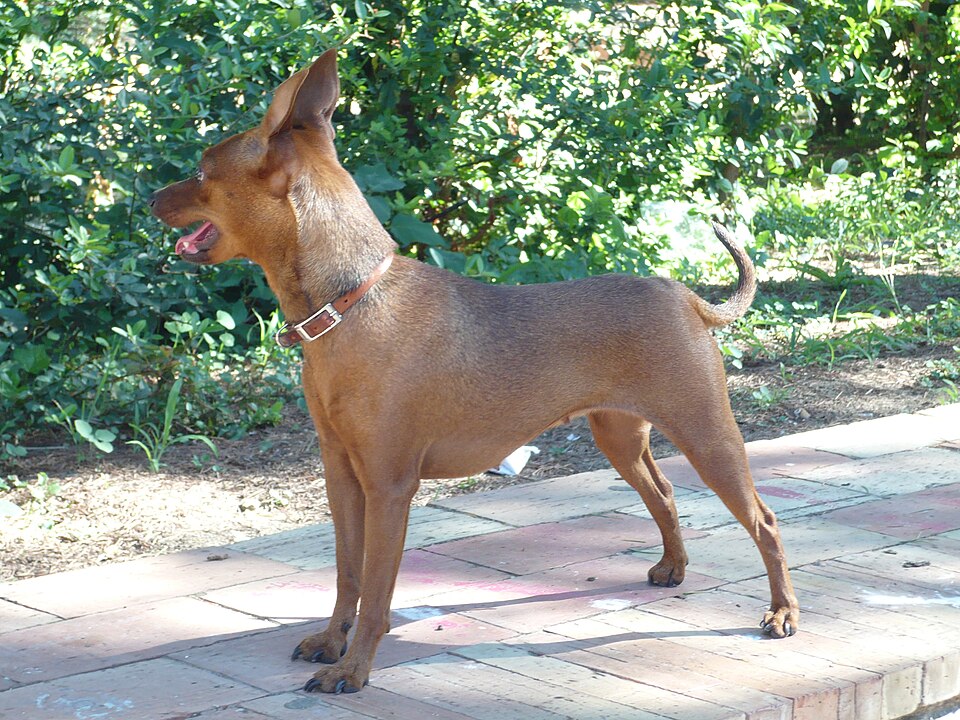
According to the FCI, the Miniature Pinscher is a reduced image of the German Pinscher without the drawbacks of a dwarfed look. Its short, smooth coat shows off an elegant, nearly square build. The skin fits tightly over the whole body.
- Height: According to the FCI, 10–12 inches (25–30 cm) at the withers. The AKC gives 10–12.5 inches (25–32 cm).
- Weight: According to the FCI, 9–13 pounds (4–6 kg); the AKC gives 8–10 pounds (3.6–4.5 kg).
- Coat: Short, dense, smooth, close-lying and shiny.
- Color: According to the FCI, solid deer red to dark reddish-brown, or glossy black with red or brown markings.
- Ears and tail: The FCI standard describes natural ears, either upright or folded forward, and a natural tail.
There's an interesting difference in how it moves. According to the Royal Kennel Club, the breed was developed in the US and the UK with a high-stepping "hackney" action that differs from the standard of its country of origin. The AKC treats this gait as a hallmark of the breed, while the FCI standard lists a hackney gait as a fault.
In some countries you may see Miniature Pinschers with cropped ears and docked tails. In Türkiye, Article 8 of Animal Protection Law No. 5199 bans cutting a pet's ears or tail to change its appearance; the exception is when a veterinarian considers it medically necessary. Rules vary by country.
Daily care
Its short, hard coat makes grooming very easy. The AKC and PDSA say a weekly once-over with a soft brush or a hound glove is enough to keep it shiny. According to the Royal Kennel Club, this breed does shed.
- Nails: The AKC recommends trimming the nails regularly; nails that are too long make a dog uncomfortable.
- Teeth: The AKC recommends brushing often with a dog toothpaste. Start when your dog is a puppy.
- Cold: PDSA notes that small animals have a harder time staying warm in the cold, and that some dogs are happier wearing a coat in cold weather. For a short-coated Miniature Pinscher, a winter coat and a warm bed away from drafts are a good idea. For more, see our article on dogs in cold weather.
- Getting wet: According to PDSA, animals that stay wet and get cold are at risk of hypothermia; dry your dog off after a rainy walk.
- Grooming habits: The AKC says short grooming sessions with a puppy get it used to being handled and strengthen your bond.
Training and exercise
Sources differ a bit on exercise: the Royal Kennel Club and PDSA consider up to half an hour a day enough, while the AKC stresses that the breed is very active and athletic and needs a couple of good walks with its owner every day. In practice, watch your own dog's energy: a half-hour walk plus ball games and short training sessions keeps most Miniature Pinschers happy.
- Reward-based training: According to the AKC, it's smart but independent and tests limits, so basic obedience training is a good idea. PDSA says plenty of practice and patience can overcome its stubbornness.
- Early socialization: The AKC recommends early socialization and puppy training classes to help the dog grow into a well-adjusted adult.
- Leash: A small, quick dog; teach it to walk without pulling while it's young. Our loose-leash walking guide can help.
- Barking: To understand the cause and calm it without punishment, read why is your dog barking?
- Brain games: Its need for mental stimulation is high; sniffing games are a good option on rainy days.
 Diet and weight
Miniature Pinschers don't need a special food; a complete, balanced dog food that suits their age and activity level is enough. The AKC notes that some dogs are prone to gaining weight and that too many treats lead to obesity. In a dog this small, even a few extra treats can change its weight quickly.
- Measure food, and subtract training treats from the daily amount.
- If you can feel the ribs under a thin layer of fat and see a waist when you look from above, the weight is right.
- Always have fresh water available.
Some human foods are toxic to dogs; check our list of foods you should never give your dog.
 Health issues to know about
The AKC considers the Miniature Pinscher a relatively healthy and hardy breed, but some problems stand out. The information below is for awareness only; ask your vet about diagnosis and treatment.
Luxating kneecap
The AKC and PDSA list a kneecap that slips out of place and back again (patellar luxation) among the breed's main health issues. According to PDSA's page on the condition, it's most common in small breeds and signs usually start before a year of age: the dog holds a back leg up and hops for a few seconds, then walks normally. Over time it can lead to arthritis in the knee. The AKC stresses that affected dogs shouldn't be bred.
Legg-Calvé-Perthes disease
Blood supply to the "ball" of the hip joint drops, and the bone dies and crumbles, leaving a stiff, painful hip. According to PDSA, it usually starts at around five months of age and mostly affects small breeds, the Miniature Pinscher among them. The Merck Veterinary Manual also lists the Miniature Pinscher among the breeds at highest risk. Signs include a limp that gets worse over time, a thinner leg from muscle loss, irritability when the leg is touched and reluctance to jump or climb stairs. According to PDSA, most dogs recover well with treatment, but because the disease can be passed on, affected dogs shouldn't be bred.
Foreleg fractures
According to UFAW, fractures of the lower foreleg bones (the radius and ulna) are common in toy breeds, the Miniature Pinscher among them; the most common cause is falling out of someone's arms or jumping from a height. A ramp or steps by the sofa and bed, and careful carrying, reduce the risk.
Eye diseases
PDSA lists progressive retinal atrophy (PRA, a retinal disease that starts with poor night vision and progresses to blindness) and cataracts (clouding of the lens). The Royal Kennel Club recommends an eye screening scheme for breeders that includes examining the puppies, and lists protecting the breed's genetic diversity as a top priority.
Others
The AKC mentions demodectic mange, and lists cervical disc problems, epilepsy, thyroid disease and heart defects among the conditions breeders screen for; PDSA adds urinary stones.
- Not putting any weight on a hind leg, a limp that keeps getting worse or a thinning leg
- Sudden limping after a fall or a jump from a height
- Shivering that won't stop in the cold, weakness or drowsiness
- Cloudy eyes, or bumping into things at night
How long does it live?
A 2024 study using data on about 585,000 UK dogs found a median lifespan of 13.7 years for the Miniature Pinscher (confidence interval 13.1–14.2), based on 167 dogs that had died. In the same study, crossbreed dogs had a median lifespan of 12.0 years. The AKC gives 12–16 years and the Royal Kennel Club more than 12 years.
A median means half of the dogs died before that age and half after, so many Miniature Pinschers live longer. A healthy weight, regular dental care, protection from cold and falls and yearly vet checkups are the most concrete ways to protect that lifespan.
 Before you get one
- Consider a shelter: Purebred dogs and Miniature Pinscher mixes end up in shelters and rescues too. Our guide to adopting a shelter dog covers the first steps.
- If you buy from a breeder: Ask to meet the parents; ask for eye screening results and whether there are knee or hip problems in the line. PDSA recommends discussing the health history of the parents and grandparents.
- Cropped ears and docked tails: In Türkiye, cosmetic ear cropping and tail docking are illegal; steer clear of anyone selling puppies that have had them done.
- Red flags: Steer clear of sellers who won't show you the mother, always have puppies available, can't provide paperwork or rush you to "buy now."
- Registration: Rules vary by country; many places require or recommend microchipping. In Türkiye, owned dogs must be microchipped and registered in the PETVET system.
- The first days: Our guide to the first week with a new puppy walks you through the first night and first week step by step.
Frequently asked questions
Is the Miniature Pinscher a small Doberman?
No. According to the FCI, it's a scaled-down German Pinscher, and the Royal Kennel Club also describes it as a miniature version of the Pinscher.
Do they bark a lot?
Often, yes. In the AKC's breed traits, barking level and watchdog instinct get the top score. Early socialization, enough activity and reward-based training help reduce barking.
Do they get cold in winter?
Yes, they can, because they're small and short-coated. PDSA notes that small animals are at greater risk in the cold. A coat, keeping the dog dry and a warm bed all help.
How much exercise do they need?
The Royal Kennel Club and PDSA say up to half an hour a day, while the AKC stresses that it's a very active, athletic dog. Combine walks, play and short training sessions based on your dog's energy.
Do their ears need to be cropped?
No. The FCI standard describes natural ears, and in Türkiye cosmetic ear cropping and tail docking are banned under Law No. 5199.
Sources
- FCI · Miniature Pinscher (Zwergpinscher) breed standard No. 185
- The Royal Kennel Club · Miniature Pinscher: breed profile and health screening
- AKC (American Kennel Club) · Miniature Pinscher breed profile
- PDSA · Miniature Pinscher
- PDSA · Legg Calvé Perthes disease in dogs
- PDSA · Luxating patella in dogs
- Merck Veterinary Manual · Heritable conformational conditions resulting in canine osteoarthritis (table)
- Science for Animal Welfare (UFAW) · Distal fractures of the radius and ulna in toy breeds
- PDSA · Hypothermia in pets
- McMillan et al. · Longevity of companion dog breeds: those at risk from early death, Scientific Reports (2024)
- Mevzuat Bilgi Sistemi (Türkiye) · Animal Protection Law No. 5199 (Article 8: prohibited procedures)
- Resmî Gazete (Türkiye) · Regulation on the identification and registration of cats, dogs and ferrets (February 26, 2018)
By Tüylüm · Last checked: November 3, 2026. Compiled from the sources above and written in our own words. Spotted a mistake? Write to [email protected] and we'll fix it right away. Photo from Wikimedia Commons, used under the license shown below it.