 Tüylüm
Snowshoe
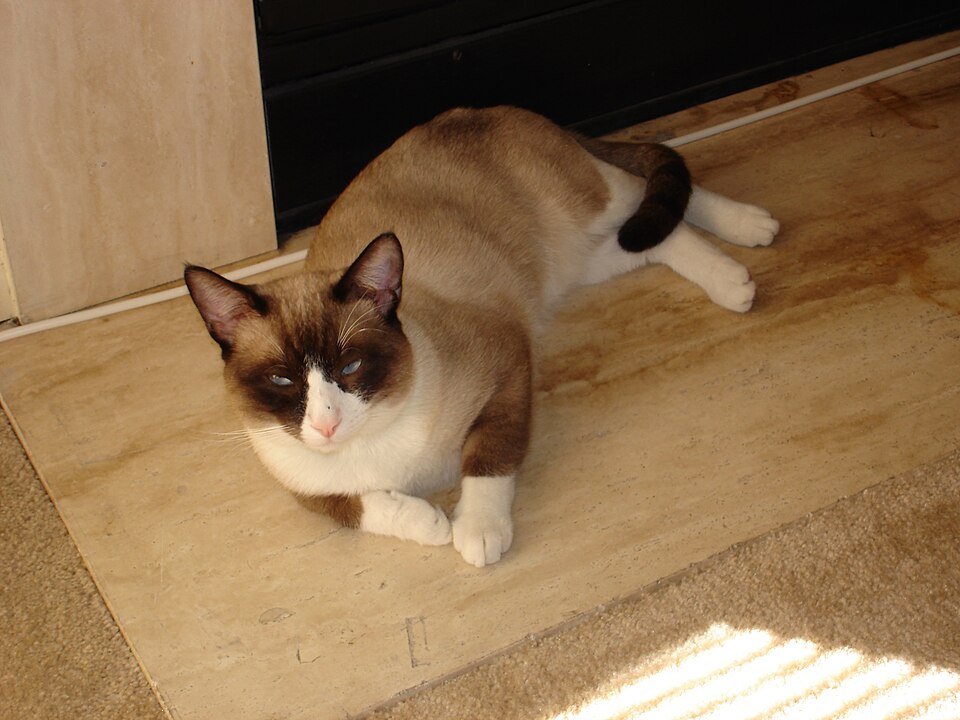
A medium-sized shorthaired cat from 1960s America, known for Siamese-type pointed colors, white "mitten" paws and often a V-shaped white mark on the face. Affectionate, clever and talkative; most bond with one person, and according to the GCCF some prefer to be the only cat.

 LifespanNo datathe GCCF page gives two different ranges
 Weight7–12 lb (3.2–5.4 kg)GCCF: females 7–10, males 9–12 lb
 OriginUSA1960s, Philadelphia
 CoatShort, smoothsingle layer, low upkeep
 EnergyActiveclever and playful; likes fetch (GCCF)
 VoiceTalkativeGCCF: many are talkative
 With childrenUsually goodGCCF: generally compatible
 Other petsUsually compatiblesome prefer to be the only cat
The Snowshoe looks like a cat wearing snowshoes: Siamese-type dark points, deep blue eyes and a set of white "socks" or "mittens." Many also have a V-shaped white mark on the face. This page covers where the breed comes from, its temperament, care, and what we know about its health, along with what we do not know.
- Personality: According to the GCCF, very steady and outgoing, clever and playful, many are talkative, and many bond strongly with one chosen person.
- Looks: Medium-sized, muscular, built like a runner; Siamese colors, white paws and deep blue eyes.
- Origin: Developed in 1960s Philadelphia from Siamese-born kittens with white feet.
- At birth: Kittens are born white; the points darken with age.
- Health: The GCCF says polycystic kidney disease (PKD) has been reported in the breed; ask the breeder about the parents' tests.
- Registration: In Türkiye, microchipping and PETVET registration are mandatory for cats.
What to know
 What is the Snowshoe like?
According to the GCCF, the Snowshoe is very steady and outgoing, especially at shows. It is clever and playful: fishing-rod toys and fetch are favorites. It generally gets along with other cats, dogs and children. Many are talkative, and most bond strongly with a single chosen person. Some prefer to be the only cat.
The ACF's standard also describes the breed as having a "friendly disposition and soft voice." So the two registries' sentences about character fit together.
Every cat is an individual. Breed traits describe general tendencies; meeting people and household sounds as a kitten shapes character at least as much as breed does.
 Who is it a good fit for?
It suits households that can play with a cat, talk with it and spend time with it. Because it bonds strongly with its chosen person, it is often happier with someone who is home a lot.
| Situation | A good fit? |
|---|---|
| Apartment | Yes, but climbing spaces and play are essential |
| Family with children | Usually compatible (GCCF) |
| Other cats and dogs | Usually compatible; some prefer to be the only cat (GCCF) |
| Long hours alone | No breed-specific information found; as a bonded breed, give it attention |
| First-time cat owners | Can be a fit; take its energy and attention needs seriously |
Where does it come from?
According to the GCCF, the breed began in the early 1960s in Philadelphia, Pennsylvania. Dorothy Hinds Daugherty noticed that three Siamese kittens in one litter had white feet and decided to build a breed. She bred them to a tuxedo-marked (black and white) domestic cat; the V-shaped white markings on the face came from that cross.
We could not verify recognition dates by registry in the sources we opened (the GCCF page does not give them), so we write no dates. The GCCF places the breed in Section 4 (Foreign), Group 1. The ACF's standard lists its source as the CCA (Canada) 2013 standard.
 Appearance and colors
The GCCF describes the Snowshoe as a medium-sized, muscular cat built like a runner, with a long, rectangular body: a blend of shorthair sturdiness and Oriental length. The ears are medium-large and triangular, the paws oval. According to the ACF, the head is a broad modified wedge with high cheekbones and gentle contours. The eyes are oval, slanting upward and not protruding.
- Points and white: The coat combines the Himalayan (pointed) pattern with white spotting. The GCCF writes that the combination of white paws, pointed color and deep blue eyes is what sets the breed apart among shorthairs. The V-shaped white mark on the face comes from the cross with the tuxedo cat.
- Colors: According to the GCCF, all Siamese colors, including tabby and tortie. Eye color is deep blue.
- Kittens: The GCCF writes that kittens are born white and the points darken with age. According to the GCCF's Siamese page, point color develops in the cooler parts of the body.
- Coat: According to the ACF, short to medium-short, smooth and fairly close-lying; the ACF treats a plush, woolly or double undercoat and long hair as faults.
- Size: The GCCF page header says 7–12 lb (3.2–5.4 kg); in the text, males are about 9–12 lb (4.1–5.4 kg) and females about 7–10 lb (3.2–4.5 kg). The ACF says balance and proportion matter more than size and that the cat should be surprisingly heavy for its size.
Daily care
Coat care is easy: according to the GCCF, the single-layer, smooth coat needs little grooming, and most Snowshoes groom themselves unless they are ill or stressed. Do nail, ear and dental care the way your veterinarian shows you. For more, see cat grooming.
- Play and mind: A clever, playful cat; give it fishing-rod toys, fetch games, a climbing tree and puzzle feeders. See play for indoor cats and why cats love high places.
- Voice: Many are talkative; think of that as part of the breed.
- One cat or two? The GCCF writes that some prefer to be the only cat; introduce a second cat slowly.
 Diet and weight
We found no special diet advice for the Snowshoe. A balanced, complete cat food suited to age and lifestyle is enough. Measure the food, subtract treats from the daily amount, set the daily amount with your veterinarian, and weigh your cat monthly. For choosing, placing and cleaning bowls, see our food and water bowl guide; always keep clean, fresh water within reach. If you want to mix wet and dry food or switch foods, talk to your veterinarian and make the change gradually.
 Health issues to know about
The following is for information only; ask your veterinarian for diagnosis and treatment.
The GCCF says polycystic kidney disease (PKD) has been reported in the breed. PKD is an inherited disease in which cysts form in the kidneys. We found no further breed-specific health research. Other problems in the Siamese group (some cancers, coughing, asthma-like signs and so on) are listed on the GCCF's Siamese page; they are written about the Snowshoe's ancestor, the Siamese, not the Snowshoe, so we do not transfer them. Ask the breeder:
- Whether the parents were tested or had a kidney scan for PKD.
- How diverse the pedigree is, and whether there is close inbreeding.
- Whether the kitten has had a veterinary check.
As with any cat, regular veterinary checks of the heart, kidneys and teeth are a good starting point.
- Drinking or urinating a lot, loss of appetite, vomiting or weight loss
- Fast or open-mouth breathing
- A swollen belly or back pain
- Hiding and reacting when touched (cats hide pain)
How long does it live?
We found no breed-specific lifespan study for the Snowshoe. The GCCF's Snowshoe page gives two different ranges: 14–20 years in the header and 9–15 years in the care section. Both are a registry's general ranges, not research data, so we do not write a single number. Lifespan is most affected by an ideal weight, regular veterinary checks, spaying or neutering, and a safe home. Asking about the parents' age and health history when you get a kitten fills this gap a little. Regular checks, vaccinations, parasite prevention and dental care are the foundation of care; ask your veterinarian which checks they recommend as your cat ages.
 Before you get one
- Think about shelters too: White-pawed, "tuxedo" shorthaired cats are common in shelters; a loving companion could be waiting there even if it is not a Snowshoe.
- If you buy from a breeder: The breed is rare. Ask to see the mother and father; ask about PKD test results, the pedigree and vaccination records. Stay away from sellers who sell any white-pawed, Siamese-looking cat as a "Snowshoe." The standard calls for a particular pattern and build.
- Red flags: Sellers who will not show the mother, who always have kittens for sale, who offer no paperwork, or who rush you to "buy now."
- Legal registration: In Türkiye, microchipping and PETVET registration are mandatory for cats. Details are in our article on PETVET registration and microchips.
- The first days: International Cat Care recommends starting a new cat in a single room, leaving a place to hide, and waiting for the cat to come out on its own rather than forcing it. Our first week with a new cat article walks through it step by step.
Frequently asked questions
Is the Snowshoe the same as the Siamese?
No. The Snowshoe is a separate breed that combines Siamese-type pointed colors with white spotting; it is also more muscular and less long-bodied than the Siamese. The Siamese has its own page: Siamese.
Why are the kittens born white?
The GCCF says kittens are born white and the points darken with age. In Siamese cats, point color develops in the cooler parts of the body (GCCF).
What colors does it come in?
According to the GCCF, all Siamese colors, including tabby and tortie; eye color is deep blue. White paws and the V-shaped mark on the face are the breed's signature.
Can it be left alone at home?
We found no breed-specific source. The GCCF writes that many Snowshoes bond strongly with one person; do not skimp on attention and play.
Does it get along with children and other pets?
According to the GCCF, generally yes, but some prefer to be the only cat. Keep introductions supervised and slow.
How much does it weigh?
According to the GCCF, males are about 9–12 lb (4.1–5.4 kg) and females about 7–10 lb (3.2–4.5 kg). Work out your own cat's ideal weight with your veterinarian.
Sources
- GCCF (Governing Council of the Cat Fancy) · Snowshoe
- ACF (Australian Cat Federation) · Snowshoe breed standard (sourced from CCA 2013)
- GCCF (Governing Council of the Cat Fancy) · Siamese (inherited problems in the Siamese group and how points form)
- International Cat Care · Helping your new cat or kitten settle in
- Resmî Gazete (Official Gazette of Türkiye) · Regulation on Identification and Registration of Cats, Dogs and Ferrets (February 26, 2018)
By Tüylüm · Last checked: November 10, 2026. Compiled from the sources above and written in our own words. Spotted a mistake? Write to [email protected] and we'll fix it right away. Photo from Wikimedia Commons, used under the license shown below it.