 Tüylüm
Italian Greyhound
A miniature sighthound with roots in ancient Egypt and Greece, once a favorite of Renaissance courts. Affectionate, sensitive and elegant, but its fine bones are prone to foreleg fractures and it feels the cold. Daily tooth brushing and never going off-leash in open areas are key habits.

 Lifespan≈ 14 yearsmedian, 2024 UK study; few dogs
 Weight7–11 lb (3–5 kg)FCI: max 11 lb (5 kg); PDSA 7–10 lb
 Height13–15 in (32–38 cm)FCI standard
 OriginItalyroots in ancient Egypt and Greece
 CoatVery short, silkyweekly care is enough
 Exercise~1 hour a dayPDSA; on leash or in a fenced area
 With kidsBest with older kidsfine bones; risky with little ones
 TrainingSensitivea bit stubborn; harsh methods don't work
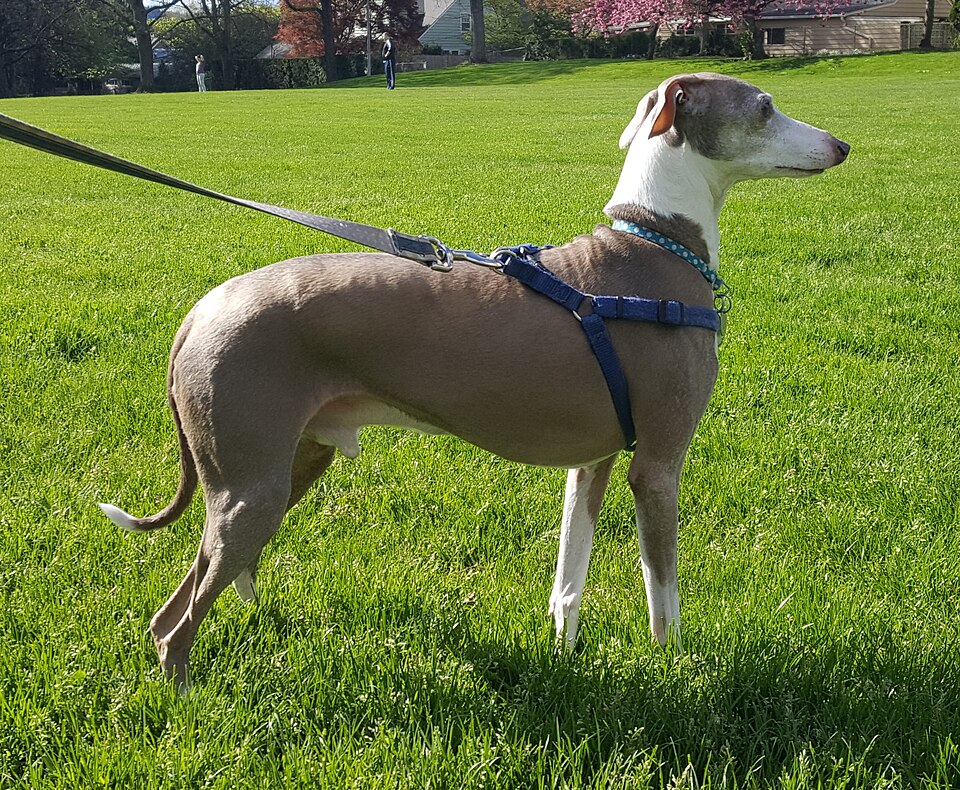
With its long, slender legs, arched back and short, silky coat, the Italian Greyhound looks like a small Greyhound that fits on your lap. The FCI calls it a model of grace and refinement, and the Royal Kennel Club compares its quality to fine Dresden china. But beneath that delicate look is a hunting dog ready to sprint the moment something moves. On this page we've pulled together its temperament, care needs and health issues from breed registry standards, animal welfare charities' guides and scientific studies.
- Temperament: According to the FCI standard, lively, affectionate and docile; the AKC describes it as alert, playful and deeply attached to its family.
- Fragile bones: Foreleg fractures are common in toy breeds, most often from falling out of someone's arms or jumping from a height.
- Cold: Very short-coated and low in body fat; the AKC stresses that it needs extra attention in cold weather.
- Teeth: According to the AKC, the most important grooming task for this breed is brushing the teeth, ideally every day.
- Lifespan: A 2024 UK study found a median lifespan of 14 years, but that figure is based on a small number of dogs.
What to know
 What is the Italian Greyhound like?
The FCI breed standard describes the Italian Greyhound as lively, affectionate and docile. The AKC presents it as alert, playful and highly affectionate, a true "Greyhound in miniature," and adds that while these dogs look decorative on the couch, at heart they're quick coursing hounds with an instinct for pursuit.
According to PDSA, the Italian Greyhound is intelligent but often prefers to do its own thing, which can make training difficult. It can also be quite timid, so early socialization is essential. PDSA adds a lovely detail: it can be slow to form a bond, but once that bond is there, it makes a fantastic companion. In the AKC's breed traits, affection for family and openness to strangers get the top score, and it gets along very well with other dogs.
Every dog is an individual. Breed traits describe general tendencies; the parents' temperament, how a puppy is socialized and the training it gets shape its personality as much as its breed.
 Who is it a good fit for?
The Italian Greyhound suits adults and families with older children who have a calm household, can play with their dog and walk it somewhere safe every day, and can take care with a fragile body.
| Situation | Good fit? |
|---|---|
| Apartment | Possible; small and adaptable indoors, but daily walks and play are a must |
| Family with kids | With older kids; PDSA doesn't consider it ideal for homes with young children because of its bone fragility |
| Other dogs | Usually gets along; take care with big, rough-playing dogs |
| Cats and small pets | Use care; the AKC stresses its chase instinct, and PDSA doesn't consider it ideal for homes with other pets because of its fragile bones |
| Cold climate | A winter coat and a warm bed are a must |
| First-time dog owners | Possible, but it takes patience, gentle training and care |
Young children may want to carry the dog around or wrestle with it; for this breed, both carry a risk of fractures. It's best to teach children to pet the dog while sitting on the floor and to give the dog a spot to retreat to. For more, see our article on kids and dogs at home.
Where does it come from?
According to the FCI standard, the Italian Greyhound descends from small sighthounds that lived at the court of the pharaohs in ancient Egypt. These little hounds passed through Laconia in Greece, where many depictions on vases and bowls confirm their presence, and the breed reached Italy at the start of the 5th century BC. It had its heyday during the Renaissance at the courts of the nobility and appears often in paintings by great Italian and foreign masters.
The Royal Kennel Club also traces the breed back to ancient Egypt and the Roman Empire, noting that dogs of the Italian Greyhound type appear on tombs from those periods. The club adds that early standards for both the Whippet and the Italian Greyhound described "a Greyhound in miniature," but the breeds have since developed along different paths. The FCI classifies it with the short-haired sighthounds; the Royal Kennel Club places it in the toy group.
If you're curious about Anatolia's own sighthound, see our Turkish Greyhound page, and for a slightly bigger cousin, our Whippet page.
Appearance and colors
According to the FCI, the Italian Greyhound is slender, its body fits into a square, and despite its small size it has all the hallmarks of a sighthound. Its head is long and narrow, and its eyes are large and expressive. The small ears fold back; when the dog is alert, the base lifts and the tips stick out to the sides, a position known as "propeller ears."
- Height: According to the FCI, 13–15 inches (32–38 cm) at the withers.
- Weight: The FCI sets a maximum of 11 pounds (5 kg); PDSA gives an average of 7–10 pounds (3–4.5 kg). The AKC gives a wider range of 7–14 pounds (3–6 kg).
- Skin and coat: According to the FCI, the skin is fine and tight all over the body, and the coat is short, silky and fine.
- Color: According to the FCI, solid black, gray or isabella (pale yellowish beige) in all shades; white is accepted only on the chest and feet.
The Royal Kennel Club highlights the breed's elegant, high-stepping gait.
Daily care
Coat care is about as easy as it gets: PDSA and the Royal Kennel Club consider weekly grooming enough. According to the AKC, baths are rarely needed unless the dog gets into something that a gentle brushing can't remove from its very short coat. The real work is the teeth, the nails and the cold.
- Teeth: According to the AKC, the most important grooming task for this breed is brushing the teeth regularly, preferably every day, with a professional dental cleaning by a vet yearly or as needed. PDSA also lists periodontal disease among the breed's predispositions.
- Nails: The AKC recommends keeping the nails short regularly, preferably with a grinding tool, without cutting into the quick.
- Cold: The AKC stresses that this short-coated, low-fat breed needs extra attention in cold weather. PDSA also notes that small, frail animals are more affected by the cold and that some dogs are happier wearing a coat. Have a winter coat and a warm bed away from drafts ready. For more, see our article on dogs in cold weather.
- Getting wet: According to PDSA, animals that stay wet and get cold can develop a dangerously low body temperature; dry your dog thoroughly after a rainy walk.
- Make your home safe: Put a ramp or steps by the sofa and bed, and hold the dog securely with both hands when carrying it.
Training and exercise
PDSA recommends about an hour of exercise a day for the Italian Greyhound, and the Royal Kennel Club also considers up to an hour enough. According to the AKC, playtime covers most of its needs, especially in a home with more than one dog, and it enjoys walks on leash.
- Leash: The AKC stresses that even an obedience-trained Italian Greyhound should never be off-leash outdoors in unfenced areas, because small moving animals can send it running into danger. PDSA also notes that it can be hard to call back once it spots prey and recommends exercising it in an enclosed area.
- Dog parks: The AKC warns that dog parks can be hazardous for this breed unless they're well supervised and have separate areas for small dogs.
- Reward-based training: According to the AKC, the breed responds best to reward-based methods rather than punishment: be firm with commands and generous with praise, and give small treats right away. Harsh methods just don't work with these intelligent, sensitive dogs, even if they can be stubborn. Our recall training guide can help, but never fully trust a sighthound's recall.
- Socialization: PDSA considers early socialization essential because the breed can be timid. Our article on dog body language helps you notice when your dog is scared.
 Diet and weight
Italian Greyhounds don't need a special food; a complete, balanced dog food that suits their age and activity level is enough. According to the AKC, it's easy to let these dogs become overweight, so keeping an eye on calories and weight matters. At a proper weight, the hip bones should just be visible; the ribs shouldn't show but should be easy to feel under a thin layer of flesh.
- Measure food, and subtract training treats from the daily amount.
- Slightly visible hip bones are normal in this breed; judge its weight together with your vet, not just by eye.
- Always have fresh water available.
Some human foods are toxic to dogs; check our list of foods you should never give your dog.
 Health issues to know about
The AKC considers the Italian Greyhound a generally long-lived, healthy breed, adding that it isn't as delicate as it looks but that situations that could lead to a broken leg should be avoided. The information below is for awareness only; ask your vet about diagnosis and treatment.
Foreleg fractures
According to UFAW, fractures of the lower foreleg bones (the radius and ulna) are common in toy breeds, the Italian Greyhound among them. In these breeds, those bones are weaker relative to body weight than in larger dogs, and fractures can happen with only minor trauma. The most common cause is falling out of someone's arms or jumping from a height. These fractures are very painful, sometimes affect both legs at once, and can take months to heal. PDSA also notes that the bones are fragile during growth.
Periodontal disease
PDSA lists periodontal disease, inflammation of the tissues that surround and support the teeth, among the breed's predispositions, which is why the AKC puts tooth brushing at the top of its care list. If you notice bad breath, red gums, tartar or difficulty eating, see your vet.
Anesthesia and sedation
Veterinarians have long known that Greyhounds and related sighthounds can recover more slowly than other breeds after certain injectable anesthetic drugs. A 2020 study showed this may be linked to a gene change affecting a liver enzyme that breaks down these drugs, and that change is found in the sighthound group that includes the Italian Greyhound. PDSA also points out that body temperature can drop during anesthesia. Before a procedure like a dental cleaning, it's a good habit to remind your vet that your dog is a sighthound.
Others
PDSA lists epilepsy, luxating kneecaps and progressive retinal atrophy (PRA, a retinal disease that starts with poor night vision and progresses to blindness). According to the AKC, breeders screen for PRA, autoimmune problems, Legg-Calvé-Perthes disease (in which the bone at the top of the thigh breaks down) and hypothyroidism. The Royal Kennel Club also recommends eye screening.
- Not putting weight on a front leg after a fall or jump, or swelling or deformity of the leg
- Shivering that won't stop in the cold, drowsiness or stumbling
- A seizure (stiffening, jerking, loss of consciousness)
- Bad breath, bleeding from the mouth or trouble eating
How long does it live?
A 2024 study using data on about 585,000 UK dogs found a median lifespan of 14.0 years for the Italian Greyhound. However, the figure is based on only 70 dogs that had died, so the confidence interval is wide (13.2–15.1 years). In the same study, crossbreed dogs had a median lifespan of 12.0 years. The AKC also notes that the breed is generally long-lived and gives 14–15 years.
Regular dental care, a home that's safe from falls, protection from the cold, a healthy weight and yearly vet checkups are the most concrete ways to protect that lifespan.
 Before you get one
- Consider a shelter: Purebred dogs end up in shelters and rescues too. Our guide to adopting a shelter dog covers the first steps.
- If you buy from a breeder: Ask to meet the parents and ask for eye screening results. PDSA recommends discussing the health history of the parents and grandparents.
- "Mini" or "pocket-size" promises: The FCI standard sets a maximum of 11 pounds (5 kg). UFAW notes that the fracture risk in toy breeds seems linked to small body size, so looking for a dog even smaller than the standard isn't a good idea.
- Red flags: Steer clear of sellers who won't show you the mother, always have puppies available, can't provide paperwork or rush you to "buy now."
- Registration: Rules vary by country; many places require or recommend microchipping. In Türkiye, owned dogs must be microchipped and registered in the PETVET system.
- The first days: Our guide to the first week with a new puppy walks you through the first night and first week step by step.
Frequently asked questions
Do Italian Greyhounds really break their legs easily?
Foreleg fractures are common in toy breeds. According to UFAW, the most common cause is falling out of someone's arms or jumping from a height. The AKC says the breed isn't as delicate as it looks, but risky situations should be avoided. Ramps, steps and careful carrying reduce the risk.
Does it need a coat in winter?
Often, yes. The AKC stresses that this short-coated, low-fat breed needs extra attention in the cold, and PDSA notes that small, frail animals are more affected by it.
Can it go off-leash?
Only in a fenced, secure area. The AKC recommends never letting it off-leash outdoors in unfenced areas, even if it's obedience-trained.
What's the difference between an Italian Greyhound and a Whippet?
Both are sighthounds that resemble the Greyhound, but the Italian Greyhound is much smaller: according to the FCI, 13–15 inches (32–38 cm) at the withers, compared with 17.5–20 inches (44–51 cm) for the Whippet. See our Whippet page for details.
How long do they live?
A 2024 UK study found a median lifespan of 14 years, but that figure is based on a small number of dogs. The AKC gives 14–15 years.
Sources
- FCI · Italian Sighthound (Piccolo Levriero Italiano) breed standard No. 200
- The Royal Kennel Club · Italian Greyhound: breed profile and health screening
- AKC (American Kennel Club) · Italian Greyhound breed profile
- PDSA · Italian Greyhound
- Science for Animal Welfare (UFAW) · Distal fractures of the radius and ulna in toy breeds
- PDSA · Hypothermia in pets
- Martinez et al. · Pharmacogenomics of poor drug metabolism in Greyhounds: cytochrome P450 (CYP) 2B11 genetic variation, breed distribution, and functional characterization, Scientific Reports (2020)
- McMillan et al. · Longevity of companion dog breeds: those at risk from early death, Scientific Reports (2024)
- Resmî Gazete (Türkiye) · Regulation on the identification and registration of cats, dogs and ferrets (February 26, 2018)
By Tüylüm · Last checked: November 3, 2026. Compiled from the sources above and written in our own words. Spotted a mistake? Write to [email protected] and we'll fix it right away. Photo from Wikimedia Commons, used under the license shown below it.