 Tüylüm
Basset Hound
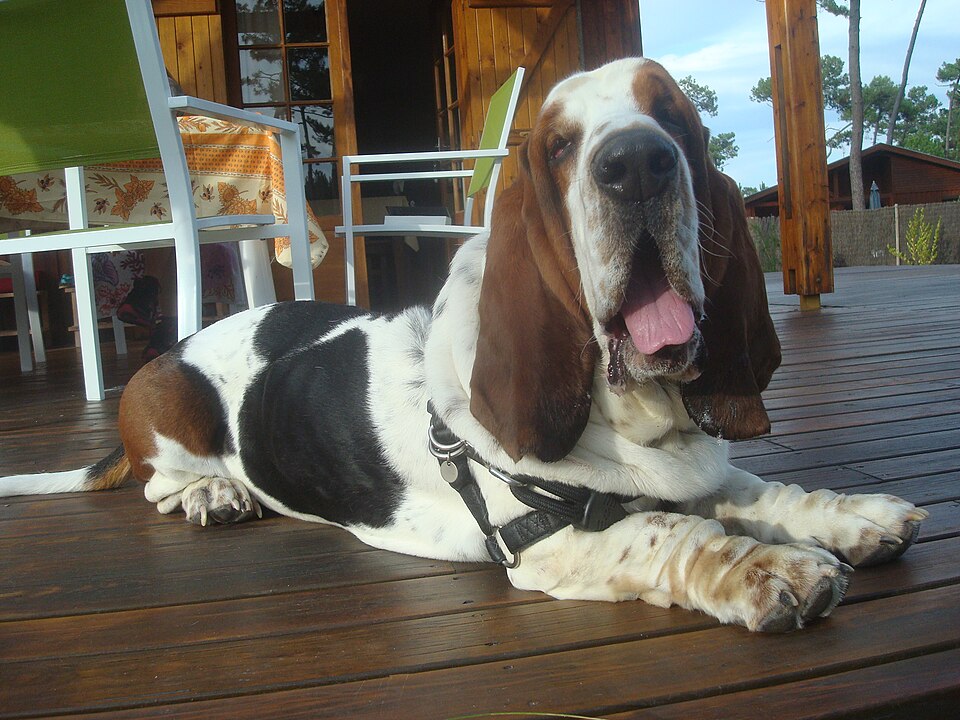
A short-legged, long-bodied scent hound with a deep voice, developed in England from French hounds. Calm and affectionate, it can turn stubborn once its nose takes over. Its long ears, loose skin and short legs set the stage for ear, eye, back and elbow problems.

 Lifespan≈ 12.5 yearsmedian, 2024 UK study
 Weight40–65 lb (18–29 kg)AKC; heavy for its height
 Height13–15 in (33–38 cm)Royal Kennel Club standard
 OriginFrance, EnglandFrench hounds developed in England
 CoatShort, denseweekly; check the skin folds
 ExerciseUp to 1 hour a dayRKC guidance; no jumping or straining
 With kidsCalm, affectionateheavy; support it with both hands
 TrainingNeeds patienceAKC: can be stubborn
With its long, low body, ears that nearly sweep the ground and soulful expression, the Basset Hound is one of the easiest dogs to recognize. It was developed as a scent hound that tracked small game while hunters followed on foot. Today it's mostly a calm family dog, but behind that look are some health issues worth knowing about. On this page we've pulled together its temperament, care needs and health issues from breed registry standards, animal welfare resources and scientific studies.
- Temperament: Placid and affectionate according to the Royal Kennel Club standard, never aggressive or timid. The AKC says it can sometimes be stubborn.
- The nose: A pack hound that follows a trail; once it locks onto a scent, it may not hear you.
- Watch for exaggeration: The Royal Kennel Club puts this breed in its highest concern category: excess skin, overly long ears, eyelid problems and a body too close to the ground.
- Health: A very high risk of ear infections; also prone to back disc, elbow and eye (glaucoma) problems.
- Lifespan: A large 2024 UK study found a median lifespan of 12.5 years.
What to know
 What is the Basset Hound like?
The Royal Kennel Club's breed standard describes the Basset as a tenacious hound that hunts by scent, has a pack instinct and a deep, melodious voice. For temperament, the standard's words are placid, affectionate, and never aggressive or timid. The AKC also describes it as a low-slung, low-key dog, adding that it can sometimes be stubborn.
That "stubbornness" usually comes from its nose. When a Basset picks up a trail, it follows it slowly but with total commitment, and being called in that moment may not matter to it much. At home it's usually calm, close to its family and fond of its comforts.
As a pack hound, it doesn't much enjoy being alone. It may use the deep voice the standard mentions when it's bored or left by itself, and that voice carries easily through apartment walls.
Every dog is an individual. Breed traits describe general tendencies; the temperament of the parents, how a puppy was socialized and the training it gets shape its personality as much as its breed.
 Who is it a good fit for?
The Basset suits households that like a relaxed pace, will take it on short but enjoyable walks every day, and will keep up with ear, skin and weight care.
| Situation | Good fit? |
|---|---|
| Apartment | Possible, but the Royal Kennel Club suggests a large home and its voice is loud. In homes with lots of stairs, think about its back |
| Family with children | Calm and affectionate; it's heavy, so don't let children pick it up or carry it |
| Other dogs | A pack hound; gets along with most dogs |
| Cats and small pets | Careful introductions needed; it's a hound bred for small game |
| Long hours alone | May struggle; it enjoys company |
| First-time owners | Possible, but its health care and recall take patience |
A Basset's short legs and heavy body make jumping from heights a poor fit. Using a ramp for the car or the sofa, and supporting both its chest and hindquarters when you lift it, can help protect its back.
Where does it come from?
According to the Royal Kennel Club, the Basset Hound is of French origin but was developed in England. Hounds from the Artois and Normandy regions of France were being imported into England by the 1860s. In the 1870s, Everett Millais played a key role in shaping the modern breed: his imported hound, Model, became an important foundation for the distinctive English-type Basset, which Millais refined with Beagle and Bloodhound lines.
The Basset Hound Club was founded in 1884, and among its supporters was Queen Alexandra, who kept Basset Hounds at Sandringham. The breed was developed to hunt small game on foot. According to the club, its low build and fine nose served that purpose; its long ears were thought to help hold scent, and its loose, elastic skin to protect it in dense undergrowth.
The point the Royal Kennel Club stresses here matters: these features should stay moderate, so the dog keeps the athleticism, soundness and ground clearance its original job required.
Appearance and colors
The Basset is a short-legged dog with a long, heavy body. Its head is large, its ears very long and folded, and its eyes expressive, with a slightly droopy look.
- Height: 13–15 in (33–38 cm) at the shoulder under the Royal Kennel Club standard.
- Weight: 40–65 lb (18–29 kg) according to the AKC. It's heavy for its height.
- Coat: Short, smooth and close; the standard does not want long or soft hair.
- Color: Usually black, white and tan (tricolor) or lemon and white; the standard accepts any recognized hound color.
Exaggerated features and Breed Watch
The Royal Kennel Club's Breed Watch program lists health concerns that show judges should pay special attention to. The Basset Hound sits in the highest concern category (Category 3). The concerns the club lists are:
- Eyelids that don't sit normally against the eye and turn inward or outward
- Ears that extend more than slightly past the end of the muzzle
- Signs of inflammation in skin folds, hair loss or scarring from earlier skin inflammation
- Too little ground clearance: an overly deep body and/or excess skin
- An incorrect bite
- Being too fat
- Excess skin on the head, body or legs
When choosing a puppy, don't look for the "droopiest," "most wrinkled" or "longest-eared" one; look for one whose parents have healthy-looking eyes, clear the ground comfortably and move freely.
Daily care
Because the coat is short, brushing is easy; the Royal Kennel Club suggests grooming once a week. But with a Basset, the real care isn't the coat; it's the ears, eyes and skin folds.
- Ears: Look inside at least once a week, and wipe ear tips that get dirty on walks with a damp cloth if needed. If you notice a smell, redness, brown discharge or frequent head shaking, see your vet.
- Eyes: If you see redness, discharge or squinting, see your vet without waiting.
- Skin folds: Check the folds around the lips and neck and keep them dry.
- Brushing and bathing: Brush weekly; bathe with a dog shampoo when needed and dry inside the ears.
- Nails and teeth: In a heavy dog, long nails affect how it walks; check them regularly.
See our dog grooming guide for more.
Training and exercise
The Royal Kennel Club recommends up to an hour of exercise a day for the Basset. Calm, steady walks where it can use its nose suit it better than fast running.
- Sniffing: A Basset's favorite job is following a trail. Finding hidden treats and trailing games tire it out both mentally and physically. Our sniffing games article has ideas.
- Leash and recall: A Basset absorbed in a scent may ignore your call. Keep it on leash in unsecured areas and practice recall on a long training line. Our article on dogs that won't come when called can help.
- Patience and rewards: As the AKC says, it can be stubborn. Short, rewarding, repeated sessions work much better than harsh methods.
- Protect its back: UFAW notes that an already degenerated disc can rupture with a jump or fall. Cutting down on jumps from heights with a ramp, plus regular, calm walks, is a sensible routine for this breed.
- Heat: Move summer walks to cooler hours; our article on dogs in hot weather covers the signs of heatstroke.
 Diet and weight
A Basset doesn't need special food; a complete and balanced dog food suited to its age and activity is enough. But weight matters a lot in this breed: the Royal Kennel Club lists being too fat among its Breed Watch concerns. Every extra pound on short legs and a long back loads the joints and spine. A 2013 study that measured 700 dogs of many breeds found that being overweight raised the risk of a slipped disc.
- Measure its food and take treats out of the daily amount.
- You should be able to feel its ribs under a thin layer of fat.
- The Merck Veterinary Manual lists once-daily feeding and eating quickly among the risk factors for bloat; ask your vet about splitting the daily food into two or more meals.
- Don't feed from the table; check our list of foods that are harmful to dogs.
 Health issues to know about
Most of the Basset's health problems are linked to the very features that make it recognizable: long ears, loose skin and short legs. The information below is for awareness; for diagnosis and treatment, talk to your veterinarian.
Ear infections
In a UK study based on 2016 veterinary records, 7.3% of dogs overall were diagnosed with outer ear infection within a year, compared with 28.8% of Bassets. At about 5.9 times the odds of mixed breeds, the Basset was the highest-risk breed in that study. The researchers also point to earlier work reporting more Malassezia yeast on the skin and in the ear canals of Bassets. Regular ear checks are essential for this breed.
Back disc disease
Like the Dachshund, the Basset is a "chondrodystrophic" breed: its short legs come from an inherited trait affecting cartilage and bone growth, and that trait is linked to early degeneration of the discs between the vertebrae. A 2013 study notes that disc extrusions are most often reported in long, low breeds such as Dachshunds, Basset Hounds and Pekingese. A 2024 study describes the Basset as the largest chondrodystrophic breed predisposed to slipped discs in the back; among dogs seen at neurology departments, the condition was less common in Bassets than in Dachshunds, the Bassets were older, and they were more often able to walk when discharged. Sudden back pain, weakness or wobbliness in the hind legs is an emergency.
Elbow problems
According to UFAW, an "ununited anconeal process" (UAP), where a part of the elbow joint fails to fuse to the bone, is seen not only in large breeds but also commonly in the Basset; the bone-growth difference behind its short legs may play a role. It's often noticed as a front-leg limp at 5–9 months of age and can lead to arthritis in the elbow. The Royal Kennel Club recommends elbow screening for breeders.
Eyes: glaucoma and eyelids
Glaucoma is a rise in pressure inside the eye and can lead to blindness. Two inherited forms have been studied in Bassets: one in which the drainage angle inside the eye closes (closed-angle glaucoma), and one in which it stays open (open-angle glaucoma). A gene change linked to the open-angle form was found in 2015, and there's a DNA test for it. The Royal Kennel Club recommends that breeders do eye exams, an exam of the drainage angle (gonioscopy) and this DNA test. According to the Merck Veterinary Manual, in sudden glaucoma the white of the eye turns red, the cornea gets cloudy, the pupil is dilated and the eye is painful; a dog with these signs should see a vet immediately. Eyelids that don't sit properly and turn in or out can also cause irritation.
Bloat (GDV)
The Merck Veterinary Manual lists the Basset Hound among the breeds at risk of gastric dilatation-volvulus, a life-threatening emergency in which the stomach fills with gas and twists. Signs include trying to vomit without bringing anything up, drooling, restlessness and a swollen belly.
Other
The Royal Kennel Club also recommends a DNA test for Lafora disease (a progressive form of epilepsy).
- Trying to vomit without bringing anything up, a quickly swelling belly, restlessness
- Sudden back pain, crying out, weakness or dragging of the hind legs
- Sudden redness, cloudiness or pain in an eye, or squinting
- Severe ear pain or a head tilt
How long does it live?
A 2024 UK study using data on about 585,000 dogs from 18 different sources found a median lifespan of 12.5 years for the Basset Hound; the median for mixed-breed dogs was 12.0 years. The AKC gives an expected lifespan of 12–13 years, and the Royal Kennel Club lists the breed's lifespan as "over 10 years."
A healthy weight, regular ear and eye checks and a daily routine that protects its back are the most practical ways to help a Basset live a long, comfortable life.
 Before you get one
- Consider a shelter: Purebred dogs end up in shelters and rescues too. Our article on adopting a dog from a shelter covers the first steps.
- If you buy from a breeder: Ask to meet the parents. Ask for their eye exam and gonioscopy results, their DNA results for open-angle glaucoma and Lafora disease, and their elbow screening.
- Look at the build: Avoid puppies from parents with red or droopy eyes, bodies very close to the ground or heavily folded skin.
- Red flags: Avoid sellers who won't show you the mother, always have puppies available or can't provide paperwork.
- Registration: In Türkiye, owned dogs must be microchipped and registered in the PETVET system. Details are in our article on PETVET registration and microchipping; rules vary by country.
- The first days: Our article a new puppy at home: the first week covers the first week step by step.
Frequently asked questions
Is the Basset Hound a lazy dog?
It's a calm dog, not a lazy one. The Royal Kennel Club still recommends up to an hour of exercise a day. A Basset that doesn't move enough gains weight easily, and that puts strain on its back and joints.
Why are its ears such a problem?
Long, floppy ears make it harder for air to reach the ear canal. In a UK study, Bassets were the highest-risk breed for being diagnosed with outer ear infection within a year: 28.8% of Bassets were diagnosed in a single year. Weekly checks and early treatment are very important.
Can a Basset use stairs?
The Basset is one of the short-legged breeds prone to back disc disease. There's no solid evidence that stairs alone are harmful, but it makes sense to cut down on jumps from heights with a ramp and to support both its chest and hindquarters when you lift it. If you notice signs of back pain, talk to your vet.
Do Bassets bark a lot?
The standard describes its voice as "deep and melodious." It may use it when it finds a scent, gets bored or is left alone. Enough walks, scent games and gradually getting used to being alone help; see our article on why your dog is barking.
Can I keep a Basset with a Beagle?
Both are pack hounds and usually get along well with other dogs. But their pace is different: the Beagle is faster and more active. To get to know the Beagle, see our Beagle page.
Sources
- The Royal Kennel Club · Basset Hound: breed profile and health tests
- The Royal Kennel Club · Basset Hound breed standard
- The Royal Kennel Club · Breed Watch: Basset Hound (Category 3)
- AKC (American Kennel Club) · Basset Hound breed profile
- McMillan et al. · Longevity of companion dog breeds: those at risk from early death, Scientific Reports (2024)
- O'Neill et al. · Frequency and predisposing factors for canine otitis externa in the UK, Canine Medicine and Genetics (2021)
- Packer et al. · How long and low can you go? Effect of conformation on the risk of thoracolumbar intervertebral disc extrusion in domestic dogs, PLOS ONE (2013)
- Thatcher et al. · Incidence and clinical characterisation of thoracolumbar intervertebral disc extrusions in Basset Hounds compared with Dachshunds, Veterinary Record (2024)
- Science for Animal Welfare (UFAW) · Dachshunds: Intervertebral disc disease (chondrodystrophic breeds)
- Science for Animal Welfare (UFAW) · Basset Hound: Elbow dysplasia (ununited anconeal process)
- Oliver et al. · Two independent mutations in ADAMTS17 are associated with primary open angle glaucoma in the Basset Hound and Basset Fauve de Bretagne, PLOS ONE (2015)
- Oliver et al. · Primary closed angle glaucoma in the Basset Hound: genetic investigations, Molecular Vision (2019)
- Merck Veterinary Manual · Glaucoma in dogs (pet owner version)
- Merck Veterinary Manual · Gastric dilation and volvulus in small animals
- Official Gazette of Türkiye · Regulation on the identification and registration of cats, dogs and ferrets (February 26, 2018; in Turkish)
By Tüylüm · Last checked: November 3, 2026. Compiled from the sources above and written in our own words. Spotted a mistake? Write to [email protected] and we'll fix it right away. Photo from Wikimedia Commons, used under the license shown below it.