 Tüylüm
Dachshund
A brave, long-bodied, short-legged hunting dog developed in Germany to go into badger and rabbit burrows. It comes in standard and miniature sizes and three coat types. The key health issue is back disc disease: it affects about one in four Dachshunds, and sudden signs are an emergency.

 Lifespan13–14 yearsmedian: standard 13.2, miniature 14.0 years
 Weight10–26 lb (4.5–12 kg)RKC: mini ≈ 10 lb, standard 20–26 lb
 Height5–9 in (13–23 cm)AKC: mini 5–6 in, standard 8–9 in
 OriginGermanythe Teckel; known since the Middle Ages
 CoatThree typessmooth, long and wire
 ExerciseUp to 1 hour a dayRKC guidance; inactivity is bad for the back
 With kidsWith supervisionkids shouldn't pick it up and carry it
 TrainingA determined hunterneeds rewards and patience
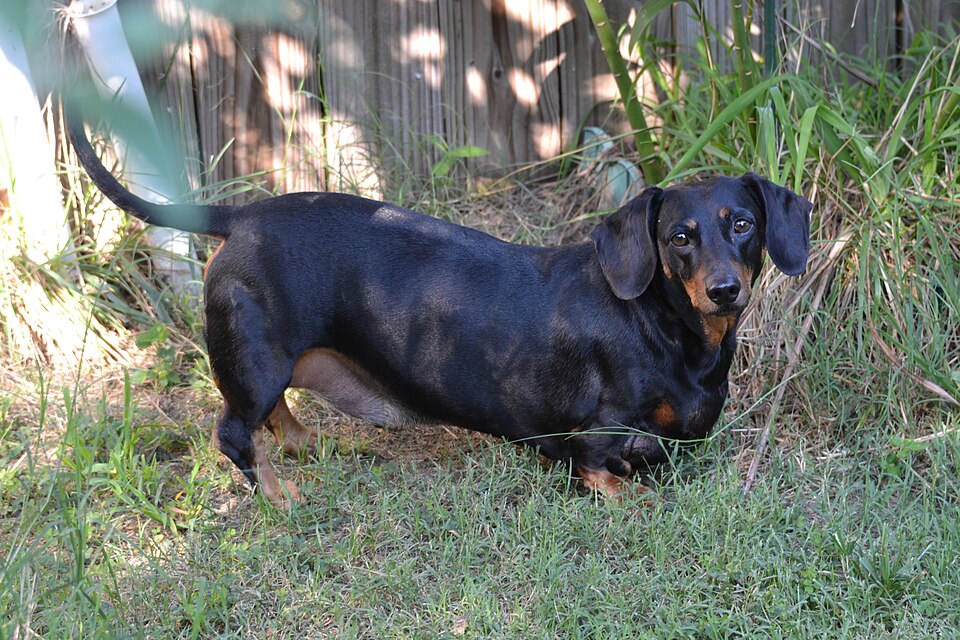
The Dachshund is a hunting dog you recognize at a glance by its long body and short legs. According to the Royal Kennel Club, it's known in Germany as the Teckel, meaning "badger dog," and its original job was to go into underground burrows after badgers and rabbits. The same long, low body is also linked to the breed's most important health problem, back disc disease. On this page we've pulled together its temperament, care needs and health issues from breed registry standards, animal welfare resources and scientific studies.
- Temperament: Intelligent, lively and loyal, and "courageous to the point of rashness," according to the Royal Kennel Club standard; a persistent hunter with an excellent nose.
- Sizes and coats: There are standard and miniature sizes, with smooth, long and wire coats. Germany also recognizes a third, "rabbit" size.
- The back: According to UFAW, about a quarter of Dachshunds have disc disease at some point in their lives. A healthy weight and regular exercise are the best protection.
- Color: Breeding two dapple dogs together can produce puppies with vision and hearing problems.
- Lifespan: In a large UK study, the median lifespan was 13.2 years for standards and 14.0 years for miniatures.
What to know
 What is the Dachshund like?
The Royal Kennel Club's breed standard describes the Dachshund as intelligent, lively, obedient and "courageous to the point of rashness," a persistent hunter and tracker with an excellent nose. For temperament, the standard's words are faithful, versatile and good-tempered. The AKC also highlights the breed's alert expression and bold, vivacious personality.
As you'd expect from a dog bred to face badgers in underground burrows, the Dachshund is small but self-assured. It can follow a scent or a movement with total determination and can be persistent about getting what it wants. As the standard stresses, it's loyal to its family.
According to the FCI standard, this breed uses its voice while trailing on a hunt and was bred to go to ground. So it's not surprising when a bored Dachshund barks or digs up the yard; the answer is usually more to do and more exercise.
Every dog is an individual. Breed traits describe general tendencies; the temperament of the parents, how a puppy was socialized and the training it gets shape its personality as much as its breed.
 Who is it a good fit for?
The Dachshund suits owners who can live in a small home, walk it every day, take protecting its weight and back seriously and patiently keep up with its determined personality.
| Situation | Good fit? |
|---|---|
| Apartment | Good fit; the Royal Kennel Club says a small home is enough. Watch the barking and protect its back |
| Family with children | With supervision; it's small and long-bodied, so don't let children pick it up and carry it around |
| Other dogs | Usually fine; early socialization matters |
| Cats and small pets | Careful introductions needed; it was bred to hunt rabbits and badgers |
| Long hours alone | May struggle; a bored Dachshund may bark and dig |
| First-time owners | Possible, but health monitoring and patient training are needed |
When you pick up a Dachshund, support its chest with one hand and its hindquarters with the other; don't lift it by the front legs or under the armpits and let its body dangle. Teach the kids in the house to do the same. See our article on children and dogs at home for more.
Where does it come from?
According to the FCI breed standard, the Dachshund, also called the Dackel or Teckel in German, has been known since the Middle Ages. It was developed from hunting hounds called Bracken by consistently selecting the short-legged dogs best suited to hunting underground. The standard stresses that the Dachshund also works very well above ground: trailing while giving voice, flushing game and tracking wounded game. The oldest club devoted to the breed is the Deutsche Teckelklub, founded in 1888.
Sizes and coat types
According to the FCI, the Dachshund has been bred for decades in three sizes (standard, miniature and rabbit) and three coat types (smooth, wire and long), making nine varieties. In Germany, sizes are defined not by weight but by chest circumference, measured after 15 months of age: about 14.5–18.5 in (37–47 cm) for standard males, 12.5–14.5 in (32–37 cm) for miniature males and 10.5–12.5 in (27–32 cm) for rabbit-size males, with females slightly smaller.
In the UK there are two sizes; according to the Royal Kennel Club, miniatures should preferably weigh under 11 lb (5 kg). All six varieties share the same standard. In the US, the AKC recognizes standard and miniature sizes in the same three coat types.
Appearance and colors
The Dachshund is a low, short-legged, long but compact and very muscular dog. Under the Royal Kennel Club standard, its body should be moderately long in proportion to its height, with no exaggeration, and the ground clearance should be at least a quarter of its height at the withers so it can move freely.
- Weight: According to the Royal Kennel Club, the ideal weight for a standard Dachshund is 20–26 lb (9–12 kg); for a miniature, the ideal is 10 lb (4.5 kg), with 11 lb (5 kg) as the desired maximum. The AKC gives 16–32 lb (7–14.5 kg) for standards and 11 lb (5 kg) and under for miniatures.
- Height: According to the AKC, 8–9 in (20–23 cm) at the shoulder for standards and 5–6 in (13–15 cm) for miniatures.
- Coat: Dense, short and shiny in smooths; silky with feathering in longhairs; a harsh, dense topcoat with a beard in wires.
- Color: The Royal Kennel Club standard accepts red, black and tan, chocolate and tan, and the dappled form of these colors. Cream is accepted in miniature smooths and longhairs, wild boar in wires, and brindle in some varieties.
Color and health: the dapple pattern
"Dapple," known in other breeds as "merle," is a pattern of lighter patches on a darker base. Dogs carrying one copy of the gene are at much lower risk, but when two dapple dogs are bred together, some puppies get two copies (double dapple, or double merle). In a 2009 study of 153 merle dogs of various breeds, 10% of dogs with two copies were deaf in one ear and 15% were deaf in both; among dogs with one copy, those figures were 2.7% and 0.9%.
That's why, since January 1, 2010, the Royal Kennel Club has refused to register Dachshund puppies whose parents are both dapple, citing the vision and hearing problems linked to the dapple gene. A 2021 study of 140 Dachshunds also reports that some dogs, especially red-coated ones, can be "hidden" carriers whose pattern doesn't show at all, and that one such dog produced a double merle puppy born without eyes. The researchers recommend genetic testing before breeding.
Non-standard colors
The Royal Kennel Club standard does not accept double dapple, blue, isabella (a pale, grayish-beige color), piebald or tricolor. Even so, these colors have become fashionable, especially in miniatures: the club places the miniature smooth Dachshund in its highest category for non-standard color registrations. As the club reminds buyers, health and temperament should come before color when choosing a puppy.
Daily care
Grooming depends on the coat type. The Royal Kennel Club suggests grooming once a week for smooths and more than once a week for longhairs and wires.
- Smooth: Wipe over once a week with a soft brush or grooming glove.
- Long: Comb several times a week, behind the ears, on the chest and on the leg feathering, before knots form.
- Wire: It has a dense, harsh topcoat with an undercoat, a beard and bushy eyebrows; comb it several times a week.
- Ears and nails: Look inside the ears weekly and check the nails regularly.
- Teeth: Get your puppy used to tooth brushing early.
See our dog grooming guide for brushing and nail care.
Training and exercise
The Royal Kennel Club recommends up to an hour of exercise a day for the Dachshund. Regular activity matters in this breed not just to burn off energy but for the health of its back: in a 2015 UK survey of 2,031 Dachshunds (DachsLife), disc disease was more common in dogs exercised less than 30 minutes a day and less common in dogs exercised more than an hour a day.
- Sniffing: It's a hunting dog with an excellent nose. Treat hunts and trailing games tire it out mentally too. Our sniffing games article has ideas.
- Reward-based training: It's a determined dog; short, rewarding, patient sessions work best.
- Leash: For a short-legged, long-backed dog, you may prefer a well-fitting harness to a neck collar. To teach loose-leash walking, see our loose-leash training article.
- Barking: The Dachshund likes to use its voice. To find the reason, see our article on why your dog is barking.
Stairs and jumping
This is the question owners ask most. UFAW notes that an already degenerated disc can rupture during an ordinary movement such as jumping or climbing. On the other hand, in the DachsLife survey, dogs that used stairs every day or were allowed to jump on and off furniture did not have more disc disease; the researchers stress that these findings don't prove cause and effect and need to be tested in new studies. Based on what we know today, the most sensible approach isn't to keep the dog inactive. It's to keep it fit with regular walks, cut down on jumps from heights (into the car, onto a high bed) with a ramp, and keep its weight healthy.
 Diet and weight
A Dachshund doesn't need special food; a complete and balanced dog food suited to its age and activity is enough. But in this breed, weight is directly tied to back health. In a 2013 study that measured 700 dogs of many breeds, dogs with longer backs relative to their height, dogs that were overweight and dogs with smaller skeletons had a higher risk of a slipped disc. The researchers stress that keeping a lean body is especially important in high-risk breeds.
- Measure its food, and take treats out of the daily amount.
- If you can feel its ribs under a thin layer of fat and see a waist when you look down from above, its weight is about right.
- The Royal Kennel Club also lists being too thin as a concern for miniatures at shows; the goal is an ideal weight, not a skinny dog.
- Don't feed from the table; check our list of foods that are harmful to dogs.
 Health issues to know about
The information below is for awareness; for diagnosis and treatment, talk to your veterinarian.
Intervertebral disc disease (IVDD)
The discs between the vertebrae act like small cushions that absorb shock when the dog moves. According to UFAW, the inherited trait that gives the Dachshund its short legs (chondrodystrophy) is linked to these discs starting to degenerate very early, at just a few months old. A degenerated disc hardens and can eventually burst out and press on the spinal cord. That can cause severe pain, paralysis and sometimes permanent damage.
- How common? UFAW says about 25% of Dachshunds develop disc disease that needs veterinary treatment during their lives. In the DachsLife survey the rate was 15.7%; it was highest in standard smooths (24.4%) and lowest in standard wires (7.1%). Older dogs and neutered dogs were at higher risk; talk through the decision and timing of neutering with your vet.
- When? According to UFAW, about 80% of cases occur between 3 and 7 years of age.
- Signs: Reluctance to climb stairs or jump into the car, crying out for no clear reason, standing with the head low and back hunched, avoiding lowering the head to eat, unexplained restlessness or panting. With discs in the neck, neck pain; with discs in the back, weakness, wobbliness or paralysis in the hind legs, and in severe cases loss of bladder and bowel control.
- Why it's urgent: UFAW stresses that how quickly treatment starts can greatly affect the outcome. If you see signs, don't wait to see whether they "pass."
- Sudden weakness, wobbliness, knuckling or dragging of the hind legs, or inability to walk
- Crying out for no reason, a hunched back, pain when touched
- Reluctance to raise or lower the head, neck pain
- Loss of bladder or bowel control
Spine screening
Using a method that Scandinavian countries have used for years, X-rays of the back are taken between 2 and 4 years of age and the number of hardened (calcified) discs is counted. According to UFAW, that number is linked to a dog's chance of developing disc disease later. In the UK, the screening program has been run by the Royal Kennel Club since May 25, 2021 and is encouraged for all six varieties. The goal is to lower the risk in future generations by breeding from dogs with few calcified discs.
Eyes and other inherited diseases
- Progressive retinal atrophy (cord1-PRA): An inherited disease in which the light-sensitive layer of the eye gradually breaks down; the Royal Kennel Club recommends a DNA test for the miniature varieties.
- Lafora disease: A progressive form of epilepsy. The known gene change was first described in miniature wirehaired Dachshunds, and the Royal Kennel Club lists the DNA test among the key tests for that variety.
- Eye irritation: The Royal Kennel Club lists redness, discharge and tear staining among the concerns for show judges in miniature smooths.
How long does it live?
A 2024 UK study using data on about 585,000 dogs from 18 different sources found a median lifespan of 13.2 years for standard Dachshunds and 14.0 years for miniature Dachshunds. In the same study the median for mixed-breed dogs was 12.0 years, so Dachshunds are among the breeds that live longer than average. The AKC gives an expected lifespan of 12–16 years.
Over a long life, protecting the back is the most important job: a healthy weight, regular exercise and acting fast when signs appear.
 Before you get one
- Consider a shelter: Dachshunds and Dachshund mixes end up in shelters and rescues too. Our article on adopting a dog from a shelter covers the first steps.
- If you buy from a breeder: Ask to meet the parents. Ask about spine X-ray screening if available, eye exams and, depending on the variety, PRA and Lafora DNA tests.
- Watch the color: Avoid puppies from two dapple parents. Be wary of sellers who charge more for "rare colors" such as blue, isabella or double dapple.
- Not extra-long, not extra-tiny: Dogs with exaggerated long backs, chests very close to the ground or marketed as extra-tiny carry more health risk; the authors of the 2013 study also write that selection for longer backs and miniaturization should be discouraged.
- Registration: In Türkiye, owned dogs must be microchipped and registered in the PETVET system. Details are in our article on PETVET registration and microchipping; rules vary by country.
- The first days: Our article a new puppy at home: the first week covers the first week step by step.
Frequently asked questions
Can a Dachshund use stairs?
The evidence is mixed. Discs are known to rupture during jumping or climbing, but in a UK survey of 2,031 Dachshunds, dogs that used stairs every day did not have more disc disease. The most sensible approach is to keep the dog fit and at an ideal weight and cut down on jumps from heights with a ramp. If you see signs of back pain, see your vet right away.
What are the signs of disc disease?
Reluctance to move, crying out for no reason, a hunched back, avoiding lowering the head; in more advanced cases, weakness, wobbliness or paralysis in the hind legs. These signs are an emergency; the sooner treatment starts, the better the outcome can be.
Are miniature Dachshunds healthier?
Size alone doesn't decide it. In the 2024 UK study, miniatures had a slightly longer median lifespan (14.0 years) than standards (13.2 years). Disc disease, however, occurs in every size. The parents' health screening matters much more than size.
Should I get a blue or isabella Dachshund?
The Royal Kennel Club standard doesn't accept these colors, and the club stresses that health and temperament should come before color. For puppies sold at high prices as "rare colors," be especially sure to ask about the parents' health tests, and avoid puppies from two dapple parents.
Sources
- FCI · Dachshund breed standard (No. 148)
- The Royal Kennel Club · Dachshund (Smooth Haired): breed profile, health tests and breeding restrictions
- The Royal Kennel Club · Dachshund (Miniature Smooth Haired): breed profile and health tests
- The Royal Kennel Club · Dachshund breed standard
- The Royal Kennel Club · Breed Watch: Dachshund (Miniature Smooth Haired)
- AKC (American Kennel Club) · Dachshund breed profile
- Science for Animal Welfare (UFAW) · Dachshunds: Intervertebral disc disease (IVDD)
- Packer et al. · DachsLife 2015: an investigation of lifestyle associations with the risk of intervertebral disc disease in Dachshunds, Canine Genetics and Epidemiology (2016)
- Packer et al. · How long and low can you go? Effect of conformation on the risk of thoracolumbar intervertebral disc extrusion in domestic dogs, PLOS ONE (2013)
- Dachshund Health UK · IVDD X-ray screening programme
- McMillan et al. · Longevity of companion dog breeds: those at risk from early death, Scientific Reports (2024)
- Strain et al. · Prevalence of deafness in dogs heterozygous or homozygous for the merle allele, Journal of Veterinary Internal Medicine (2009)
- Ballif et al. · The PMEL gene and merle (dapple) in the dachshund: cryptic, hidden, and mosaic variants, Human Genetics (2021)
- Hajek et al. · NHLRC1 repeat expansion in two beagles with Lafora disease, Journal of Small Animal Practice (2016)
- Official Gazette of Türkiye · Regulation on the identification and registration of cats, dogs and ferrets (February 26, 2018; in Turkish)
By Tüylüm · Last checked: November 3, 2026. Compiled from the sources above and written in our own words. Spotted a mistake? Write to [email protected] and we'll fix it right away. Photo from Wikimedia Commons, used under the license shown below it.