 Tüylüm
Shar Pei
A calm, independent, people-devoted dog from China, known for its wrinkled skin, sandpaper-harsh coat and blue-black tongue. The inherited skin change behind the wrinkles is also linked to inward-turning eyelids, ear and skin inflammation, recurring fevers and kidney amyloidosis.

 Lifespan≈ 10.6 yearsmedian, 2024 UK study; mixed breeds 12.0
 Weight45–60 lb (20–27 kg)AKC
 Height18–20 in (46–51 cm)Royal Kennel Club standard
 OriginChinafrom old guard, hunting and fighting dogs
 CoatShort, very harshno undercoat; weekly care
 ExerciseUp to 1 hour a dayRoyal Kennel Club guidance
 EyesHigh riskabout 1 in 5 treated for eyelid problems each year
 TrainingIndependentstandard: calm, independent, devoted
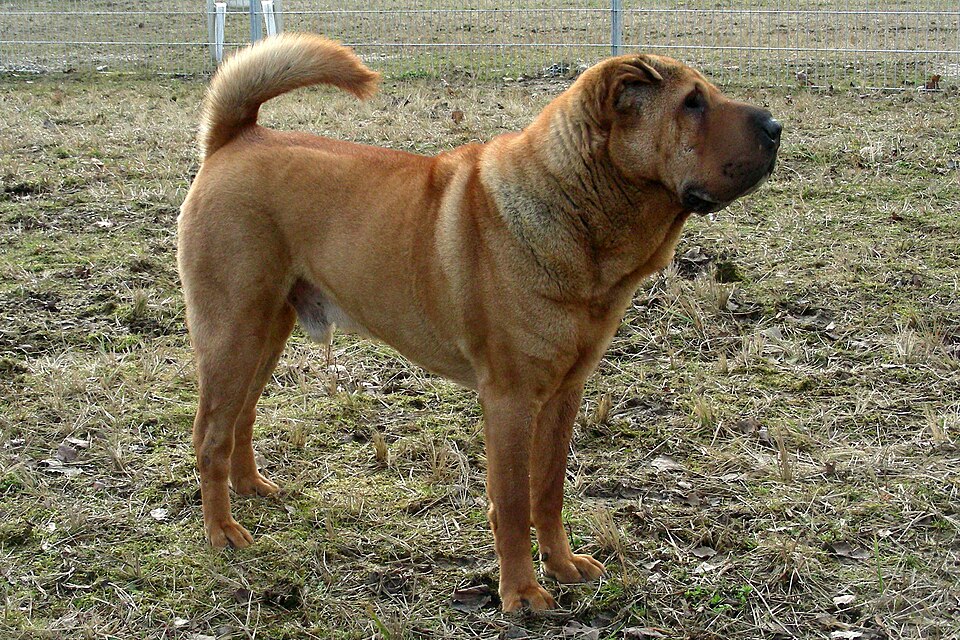
The Shar Pei, with its thick, wrinkled skin, broad muzzle and blue-black tongue, is an instantly recognizable dog from China. Its name means "harsh sandy coat" or "sandpaper skin" in Chinese. It has a calm, independent temperament and is deeply devoted to its people. But the thick, folded skin that makes the breed so recognizable comes from an inherited change, and it's linked to eye, skin, ear and kidney problems. On this page we've pulled together its temperament, care needs and health issues from breed registry standards, animal welfare resources and scientific studies, honestly and without blame.
- Temperament: According to the breed standard, calm, independent, very affectionate and devoted to people.
- Wrinkles: The skin folds come from an inherited change that causes overproduction of a substance called hyaluronic acid.
- Eyes: In UK data, about one in five Shar Peis sees a vet each year for inward-turning eyelids (entropion).
- Fever and kidneys: Recurring "Shar Pei fever" and amyloidosis, which affects the kidneys, are important issues in this breed.
- Choosing a pup: Favor parents with moderate wrinkling and healthy eyes; ask for eye exam and glaucoma DNA test results.
- Lifespan: A large 2024 UK study found a median lifespan of 10.6 years.
What to know
 What is the Shar Pei like?
The Royal Kennel Club's breed standard describes the Shar Pei as calm, independent, very affectionate and devoted to people. Its independent nature may mean it isn't a dog that wants attention every moment.
The breed's history includes guarding, hunting and fighting. In a 2023 VetCompass study, aggression was the fourth most commonly recorded problem in Shar Peis (about 5% a year) and was more common in males. That doesn't mean every Shar Pei is aggressive, but it makes early, careful socialization, reward-based training and respect for the dog's boundaries especially important in this breed.
Every dog is an individual. Breed traits describe general tendencies; the parents' temperament, how a puppy was socialized and its health shape its personality as much as its breed.
 Who is it a good fit for?
According to the Royal Kennel Club's breed profile, the Shar Pei is a medium-sized dog that can live in a small house and needs up to an hour of exercise a day and grooming once a week.
| Situation | Good fit? |
|---|---|
| Small house | Good; the Royal Kennel Club considers a small house enough, but daily walks are a must |
| A calm lifestyle | Good; a calm, independent dog |
| First-time dog owners | Think carefully; socialization and health monitoring take work |
| Time for eye, skin and ear checks | A must; problems are common in this breed |
| Vet costs | Be ready for eyelid surgery and long-term problems |
In homes with children, play should be supervised, and children should learn not to touch the dog's food, bed or sleep. Our article on kids and dogs at home has more.
Where does it come from?
FCI records list China as the breed's country of origin. According to the Royal Kennel Club, the Shar Pei probably shares some ancestry with the Chow Chow and descends from the ancient "Han dog," a guard dog in China about 2,000 years ago. It was developed as a fighting dog and a hunter: the loose, wrinkled skin made it hard for a rival to get a firm grip, and the bristly coat was uncomfortable in the mouth.
According to the Royal Kennel Club, the breed was almost wiped out in the 20th century when the regime in China destroyed thousands of domestic dogs, and it was later revived. A 2023 VetCompass paper describes how a small number of dogs were exported to the US in the late 1970s as part of a "Save the Shar Pei" movement, and how demand there favored a much more wrinkled, heavy-set "meat mouth" type over the traditional "bone mouth" type popular in China. The Royal Kennel Club notes that modern breeders have been addressing the problem of excessive wrinkling and eye problems.
Appearance and colors
The Royal Kennel Club standard describes a medium-sized dog whose body length roughly equals its height at the shoulder, with a broad, deep chest and a short, strong back.
- Height: According to the Royal Kennel Club standard, 18–20 inches (46–51 cm) at the shoulder.
- Weight: According to the AKC, 45–60 lb (20–27 kg). In the 2023 VetCompass study, UK adults averaged 22.26 kg (about 49 lb).
- Head and tongue: The head is relatively large and the muzzle broad and full. The tongue, roof of the mouth and gums are preferably solid bluish-black; dilute-colored dogs may have a lavender tongue.
- Eyes: Dark, medium-sized and almond-shaped, with a frowning expression. The standard says the eyes and lids should never be disturbed by the surrounding skin and folds, and that the dog should be free from entropion.
- Wrinkles: The standard asks for moderate wrinkling on the forehead and cheeks; excess skin on the body of an adult is highly undesirable, and the front legs should be completely free of wrinkles at maturity. Puppies are more wrinkled than adults.
- Coat: Extremely harsh, straight, standing off the body and with no undercoat. It can be under half an inch (1.25 cm), short and bristly, or between half an inch and an inch (1.25–2.5 cm), longer and thicker; the standard treats both equally.
- Colors: Any solid color except white.
On the Royal Kennel Club's Breed Watch list for show judges, the Shar Pei is in category 2; the points needing special attention are eyelids turned in or out, irritation in the skin folds and a lower lip that folds over the lower front teeth ("tight lip").
Daily care
According to the Royal Kennel Club, the short coat needs care once a week; the breed sheds. The real attention goes to the skin, ears and eyes.
- Folds: According to UFAW, the thick skin and bristle-like hairs rub together in the folds and irritate the skin; skin-fold dermatitis is more common in puppies but also frequent in adults. Check between the folds regularly and show your vet any redness, smell, itching or discharge.
- Ears: In the 2023 VetCompass study, outer ear inflammation was the second most common problem, seen in about 16% of Shar Peis. Check the ears weekly.
- Eyes: Check every day for watering, squinting, discharge or avoiding light.
- Nails and teeth: Trim nails regularly and get your puppy used to tooth brushing early.
Our dog grooming guide covers brushing and nail care.
Training and exercise
The Royal Kennel Club recommends up to an hour of exercise a day for the Shar Pei. Regular walks, sniffing games and play are enough for this breed.
- Early socialization: Give your puppy calm, positive experiences with different people, dogs, sounds and places.
- Reward-based training: It's an independent dog; short, rewarding and consistent sessions work best.
- Leash: Teach loose-leash walking early. Our loose-leash training guide walks you through it.
- Heat: UFAW notes that airway obstruction (BOAS) can also occur in the Shar Pei, though less often and less severely. Move summer walks to the cool hours; our article on dogs in hot weather explains the warning signs.
 Diet and weight
Shar Peis don't need a special food; a complete, balanced dog food that suits their age and activity is enough. If a special diet is needed for skin or digestive problems, always decide on it together with your vet.
- Measure food; decide the daily amount with your vet based on your dog's ideal weight.
- Count treats as part of the daily food.
- Being able to feel the ribs under a thin layer of fat and seeing a waist from above are good signs.
- Weigh your dog once a month; unexplained weight loss can be a sign of kidney problems.
- Always have fresh water available and notice how much your dog drinks; drinking a lot more than usual is also something to tell your vet.
Some human foods are toxic to dogs; see our list of foods dogs should never eat.
 Health issues to know about
The title of the 2023 VetCompass paper puts the question bluntly: "Is it now time to iron out the wrinkles?" The authors stress that many of the breed's health problems are linked to its thick, folded skin. The information below is for awareness only; ask your vet about diagnosis and treatment.
Why the wrinkles: hyaluronosis
According to the same paper, a change involving a gene called HAS2 causes excess hyaluronic acid to build up in the skin of Shar Peis, which is where the thick, folded skin comes from. Almost every Shar Pei is affected to some degree. The same substance is also the main component of mucinosis, a skin condition often seen in the breed, and its high level in the blood is thought to underlie the breed's predisposition to the inflammatory diseases below.
Inward-turning eyelids (entropion)
According to UFAW, the edge of the eyelid turns inward so that lashes and hair constantly rub on the surface of the eye, which can cause watering, squinting, light sensitivity, corneal sores and permanent vision loss. The problem often starts soon after a puppy's eyes open. In the 2023 study, entropion was the most common problem, recorded in 17.9% of Shar Peis in a year; in a 2025 study, the breed's rate of eyelid structure disorders, 15.5%, was the highest of any breed, with more than a hundred times the odds of mixed-breed dogs.
Shar Pei fever and autoinflammatory disease (SPAID)
Recurring bouts of fever with no clear cause; according to the 2023 paper, the fever typically lasts 12–36 hours and often comes with swelling of the joints (especially the hocks) and muzzle, listlessness and loss of appetite. In a UK survey cited by the 2023 paper, 49% of Shar Peis had had at least one fever episode that a vet attributed to this disease. Skin and ear inflammation, chronic gut problems and amyloidosis are considered part of the same broader picture.
Amyloidosis
According to UFAW, in this disease misfolded proteins build up in organs, mainly the kidneys, and can eventually cause kidney failure. In Shar Peis it's usually diagnosed before 6 years of age, younger than in other breeds, and dogs with recurring fevers are thought to be more susceptible. Signs include drinking and urinating a lot, lethargy, poor appetite, weight loss, vomiting and pale gums. According to UFAW, there's currently no reliable genetic test, so breeding from affected dogs and their close relatives is discouraged.
Other issues
The Royal Kennel Club recommends a DNA test for primary open-angle glaucoma and primary lens luxation (POAG/PLL) for the breed, as well as hip and elbow screening. In the 2023 study, skin infection (pyoderma) was also among the common problems.
- Watering, squinting, avoiding light, or sudden redness or cloudiness in an eye
- High fever, swelling of the joints or muzzle, listlessness
- Drinking and urinating a lot, weight loss, vomiting
- An ear that smells, has discharge or that your dog keeps shaking and scratching
How long does it live?
A 2024 study using data on about 585,000 dogs from 18 UK sources found a median lifespan of 10.6 years for the Shar Pei; for mixed-breed dogs it was 12.0 years.
In the 2023 VetCompass study, which used 2013 data, the median age at death of 190 Shar Peis that died that year was 7.28 years; where a cause was recorded, the most common were cancer (15%), kidney disease (13%) and behavioral problems (11%). The figures vary with each study's methods and timing. The Royal Kennel Club gives the breed's lifespan as "over 10 years," and the AKC as 8–12 years. Regular kidney and eye checks, and recording fever episodes to share with your vet, are the most practical ways to protect both lifespan and quality of life.
 Before you get one
- Consider a shelter: Shar Peis end up in shelters and rescues too. Our article on adopting a dog from a shelter covers the first steps.
- Eyes: The Royal Kennel Club recommends that breeders at a minimum have eye exams done. UFAW advises against buying a puppy that has entropion or whose parents have had it; ask whether either parent has had eyelid surgery.
- Other screening: Ask for the POAG/PLL DNA test and hip and elbow screening results.
- Family history: Ask whether the parents or their relatives have had recurring fevers or kidney disease.
- Moderate wrinkling: The standard itself asks for moderate wrinkling; favor parents with fewer folds and open, comfortable eyes.
- Registration: Rules vary by country. In Türkiye, owned dogs must be microchipped and registered in the PETVET system.
Frequently asked questions
Why is a Shar Pei's tongue blue?
The breed standard prefers a solid bluish-black tongue, roof of the mouth and gums; dilute-colored dogs may have a lavender tongue. A solid pink tongue is undesirable under the standard.
Are the wrinkles harmless?
Not always. The wrinkles come from an inherited skin change and are linked to problems such as inward-turning eyelids and skin-fold and ear inflammation. That's why the standard asks for moderate wrinkling.
What is Shar Pei fever?
Recurring bouts of fever with no clear cause, often with swollen joints or muzzle and listlessness. Noting the date and length of each episode and sharing it with your vet also matters for monitoring later problems such as amyloidosis.
Do Shar Peis shed?
Yes. The Royal Kennel Club notes that the breed sheds but that its short, harsh coat only needs weekly care. It has no undercoat.
Are the Shar Pei and the Chow Chow related?
The Royal Kennel Club writes that the Shar Pei probably shares some ancestry with the Chow Chow and that it descends from ancient Chinese dogs. See our Chow Chow page for details.
Sources
- The Royal Kennel Club (UK) · Shar Pei: breed profile and health screening
- The Royal Kennel Club · Shar Pei breed standard
- The Royal Kennel Club · Breed Watch: Shar Pei (category 2)
- AKC (American Kennel Club) · Chinese Shar-Pei breed profile
- FCI · Shar Pei (309) breed nomenclature
- Science for Animal Welfare (UFAW) · Shar Pei: Amyloidosis
- Science for Animal Welfare (UFAW) · Shar Pei: Entropion
- Science for Animal Welfare (UFAW) · Shar Pei: Brachycephalic airway obstruction syndrome
- Science for Animal Welfare (UFAW) · Shar Pei: Skin fold dermatitis
- O'Neill et al. · Is it now time to iron out the wrinkles? Health of Shar Pei dogs under primary veterinary care in the UK, Canine Medicine and Genetics (2023)
- O'Neill et al. · Conformational eyelid disorders in dogs under primary veterinary care in the UK: Epidemiology and clinical management, PLOS One (2025)
- McMillan et al. · Longevity of companion dog breeds: those at risk from early death, Scientific Reports (2024)
- Resmî Gazete (Türkiye) · Regulation on the identification and registration of cats, dogs and ferrets (February 26, 2018)
By Tüylüm · Last checked: November 3, 2026. Compiled from the sources above and written in our own words. Spotted a mistake? Write to [email protected] and we'll fix it right away. Photo from Wikimedia Commons, used under the license shown below it.