 Tüylüm
Tibetan Mastiff
An ancient, lion-maned, independent guardian that protected flocks, monasteries and homes in the high mountains. Calm indoors and loyal to its family but aloof with strangers and territorial; it doesn't take well to obedience drills. It needs a large, very secure fenced space, an experienced owner and early socialization.

 Lifespan≈ 10–12 yearsAKC; no reliable breed-specific study
 Weight90–150 lb (41–68 kg)AKC range; the FCI standard gives no weight
 Height at shoulder≥ 24–26 in (61–66 cm)FCI: males 26 in+, females 24 in+
 OriginTibet (China)ancient guardian and flock dog; "do-khyi"
 CoatThick, doubleone heavy shed a year, then low upkeep
 ExerciseModerateAKC: moderate daily, in a fenced area
 With kidsAlways superviseloyal to family; very big and territorial
 TrainingHardAKC: doesn't take well to obedience drills
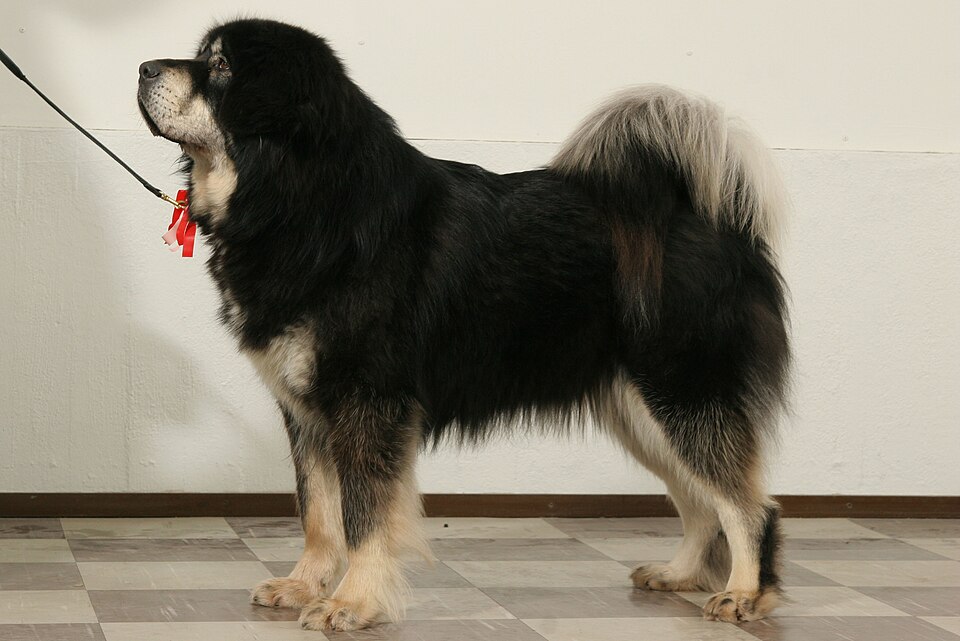
With its thick mane and heavy head, the Tibetan Mastiff looks like a lion at first glance. For centuries this dog guarded flocks, homes and monasteries on Tibet's high plateaus. Indoors it can be calm and affectionate, but it remains a guardian: aloof with strangers, attached to its territory and willing to make its own decisions. We built this page from the FCI standard, the AKC profile, the giant-breed study in the UK and Turkish legislation.
- Temperament: According to the FCI, independent, protective, commanding respect, and extremely loyal to its family and territory. The AKC says it's aloof and territorial with strangers and calm at home.
- Owner: Not a first dog. It needs experience with large guardian breeds, a large, very secure fenced space and patience.
- Training: The AKC says it doesn't respond well to traditional obedience training and can't reliably be motivated with food; you work with trust and respect.
- Lifespan: The AKC says 10–12 years; there's no reliable breed-specific lifespan study, and the giant-breed study in the UK had only 4 recorded deaths.
- Coat: One heavy shed a year; the rest of the time it's relatively low maintenance.
What to know
 What is the Tibetan Mastiff like?
The FCI standard describes the Tibetan Mastiff's behavior as independent, protective, commanding respect and extremely loyal to its family and territory. It lists its uses as a companion, watch and guard dog.
The AKC calls the breed watchful, aloof, imposing and intimidating, but adds right away that it's mellow and calm around the house and sweetly devoted to family, while aloof and territorial with strangers. In Tibet these dogs are called "do-khyi," or "tied dog," and were kept tied at the gates by day and let loose at night. Today that's not the right way to keep one; you need to make room for its nature with a closed, very secure fenced space and calm handling.
The same source makes an important point about training: the breed doesn't respond well to traditional obedience. The dog does what its owner asks as long as it respects and trusts the owner, but if there's ever a doubt, it follows its instincts over its training. Because it isn't generally food-driven, working with treats doesn't always work either.
Every dog is an individual. Breed describes what a dog was bred for; it can't tell you how a particular dog will turn out. The parents' temperament, early experiences and training matter at least as much as breed.
 Who is it a good fit for?
The Tibetan Mastiff suits calm, patient and consistent people who have experience with large, independent guardian dogs and a large, secure space. The dog can live indoors with its family, and the AKC says it's calm at home. But you have to keep in mind that it's a "guardian" in daily life.
| Situation | Good fit? |
|---|---|
| Apartment | Not recommended; a very large, thickly coated guardian tied to its territory |
| House with a yard | Good; the fence must be very tall and very solid, with locked gates |
| Family with kids | Loyal to family but very large; always supervise, including play with the children's friends |
| Other dogs | Careful introductions and early socialization are needed |
| Home with frequent guests | Hard; a dog that's aloof and watchful with strangers |
| First-time dog owners | Not recommended |
| People who are away for long hours | Not recommended; a bored dog can wreck a house |
Where does it come from?
According to the FCI, the Tibetan Mastiff comes from Tibet (China), and its use is as a companion, watch and guard dog. The AKC describes the breed as ancient and writes that there's evidence early travelers to Tibet were sometimes given these giants as gifts and that these dogs fed into the ancestors of the mastiff breeds of the Middle East and Europe; but no one knows the exact origin.
The AKC also notes that the Tibetan Mastiff has one breeding season a year and most puppies are born in December and January. That means finding a puppy may mean waiting for a particular time of year.
It's often mixed up with its close relatives the Central Asian Shepherd Dog and the Caucasian Shepherd Dog; all three are listed separately with their own FCI standards. Türkiye's own flock guardians, the Kangal and the Akbash, have different origins and looks.
Appearance and colors
According to the FCI, it's a strong, thick and heavy dog with a broad, heavy and powerful head. In adults a wrinkle may run from above the eyes down to the corner of the mouth, but the standard treats a heavily wrinkled head as a serious fault, as well as pendulous flews and a pronounced dewlap. The neck is strong and muscular, covered in a thick mane, less pronounced in females.
- Height: At least 26 in (66 cm) for males and 24 in (61 cm) for females (FCI). The AKC says it can stand 26 in at the shoulder.
- Weight: The FCI standard gives no weight; the AKC gives 90–150 lb (41–68 kg). In the UK, the median adult weight of 216 Tibetan Mastiffs was 104 lb (47.3 kg) (O'Neill et al., 2026).
- Coat: A harsh, thick, straight, off-standing top coat; a dense, woolly undercoat in cold weather that thins in the warmer months. Males carry noticeably more coat than females. It should never be silky, curly or wavy.
- Ears and tail: The ears are medium-sized, triangular, pendant and close to the head; the tail is set high and carried loosely curled over the back when the dog is alert or moving.
In Türkiye, article 8 of Animal Protection Law no. 5199 bans cutting a pet's tail or ears to change its appearance or for any other non-therapeutic reason; if there's a medical reason, the decision belongs to a veterinarian. The FCI standard also describes pendant ears and a natural tail. Rules vary by country.
Daily care
The AKC says the Tibetan Mastiff's double coat often needs little care, but once a year, in late spring or summer, it "blows" its undercoat. At that time an undercoat rake or de-shedding tool gives the best result. The standard wants the dog shown in its natural state, and only the feet and hocks may be shaped, so no clipping or shaving is needed. See our dog grooming guide for general methods.
- Nails: Long nails throw off the gait of a heavy dog; trim them regularly.
- Teeth and jaws: The AKC mentions its very strong jaws and teeth and its fondness for chewing wood; provide safe chew items and keep valuables out of reach.
- Skin and ears: Moisture, grit and ticks can hide under a thick coat; check by hand after walks.
- Hot weather: A big dog with a thick coat struggles in the heat. Shade, plenty of water and exercise during cool hours are a must; our article on dogs in hot weather covers the warning signs.
Training and exercise
The AKC says the Tibetan Mastiff needs moderate exercise every day, and it doesn't have to be an organized activity. According to the same source, because of its very independent nature the breed isn't suited to obedience classes and dog sports, and even outdoors it's best to have a contained, fenced exercise space. Because it's highly intelligent, it can be destructive when bored.
The center of training is trust and respect. A dog does what it understands and trusts you about, not what it's forced to do. Harsh corrections and intimidation don't work with this breed and damage the relationship.
- Early socialization: As a puppy, give it short, positive meetings with different people, children, sounds, vehicles and calm dogs, and keep this up for the first two years. It won't remove the protective instinct, but it helps the dog learn what isn't a threat.
- A reliable leash and fence: Get a very strong leash and harness, a fence far above shoulder height, and a double gate or a locked yard gate. Don't let the dog be outside unsupervised.
- Basic cues: Come, wait, drop it and walking without pulling are the foundation of safe life with a dog that can top 110 lb (50 kg). Our guide to loose-leash walking explains it step by step.
- A routine for visitors: Use rewards to teach it to go to a calm spot when the doorbell rings; never leave guests alone with the dog.
- Vet prep: Use rewards early on to get it comfortable with being handled and having its mouth and paws checked.
The Tibetan Mastiff is already attached to its territory. Steer clear of puppies marketed as "tougher," "man-stopping" or "protection-trained," and of anyone who suggests "sharpening" a dog by provoking it.
 Diet and weight
The Tibetan Mastiff doesn't need a special food; the AKC says a high-quality dog food suited to its age (puppy, adult, senior) is enough. According to the same source, adults eat much less than you'd expect. When females are in season, males can refuse food for weeks and lose weight; if that happens, talk to your vet.
- Controlled growth in puppyhood: Large-breed puppies grow very fast; extra weight and unnecessary supplements strain the joints. Make a growth plan with your vet covering the type of food, the amount and weight checks.
- Lower the risk of bloat: Splitting the daily food into several small meals and keeping things calm right before and after eating is commonly advised for large, deep-chested dogs; talk through the details with your vet.
- Ideal weight: If you can feel the ribs under a thin layer of fat and see a waist from above, the weight is about right.
Also check our list of foods that are dangerous for dogs.
 Health issues to know about
The AKC describes the Tibetan Mastiff as a relatively healthy breed and says responsible breeders screen their stock for hip and elbow dysplasia, hypothyroidism (an underactive thyroid) and eyelid problems (the eyelid rolling inward or outward: entropion and ectropion). Seizures have been reported but aren't common in the breed. The information below is for awareness only; ask your vet about diagnosis and treatment.
Hips and elbows
Joints that don't develop properly during growth can lead to painful arthritis over time. Limping, trouble getting up, and avoiding stairs or jumping can be signs. When choosing a puppy, ask for the parents' hip and elbow X-ray results.
Thyroid
An underactive thyroid can show up as weight gain, tiredness and changes to the coat and skin. If you notice these signs, talk to your vet.
Eyelids
An eyelid that rolls inward lets lashes irritate the eye, while one that sags outward leaves the eye exposed to irritants. If you notice watering, redness or squinting, show your vet.
Bloat and heatstroke
The stomach can fill with gas and fluid and twist on itself (gastric dilatation-volvulus, or GDV). The Merck Veterinary Manual describes it as an acute, life-threatening emergency that primarily affects large and giant breeds, needing immediate care, with a mortality rate around 20% even in treated animals. A big dog with a thick coat is also at high risk of heatstroke.
- Retching without bringing anything up, a swollen belly, heavy drooling, restlessness
- Pale gums, weakness or collapse
- Fast, labored breathing or stumbling in the heat
- A seizure
- Limping or obvious trouble getting up
How long does it live?
The AKC gives 10–12 years for the Tibetan Mastiff. But that's a general range from a registry; we couldn't find a reliable breed-specific lifespan study. In the giant-breed study using UK data from 2019 (O'Neill et al., 2026), the Tibetan Mastiff had only 4 recorded deaths (median 4.77 years), which is too few to draw any conclusion. In the same study, the median age at death across 29 giant breeds was 8.94 years.
The honest summary: scientific data is thin, and large, heavy breeds generally live shorter lives than mixed-breed dogs. A puppy from screened parents, a healthy weight, regular checkups and knowing the signs of bloat are the most concrete steps.
 Before you get one
- Consider a shelter: Purebred and large dogs end up in shelters and rescues too. With a dog this size, being able to see an adult's temperament up front is a big advantage. Our guide to adopting a dog from a shelter walks you through it.
- If you buy from a breeder: Meet the parents in person and make sure they're calm and steady. Ask for hip and elbow X-ray results, thyroid tests and an eye exam, and check that the puppies are raised in a home around people.
- Red flags: Puppies sold as "tough," "guard" or "lion-blooded" dogs; promises of "rare" colors or "giant size" at very high prices; sellers who won't show you the mother.
- Time and budget: Food, vet care and transport for a giant dog are expensive; make sure it fits in your car and that your vet can see it.
- Registration: Rules vary by country. In Türkiye, owned dogs must be microchipped and registered in the PETVET system. Details are in our article on PETVET registration and microchips.
Frequently asked questions
Is the Tibetan Mastiff banned in Türkiye?
No. Law no. 5199 bans breeding and owning animals the Ministry has designated as "posing a danger" (article 14/l), and the Tibetan Mastiff isn't on the list in the Ministry's 2021 circular. Rules can change, so check the current situation with your provincial or district agriculture directorate. Rules vary by country.
Can a Tibetan Mastiff live in an apartment?
It's not recommended. It's a very large, thickly coated dog attached to its territory that can be destructive when bored. It needs a large, very secure fenced space.
Is it good with kids?
The AKC says it's sweetly devoted to its family, but the dog is very large and aloof with strangers. Children and dogs should never be left unsupervised together; our article on kids and dogs at home covers the ground rules.
Can it be trained in obedience?
The AKC says it doesn't take well to traditional obedience. Basic safety cues (come, wait, drop it, leash walking) are still a must; work patiently, with rewards, in short sessions.
Does it shed a lot?
According to the AKC, the dog sheds heavily once a year, in late spring or summer; the rest of the year it needs little grooming.
Sources
- FCI · Tibetan Mastiff breed standard (No. 230)
- AKC (American Kennel Club) · Tibetan Mastiff breed profile
- O'Neill et al. · Giant dog breeds under primary veterinary care in the UK: demography, common disorders and mortality, Companion Animal Health and Genetics (2026)
- Merck Veterinary Manual · Gastric dilation and volvulus in small animals
- Türkiye legislation database · Animal Protection Law no. 5199, current text (in Turkish)
- Türkiye Ministry of Agriculture and Forestry · Circular on animals posing a danger (2021/48, in Turkish)
- Resmî Gazete (Türkiye) · Regulation on the identification and registration of cats, dogs and ferrets (February 26, 2018)
By Tüylüm · Last checked: November 10, 2026. Compiled from the sources above and written in our own words. Spotted a mistake? Write to [email protected] and we'll fix it right away. Photo from Wikimedia Commons, used under the license shown below it.