 Tüylüm
Saint Bernard
A calm, friendly giant devoted to its family, made famous as a rescue dog at a hospice in the Swiss Alps. Moderate exercise is enough, but expect lots of drool, lots of hair and the costs of a giant dog. Its lifespan is short; watch for bloat and joint and eyelid problems.

 Lifespan≈ 9.3 yearsmedian, 2024 UK study; AKC says 8–10
 Weight120–180 lb (54–82 kg)AKC: males 140–180 lb, females 120–140 lb
 Height at shoulder25.5–35.5 in (65–90 cm)FCI: males 27.5–35.5 in, females 25.5–31.5 in
 OriginSwitzerlandthe Great St. Bernard Pass hospice
 CoatShort or longtwo varieties; brush several times a week
 ExerciseUp to 1 hour a dayRoyal Kennel Club guidance
 With kidsPatientbig and heavy; can knock over small kids
 TrainingWillingstart no-jumping and leash training early
Thanks to the legend of the rescue dog that found travelers lost in the snow, the Saint Bernard is one of the best-known dogs in the world. With its red-and-white coat, big head and soft expression, it's a calm, friendly giant devoted to its family. But that giant size comes at a price: lots of drool, lots of hair, high costs and a short life. We built this page from breed registry standards, animal welfare resources and scientific studies.
- Temperament: Friendly, somewhere between calm and lively, and watchful; according to the AKC, patient and fond of children.
- Exercise: The Royal Kennel Club considers up to an hour a day enough; long runs aren't its thing.
- Care: It comes in short-haired and long-haired varieties, and both shed heavily. On the AKC's scale, its drooling is at the very top.
- Health: Prone to bloat, hip and elbow dysplasia, eyelid problems and bone cancer, and sensitive to heat.
- Lifespan: A median of 9.3 years in a large UK study, among the breeds at highest risk of early death.
What to know
 What is the Saint Bernard like?
The FCI standard describes the Saint Bernard as friendly by nature, with a temperament somewhere between calm and lively, and watchful. Aggressive or overly shy dogs and a weak temperament are disqualifying faults under the standard.
The AKC calls the Saint Bernard the "genial giant" of the Swiss Alps, famous for being watchful, patient and fond of children. According to the AKC, it's kind-hearted and eager to please, it wants to be with its family, and undesirable behaviors can develop if it's regularly left alone for long periods. It barks little but keeps an eye on its home.
Every dog is an individual. Breed traits describe general tendencies; the parents' temperament, how a puppy was socialized and the training it gets shape its personality as much as its breed.
 Who is it a good fit for?
The Saint Bernard suits families with a roomy home and yard, a fairly calm lifestyle, a tolerance for drool and hair, and a budget for a giant dog. The Royal Kennel Club recommends a large house and a large yard.
| Situation | Good fit? |
|---|---|
| Apartment | Hard; calm but giant, it needs space |
| House with a yard | Good; a cool, shaded resting spot is a must |
| Family with kids | According to the AKC, patient and fond of kids; supervise because of its size |
| Long hours alone | Struggles; the AKC says unwanted behaviors can develop |
| Hot climate | Take care; a cool place and plenty of water are a must |
| A spotless home | Hard; it means lots of drool and lots of hair |
Where does it come from?
According to the FCI, in the 11th century monks founded a hospice for travelers and pilgrims at the Great St. Bernard Pass, 8,100 feet (2,469 m) above sea level. Large mountain dogs have been kept there since the mid-1600s for guarding and protection; they appear in pictures from 1695 and in the hospice's written records in 1707. The dogs soon became rescue dogs that found travelers lost in snow and fog. According to the FCI, the stories told by soldiers who crossed the pass with Napoleon's army in 1800 spread the fame of these "Barry dogs," as they were then known, across Europe in the 19th century, and the legendary dog Barry became the very image of a rescue dog.
According to the FCI, the breed's direct ancestors were the region's large farm dogs. The Royal Kennel Club explains that the monks brought in new blood to breed bigger dogs, possibly including the Newfoundland and the Bloodhound; some monks objected because they feared a longer coat would ice up, so part of the stock was kept short-coated. That's why both coat varieties still exist today. The first pedigree documents were issued in 1867; in 1884 the very first dog entered in the Swiss stud book was a Saint Bernard named "Leon," and the Swiss St. Bernard Club was founded the same year. The breed was officially recognized as a Swiss breed in 1887 and is regarded today as Switzerland's national dog.
Appearance and colors
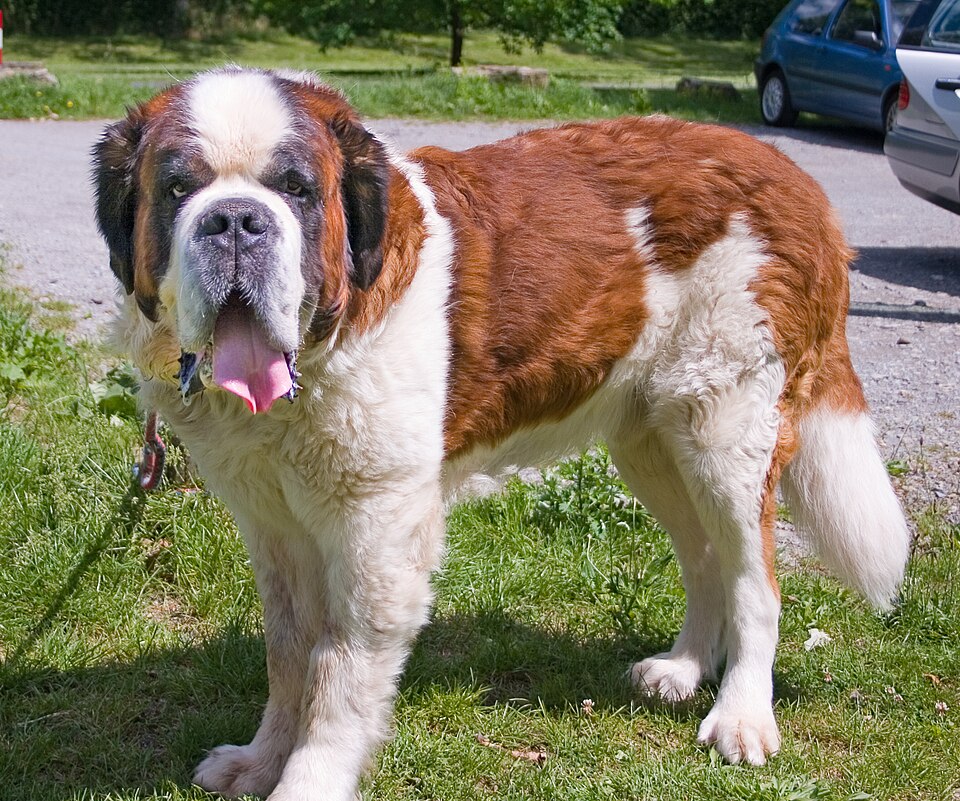
According to the FCI, there are two varieties of Saint Bernard: the short-haired variety, with a dense, coarse topcoat and plenty of undercoat, and the long-haired variety, with a straight, medium-length coat. Both are of considerable size, balanced, powerful and muscular, with an impressive head.
- Height: 27.5–35.5 in (70–90 cm) at the shoulder for males and 25.5–31.5 in (65–80 cm) for females; larger dogs aren't penalized if they're balanced and move well (FCI).
- Weight: According to the AKC, males weigh 140–180 lb (64–82 kg) and females 120–140 lb (54–64 kg).
- Color: White with smaller or larger red patches, or a red "mantle" covering the back and sides. White markings on the chest, feet, tail tip, around the muzzle, as a blaze and on the neck are required; a white collar and a symmetrical dark mask are desirable.
- Eyes: The FCI calls for naturally tight eyelids; a very small fold on the lower lid is allowed, but eyelids that turn outward (ectropion) or inward (entropion) are disqualifying faults.
Daily care
According to the AKC, short-haired and long-haired Saint Bernards need the same care: weekly brushing removes dirt and loose hair, and tangles can be worked out with a slicker brush or metal comb. During the shedding season that comes twice a year, brushing becomes a daily job. The Royal Kennel Club recommends grooming more than once a week. An occasional bath is enough. See our dog grooming guide for details.
- Drool: On the AKC's scale, its drooling is 5 out of 5, as in "always have a towel." Keep the area around the mouth and the folds of the face clean and dry.
- Eyes: According to the Merck Veterinary Manual, an outward-sagging eyelid (ectropion) is common in Saint Bernards. Check the eyes every day and show your vet any redness, discharge or squinting.
- Nails: Long nails cause pain and walking problems; trim them regularly and start in puppyhood.
- Hot weather: According to the AKC, a Saint can handle heat as long as it has a cool place to rest and plenty of water, but going straight from air conditioning into high heat can cause it serious distress. Our article on dogs in hot weather covers the signs of heatstroke.
Training and exercise
The AKC recommends early socialization and puppy classes for all dogs, and calls them absolutely required for dogs as big and strong as the Saint Bernard. Obedience training teaches a Saint not to jump on people, bump into small children, steal food from the table or otherwise use its size to its advantage. According to the AKC, the breed is kind-hearted and eager to please and starts following cues as soon as it understands what's expected.
Despite its size and strength, the Saint Bernard has moderate exercise needs: according to the AKC, one long walk or a half-hour play session a day is enough, and the Royal Kennel Club recommends up to an hour a day. It loves to join its owner on hikes and camping trips, and some even enjoy pulling kids in a little cart. Don't push a growing puppy into strenuous exercise; talk to your vet about activity that suits its age.
- No jumping: Reward sitting instead of jumping on people; a 130 lb (60 kg) adult jumping up is dangerous.
- Leash training: Teach it to walk without pulling while it's small. Our guide to loose-leash walking explains it step by step.
- Teach it to be alone: Start with short absences and build up slowly. Our article on separation anxiety can help.
- Vet prep: You may not be able to lift a giant dog; use rewards early on to get it comfortable with being handled, examined and getting in and out of the car.
 Diet and weight
The AKC recommends a quality food suited to the Saint Bernard's age, ideally one made for large breeds, and notes that some dogs gain weight easily. Treats are great for training but should count toward the daily amount.
- Controlled growth in puppyhood: The Merck Veterinary Manual notes that too much calcium (for example, from unnecessary supplements) can harm bone and joint development in fast-growing large and giant breed puppies. Make a growth plan with your vet covering the type of food, the amount and the weight curve, and don't add supplements your vet hasn't recommended.
- Lower the risk of bloat: According to the AKC, splitting the daily food into several small meals and preventing vigorous exercise around mealtimes may help reduce the risk. For dogs at risk, Merck also advises avoiding raised food bowls and keeping mealtimes calm.
- Ideal weight: Extra weight strains both the joints and heat tolerance. If you can feel the ribs under a thin layer of fat, the weight is about right.
Also check our list of foods that are dangerous for dogs.
 Health issues to know about
Its giant size makes the Saint Bernard prone to certain problems. The information below is for awareness only; ask your vet about diagnosis and treatment.
Bloat (GDV)
In bloat, the stomach fills with gas and twists on itself; according to the Merck Veterinary Manual, it's a life-threatening emergency of large and giant breeds that needs immediate care. Merck and Cornell both list the Saint Bernard among the breeds at risk, and a US study that followed large and giant breeds (Glickman et al., 2000) included the Saint Bernard; 28.6% of the dogs that developed bloat died. Retching without bringing anything up, heavy drooling, restlessness and a swollen belly are emergency signs.
Hip and elbow dysplasia
The joints don't develop properly during growth, which leads to painful arthritis over time. The Royal Kennel Club asks breeders, at a minimum, to hip and elbow score dogs and have their eyes examined before breeding, and the AKC lists hip dysplasia among the conditions seen in the breed.
Eyelid problems
An eyelid that sags outward (ectropion) leaves the eye exposed to dust and irritation, while one that rolls inward (entropion) lets the lashes scratch the eye. According to Merck, ectropion is a common conformation-related problem in Saint Bernards. The FCI standard treats both as disqualifying faults, which means breeders are expected to select against them.
Bone cancer
UFAW's resource lists the Saint Bernard among the large breeds predisposed to bone cancer (osteosarcoma). Lameness that doesn't go away or keeps getting worse, or a swelling on a leg, should be checked by a vet without delay.
Heatstroke
In a 2020 UK study (Hall et al.), dogs weighing 50 kg (110 lb) or more had more than three times the odds of heatstroke of dogs under 10 kg (22 lb), and being heavier than the average for the breed also raised the risk.
- Retching without bringing anything up, a swollen belly, heavy drooling, restlessness
- Pale gums, weakness or collapse
- Sudden redness or discharge in an eye, or keeping an eye shut
- Lameness that won't go away or a swelling on a leg
- Fast, labored breathing or stumbling in the heat
How long does it live?
A 2024 study using data on about 585,000 dogs in the UK (McMillan et al.) found a median lifespan of 9.3 years for 1,638 Saint Bernards and listed the breed among those at highest risk of early death; mixed-breed dogs in the same study had a median of 12 years. The AKC gives 8–10 years, and the Royal Kennel Club lists the breed as living under 10 years.
Knowing the signs of bloat, a healthy weight, heat precautions and getting lameness checked early are the most concrete ways to protect a Saint Bernard's lifespan.
 Before you get one
- Consider a shelter: Purebred dogs end up in shelters and rescues too. Our guide to adopting a dog from a shelter walks you through it.
- If you buy from a breeder: Meet the parents in person and make sure they're calm and friendly. Ask for hip and elbow X-ray results and an eye exam, look at their eyelids, and find out whether any dogs in the family have had bloat.
- Space and budget: Food, bedding, transport and vet bills are all noticeably higher with a giant dog.
- Red flags: Sellers who won't show you the mother, always have puppies available, can't provide paperwork or rush you.
- Registration: Rules vary by country. In Türkiye, owned dogs must be microchipped and registered in the PETVET system.
- The first days: See our guide to the first week with a new puppy.
Frequently asked questions
Did Saint Bernards really carry barrels around their necks?
No. According to the Royal Kennel Club, the image of a Saint Bernard rushing to the rescue with a cask of brandy on its collar is a romantic fancy created by the Victorian painter Edwin Landseer, who painted the first two Saint Bernards to arrive in London; the AKC also calls it a myth.
Are short-haired and long-haired Saint Bernards different breeds?
No, they're two varieties of the same breed. The FCI covers both in a single standard, and according to the Royal Kennel Club the short-haired type was kept because some monks feared a long coat would ice up.
Do Saint Bernards drool a lot?
Yes. On the AKC's scale, its drooling is at the very top. That can be hard in a spotless home, so keep a towel handy.
Can a Saint Bernard live in a hot climate?
With care. According to the AKC, it can handle heat as long as it has a cool place to rest and plenty of water, but sudden jumps in temperature are hard on it. In summer, shade, a cool floor and morning or evening walks are a must.
Can a Saint Bernard live in an apartment?
It's hard. It may be calm, but its giant size needs space, and the Royal Kennel Club recommends a large house and yard.
Sources
- FCI · St. Bernhardshund (St. Bernard) breed standard (No. 61, 2016)
- The Royal Kennel Club · St Bernard: breed profile and health screening
- AKC (American Kennel Club) · Saint Bernard breed profile
- McMillan et al. · Longevity of companion dog breeds: those at risk from early death, Scientific Reports (2024)
- Glickman et al. · Incidence of and breed-related risk factors for gastric dilatation-volvulus in dogs, JAVMA (2000)
- Cornell Riney Canine Health Center · Gastric dilatation-volvulus (GDV) or bloat
- Merck Veterinary Manual · Gastric dilation and volvulus in small animals
- Merck Veterinary Manual · Eyelids in animals
- Science for Animal Welfare (UFAW) · Osteosarcoma and predisposed large breeds
- Hall et al. · Incidence and risk factors for heat-related illness (heatstroke) in UK dogs under primary veterinary care in 2016, Scientific Reports (2020)
- Merck Veterinary Manual · Nutritional requirements of small animals
- Resmî Gazete (Türkiye) · Regulation on the identification and registration of cats, dogs and ferrets (February 26, 2018)
By Tüylüm · Last checked: November 3, 2026. Compiled from the sources above and written in our own words. Spotted a mistake? Write to [email protected] and we'll fix it right away. Photo from Wikimedia Commons, used under the license shown below it.