 Tüylüm
Newfoundland
A calm, exceptionally gentle giant that worked on land and water with fishermen on Canada's Newfoundland island and loves to swim. Famous for its patience with kids, but expect lots of drool, a heavy coat and giant-dog costs. Watch for aortic stenosis, cystinuria and knee ligament problems.

 Lifespan≈ 11 yearsmedian, 2024 UK study; AKC says 9–10
 Weight≈ 120–150 lb (54–68 kg)FCI averages: males 150 lb, females 120 lb
 Height at shoulder≈ 26–28 in (66–71 cm)FCI averages: males 28 in, females 26 in
 OriginCanadafishermen's water and draft dog
 CoatLong, water-resistantdouble coat; RKC advises daily grooming
 ExerciseUp to 1 hour a dayRKC guidance; loves to swim
 With kidsVery patient"nanny dog" reputation; still supervise
 TrainingQuick learnerdoesn't respond well to harsh methods
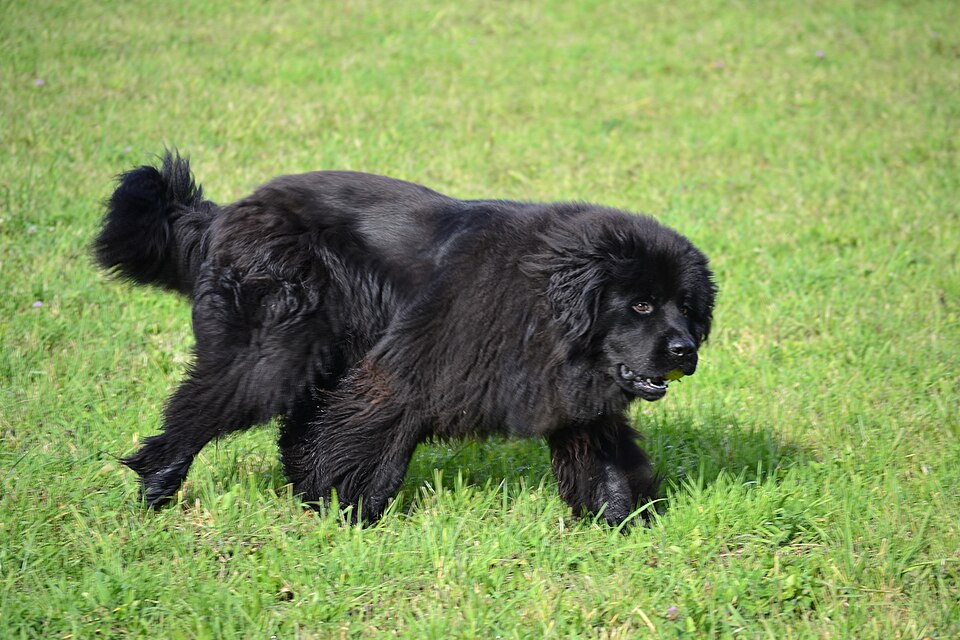
With its thick black or brown coat, big head and soft expression, the Newfoundland looks like a giant teddy bear, and it adores the water. For centuries it worked alongside fishermen in the North Atlantic, hauling nets, pulling loads and rescuing people who fell overboard. Today it's known as a family dog with a gentle nature and remarkable patience with children, but its size, coat and drool call for serious preparation. We built this page from breed registry standards, animal welfare resources and scientific studies.
- Temperament: Exceptionally gentle, calm and patient; according to the AKC, a sweet temperament is the breed's most important trait.
- Exercise: The Royal Kennel Club considers up to an hour a day enough; swimming is ideal for it.
- Care: A thick, water-resistant double coat, and the Royal Kennel Club recommends daily grooming. Its drooling is also at the very top of the scale.
- Health: Aortic stenosis (heart), cystinuria (urinary stones), torn knee ligaments, and hip and elbow dysplasia; ask for the parents' heart exams and cystinuria DNA test.
- Lifespan: A median of 11 years in the UK; the AKC gives 9–10 years.
What to know
 What is the Newfoundland like?
According to the FCI standard, the Newfoundland's expression reflects benevolence and softness; it's dignified, joyful and creative, and known for its outstanding gentleness and serenity. Aggressive or overly shy dogs are disqualified under the standard.
According to the AKC, the breed standard calls a sweet temperament the Newfoundland's "most important single characteristic." This sweet-tempered, trusting and trainable dog is famous for its affinity for kids and has earned a reputation as a patient, watchful "nanny dog." On the AKC's scales, it rates at the top for getting along with other dogs and for openness to strangers, and very low for barking. Puppies are outgoing, intelligent and curious, never timid, skittish or aggressive. The AKC stresses that daily human contact is absolutely essential for this breed.
Every dog is an individual. Breed traits describe general tendencies; the parents' temperament, how a puppy was socialized and the training it gets shape its personality as much as its breed.
 Who is it a good fit for?
The Newfoundland suits families with a roomy home and yard, a fairly calm lifestyle and a tolerance for drool and hair, who can spend time with their dog every day. The Royal Kennel Club recommends a large house, a large yard and a rural setting.
| Situation | Good fit? |
|---|---|
| Apartment | Hard; calm but giant and very hairy |
| House with a yard, country life | Good; the Royal Kennel Club recommends the country |
| Family with kids | Excellent; still supervise around little ones because of its size |
| Other dogs | According to the AKC, gets along very well |
| Hot climate | Take care; a heavy dog with a thick coat struggles in the heat |
| A spotless home | Hard; it means lots of drool and lots of hair |
In homes with kids, it's important that nobody bothers the dog while it eats or sleeps and that the dog has a quiet spot to rest; our article on kids and dogs at home covers the ground rules.
Where does it come from?
The breed takes its name from the island of Newfoundland in northeastern Canada. According to the FCI standard, it arose from the island's native dogs and the big black "bear dog" brought by the Vikings after the year 1100, with other breeds arriving with European fishermen adding to the mix. By the time colonization of the island began in 1610, the Newfoundland had largely taken on today's form: a dog that could stand up to the harsh climate and the sea, pull heavy loads on land and serve as a lifeguard in the water. The Royal Kennel Club, on the other hand, reports the view that the breed wasn't native to the island and that its ancestors came with European fishermen, so sources don't fully agree on its origins.
What the sources do agree on is its work. According to the Royal Kennel Club, the Newfoundland towed fishermen's carts, pulled logs out of the forest, hauled nets ashore and jumped from boats to retrieve lost gear, and in more recent times it has jumped from low-flying planes and helicopters to rescue swimmers in trouble. Its well-sprung ribs, oily waterproof coat and webbed feet were selected for exactly that work. The AKC notes that the breed still serves as a water-rescue dog around the world. The AKC also recounts that a Newfoundland named Seaman traveled with Lewis and Clark on their famous expedition across America, and that the poet Lord Byron built a monument for his Newfoundland, Boatswain.
Appearance and colors
According to the FCI, the Newfoundland is a massive dog with a powerful, well-muscled body and well-coordinated movement; its body is longer than it is tall. It has webbing between its toes, and its tail works as a rudder when it swims.
- Height: The FCI gives an average height at the shoulder of 28 in (71 cm) for males and 26 in (66 cm) for females.
- Weight: FCI averages are about 150 lb (68 kg) for males and 120 lb (54 kg) for females. According to the AKC, males weigh 130–150 lb (59–68 kg) and females 100–120 lb (45–54 kg).
- Coat: A water-resistant double coat: a moderately long, straight outer coat and a soft, dense undercoat that gets thicker in winter. The legs are feathered.
- Color: Black (the traditional color), white and black, and brown. According to the AKC, the black-and-white coat is called "Landseer" after the painter Sir Edwin Landseer, who often featured these dogs in his paintings; the FCI notes that this color is of historical significance for the breed.
Daily care
The Newfoundland's thick coat takes regular work. The Royal Kennel Club recommends grooming every day. The AKC recommends a thorough brushing with a slicker brush and a long-toothed comb at least once a week, stepping up to daily during the shedding season that comes twice a year; spayed and neutered Newfs shed year-round and may need brushing several times a week. Brushing removes dead hair and prevents mats. See our dog grooming guide for details.
- Drool: On the AKC's scale, its drooling is 5 out of 5; keeping a towel in every room is a good idea.
- Ears: As with all drop-eared dogs, the AKC recommends checking the ears regularly for signs of infection.
- Eyes: According to the Merck Veterinary Manual, an outward-sagging eyelid (ectropion) is common in Newfoundlands; show your vet any redness or discharge.
- Nails: Trim them regularly; with a giant dog, getting it used to this as a puppy is essential.
- Hot weather: In a 2020 UK study (Hall et al.), dogs weighing 50 kg (110 lb) or more had more than three times the odds of heatstroke of dogs under 10 kg (22 lb). In summer, shade, a cool floor and plenty of water are a must; our article on dogs in hot weather covers the warning signs.
Training and exercise
The AKC recommends early socialization and puppy classes to help the Newfoundland grow into a well-adjusted, well-mannered adult. The breed is eager to please and generally easy to train. Because it's affectionate and trusting, it responds well to gentle guidance and poorly to harsh corrections or harsh training methods. Short, calm, reward-based sessions work best.
According to the AKC, the Newfoundland needs at least half an hour of moderate exercise every day to stay healthy and happy, and the Royal Kennel Club recommends up to an hour a day. Swimming is the breed's favorite activity, and it happily comes along on long walks. It also does well at carting, agility, obedience and tracking. Don't push a growing puppy into strenuous exercise; talk to your vet about activity that suits its age.
- Introducing water: The AKC recommends that a puppy meant for water work be carefully introduced to water by about 4 months of age. Pick a shallow, calm, safe spot and never force the puppy.
- Leash training: Teach it to walk without pulling while it's small; an adult Newfoundland can be hard to hold. Our guide to loose-leash walking explains it step by step.
- No jumping: Reward sitting instead of jumping on people.
- Vet prep: Use rewards early on to get it comfortable with being handled, examined, groomed and getting in and out of the car.
 Diet and weight
According to the AKC, a quality food suited to the Newfoundland's age is enough, though some dogs gain weight easily. Extra weight strains both the joints and heat tolerance; in the 2020 UK study, dogs heavier than the average for their breed had a higher risk of heatstroke.
- Controlled growth in puppyhood: The Merck Veterinary Manual notes that too much calcium (for example, from unnecessary supplements) can harm bone and joint development in fast-growing large and giant breed puppies. Make a growth plan with your vet covering the type of food, the amount and the weight curve, and don't add supplements your vet hasn't recommended.
- Lower the risk of bloat: The AKC recommends splitting the daily food into several small meals and preventing vigorous exercise around mealtimes; Merck also advises keeping mealtimes calm and avoiding raised food bowls for dogs at risk.
- If your dog has cystinuria: Your vet will plan its diet and water intake; don't switch foods on your own.
Also check our list of foods that are dangerous for dogs.
 Health issues to know about
Some inherited problems are more common in Newfoundlands. The information below is for awareness only; ask your vet about diagnosis and treatment.
Aortic stenosis
A narrowing where blood leaves the heart for the main artery to the body; according to UFAW, the Newfoundland is one of the breeds at increased risk. Among 6,023 Newfoundlands examined in Europe and North America between 1976 and 2007, 4.7% had aortic stenosis, and about half of those cases were severe. The condition isn't present at birth but develops as the puppy grows. Exercise intolerance, fainting, weakness and shortness of breath can be signs, and severe cases can lead to death in early adulthood. Ask for the parents' heart exam results when choosing a puppy.
Cystinuria
The kidneys fail to reabsorb an amino acid called cystine, which builds up in the urine and can form stones in the kidneys, bladder or urethra. According to UFAW, Newfoundlands were 12 times more likely than other breeds to be diagnosed with cystine stones. The disease is recessive, meaning a puppy has to inherit the gene from both its mother and its father to be affected. A DNA test is available, and the Royal Kennel Club asks breeders to do it, at a minimum, before breeding. If you see straining, pain or blood when your dog urinates, see your vet; if no urine comes out at all, it's an emergency.
Torn knee ligament
Wear and eventual rupture of the cranial cruciate ligament in the knee; according to UFAW, Newfoundlands are prone to it from a young age, and one study found it in 22% of the breed. It causes hind-leg lameness and pain.
Heart muscle disease, joints and bloat
According to UFAW, about 10% of Newfoundlands develop dilated cardiomyopathy (DCM), which can be picked up early with ultrasound and 24-hour ECG monitoring. The Royal Kennel Club lists hip and elbow screening as minimum requirements and an eye exam as an additional recommendation. A US study of bloat that followed large and giant breeds (Glickman et al., 2000) included the Newfoundland, and the Merck Veterinary Manual describes bloat as an emergency that needs immediate care.
- Straining to urinate without success, blood in the urine or pain when urinating
- Fainting, sudden weakness, coughing or labored breathing
- Retching without bringing anything up, a swollen belly, marked restlessness
- Sudden lameness in a hind leg
- Fast breathing or stumbling in the heat
How long does it live?
A 2024 study using data on about 585,000 dogs in the UK (McMillan et al.) found a median lifespan of 11 years for 2,162 Newfoundlands; mixed-breed dogs in the same study had a median of 12 years. The AKC gives 9–10 years, and the Royal Kennel Club lists the breed as living under 10 years.
Among giant breeds, the Newfoundland lives relatively long, but still shorter than mixed-breed dogs. A puppy from screened parents, a healthy weight, heat precautions and regular checkups are the most concrete steps.
 Before you get one
- Consider a shelter: Purebred dogs end up in shelters and rescues too. Our guide to adopting a dog from a shelter walks you through it.
- If you buy from a breeder: Meet the parents in person. Ask for the cystinuria DNA test, hip and elbow X-rays, and heart and eye exam results.
- Space and budget: Food, grooming, transport and vet bills are all noticeably higher with a giant dog.
- Red flags: Sellers who won't show you the mother, always have puppies available, can't provide paperwork or rush you.
- Registration: Rules vary by country. In Türkiye, owned dogs must be microchipped and registered in the PETVET system.
- The first days: See our guide to the first week with a new puppy.
Frequently asked questions
Do Newfoundlands like to swim?
Yes. According to the AKC, Newfs are born swimmers with webbed feet, and the breed still works as a water-rescue dog. Still, introduce any dog to water slowly and somewhere safe, and dry its coat thoroughly afterward.
Do Newfoundlands shed a lot?
Yes. Its thick double coat sheds heavily twice a year, and according to the AKC spayed and neutered dogs may shed year-round. The Royal Kennel Club recommends daily grooming.
Do Newfoundlands drool a lot?
Yes. On the AKC's scale, its drooling is at the very top. That can be hard in a spotless home.
Can a Newfoundland live in a hot climate?
With care. It's a heavy dog with a thick coat, and dogs over 50 kg (110 lb) have a higher risk of heatstroke. In summer it needs a cool home, shade, plenty of water and morning or evening walks.
What does "Landseer" mean?
According to the AKC, black-and-white Newfoundlands are named after the painter Sir Edwin Landseer, who often featured them in his paintings. The FCI notes that this color is of historical significance for the breed.
Sources
- FCI · Newfoundland breed standard (No. 50, 1996)
- The Royal Kennel Club · Newfoundland: breed profile and health screening
- AKC (American Kennel Club) · Newfoundland breed profile
- Science for Animal Welfare (UFAW) · Newfoundland: Aortic stenosis
- Science for Animal Welfare (UFAW) · Newfoundland: Cystinuria and urolithiasis
- Science for Animal Welfare (UFAW) · Newfoundland: Dilated cardiomyopathy
- Science for Animal Welfare (UFAW) · Newfoundland: Cranial cruciate ligament rupture
- McMillan et al. · Longevity of companion dog breeds: those at risk from early death, Scientific Reports (2024)
- Glickman et al. · Incidence of and breed-related risk factors for gastric dilatation-volvulus in dogs, JAVMA (2000)
- Merck Veterinary Manual · Gastric dilation and volvulus in small animals
- Merck Veterinary Manual · Eyelids in animals
- Hall et al. · Incidence and risk factors for heat-related illness (heatstroke) in UK dogs under primary veterinary care in 2016, Scientific Reports (2020)
- Merck Veterinary Manual · Nutritional requirements of small animals
- Resmî Gazete (Türkiye) · Regulation on the identification and registration of cats, dogs and ferrets (February 26, 2018)
By Tüylüm · Last checked: November 3, 2026. Compiled from the sources above and written in our own words. Spotted a mistake? Write to [email protected] and we'll fix it right away. Photo from Wikimedia Commons, used under the license shown below it.