 Tüylüm
American Akita
A big, heavy-boned dog recognized as a separate breed from the Japanese Akita, developed in the United States. Dignified, courageous and self-assured; but it can be very reactive toward other dogs, especially of the same sex, it sheds, and it appears prone to immune-related disease.

 Lifespan≈ 10+ yearsRKC: over 10 years; no breed-specific study found
 Height at shoulder24–28 in (61–71 cm)FCI: males 26–28, females 24–26 in
 OriginJapan / USAcame from Japan, became its own type in the US
 SheddingHeavyRKC: sheds; weekly grooming; double coat
 ExerciseA lotRKC: more than 2 hours a day
 With other dogsCan be reactiveFCI: especially toward dogs of the same sex
 TrainingFirm and patientFCI: alert, self-assured; early socialization is a must
 Legal statusAllowednot on the banned list in circular 2021/48
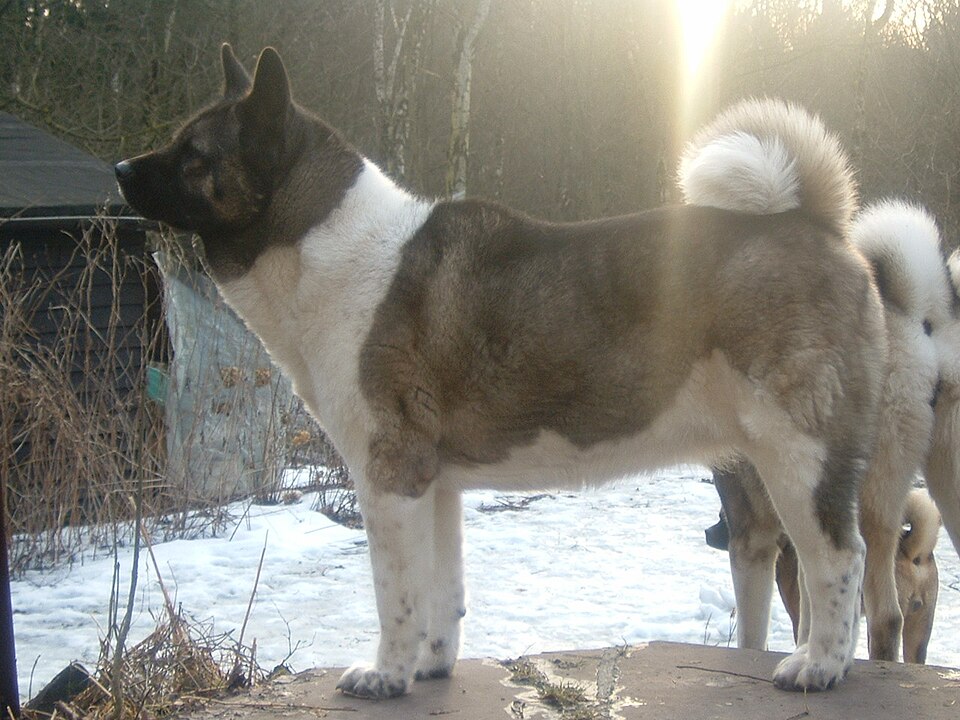
The American Akita takes its name from Japan but followed its own path in America: a big dog with a broad, blunt triangle of a head, small eyes, erect ears carried forward and a thick tail curled over the back. The FCI gives it its own standard (No. 344) and lists it separately from the Japanese Akita. It's a heavy-boned, powerful, self-assured dog; the FCI describes its temperament as alert and responsive, dignified and courageous, and adds that American Akitas may be highly reactive toward other dogs, particularly of the same sex. We built this page from the FCI standard, the Royal Kennel Club's breed page and a published study of the breed's immune-mediated diseases.
- Temperament: According to the FCI, alert and responsive, dignified and courageous. It may be highly reactive toward dogs of the same sex, so relationships with other dogs need to be built early and carefully.
- Size: Males stand 26–28 in (66–71 cm), females 24–26 in (61–66 cm) (FCI). The standard gives no weight; it's a heavy-boned dog with a substantial body.
- Coat: A double coat with a thick undercoat and a harsh outer coat that stands slightly off the body; the Royal Kennel Club says it sheds.
- Health: Immune-related diseases such as thyroiditis, sebaceous adenitis and uveitis are reported in the Akita breed; like other large, deep-chested dogs it's also at risk of bloat.
- Lifespan: The Royal Kennel Club says over 10 years; we couldn't find a solid breed-specific lifespan study.
What to know
 What is the American Akita like?
The FCI standard describes the American Akita as alert and responsive, dignified and courageous. It also gives a warning: American Akitas may be highly reactive toward other dogs, particularly of the same sex. In other words, this isn't a dog you can release into any dog park. The standard disqualifies dogs that are aggressive or overly shy, so a sound temperament is the expected goal.
For owners, the takeaway is this: the Akita is a large, powerful dog known for devotion to its family but reserved with strangers and other dogs, and inclined to make its own decisions. The American Kennel Club (AKC) describes the breed as dignified, courageous and loyal. Put those traits together without good socialization and consistent rules, and you can end up with a difficult dog.
Every dog is an individual. Breed describes what a dog was bred for; it can't tell you how a particular dog will turn out. The parents' temperament, early experiences and training matter at least as much as breed.
 Who is it a good fit for?
The American Akita suits experienced people who have a large space, can exercise the dog for long periods every day, take training seriously and can manage relationships with other dogs at home. The Royal Kennel Club lists the breed as needing a large house, a large garden and more than two hours of exercise a day.
| Situation | Good fit? |
|---|---|
| Apartment | Hard; large size, lots of exercise and heavy shedding |
| House with a yard | Good; a solid fence, long daily walks and supervision |
| Family with kids | Possible, but it's a big, powerful dog; children and dogs should never be left unsupervised together |
| Home with other dogs | Caution: the FCI specifically mentions reactivity toward dogs of the same sex |
| First-time dog owners | Not recommended; experience and consistency are needed |
| Home with frequent guests | Needs preparation; may be reserved with strangers |
| Hot climates | Hard; thick double coat |
Where does it come from?
The FCI standard lists the American Akita's origin as Japan and the country of development as the USA. Its history section says that from 1603, medium-sized, bear-hunting "Akita Matagi" dogs in the Akita region were also used as fighting dogs. From 1868 they were crossed with Tosas and mastiffs, which increased their size but lost spitz characteristics. Dog fighting was banned in 1908; the Akita was nevertheless preserved as a large Japanese breed, and nine superior examples were named "Natural Monuments" in 1931.
During World War II, dogs were used as a source of fur for military garments, so some fanciers tried to protect theirs by crossbreeding them with German Shepherds. After the war the breed had been drastically reduced and existed in three types: Matagi, fighting and shepherd. During the restoration, Akitas of the "Dewa line," carrying mastiff and German Shepherd influence, were brought back to the US by members of the military. The Akita Club of America was founded in 1956, and the AKC accepted the breed in October 1972. At that time the AKC and the Japan Kennel Club had no reciprocal pedigree agreement, so Akitas in the US became considerably different from those in Japan. The FCI standard says so plainly: a type unique to the United States developed, unchanged since 1955.
The Royal Kennel Club also describes the breed as developed in Japan to hunt bear, deer and wild boar, and as it's seen today, developed in America with stronger bone and substance. For the Japanese type, see our Akita page; comparing the two helps you decide.
Appearance and colors
According to the FCI, the American Akita is a large, sturdily built, well-balanced dog with heavy bone and a lot of substance. The broad head forms a blunt triangle and is free of wrinkles at rest. The eyes are relatively small and dark brown, the ears small, erect and angled forward, and the neck thick and muscular.
- Height: Males 26–28 in (66–71 cm), females 24–26 in (61–66 cm) (FCI). Males under 25 in (63.5 cm) and females under 23 in (58.5 cm) are disqualified under the standard.
- Weight: The FCI standard gives no weight. We don't have a reliable weight range, so we're not printing a number; your vet can tell you your dog's ideal weight.
- Coat: Double. The undercoat is thick, soft and dense; the outer coat is straight, harsh and stands slightly off the body. The hair is short on the head, lower legs and ears; the tail has the longest, most profuse coat. The tail is set high and curls over the back or against the flank.
- Color: Any color, such as red, fawn or white, and also pinto and brindle. Merle and liver are disqualifying under the standard.
In Türkiye, article 8 of Animal Protection Law no. 5199 bans cutting a pet's tail or ears to change its appearance or for any other non-therapeutic reason; where a veterinarian has a medical reason, that's treated separately. The FCI standard describes the Akita's ears and tail in their natural state. Rules vary by country.
 Daily care
The Royal Kennel Club says the breed has a short coat, sheds and needs grooming once a week. In double-coated dogs, brushing more often during heavier shedding periods makes the job easier. See our dog grooming guide for general methods.
- Nails: Long nails throw off the gait of a heavy dog; trim them regularly.
- Ears: Erect ears get airflow, but still check for dirt and redness.
- Teeth: Brush often with a toothpaste made for dogs.
- Hot weather: A dog with a thick double coat needs shade, plenty of water and exercise during cool hours in summer. Our article on dogs in hot weather covers the warning signs.
Training and exercise
Since the FCI says the breed can be highly reactive toward other dogs, particularly of the same sex, the most important training topic is socialization and management. As a puppy, once vaccinations are done and your vet gives the go-ahead, set up short, positive meetings with calm, steady dogs; as an adult, walking with one calm dog you know is often safer than a dog park.
On exercise, the Royal Kennel Club says more than two hours a day. Think of that as walks plus sniffing games; avoid long runs and strenuous movement in a growing puppy, and talk to your vet about exercise that suits its age.
- Early socialization: Give it short, positive meetings with different people, children, sounds, vehicles and calm dogs, and keep this up through the first year.
- Leash manners: Walking without pulling is the foundation of safety with a strong dog. Our guide to loose-leash walking explains it step by step.
- Read body language: A stiffening stance, a fixed stare and a tense body can signal a reaction coming. Our article on dog body language explains the signs.
- Joint-friendly movement: Limit stairs and jumping from heights while it's a puppy; go for short, frequent walks on flat ground.
- Vet prep: Use rewards early on to get it comfortable with being handled and having its mouth, ears and paws checked.
 Diet and weight
We have no source saying the American Akita needs a special food; a balanced dog food suited to its age (puppy, adult, senior) is the basis. Talk with your vet about the type of food, the number of meals and the amount.
- Controlled growth in puppyhood: Large-breed puppies grow fast; extra weight and unnecessary supplements strain the joints. Make a growth plan with your vet covering weight checks.
- Lower the risk of bloat: The Merck Veterinary Manual says deep, narrow-chested large dogs are at higher risk of bloat. Splitting the daily food into several meals and keeping things calm after eating are commonly advised; talk through the details with your vet.
- Ideal weight: If you can feel the ribs under a thin layer of fat and see a waist from above, the weight is about right.
Also check our list of foods that are dangerous for dogs.
 Health issues to know about
The clearest information we have on the Akita breed's health concerns immune-related disease. The information below is for awareness only; ask your vet about diagnosis and treatment.
Immune-related diseases
A 2005 study (Angles et al.) says the Akita breed is affected by a number of immune-mediated diseases, including thyroiditis, sebaceous adenitis (inflammation of the skin's oil glands), pemphigus foliaceus (a crusting skin disease), uveitis (inflammation inside the eye), polyarthritis (joint inflammation), myasthenia gravis (muscle weakness) and uveodermatologic syndrome. Uveodermatologic syndrome shows up as progressive eye inflammation and loss of skin color, and it closely resembles Vogt-Koyanagi-Harada syndrome in humans. The same study reports low variety in the immune-related genes of American Akitas, almost half of the dogs carrying the same variant in both copies of one gene, and a particular variant that raised the risk of the syndrome markedly. Keep in mind that it rests on a small group of dogs, but it does show that genetic diversity in the breed is limited.
What you can do as an owner: when you notice redness, squinting or cloudiness in the eye, loss of color or crusting on the nose or lips, irritability or constant licking, show your vet without waiting.
Bloat
The stomach can fill with gas and fluid and twist on itself (gastric dilatation-volvulus, or GDV). The Merck Veterinary Manual describes it as an emergency needing immediate care, with a mortality rate around 20% even in treated animals, and says risk climbs the longer care is delayed. It lists large and giant breeds, a deep chest, eating fast and a single daily meal as risk factors.
Hips and joints
Hip and elbow dysplasia are common concerns in big dogs. Limping, trouble getting up and avoiding stairs can be signs. When choosing a puppy, ask for the parents' hip and elbow X-ray results.
- Retching without bringing anything up, a swollen belly, heavy drooling, restlessness
- Pale gums, weakness or collapse
- Redness, squinting, cloudiness or sudden vision trouble in the eye
- Loss of color and sores on the nose, lips or around the eyes
- Sudden limping or an obvious change in gait
- Fast, labored breathing or stumbling in the heat
How long does it live?
The Royal Kennel Club says "over 10 years" for the Akita. That's a broad range, and we couldn't find a solid breed-specific lifespan study, so we're not giving a single number.
The honest summary: large breeds generally live shorter lives than small ones, and the breed also carries immune-related disease and bloat risk. A puppy from screened parents, a healthy weight, regular checkups and knowing the signs of bloat are the most concrete steps.
 Before you get one
- Consider a shelter: Purebred and large dogs end up in shelters and rescues too; with this breed, seeing an adult's temperament and how it gets along with other dogs up front is a big advantage. Our guide to adopting a dog from a shelter walks you through it.
- If you buy from a breeder: Meet the parents in person and make sure they're calm and steady. Ask for health records, hip and elbow screening, and any history of eye or immune-related disease. Ask for the inbreeding coefficient and pedigree too.
- Red flags: Sellers who show no health records; promises of "giant size" or a "rare color"; sellers who won't show you the mother.
- Time and budget: Food, vet care and grooming costs for a big dog are serious; this is a commitment for years.
- Registration: Rules vary by country. In Türkiye, owned dogs must be microchipped and registered; for puppies, a declaration is made within three months of birth. Details are in our article on PETVET registration and microchips.
Frequently asked questions
Is the American Akita banned in Türkiye?
No. Law no. 5199 bans breeding and owning animals the Ministry has designated as "posing a danger" (article 14/l), and the Akita isn't among the six breeds named in the Ministry's 2021 circular. Rules can change, so check the current situation with your provincial or district agriculture directorate. Rules vary by country.
Are the American Akita and the Japanese Akita the same breed?
No. The FCI gives the American Akita its own standard, and the breed developed as a separate type in the US. For the Japanese type, see our Akita page.
Does it get along with other dogs?
The FCI says it may be highly reactive toward dogs of the same sex. Early socialization and careful management are a must; homes with other dogs need slow, careful introductions.
Does it shed a lot?
The Royal Kennel Club says it sheds. As a double-coated breed, shedding can increase around seasonal changes; regular brushing makes it easier to manage.
Can it live in an apartment?
With its large size, need for more than two hours of exercise a day and shedding, an apartment is a hard fit. The Royal Kennel Club suggests a large house and garden.
Sources
- FCI · American Akita breed standard (No. 344, 2026 version)
- The Royal Kennel Club · Akita breed page (care, exercise, lifespan range)
- AKC (American Kennel Club) · Akita breed profile
- Angles et al. · Uveodermatologic (VKH-like) syndrome in American Akita dogs is associated with an increased frequency of DQA1*00201, Tissue Antigens (2005)
- Merck Veterinary Manual · Gastric dilation and volvulus in small animals
- Türkiye legislation database · Animal Protection Law no. 5199, current text (article 8, in Turkish)
- Türkiye Ministry of Agriculture and Forestry · Circular on animals posing a danger (2021/48, in Turkish)
- Resmî Gazete (Türkiye) · Regulation on the identification and registration of cats, dogs and ferrets (February 26, 2018)
By Tüylüm · Last checked: November 10, 2026. Compiled from the sources above and written in our own words. Spotted a mistake? Write to [email protected] and we'll fix it right away. Photo from Wikimedia Commons, used under the license shown below it.