 Tüylüm
Australian Shepherd
Despite its name, an energetic herding dog developed on ranches in the United States, known for its merle colors and sometimes blue eyes. It needs plenty of daily exercise and a job; the MDR1 gene change, which causes dangerous sensitivity to certain medications, is common in the breed, and there's a DNA test for it.

 Lifespan≈ 13.7 yearsmedian lifespan in the UK; small sample
 Weight40–65 lb (18–30 kg)males 50–65 lb, females 40–55 lb (AKC)
 Shoulder height18–23 in (46–58 cm)males 20–23 in, females 18–21 in
 OriginUnited Statesdeveloped in America despite its name
 CoatMedium, doubleweekly brushing, more when shedding
 Exercise2+ hours a daygive it a job or a sport
 With kidsGood, with supervisionmay try to herd children
 TrainingEasy to trainearly socialization and training are musts
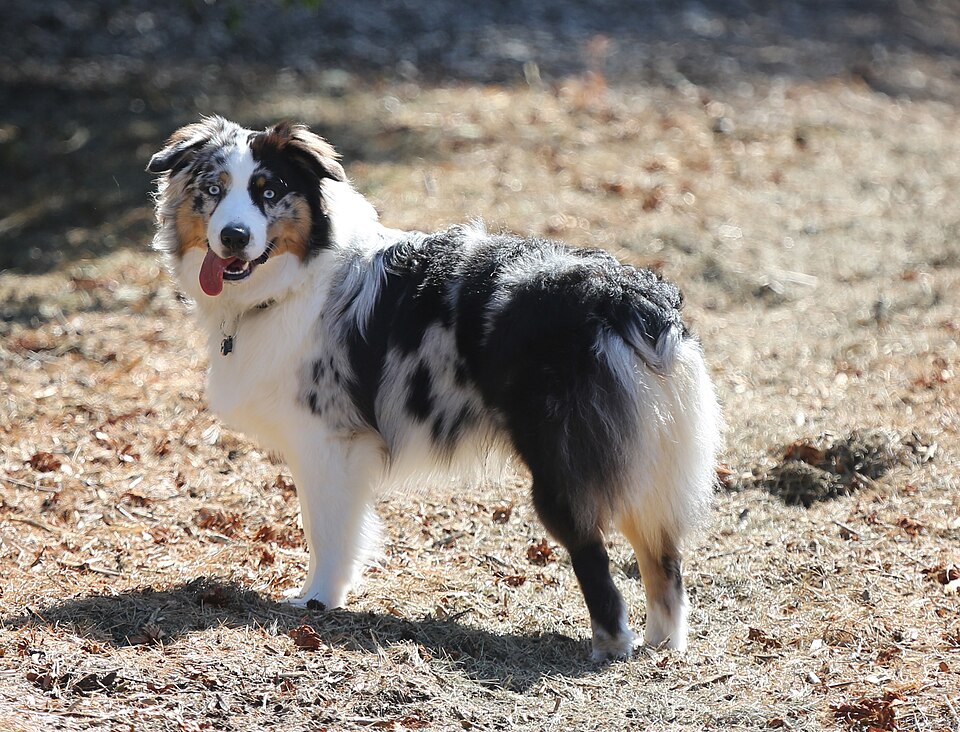
The Australian Shepherd, or "Aussie," is a medium-sized herding dog that turns heads with its marbled merle coat, its sometimes blue or two-colored eyes and its seemingly endless energy. The name is misleading: the breed developed on American ranches, not in Australia. It is smart, loyal and very eager to learn, but a dog bred to work on a ranch also has big daily needs. On this page we've pulled together its temperament, care needs and health issues from breed registry standards, university resources and scientific studies.
- Temperament: Smart, loyal, energetic and deeply attached to its family; may be reserved with strangers at first.
- Needs a lot to do: According to the Royal Kennel Club, more than 2 hours of exercise a day; giving it a job is best.
- MDR1: This gene change, which causes serious sensitivity to certain medications, is very common in the breed; get the DNA test and share the result with your vet.
- Merle warning: Puppies from two merle parents have far higher rates of deafness and vision problems.
- Lifespan: In a large UK study the median lifespan was 13.7 years.
What to know
 What is the Australian Shepherd like?
According to the Royal Kennel Club standard, the Australian Shepherd has an even disposition; it may be reserved with strangers at first but should never be shy or aggressive. It learns very quickly: on the AKC's breed chart it scores at the top for trainability, energy and mental stimulation needs.
It bonds very tightly to its family. According to the AKC, that loyalty can turn into being territorial and overprotective of its owners' property, and it can become destructive if it's left without companionship for long periods too often. The herding instinct is strong: the AKC writes that the best approach is to give the Aussie a job, whether that's herding livestock, "shepherding" children or competing in dog sports.
One point the AKC highlights is important: one of the most frequent reasons Aussies end up in rescue is that owners couldn't, or wouldn't, channel the breed's boundless energy constructively through training.
Every dog is an individual. Breed traits describe general tendencies; the puppy's parents, how much contact it had with people in its first weeks, its training and its health shape its personality as much as its breed.
 Who is it a good fit for?
The Aussie is a great companion for active families who love the outdoors, go on long walks and hikes, and want to do sports or training with their dog. The Royal Kennel Club suggests country living, a large house and a large yard for this breed.
| Situation | Good fit? |
|---|---|
| Apartment | Hard; it needs hours outdoors every day |
| Family with kids | Good; the AKC rates it highly with children, but it may try to herd them |
| Other dogs | Usually gets along with early socialization |
| Long hours alone | Not a good fit; can become destructive without company |
| First-time dog owners | Only if you'll truly make time for exercise and training |
| Country life, farms | Excellent; a breed that can still do its original job |
Always supervise play with small children, and don't let the dog chase them. Our article on kids and dogs goes into detail.
Where does it come from?
According to the Royal Kennel Club, despite its name the Australian Shepherd was developed in the United States as a ranch dog; its roots go back to Spanish sheepdogs brought by Basque shepherds who emigrated to America in the 19th century. The AKC tells a similar story: Basque shepherds from the Pyrenees sailed to Australia with their dogs in the 1800s and later moved on to California; American ranchers assumed the dogs were an Australian breed, and the misleading name stuck.
According to the AKC, the breed's popularity boomed after World War II along with Western culture and horse riding; Aussies were often seen at rodeos, horse shows and in movies. Today they're common on ranches, in dog sports and as family dogs.
Appearance and colors
A medium-sized, balanced and athletic dog; with its many colors and eye combinations, it can look very different from one dog to the next.
- Height: According to the Royal Kennel Club standard, 20–23 in (51–58 cm) for males and 18–21 in (46–53 cm) for females.
- Weight: The standard gives no weight; the AKC gives 50–65 lb (23–30 kg) for males and 40–55 lb (18–25 kg) for females.
- Coat: A medium-length, weather-resistant outer coat that ranges from straight to slightly wavy, with an undercoat.
- Colors: Blue merle, black, red merle and red, with or without copper markings. White is accepted only in limited areas: the collar, chest, muzzle, blaze, underparts and legs.
- Eyes: Brown, blue, amber or any combination, including flecks and marbling.
- Tail: Some dogs are born with a naturally short tail (bobtail). The Royal Kennel Club standard accepts both undocked tails and natural bobtails.
"Merle" is a marbled pattern in which dark patches are scattered over a lighter base. It's almost a symbol of the breed, but it also matters for health, as explained below.
Daily care
According to the AKC, weekly brushing usually keeps the Aussie's weather-resistant double coat looking its best. Shedding season means more work: the AKC suggests using an undercoat rake every two or three days to remove the dead hair. An occasional bath is enough.
- Nails: The AKC recommends trimming them regularly.
- Ears: The AKC recommends checking the ears regularly to remove debris and prevent wax buildup.
- Teeth: Brush the teeth regularly.
- After outings: According to the AKC, Aussies spend a lot of time outdoors and often come home dirtier than they left; check the paws and coat.
For more, see our article on dog grooming.
Training and exercise
According to the AKC, the Aussie is a high-energy, athletic dog that needs a great deal of exercise every day; at minimum it wants a large, fenced area to run in for an hour or two daily. The Royal Kennel Club recommends more than 2 hours of exercise a day. It loves long walks and, better yet, hikes.
- Give it a job: Herding, obedience, agility, tracking or dock diving; according to the AKC, giving it a job is the best course.
- Early socialization and training: The AKC calls both musts. Because it's so devoted and smart, it's easy to train.
- Running: According to the AKC, it makes a great running partner once puppyhood is over and its skeleton has fully developed; don't take a puppy on long runs.
- Time alone: Long stretches without company are hard for this breed. Teach it to be alone step by step; our article on separation anxiety can help.
- Brain games: Scent games and new tricks tire out its mind.
 Diet and weight
It doesn't need a special food; a complete, balanced dog food suited to its age and activity level is enough. The AKC reminds owners that some dogs are prone to weight gain and that too many treats can lead to obesity.
- Measure food; decide the daily amount with your vet based on your dog's ideal weight and activity.
- Count training treats as part of the daily food.
- You should be able to feel the ribs under a thin layer of fat, and see a waist when you look from above.
- Always have fresh water available.
- Learn which foods are harmful to dogs, and don't feed from the table.
 Health issues to know about
The AKC considers the Aussie a generally healthy breed, but there are a few important inherited issues to know about. The information below is for awareness only; ask your vet about diagnosis and treatment.
MDR1: dangerous sensitivity to certain medications
A change in the MDR1 gene causes serious sensitivity to certain medications. According to Washington State University, dogs with this change can become very ill, or even die, if given some common medications. The change is most common in herding breeds, and the university's table gives a frequency of about 50% for Australian Shepherds.
The good news: a simple DNA test shows your dog's status. The Royal Kennel Club also recommends this test for breeders.
- Find out your dog's MDR1 status; ask the breeder for the parents' results or have your vet test your dog.
- Write the result in your dog's health record and always mention it at every vet visit, especially before surgery or sedation.
- Never give your dog a medication meant for people or prescribed for another animal on your own.
Merle to merle: risk of deafness and blindness
The merle pattern is one of the breed's best-loved features, but "double merle" puppies that carry two copies of the merle gene are at serious risk. In a 2009 study, 2.7% of dogs with one copy were deaf in one ear and 0.9% in both, while in double merles the figures were 10% and 15%. That's why the Royal Kennel Club has not registered puppies from merle-to-merle matings since 2013; vision problems are among the reasons too. When buying a puppy, make sure only one parent is merle.
Eye diseases
- Collie eye anomaly (CEA): An inherited disease in which layers at the back of the eye don't develop fully. According to a large 2023 study, it does not progress and vision is only minimally affected in most dogs, but severe cases can lead to blindness. The Royal Kennel Club recommends, as a minimum, a CEA DNA test for breeders.
- Hereditary cataracts: A progressive disease in which the lens of the eye turns cloudy; in this breed it's mainly caused by a change in the HSF4 gene, and there's a DNA test.
- Progressive retinal atrophy (PRA): A disease in which the retina degenerates over time, affecting night vision first; there's a DNA test for this type too.
Natural bobtail
A naturally short tail looks harmless, but according to a 2023 European study, most puppies that inherit two copies of the bobtail gene die early in the womb, and two copies can also cause spinal cord defects. That's why breeding two bobtailed dogs together is risky; ask the breeder about it.
Other issues
The AKC recommends that breeders screen for hip dysplasia, epilepsy, cataracts and certain cancers; the Royal Kennel Club also recommends hip and elbow X-rays and eye exams. The gene linked to degenerative myelopathy, a spinal cord disease of older age, has also been found in European Aussies.
- Stumbling, trembling, sudden weakness or seizures after a medication is given
- No response to sounds, or bumping into things
- Cloudiness or redness in the eye, or sudden vision loss
- Sudden limping or inability to get up
How long does it live?
In the 2024 UK study by McMillan and colleagues covering about 585,000 dogs, the median lifespan of 245 Australian Shepherds was 13.7 years (confidence interval 12.8–14.6), compared with 12.0 years for mixed-breed dogs. Because the sample is small, this result should be read with caution. The AKC gives a range of 12–15 years.
Being a long-lived breed means years of daily exercise and attention. Regular vet checkups, a healthy weight and eye exams help protect quality of life in old age.
 Before you get one
- Consider a shelter: According to the AKC, one of the most frequent reasons Aussies end up in rescue is that their energy wasn't channeled through training. An adult dog's energy level and personality are already known. Our article on adopting a shelter dog can help.
- If you buy from a breeder: Ask for the parents' MDR1, CEA, hereditary cataract and PRA DNA tests, hip and elbow X-rays and eye exams. Find out the parents' colors; don't buy a puppy from two merle parents.
- Red flags: Steer clear of sellers who market puppies as "rare colors" or "double merles," won't show you the mother or can't show test results.
- Lifestyle: Make sure you can give more than 2 hours of exercise and training a day.
- Registration: Rules vary by country; many places require or recommend microchipping. In Türkiye, owned dogs must be microchipped and registered.
- The first days: Our guide to bringing home a new puppy walks you through it step by step.
Frequently asked questions
Is the MDR1 test really necessary?
For this breed it's very important. Washington State University's table gives a frequency of about 50% for the breed, and some common medications can make dogs with this change very ill or even kill them. The test is simple, and knowing the result helps your vet choose the right medication when needed.
Why shouldn't two merle dogs be bred together?
Because some of the puppies will get two copies of the merle gene. Deafness and vision problems are far more common in these "double merle" dogs. The Royal Kennel Club doesn't register puppies from such matings.
Is the Australian Shepherd really from Australia?
No. According to breed registries, it was developed on ranches in the United States. Basque shepherds' dogs arriving in America by way of Australia led to the breed being mistaken for an Australian one.
Can an Aussie live in an apartment?
It's hard. The Royal Kennel Club recommends a large house and a large yard for this breed. If you can provide hours of running, play and training every day, it can live in an apartment; if you can't, it will be unhappy.
Do Aussies shed a lot?
Yes, especially during shedding season. Raking out the undercoat every two or three days during that time cuts down the hair around your home.
Sources
- Royal Kennel Club · Australian Shepherd breed page, health screening and breeding restrictions
- Royal Kennel Club · Australian Shepherd breed standard
- AKC (American Kennel Club) · Australian Shepherd breed profile
- McMillan et al. · Longevity of companion dog breeds: those at risk from early death, Scientific Reports (2024)
- Washington State University · Breeds commonly affected by the MDR1 mutation
- Washington Animal Disease Diagnostic Laboratory (WSU) · MDR1 in dogs
- Strain et al. · Prevalence of deafness in dogs heterozygous or homozygous for the merle allele, Journal of Veterinary Internal Medicine (2009)
- Clark et al. · Global frequency analyses of canine prcd-PRA and collie eye anomaly, Genes (2023)
- Majchrakova et al. · The incidence of genetic disease alleles in Australian Shepherd dog breed in European countries, PLOS ONE (2023)
- De Iorio et al. · Genotypic and allelic frequencies of hereditary cataract in the Italian population of Australian Shepherd, Animals (2025)
- Resmî Gazete (Official Gazette of Türkiye) · Regulation on the identification and registration of cats, dogs and ferrets (February 26, 2018)
By Tüylüm · Last checked: November 3, 2026. Compiled from the sources above and written in our own words. Spotted a mistake? Write to [email protected] and we'll fix it right away. Photo from Wikimedia Commons, used under the license shown below it.