 Tüylüm
Shetland Sheepdog
A small, long-coated herding dog from Scotland's Shetland Islands, very smart and devoted to its family. It's easy to train and can adapt to city life, but it can be very barky, sheds heavily, and DNA tests for MDR1 and eye diseases matter.

 Lifespan≈ 13.4 yearsmedian lifespan in the UK, 2024 study
 Weight15–25 lb (7–11 kg)per the AKC; the standard gives no weight
 Shoulder height14–14.5 in (35–37 cm)ideal: males 14.5 in, females 14 in
 OriginShetland Islandsislands off northeast Scotland
 CoatLong, doublesheds heavily; regular brushing is a must
 ExerciseUp to 1 hour a dayalso loves brain games
 With kidsExcellenttop score on the AKC breed chart
 TrainingLearns very fastexcels at obedience and agility
The Shetland Sheepdog, or Sheltie, is a graceful herding dog with a long, full coat that looks at first glance like a miniature Collie. It is very smart, eager to learn and devoted to its family; because it gets by on less exercise than the big herding breeds, it's also popular with city families. On this page we've pulled together its temperament, care needs and health issues from breed registry standards, university resources and scientific studies.
- Temperament: Affectionate, smart and very responsive to its owner; may be reserved with strangers.
- Easy to train: One of the most successful breeds in obedience and agility; learns very fast with rewards.
- Be ready for barking: It scores at the top for barking on the AKC's breed chart; early training matters.
- Lots of coat: The long double coat needs regular brushing; shaving isn't recommended.
- Health: MDR1, collie eye anomaly, hypothyroidism and gallbladder problems are known issues in the breed.
What to know
 What is the Shetland Sheepdog like?
According to the Royal Kennel Club standard, the Sheltie is affectionate and responsive to its owner and reserved with strangers, but never nervous. According to the AKC, it is very intelligent, trainable and willing to please, and reaches its full potential as a companion once it has learned at least basic obedience.
Within the family it's usually warm and easygoing: on the AKC's breed chart it scores at the top for affection with family, good with young children, good with other dogs and adaptability. On the same chart its openness to strangers is low, so it may need time to warm up to new people. That's why plenty of positive socialization from puppyhood matters.
Two traits are worth knowing about. The first is barking: the AKC writes that Shelties may express even happiness by barking, and that owners must be prepared to teach the dog to stop when asked. The second is chasing: like other herding breeds, it loves to chase moving things, including cars, so the AKC recommends a well-fenced yard and walks on a leash.
Every dog is an individual. Breed traits describe general tendencies; the puppy's parents, how much contact it had with people in its first weeks, its training and its health shape its personality as much as its breed.
 Who is it a good fit for?
The Sheltie suits families who want to spend time with their dog, can make time for a daily walk and play, and don't mind coat care. Among herding breeds it may be one of the best choices for first-time owners, as long as they know about the barking and the coat from the start.
| Situation | Good fit? |
|---|---|
| Apartment | Good; the AKC says it does well in the city with enough exercise, but watch for barking that bothers the neighbors |
| Family with kids | Excellent, as long as children learn to be gentle with the dog |
| Other dogs | Usually gets along very well |
| Long hours alone | Not ideal; it wants to be with its family |
| First-time dog owners | Good; easy to train with moderate exercise needs |
Because it's a small dog, it's important that children don't hug and squeeze it, drop it or bother it while it sleeps. Our article on kids and dogs can help.
Where does it come from?
According to the Royal Kennel Club, the small Shetland Islands off Scotland's northeast coast produced small animals suited to their small land, the Shetland Sheepdog and the Shetland pony being two examples. The Scottish sheepdogs that are the rootstock of the Collie, Border Collie and Bearded Collie are thought to have played a part in its ancestry too. The AKC also explains that small animals that needed less food were preferred in the harsh climate, and that Shelties herded sheep, ponies and chickens on the farms.
According to the club, the breed was first shown at Crufts in 1906 as a "miniature Collie." According to the AKC, the English Kennel Club recognized it in 1909, but separate classification from the Collie came only in 1914. Though related to and resembling the Collie, it has long been a separate breed.
Appearance and colors
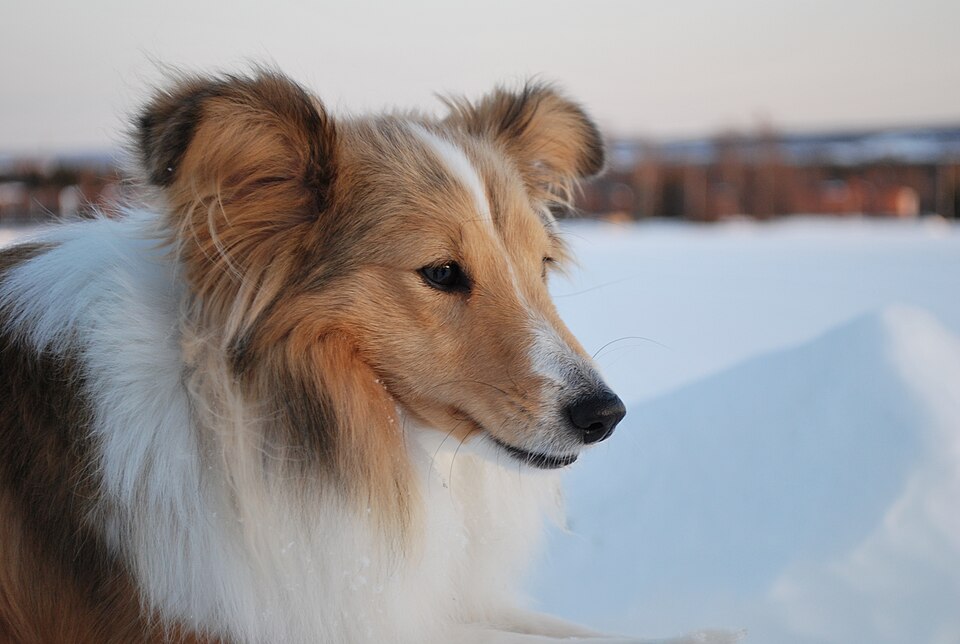
A small, elegant, long-coated dog with an abundant mane framing its neck.
- Height: According to the Royal Kennel Club standard, the ideal is 14.5 in (37 cm) for males and 14 in (35.5 cm) for females; more than 1 in (2.5 cm) above or below is considered highly undesirable.
- Weight: The standard gives no weight; the AKC gives a range of 15–25 lb (7–11 kg).
- Coat: A long, harsh, straight outer coat over a short, soft, dense undercoat. The mane and frill are very abundant, and the forelegs are well feathered.
- Colors: Sable in any shade from pale gold to deep mahogany, tricolor with a black body, blue merle, black and white, and black and tan. White markings on the collar, chest, legs and tail tip are preferred.
- Eyes: Dark brown; in merles one or both eyes may be blue or blue-flecked.
Daily care
A Sheltie's coat is beautiful but takes work. The AKC says the breed's profuse double coat sheds considerably and that owners must be prepared to brush it weekly, and more often during shedding season; the Royal Kennel Club suggests grooming every day. The AKC especially advises checking for mats behind the ears, under the elbows of the front legs and in the "pants" under the tail.
- Don't shave: The AKC doesn't recommend shaving; the coat protects against sunburn and heat as well as cold.
- Baths: An occasional bath is enough.
- Nails: Trim them regularly.
- Ears and teeth: Check weekly and brush the teeth regularly.
For more, see our article on dog grooming.
Training and exercise
According to the AKC, the Sheltie is active and athletic but needs only a moderate amount of exercise and adapts easily to its family's way of life. The Royal Kennel Club recommends up to 1 hour of exercise a day. It loves outings that work both its body and its mind.
- Dog sports: According to the AKC, it excels at obedience, agility, herding and tracking, and shines as a therapy dog.
- Early socialization: Because the breed tends to be reserved with strangers, safely introduce your puppy to different people and places; the AKC recommends puppy training classes.
- A "quiet" cue: Reduce barking by finding the cause and redirecting with rewards, not punishment. Our article on why dogs bark walks you through it.
- Leash and fence: Because it likes to chase moving things, don't walk it off leash near traffic; work on a reliable recall.
- Brain games: Scent games and learning tricks make it very happy.
 Diet and weight
It doesn't need a special food; a complete, balanced dog food suited to its age and activity level is enough. The AKC reminds owners that some dogs are prone to weight gain. A long coat can hide extra weight, so trust your hands, not your eyes.
- Measure food; decide the daily amount with your vet based on your dog's ideal weight.
- Count training treats as part of the daily food; in a small dog even a few treats add up.
- Feel for the ribs under the coat: they should be felt under a thin layer of fat.
- Weigh your dog monthly; hypothyroidism, which is common in this breed, can also show up as weight gain.
- Learn which foods are harmful to dogs.
 Health issues to know about
The AKC considers Shelties generally healthy dogs, but it recommends that breeders screen for hip dysplasia, thyroid disease, eye diseases, dermatomyositis (Sheltie skin syndrome), von Willebrand's disease, gallbladder mucoceles and epilepsy. The information below is for awareness only; ask your vet about diagnosis and treatment.
MDR1: sensitivity to certain medications
The MDR1 gene change causes serious sensitivity to certain medications; according to Washington State University, dogs with this change can become very ill, or even die, from some common medications. The university's table gives a frequency of about 15% for Shelties. A simple DNA test shows your dog's status, and the Royal Kennel Club recommends it too. Always tell your vet the result, and never give your dog a medication meant for people on your own.
Collie eye anomaly (CEA) and other eye diseases
CEA is an inherited disease in which layers at the back of the eye don't develop fully. According to a large 2023 study, it particularly affects herding breeds such as Collies and Shelties; it does not progress and vision is only minimally affected in most dogs, but severe cases can lead to blindness. The Royal Kennel Club recommends, as a minimum, eye exams that include litter screening; DNA tests also exist for CEA and two types of progressive retinal atrophy (PRA).
Hypothyroidism
The thyroid gland doesn't make enough hormone. According to a 2022 UK study, affected dogs often show weight gain, lethargy, hair loss and intolerance to cold. In the same study, which looked at records of about 906,000 dogs, Shelties had about 8 times the risk of hypothyroidism of mixed-breed dogs. If you notice these signs, talk to your vet.
Gallbladder mucocele
An abnormal buildup of thick mucus in the gallbladder. According to a 2018 study, it can block the bile duct or cause the gallbladder to rupture, with serious consequences. Shelties are considered among the predisposed breeds, and a 2010 study found a link to a gene change in this breed. If you notice vomiting, loss of appetite or belly pain, see your vet.
Merle and other issues
Blue merle Shelties are much loved, but "double merle" puppies from two merle parents have far higher rates of deafness and vision problems. In a 2009 study, 15% of double merles were deaf in both ears. That's why the Royal Kennel Club hasn't registered puppies from merle-to-merle matings since 2010. The club also recommends a DNA test for von Willebrand disease, which affects blood clotting, plus hip and elbow screening; it places the breed in "Category 2" of Breed Watch and asks judges to watch for misplaced canine teeth.
- Stumbling, trembling, sudden weakness or seizures after a medication is given
- Vomiting, loss of appetite and belly pain together
- Bleeding that won't stop or unexplained bruising
- Cloudy eyes, bumping into things or no response to sounds
How long does it live?
The Sheltie is a long-lived breed. In the 2024 UK study by McMillan and colleagues covering about 585,000 dogs, the median lifespan of about 1,900 Shelties was 13.4 years (confidence interval 13.1–13.6), compared with 12.0 years for mixed-breed dogs. The AKC gives a range of 12–14 years.
Over a long life, regular eye exams, a healthy weight and regular vet checkups in old age help catch problems early.
 Before you get one
- Consider a shelter: Purebred dogs and herding mixes end up in shelters and rescues too. Our article on adopting a shelter dog can help.
- If you buy from a breeder: Ask for the parents' eye exams, CEA, PRA, MDR1 and von Willebrand DNA tests, and hip and elbow screening. Make sure only one parent is merle.
- Red flags: Steer clear of sellers who market "miniature" or "toy" Shelties far smaller than the standard, won't show you the mother or can't show test results.
- Neighbors: If you live in an apartment, start barking training from day one.
- Registration: Rules vary by country; many places require or recommend microchipping. In Türkiye, owned dogs must be microchipped and registered.
- The first days: Our guide to bringing home a new puppy walks you through it step by step.
Frequently asked questions
Is a Sheltie just a small Collie?
No. It's related to the Collie and looks like one, but it's a separate breed. According to the Royal Kennel Club, it was first shown at Crufts in 1906 as a "miniature Collie"; today the two breeds have different standards.
Do Shelties bark a lot?
They're prone to barking; the breed scores at the top for barking on the AKC's breed chart. Early training, enough exercise and brain games can keep it under control.
Can a Sheltie live in an apartment?
Yes, it usually adapts well. The Royal Kennel Club says a small house is enough and recommends up to 1 hour of exercise a day. The main thing to watch is barking.
Can I shave my Sheltie in summer?
The AKC doesn't recommend it; the double coat protects the dog from sun and heat as well as cold. Regular brushing to remove dead undercoat is a better approach in summer.
Should I get an MDR1 test?
Yes, it's recommended. Washington State University's table gives a frequency of about 15% for Shelties. Knowing the result lets your vet choose safe medications when needed.
Sources
- Royal Kennel Club · Shetland Sheepdog breed page, health screening and breeding restrictions
- Royal Kennel Club · Shetland Sheepdog breed standard
- Royal Kennel Club · Breed Watch: Shetland Sheepdog (Category 2)
- AKC (American Kennel Club) · Shetland Sheepdog breed profile
- McMillan et al. · Longevity of companion dog breeds: those at risk from early death, Scientific Reports (2024)
- Washington State University · Breeds commonly affected by the MDR1 mutation
- Washington Animal Disease Diagnostic Laboratory (WSU) · MDR1 in dogs
- Clark et al. · Global frequency analyses of canine prcd-PRA and collie eye anomaly, Genes (2023)
- O'Neill et al. · Frequency, breed predispositions and other demographic risk factors for diagnosis of hypothyroidism in dogs under primary veterinary care in the UK, Canine Medicine and Genetics (2022)
- Mealey et al. · An insertion mutation in ABCB4 is associated with gallbladder mucocele formation in dogs, Comparative Hepatology (2010)
- Gookin et al. · Qualitative metabolomics profiling of serum and bile from dogs with gallbladder mucocele formation, PLOS ONE (2018)
- Strain et al. · Prevalence of deafness in dogs heterozygous or homozygous for the merle allele, Journal of Veterinary Internal Medicine (2009)
- Resmî Gazete (Official Gazette of Türkiye) · Regulation on the identification and registration of cats, dogs and ferrets (February 26, 2018)
By Tüylüm · Last checked: November 3, 2026. Compiled from the sources above and written in our own words. Spotted a mistake? Write to [email protected] and we'll fix it right away. Photo from Wikimedia Commons, used under the license shown below it.