 Tüylüm
Bernese Mountain Dog
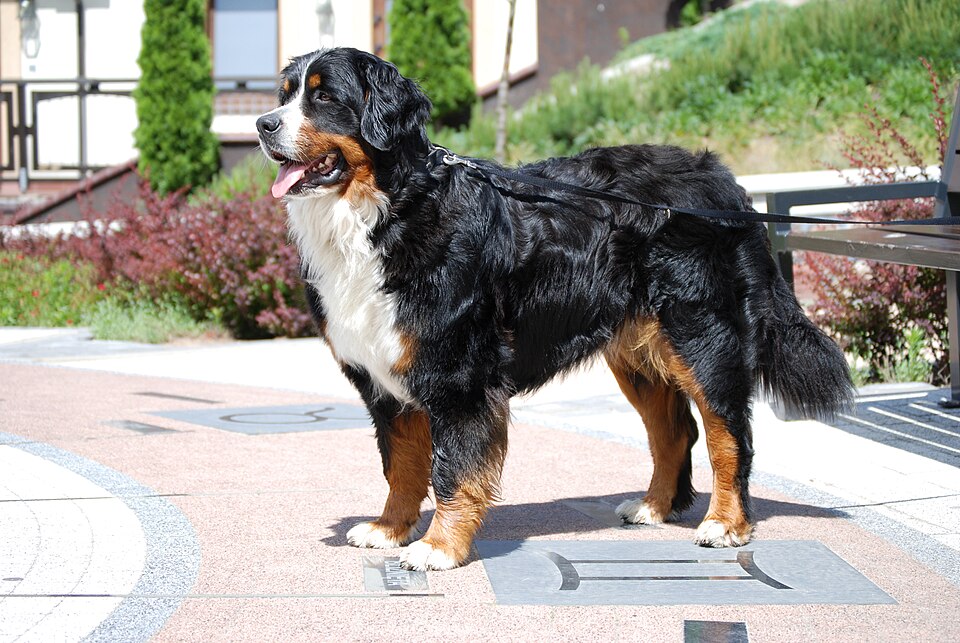
A calm, very affectionate tricolor dog that guarded farms, drove cattle and pulled milk carts around Bern in Switzerland. It's known for being good with kids, but cancer is very common in this breed and its life is short. Hip and elbow screening is a must.

 Lifespan≈ 8.4–10.1 yearsmedians: Switzerland 8.4, UK 10.1 years
 Weight70–115 lb (32–52 kg)AKC: males 80–115 lb, females 70–95 lb
 Height at shoulder23–27.5 in (58–70 cm)FCI: males 25–27.5 in, females 23–26 in
 OriginSwitzerland (Bern)the farm dogs of Dürrbach
 CoatLong, tricolorheavy shedder; brush several times a week
 ExerciseUp to 1 hour a dayRoyal Kennel Club guidance
 With kidsVery gentlethe AKC says especially gentle with kids
 TrainingQuick learnersensitive; harsh methods backfire
With its glossy, long black, rust and white coat and its soft expression, the Bernese Mountain Dog is one of the easiest breeds to recognize. It worked on farms around Bern in Switzerland and is now loved around the world as a calm, affectionate family dog. The most important thing to know before you get one is hard but simple: cancer is very common in this breed, and its life is short. We built this page from breed registry standards, animal welfare resources and scientific studies.
- Temperament: Calm, good-natured, docile and very devoted to its family; self-assured and placid with strangers.
- Exercise: The Royal Kennel Club considers up to an hour a day enough, and the AKC recommends at least half an hour of moderate activity.
- Care: Its long double coat sheds heavily; brush at least weekly, and daily during shedding season.
- Health: In a Swiss study, 58% of deaths were due to cancer, and elbow and hip dysplasia are also common. Always ask for the parents' hip and elbow X-rays.
- Lifespan: A median of 8.4 years in Switzerland and 10.1 years in the UK, clearly shorter than for mixed-breed dogs.
What to know
 What is the Bernese Mountain Dog like?
The FCI standard describes the Bernese Mountain Dog as self-confident, attentive, vigilant and fearless in everyday situations; good-natured and devoted to its own people, and self-assured and placid with strangers. Its temperament is moderately lively and docile.
According to the AKC, the breed has a sweet, affectionate nature; it's generally placid but always up for a romp with its owner, whom it lives to please. It gets along with the whole family and is especially gentle with children, though it often becomes more attached to one person. In the AKC's words, it's imposing but not threatening, with an aloof dignity toward strangers. Its feelings are easily hurt, it wants to be with its family, and undesirable behaviors can develop if it's regularly left alone for long periods.
Every dog is an individual. Breed traits describe general tendencies; the parents' temperament, how a puppy was socialized and the training it gets shape its personality as much as its breed.
 Who is it a good fit for?
The Bernese suits families with a fairly calm lifestyle who can spend time with their dog every day, put up with plenty of hair and take on the breed knowing its health risks. The Royal Kennel Club recommends a large house and a large yard.
| Situation | Good fit? |
|---|---|
| Apartment | Hard; a big dog that sheds heavily |
| House with a yard | Good; the dog should still live indoors with its family |
| Family with kids | Excellent; the AKC says it's especially gentle with children |
| Other dogs | According to the AKC, gets along very well |
| Long hours alone | Struggles; wants to be with its family |
| Hot climate | Take care; the AKC describes a cold-loving dog with a thick coat |
Where does it come from?
According to the FCI, the Bernese Mountain Dog is an ancient farm dog used as a guard dog, draft dog and cattle drover in the foothills of the Alps and the midlands around Bern. It used to be called the "Dürrbächler," after the hamlet and inn of Dürrbach near Riggisberg, where these long-haired tricolor dogs were especially common. It appeared at shows in 1902, 1904 and 1907; in 1907 breeders around Burgdorf founded a club to promote pure breeding and set down the breed's traits. In 1910, 107 dogs were brought to a show in Burgdorf. The breed was later renamed the Bernese Mountain Dog, in line with the other Swiss mountain dogs.
According to the Royal Kennel Club, the Bernese was a draft dog that pulled carts for the region's weavers; on farms it herded sheep and cattle and pulled milk and cheese carts. It's one of the four Swiss mountain dog breeds with the black, tan and white coat and white chest markings. The AKC explains that the 1907 club was formed under the leadership of Professor Albert Heim, one of the most respected dog experts of his day, and that the breed arrived in the United States in 1926. In Switzerland you can still see Bernese dogs pulling light carts in parades.
Appearance and colors
According to the FCI, the Bernese is a long-haired, tricolor, strong and agile working dog of above-medium size, with sturdy legs and a harmonious, balanced build. Its body is slightly longer than its height at the shoulder (about 10 to 9), and it looks compact rather than long.
- Height: 25–27.5 in (64–70 cm) for males, ideally 26–27 in (66–68 cm), and 23–26 in (58–66 cm) for females, ideally 23.5–25 in (60–63 cm) (FCI).
- Weight: According to the AKC, males weigh 80–115 lb (36–52 kg) and females 70–95 lb (32–43 kg).
- Coat: Long, shiny, straight or slightly wavy, with a woolly undercoat.
- Color: A jet-black base with rich rust markings on the cheeks, above the eyes, on all four legs and on the chest. A symmetrical white blaze and muzzle band on the head and white on the throat and chest; white feet and a white tail tip are desirable.
Daily care
According to the AKC, the Bernese has a longer outer coat and a woolly undercoat; it sheds a fair amount year-round and much more during the shedding season that comes twice a year. On the AKC's scale, its shedding is 5 out of 5. Brush it weekly, stepping up to daily during shedding season; tangles can be worked out with a slicker brush or metal comb. The Royal Kennel Club recommends grooming more than once a week. See our dog grooming guide for details.
- Nails: Long nails cause pain and walking problems; trim them regularly.
- Ears and teeth: The AKC recommends checking the ears regularly for signs of infection and brushing the teeth often with a toothpaste made for dogs.
- Hot weather: According to the AKC, this is a hardy dog that thrives in cold weather; in the heat its thick coat becomes a burden. In a 2020 UK study (Hall et al.), heavy dogs and dogs heavier than the average for their breed had a higher risk of heatstroke. In summer, shade, a cool floor and plenty of water are a must; our article on dogs in hot weather covers the warning signs.
Training and exercise
The AKC calls early socialization and obedience training important for all dogs, but especially for breeds as large as the Bernese. Because it's intelligent and eager to please, it's usually easy to train. It's affectionate and openhearted; according to the AKC its feelings are easily hurt and it doesn't respond well to harsh corrections or harsh training methods. Short, calm, reward-based sessions work best.
According to the AKC, the Bernese needs at least half an hour of moderate exercise every day to stay healthy and happy, and the Royal Kennel Club recommends up to an hour a day. It loves long walks and hikes. Thanks to its draft-dog history it does well at carting, and it also takes part in agility, herding, obedience and tracking. Don't push a growing puppy into strenuous exercise; talk to your vet about activity that suits its age.
- Early socialization: As a puppy, give it short, positive experiences with different people, children, sounds, vehicles and calm dogs.
- Leash training: Teach it to walk without pulling while it's small. Our guide to loose-leash walking explains it step by step.
- Teach it to be alone: Start with short absences and build up slowly. Our article on separation anxiety can help.
- Vet prep: Use rewards early on to get it comfortable with being handled, examined, groomed and getting in and out of the car; vet visits may be frequent with this breed.
 Diet and weight
According to the AKC, a quality food suited to the Bernese's age is enough, though some dogs gain weight easily. Extra weight puts more strain on the joints in a breed where dysplasia is common.
- Controlled growth in puppyhood: The Merck Veterinary Manual notes that too much calcium (for example, from unnecessary supplements) can harm bone and joint development in fast-growing large-breed puppies. Make a growth plan with your vet covering the type of food, the amount and the weight curve, and don't add supplements your vet hasn't recommended.
- Lower the risk of bloat: The AKC reminds owners that all large breeds are susceptible to bloat. For dogs at risk, the Merck Veterinary Manual recommends splitting the daily food into several small meals, limiting exercise before and after meals and keeping mealtimes calm.
- Ideal weight: If you can feel the ribs under a thin layer of fat and see a waist from above, the weight is about right.
Also check our list of foods that are dangerous for dogs.
 Health issues to know about
Before you get a Bernese, it's important to know the breed's health picture clearly. The information below is for awareness only; ask your vet about diagnosis and treatment.
Cancer
In a study that followed Bernese dogs born in Switzerland in 2001 and 2002 (Klopfenstein et al., 2016), cancer was by far the most common cause of death: 58.3% of the 381 dogs that died. The authors note that some of these cancer diagnoses weren't confirmed by tissue testing, but the overall picture shows how common cancer is in the breed. Dogs with cancer had shorter lives than those with other conditions.
The cancer most discussed in this breed is histiocytic sarcoma, a fast-spreading tumor that develops from certain immune system cells. A 2009 study of 800 Bernese dogs (Abadie et al.) reported that it occurs in about 25% of the breed, starts at an average age of 6.5 years and affects males and females equally; pedigree analysis suggests it's inherited through several genes. If you notice unexplained tiredness, loss of appetite, weight loss, breathing trouble, lameness or a new lump, see your vet without waiting.
Elbow and hip dysplasia
Dysplasia means a joint doesn't develop properly during growth. According to UFAW, fragmentation of a bony process in the elbow (FMCP) is common in Bernese dogs and may affect a third to two thirds of the breed, with arthritis usually starting in the first year. The Royal Kennel Club asks breeders, at a minimum, to hip and elbow score dogs before breeding. In the Swiss study, degenerative joint disease was the second most common cause of death.
Bloat
In bloat, the stomach fills with gas and twists on itself; according to the Merck Veterinary Manual, it's a life-threatening emergency that needs immediate care. In the Swiss study, 1.8% of deaths were due to a twisted stomach or mesentery.
Others
The AKC also lists narrowing below the aortic valve (subaortic stenosis), von Willebrand bleeding disorder, progressive retinal atrophy (PRA), eyelid problems, and thyroid and immune system diseases among conditions seen in the breed; the screenings it lists include a heart exam, an eye exam and DNA tests for degenerative myelopathy, a nervous system disease.
- Unexplained tiredness, loss of appetite or rapid weight loss
- Coughing, shortness of breath or pale gums
- Retching without bringing anything up, a swollen belly, restlessness
- Limping or obvious trouble getting up
- Fast, labored breathing or stumbling in the heat
How long does it live?
A study that followed Bernese dogs born in Switzerland in 2001 and 2002 found a median lifespan of 8.4 years, with females (8.8 years) living clearly longer than males (7.7 years). A 2024 study using data on about 585,000 dogs in the UK (McMillan et al.) found a median of 10.1 years for 1,565 Bernese dogs, compared with 12 years for mixed-breed dogs. The AKC gives 7–10 years, and the Royal Kennel Club lists the breed as living under 10 years.
The numbers vary by country and method, but the message is the same: you may have fewer years with a Bernese than with most dogs. A puppy from screened parents, a healthy weight, regular checkups and getting new symptoms checked early are the most concrete steps.
 Before you get one
- Consider a shelter: Purebred dogs end up in shelters and rescues too. Our guide to adopting a dog from a shelter walks you through it.
- If you buy from a breeder: Meet the parents in person. Ask for hip and elbow X-ray results, heart and eye exams and the degenerative myelopathy DNA test. It's also worth asking how long the dogs in the family lived and whether there's a history of cancer, since histiocytic sarcoma is known to cluster in families.
- Emotional preparation: A short lifespan and a high cancer risk are things to accept knowingly when choosing this breed.
- Red flags: Sellers who won't show you the mother, always have puppies available, can't provide paperwork or rush you.
- Registration: Rules vary by country. In Türkiye, owned dogs must be microchipped and registered in the PETVET system.
- The first days: See our guide to the first week with a new puppy.
Frequently asked questions
Why do Bernese Mountain Dogs live such short lives?
Mainly because of cancer. In the Swiss study, 58% of deaths were due to cancer, and an aggressive cancer called histiocytic sarcoma affects roughly one in four dogs of the breed. Researchers believe the disease is inherited, with several genes involved.
Do Bernese Mountain Dogs shed a lot?
Yes. On the AKC's scale, its shedding is at the very top, and it needs daily brushing during the shedding season that comes twice a year.
Are Bernese Mountain Dogs good with kids?
Usually very good: according to the AKC, they get along with the whole family and are especially gentle with children. Still, it's a big dog, so always supervise around little ones.
Can a Bernese live in a hot climate?
With care. According to the AKC, it's a dog that loves cold weather, and its thick coat is a burden in the heat. In summer it needs a cool home, shade, plenty of water and morning or evening walks.
Is the Bernese the same as the Saint Bernard?
No. Both come from Switzerland, but they're different breeds. According to the Royal Kennel Club, the Bernese is one of the four Swiss mountain dog breeds with the black, tan and white coat, while the Saint Bernard comes from the rescue dogs of the hospice at the Great St. Bernard Pass.
Sources
- FCI · Berner Sennenhund (Bernese Mountain Dog) breed standard (No. 45, 2003)
- The Royal Kennel Club · Bernese Mountain Dog: breed profile and health screening
- AKC (American Kennel Club) · Bernese Mountain Dog breed profile
- Klopfenstein et al. · Life expectancy and causes of death in Bernese mountain dogs in Switzerland, BMC Veterinary Research (2016)
- Abadie et al. · Epidemiology, pathology, and genetics of histiocytic sarcoma in the Bernese mountain dog breed, Journal of Heredity (2009)
- McMillan et al. · Longevity of companion dog breeds: those at risk from early death, Scientific Reports (2024)
- Science for Animal Welfare (UFAW) · Bernese Mountain Dog: Elbow dysplasia (FMCP)
- Hall et al. · Incidence and risk factors for heat-related illness (heatstroke) in UK dogs under primary veterinary care in 2016, Scientific Reports (2020)
- Merck Veterinary Manual · Gastric dilation and volvulus in small animals
- Merck Veterinary Manual · Nutritional requirements of small animals
- Resmî Gazete (Türkiye) · Regulation on the identification and registration of cats, dogs and ferrets (February 26, 2018)
By Tüylüm · Last checked: November 3, 2026. Compiled from the sources above and written in our own words. Spotted a mistake? Write to [email protected] and we'll fix it right away. Photo from Wikimedia Commons, used under the license shown below it.