 Tüylüm
Bloodhound
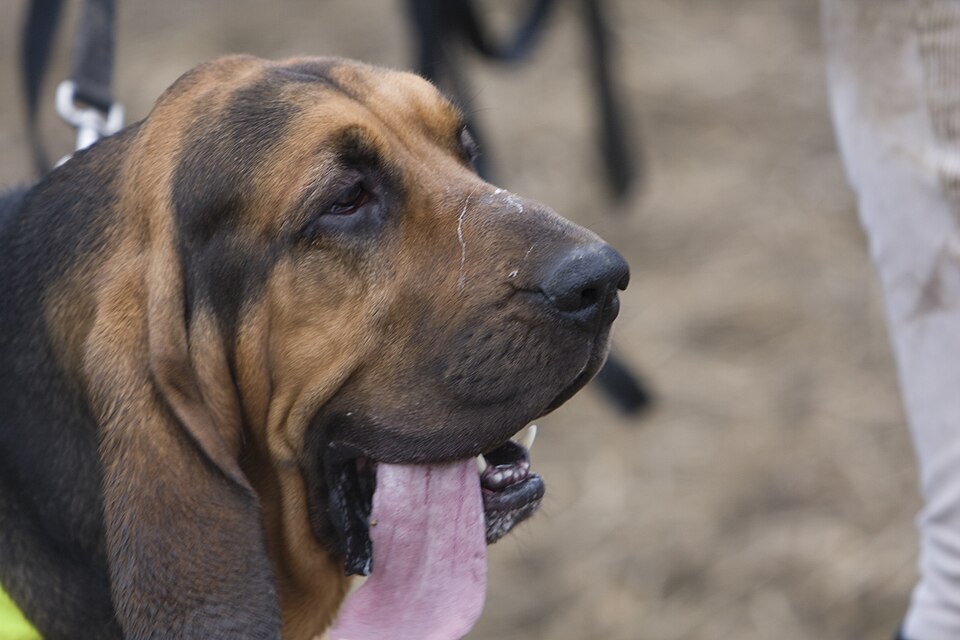
A large scent hound known for its remarkable nose and drooping, wrinkled face. Gentle and sociable, but it needs lots of exercise, a secure fence and attention to health: eyelid problems, skin-fold infections and bloat risk stand out in the breed.

 LifespanMedian 9.3 yearsUK study (McMillan 2024); KC: under 10 years
 Weight88–119 lbFCI: females 88–106, males 101–119 lb (40–54 kg)
 Height23–28 inFCI: females 24, males 27 in, ±1.5 in (62–68 cm ±4)
 OriginBelgiumFCI: Belgium; developed in Britain
 EyesWatch closelyeyelid problems common (UFAW)
 Exercise2+ hours a dayRoyal Kennel Club
 With kidsSupervisedFCI: gentle, sociable; a big dog
 TrainingNeeds patienceFCI: somewhat reserved and stubborn
The Bloodhound is a large tracking dog known for its droopy face, long ears and extraordinary nose. For centuries it has been used both for hunting and for finding missing people. It may look calm and heavy, but once it picks up a scent it doesn't stop. This page covers the breed standard, care needs and the health topics linked to its facial structure, along with the risk of bloat.
- A tracker: The FCI standard defines the breed as a large scent hound; it is also used to find missing people.
- Temperament: According to the FCI, gentle, placid, sociable and attached to its owner; also somewhat reserved and stubborn.
- Exercise: The Royal Kennel Club recommends more than 2 hours a day and describes a large house and large garden as suitable.
- Facial structure: Eyelid problems (turning in or out), excess skin and irritation in skin folds are known health topics in the breed.
- Bloat: Risk is higher in large and giant breeds; sudden swelling and unproductive retching are an emergency.
What to know
 What is the Bloodhound like?
The FCI standard describes the Bloodhound's temperament as gentle, placid, kind and sociable with people, particularly attached to its owner and tolerant of kennel companions and other domestic animals. At the same time it calls the breed somewhat reserved and stubborn, and just as sensitive to compliments as to corrections. The standard describes a dog that is never aggressive; its voice is deep but it rarely barks.
The Bloodhound's character can't be separated from its work: the FCI stresses that the breed "must always remain a hound" and is, above all, a leash hound that works by its remarkable sense of smell. So when its nose is down on a walk, it may not "hear" you; that's not deliberate disobedience, it's doing its job.
A Bloodhound following a scent can travel for miles. Off-leash or unfenced areas carry a serious risk of running off and getting lost with this breed.
 Who is it a good fit for?
The Bloodhound can suit active people who can give a large dog space and time and who enjoy scent-based games. The Royal Kennel Club associates the breed with a large house, a large garden and country settings.
| Situation | A good fit? |
|---|---|
| Apartment | Difficult; a large body and heavy exercise needs call for space and safe areas |
| Family with children | With care; the FCI says gentle and sociable, but a large dog can knock a child over by accident |
| Other dogs and animals | The FCI says it tolerates other household animals; still, introduce calmly and under supervision |
| Long stretches alone | A breed attached to its owner; teach alone time gradually |
| First-time dog owners | May be difficult; size, a stubborn streak, scent-driven wandering and health follow-up call for experience |
| Neatness | A wrinkled face and long ears need regular, careful cleaning |
Where does it come from?
The FCI gives Belgium as the Bloodhound's origin: the breed descends from the large scent hounds bred by the monks of the Abbey of Saint-Hubert in the Ardennes. These dogs, named for Saint Hubert, the patron saint of hunters, were famed for their endurance, especially when hunting wild boar. According to the FCI, William the Conqueror brought these dogs to England in the 11th century; the name "Bloodhound" comes from "blooded hound," meaning a dog of pure blood, a purebred.
The Royal Kennel Club adds that the breed has been bred and developed in Britain since before 1300 and has been used from very early times in tracking humans. In Scotland known as the sleuth-hound, it was used until about 1600 on both sides of the border in pursuit of raiders and cattle thieves. In the 19th century the Bloodhound was used to rescue the French Chien de St Hubert from extinction, and it carries that name in parts of Europe.
Appearance and colors
The FCI standard describes the Bloodhound as a large, harmonious, noble-looking hound that never appears heavy, the most powerful of the scent hounds. Its head and neck stand out because of abundant, thin, supple skin that hangs in deep folds.
- Height and weight: Ideal height at the withers is 27 in (68 cm) for males and 24 in (62 cm) for females, with a tolerance of about 1.5 in (4 cm); weight is about 101–119 lb (46–54 kg) for males and 88–106 lb (40–48 kg) for females.
- Head: Deep but narrow, a distinct, noble head; wrinkles on the forehead and cheeks.
- Ears: Thin and supple, very long; set low and hanging in curling folds.
- Eyes: Dark brown or hazel, moderate in size, "not weeping," neither protruding nor sunk in the socket.
- Coat and color: Short, dense and rather harsh on the body; very short and soft on the head and ears. Black and tan, liver and tan, or solid red.
The FCI standard itself lists the "exaggerations": eyes that are too deep set or too small, distended eyelids, too much and too loose skin with too many and too deep folds, too much dewlap, and bodies that are too heavy or too massive. The standard says no characteristic should be so exaggerated as to harm the harmony of the whole or the health or well-being of the dog.
 Daily care
The Royal Kennel Club marks the Bloodhound's grooming as "once a week," calls the coat short and notes that the breed sheds. The main care topics are less about the coat and more about skin folds, ears and eyes.
- Skin folds: The Royal Kennel Club's Breed Watch list names irritation in skin folds, hair loss or scarring from previous dermatitis as concerns in the breed. Check the folds regularly; if you notice redness, dampness or odor, show your vet.
- Eyes: If there's redness, discharge or constant watering, show your vet (see below).
- Ears: Long, closed ears don't get much air; check them weekly.
- Teeth and nails: Get your dog used to tooth brushing from puppyhood.
Our dog grooming post offers a general overview.
Training and exercise
The Royal Kennel Club recommends more than 2 hours of exercise a day for the Bloodhound. The best exercise is walks where it can use its nose, and scent games.
- Scent games: Using its nose both tires and pleases a dog; sniffing games are a good way to start, indoors and out.
- Leash: A strong dog can pull on the leash; our post on leash and walking training is useful to start early.
- Secure fencing: A dog following a scent can disappear quickly. Off-leash time should happen in tall, sturdy fenced areas.
- Recall: You can work on recall, but it may not be reliable for a Bloodhound on a scent.
- Temperament: The FCI finds the breed sensitive to both praise and correction; calm, consistent, reward-based work seems more fitting than harsh reactions.
 Diet and weight
The Bloodhound doesn't need a special food; a complete, balanced large-breed diet that suits its age and activity level is enough. Talking with your vet about meal count, amounts and eating speed makes sense, especially because of the bloat risk (see below).
- Weight: Extra weight puts additional load on the joints of a big dog; work out the ideal weight with your vet.
- Harmful foods: Take a look at our post on foods dogs shouldn't eat.
 Health issues to know about
Most of the known health topics in the Bloodhound relate to the breed's structure. What follows is for information only; for diagnosis and treatment, talk to your veterinarian.
Eyelid problems
Science for Animal Welfare (UFAW) writes that Bloodhounds have been selected for overlong, lax eyelids to produce a "hang dog" look, and as a result are prone to eyelid abnormalities. The lower lid may turn out (ectropion) and the upper lid may turn in (entropion). These disrupt the eye's protection and the drainage of tears; they can cause long-lasting conjunctivitis, pain and, in severe cases, loss of vision. UFAW says these problems are frequently seen in the breed but that there are no prevalence data, and notes that some dogs may need surgical correction. The Royal Kennel Club's Breed Watch list also names eyelids not in normal contact with the eyeball, excess skin and irritation in skin folds as points of concern.
Bloat (GDV)
Gastric dilatation-volvulus (GDV), or bloat, is an emergency in which the stomach fills with gas and twists. The Bloodhound was one of 11 breeds in a large-breed GDV risk study (JAVMA 2000). Across the study, the cumulative incidence of GDV in these large and giant breeds was about 6%. Risk increased with age; having a first-degree relative with a history of GDV, eating faster and using a raised feeding bowl were also associated with higher risk. Talk with your vet about these findings and what's right for your dog. Slowing down fast eating and meal routines may be part of that conversation.
Hip and elbow screening
The Royal Kennel Club recommends hip (BVA/KC Hip Dysplasia Scheme) and elbow (BVA/KC Elbow Dysplasia Scheme) screening as "good practice" for Bloodhounds, and an eye exam as a "best practice" test. The breed is also monitored on Breed Watch for points such as poor hind conformation and nervous temperament. When buying a puppy, it makes sense to ask for the parents' results.
- Sudden belly swelling, unproductive retching (nothing comes up), restlessness, drooling
- Can't open an eye, redness or cloudiness that's getting worse quickly
- Trouble breathing, blue-tinged gums or fainting
- Sudden limping or refusing to put weight on a leg
- Refusing food, repeated vomiting or diarrhea
How long does it live?
In a large UK study (McMillan et al. 2024) the Bloodhound's median lifespan was 9.3 years, and the study counted the breed among those most at risk from early death. The Royal Kennel Club also lists the lifespan as "under 10 years." For comparison, crossbred dogs in the same study had a median of 12.0 years. There's no guaranteed way to extend a Bloodhound's life, but an ideal weight, regular vet checkups and eye and skin care are the most concrete support.
 Before you get one
- Consider a shelter: Large dogs also end up in shelters. Our post on adopting a dog from a shelter explains the first steps.
- If buying from a breeder: See the mother and father; look at their eyelids, skin folds and hip and elbow results. UFAW recommends examining the eyelid structure of the puppy, its parents and siblings carefully before purchase. Choose breeders who don't favor extremely wrinkled, droopy-faced dogs.
- Time: Do you have time for more than 2 hours of exercise and scent work a day?
- Space: A large living space and a tall, sturdy fence.
- Budget: Large-dog food, eye and skin checks, possible surgery and emergency costs.
- Legal registration: In Türkiye, owned dogs must be microchipped and registered in the PETVET system; rules vary by country. Details are in our post on PETVET registration and microchips.
Frequently asked questions
Do Bloodhounds shed?
The Royal Kennel Club notes that the breed sheds; the coat is short, so weekly brushing is usually enough.
Is a Bloodhound good in a home with kids?
With care. The FCI finds the breed gentle and sociable, but a big, strong dog can knock a child over in play. Teach your child how to approach dogs and supervise play. See our post on kids and dogs.
Can a Bloodhound be walked off leash?
Only inside tall, sturdy fenced areas. The FCI defines the breed above all as a leash hound that works by scent; once it finds a trail, its attention is hard to get back.
Are the wrinkles on a Bloodhound's face a problem?
The folds are a breed feature, but when exaggerated they can cause eyelid problems and irritation inside the folds. UFAW and the Royal Kennel Club say so openly; when choosing a puppy, prefer dogs without excessively loose skin or eyelid problems.
How long does a Bloodhound live?
A UK study found a median of 9.3 years; the Royal Kennel Club says under 10 years.
Sources
- FCI · Chien de Saint-Hubert (Bloodhound) breed standard No. 84
- The Royal Kennel Club (UK) · Bloodhound: breed profile and health screening
- Royal Kennel Club · Bloodhound, Breed Watch Category 2
- Science for Animal Welfare (UFAW) · Bloodhound: Ectropion (outward-turning eyelid) and entropion
- McMillan et al. · Longevity of companion dog breeds: those at risk from early death, Scientific Reports (2024)
- Glickman et al. · Incidence of and breed-related risk factors for gastric dilatation-volvulus in dogs, JAVMA (2000)
- Glickman et al. · Non-dietary risk factors for gastric dilatation-volvulus in large and giant breed dogs, JAVMA (2000)
- Resmî Gazete (Türkiye) · Regulation on the identification and registration of cats, dogs and ferrets (February 26, 2018)
By Tüylüm · Last checked: November 10, 2026. Compiled from the sources above and written in our own words. Spotted a mistake? Write to [email protected] and we'll fix it right away. Photo from Wikimedia Commons, used under the license shown below it.