 Tüylüm
Weimaraner
A large, athletic, silver-gray hunting dog developed for the nobility at the court of Weimar in Germany. It's deeply attached to its family and needs more than two hours of activity a day. Its large, deep-chested build puts it at risk of bloat (GDV); knowing the signs can save its life.

 Lifespan≈ 12.8 yearsmedian, 2024 UK study
 Weight55–90 lb (25–41 kg)AKC: males 70–90, females 55–75 lb
 Height22–27 in (56–69 cm)males 24–27 in, females 22–25 in
 OriginGermanythe court of Weimar, early 1800s
 CoatShort or longshorthair is common; weekly grooming
 Exercise2+ hours a dayRoyal Kennel Club guidance
 With kidsFriendlybig and bouncy; supervise with little ones
 TrainingEager to learnobedient per the standard; needs a job
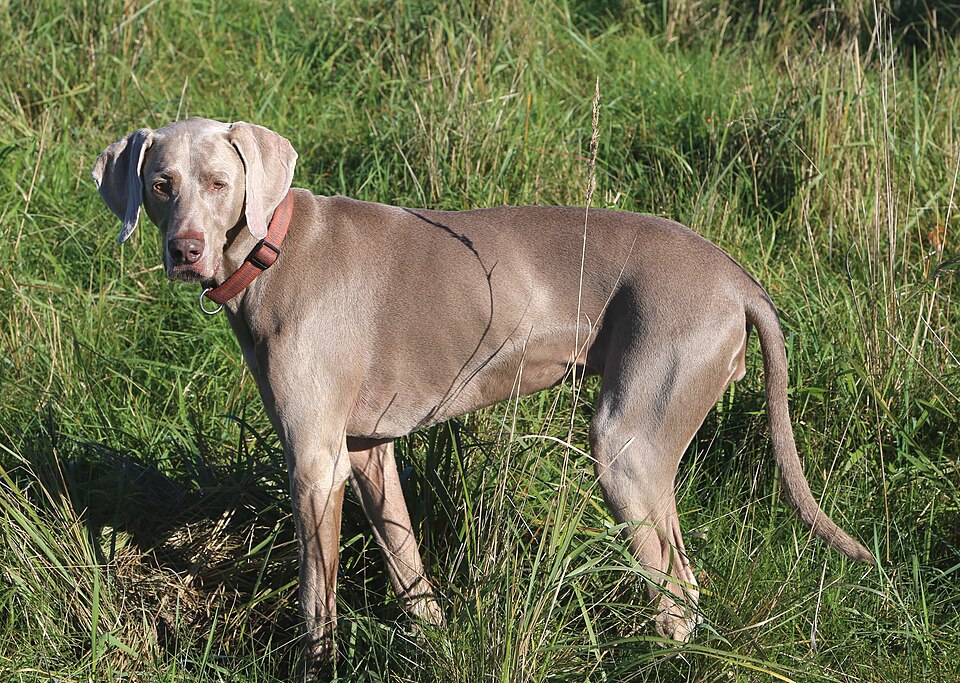
The Weimaraner is a hunting dog that earned the nickname "Grey Ghost" for its silver-gray coat with a metallic sheen. It's big, fast and full of stamina, and it loves being at its person's side, both in the field and at home. That energy and devotion make it a wonderful companion in the right home, but without enough exercise and attention it can become a dog that struggles. On this page we've pulled together its temperament, care needs and health issues from breed registry standards and scientific studies.
- Temperament: Fearless, friendly, protective, obedient and alert, according to the Royal Kennel Club standard.
- Activity: The Royal Kennel Club recommends more than two hours of exercise a day and suggests a large home and yard.
- Time alone: According to the AKC, it wants plenty of quality time with its people; it's not suited to homes where it will be alone for long hours.
- Health: One of the breeds at high risk of bloat (GDV); hip, elbow and eye screening are recommended.
- Lifespan: A large UK study found a median lifespan of 12.8 years.
What to know
 What is the Weimaraner like?
The Royal Kennel Club's breed standard sums up the Weimaraner's temperament in five words: fearless, friendly, protective, obedient and alert. Under the standard, hunting ability comes first in this breed. The AKC notes that both hunters and pet owners love it for its friendliness, obedience and beauty, and adds that it needs exercise, and plenty of it, along with lots of quality time with its people.
That last point is the key to understanding the Weimaraner. It can be very close to its family, a dog that follows its person everywhere. A young Weimaraner that doesn't get enough exercise and activity, or that's left alone for long hours, can get bored and may show it by chewing, barking or restlessness.
It also has a protective side: it keeps an eye on its home and family. To keep that trait balanced, it's important for a puppy to have calm, positive experiences with different people, dogs and places.
Every dog is an individual. Breed traits describe general tendencies; the temperament of the parents, how a puppy was socialized and the training it gets shape its personality as much as its breed.
 Who is it a good fit for?
The Weimaraner suits active people and families who love spending lots of time outdoors every day, enjoy running, hiking or dog sports, and won't leave their dog alone all day. The Royal Kennel Club recommends a large home and a large yard for this breed.
| Situation | Good fit? |
|---|---|
| Apartment | Hard; it's a large, very energetic dog. More than two hours of activity every day is a must |
| Family with children | Friendly, but big and bouncy, so supervision is needed with young children |
| Other dogs | Usually fine with early socialization |
| Cats and small pets | Be careful; it has a strong prey drive |
| Long hours alone | Not suitable; it wants time with its people |
| First-time owners | Only with a very active lifestyle and time to devote to training |
The Royal Kennel Club's description of the gundog group says these breeds can make good family dogs thanks to their temperament. With a Weimaraner, the condition is genuinely making room for its energy and its need for company.
Where does it come from?
According to the Royal Kennel Club, the Weimaraner was developed in the early 19th century at the court of Grand Duke Karl August of Weimar as a hunting dog for the nobility. The club notes that a dog of Weimaraner type appears in a Van Dyck portrait from three centuries earlier.
The Weimar nobility wanted to keep the breed exclusive to their circle and set up a club that strictly controlled breeding and ownership. According to the club, a dog sold to a non-member was secretly sterilized first. The breed became better known outside Germany only around the Second World War, with some dogs exported to the US and the UK. It was first seen in the UK in the 1950s and quickly won admirers for its skills in the field. Today it's also very popular in the show ring.
The breed also has a longhaired variety, which, according to the Royal Kennel Club, is much less common.
If you're thinking of hunting with a Weimaraner in Türkiye, check the current hunting rules with the General Directorate of Nature Conservation and National Parks; rules vary by country.
Appearance and colors
The Weimaraner is a strong, balanced, athletic and large dog. Under the standard, its eyes are shades of amber or blue-gray, and its ears are long, set high and slightly folded.
- Height: Under the Royal Kennel Club standard, 24–27 in (61–69 cm) at the shoulder for males and 22–25 in (56–64 cm) for females.
- Weight: According to the AKC, 70–90 lb (32–41 kg) for males and 55–75 lb (25–34 kg) for females.
- Coat: Short, smooth and sleek in the shorthaired variety. In the longhaired variety, 1–2 in (2.5–5 cm) long on the body, with feathering on the tail and the backs of the legs.
- Color: Under the standard, the only correct color is gray; silver gray is preferred, and shades of mouse gray or roe gray are also acceptable. A dark stripe along the back is common, and the coat has a metallic sheen. A small white mark on the chest is allowed.
The Royal Kennel Club registers blue Weimaraners as a non-standard color. When choosing a puppy, the parents' health screening and temperament should come before color.
Daily care
The shorthaired Weimaraner is easy to groom; the Royal Kennel Club suggests grooming once a week. But it does shed.
- Brushing: Once a week, remove loose hair with a rubber grooming glove or soft brush. In the longhaired variety, comb behind the ears and the feathering before it knots.
- Ears: Look inside weekly; if you see redness, a smell or discharge, see your vet.
- Nails and paws: For a dog that runs a lot, check the pads and nails regularly, and look for burrs and grass seeds after walks.
- Cold and wet weather: In the shorthaired variety the coat is short and fine; don't leave it standing around in the cold. Our article on dogs in cold weather can help.
See our dog grooming guide for more.
Training and exercise
The Royal Kennel Club recommends more than two hours of exercise a day for the Weimaraner. That's not a need you can skip one day and make up the next; it has to be met regularly, every day.
- Running and play: Off-leash running in safe, fenced areas, fetch and running with its owner suit this breed well.
- Sniffing and searching: As a hunting dog, it has a strong nose. Treat hunts and search games tire out its brain too; our sniffing games article has ideas.
- Recall: It has a strong prey drive and may chase something moving, like a bird or a cat. Before letting it off leash, make recall reliable using a long training line. Our article on dogs that won't come when called explains it step by step.
- Reward-based training: The standard describes it as an obedient dog; short, rewarding and varied sessions work best.
- Time alone: A people-oriented dog needs to learn to be alone gradually. Our article on separation anxiety explains it step by step.
- Rest around meals: Because of the bloat risk, ask your vet for advice on avoiding hard exercise right before and after meals.
In hot weather, move long runs to cooler hours; our article on dogs in hot weather covers the signs of heatstroke.
 Diet
A Weimaraner doesn't need special food; a complete and balanced dog food suited to its age and activity is enough. In this breed, the most important part of feeding is how it's fed. The Merck Veterinary Manual lists once-daily feeding, eating only dry kibble and eating very quickly among the factors associated with bloat.
- Talk to your vet about splitting the daily food into two or more meals.
- If it eats very fast, you can use a slow-feeder bowl or scatter its food.
- Measure its food, and take treats out of the daily amount.
- You should be able to feel its ribs under a thin layer of fat.
- Don't feed from the table; check our list of foods that are harmful to dogs.
 Health issues to know about
Bloat tops the list of health issues to know about in the Weimaraner. The information below is for awareness; for diagnosis and treatment, talk to your veterinarian.
Bloat (GDV)
Gastric dilatation-volvulus is when the stomach fills with gas and twists on itself; it's an emergency that can get worse quickly and is life-threatening. The Merck Veterinary Manual lists the Weimaraner among the breeds at risk and states that genetics, a deep and narrow chest and having a first-degree relative with GDV are proven risk factors.
In a study based on a 2004 UK purebred dog health survey, GDV accounted for 2.5% of all reported deaths, and the Weimaraner was among the breeds at highest risk of having GDV. A 2020 genetic study notes that the lifetime risk of GDV in large and giant breeds ranges from 3.9% to 36.7%.
According to Merck, the signs are trying to vomit without bringing anything up, drooling, restlessness and a quickly swelling belly; later, weakness, pale gums and trouble breathing. Waiting more than 6 hours after signs start before seeing a vet is listed among the factors that raise the short-term risk of death. In other words, waiting is the biggest danger.
Merck describes a preventive surgery for at-risk breeds and dogs with affected relatives that tacks the stomach to the body wall (gastropexy); it can be done at the same time as a spay or neuter. Gastropexy is meant to prevent the stomach from twisting, not from bloating. Talk with your vet about whether it's right for your dog.
- Trying to vomit without bringing anything up, heavy drooling
- A quickly swelling belly, restlessness, lying down and getting up again
- Weakness, pale gums, fast or labored breathing
- In puppies: high fever, lethargy and leg pain when touched
Hips, elbows and eyes
The Royal Kennel Club recommends that Weimaraner breeders X-ray for hip and elbow dysplasia and have an eye exam before breeding. Hip and elbow dysplasia mean the joint didn't develop properly during growth, which can lead to painful arthritis over time. If you notice limping, trouble getting up or avoiding movement, see your vet.
Hypertrophic osteodystrophy (HOD)
HOD is a bone disease that mostly affects large breeds and causes fever, lethargy and bone pain in young dogs. In a 2013 study of 53 Weimaraners, more than half of the dogs had a littermate with the same disease, which points to a family predisposition. In the same study, all the dogs had been vaccinated within 1–30 days before signs began. That doesn't show the vaccine is the sole cause, and skipping vaccines is not the answer; plan your puppy's vaccinations with your vet and let them know right away if fever, lethargy or limping appear in the days after a vaccine.
How long does it live?
A 2024 UK study using data on about 585,000 dogs from 18 different sources found a median lifespan of 12.8 years for the Weimaraner; the median for mixed-breed dogs was 12.0 years. The AKC gives an expected lifespan of 10–13 years, and the Royal Kennel Club says "over 10 years."
Knowing the signs of bloat and acting without delay, regular exercise and a healthy weight are the most practical ways to help a Weimaraner live a long, healthy life.
 Before you get one
- Consider a shelter: Purebred dogs end up in shelters and rescues too. Our article on adopting a dog from a shelter covers the first steps.
- If you buy from a breeder: Ask to meet the parents and ask for their hip and elbow X-ray results and eye exams. Also ask whether GDV or HOD has occurred in the family.
- Red flags: Avoid sellers who won't show you the mother, always have puppies available, can't provide paperwork or push colors such as "rare blue."
- Time: Can you meet its need for more than two hours of activity and lots of human company every day? With this breed, that's the most important question.
- Registration: In Türkiye, owned dogs must be microchipped and registered in the PETVET system. Details are in our article on PETVET registration and microchipping; rules vary by country.
- The first days: Our article a new puppy at home: the first week covers the first week step by step.
Frequently asked questions
Can a Weimaraner be left alone?
According to the AKC, this breed wants plenty of time with its people. Being alone all day is hard on it; you may need to teach it to be alone gradually and find someone to walk it during the day.
Can it live in an apartment?
It's hard. The Royal Kennel Club recommends a large home and yard and more than two hours of exercise a day. If it lives in an apartment, long, tiring outdoor activity every day is a must.
Why does bloat matter so much?
Because it's an emergency that can be fatal within hours, and the Weimaraner is one of the at-risk breeds. If you see retching without vomiting and a swollen belly, go to the vet without waiting. It's a good idea to discuss preventive options with your vet ahead of time.
What's the difference between a Weimaraner and a Vizsla?
Both are short-coated, energetic hunting dogs. The clearest differences are color and size: the Weimaraner is gray and larger, while the Vizsla is russet gold and a bit smaller. See our Vizsla page for details.
Is there a longhaired Weimaraner?
Yes. According to the Royal Kennel Club, the breed has a longhaired variety, but it's much less common than the shorthair. In longhairs, the body coat is 1–2 in (2.5–5 cm) long, with feathering on the tail and the backs of the legs.
Sources
- The Royal Kennel Club · Weimaraner: breed profile and health screening
- The Royal Kennel Club · Weimaraner breed standard
- AKC (American Kennel Club) · Weimaraner breed profile
- McMillan et al. · Longevity of companion dog breeds: those at risk from early death, Scientific Reports (2024)
- Evans and Adams · Mortality and morbidity due to gastric dilatation-volvulus syndrome in pedigree dogs in the UK, Journal of Small Animal Practice (2010)
- Merck Veterinary Manual · Gastric dilation and volvulus in small animals
- Piras et al. · Identification of genetic susceptibility factors associated with canine gastric dilatation-volvulus, Genes (2020)
- Crumlish et al. · Hypertrophic osteodystrophy in the Weimaraner dog: lack of association between DQA1 alleles of the canine MHC and HOD, The Veterinary Journal (2006)
- Safra et al. · Clinical manifestations, response to treatment, and clinical outcome for Weimaraners with hypertrophic osteodystrophy: 53 cases (2009–2011), JAVMA (2013)
- Official Gazette of Türkiye · Regulation on the identification and registration of cats, dogs and ferrets (February 26, 2018; in Turkish)
By Tüylüm · Last checked: November 3, 2026. Compiled from the sources above and written in our own words. Spotted a mistake? Write to [email protected] and we'll fix it right away. Photo from Wikimedia Commons, used under the license shown below it.