 Tüylüm
Rhodesian Ridgeback
An athletic, dignified dog developed in southern Africa for hunting and guarding, known for the ridge of backward-growing hair along its spine. Aloof with strangers and needs a lot of exercise; a congenital skin defect tied to the ridge (dermoid sinus) and inherited seizure, hearing and heart problems are reported in the breed.

 Lifespan≈ 10+ yearsRKC: over 10 years; no breed-specific study found
 Weight70–80 lb (32–36.5 kg)FCI: males 80 lb, females 70 lb
 Height at shoulder24–27 in (61–69 cm)FCI: males 25–27, females 24–26 in
 OriginSouthern Africaa hunting dog bred to hold lions at bay
 SheddingShedsRKC: short coat, sheds; weekly grooming
 ExerciseA lotRKC: more than 2 hours a day
 With strangersAloofFCI: aloof, but no aggression or shyness
 Legal statusAllowednot on the banned list in circular 2021/48
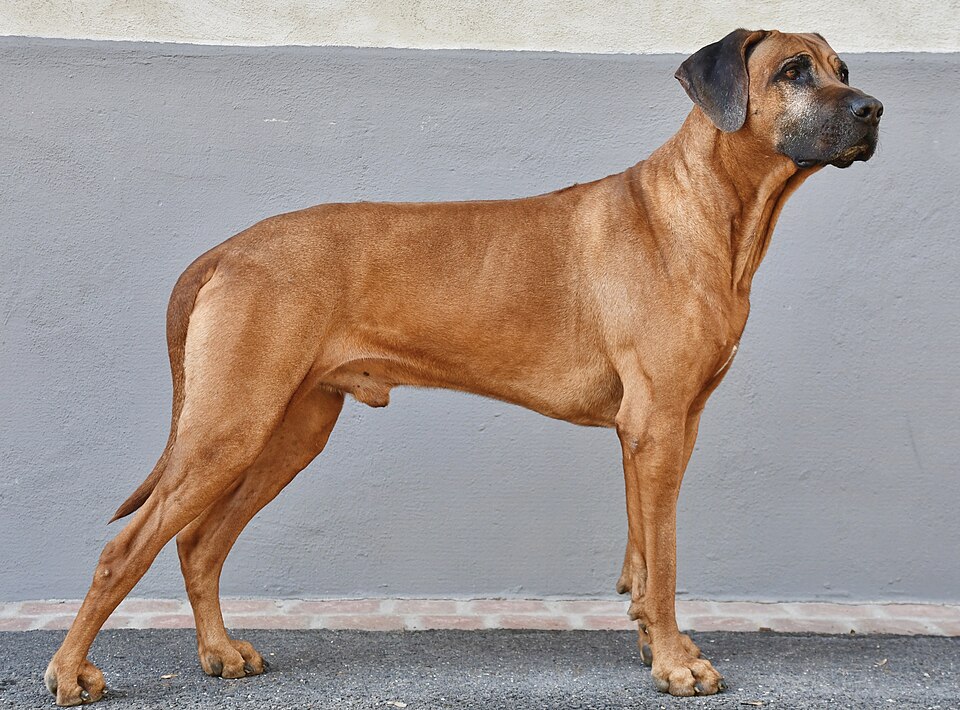
The Rhodesian Ridgeback is southern Africa's own dog: according to the FCI, the only registered breed native to the region. It carries a distinct ridge of hair growing in the opposite direction along its back, and that's where the name comes from. It's strong, elegant and enduring; the FCI standard describes its temperament as dignified, intelligent and aloof with strangers, but showing no aggression or shyness. The ridge itself is tied to the breed's most debated health issue: a congenital skin defect called dermoid sinus. We built this page from the FCI standard, the Royal Kennel Club, the Science for Animal Welfare page on dermoid sinus and published studies on the breed's known inherited diseases.
- Temperament: According to the FCI, dignified, intelligent, aloof with strangers but showing no aggression or shyness.
- Size: Males 25–27 in (63–69 cm) and 80 lb (36.5 kg), females 24–26 in (61–66 cm) and 70 lb (32 kg) (FCI).
- Coat: Short, dense, sleek and glossy; light wheaten to red wheaten. The Royal Kennel Club says it sheds.
- Health: Dermoid sinus, a juvenile seizure disorder (JME), early-onset hearing loss and a heart rhythm problem are inherited conditions reported in the breed; as in other deep-chested dogs, there's also a bloat risk.
- Lifespan: The Royal Kennel Club says over 10 years; we couldn't find a solid breed-specific lifespan study.
What to know
 What is the Rhodesian Ridgeback like?
The FCI standard describes the Rhodesian Ridgeback as dignified, intelligent and aloof with strangers, but showing no aggression or shyness. The Royal Kennel Club says the breed was developed in South Africa as a dog that tracked game by scent, and that it needs more than two hours of exercise a day. The FCI lists its use as still hunting game in many parts of the world, but especially prized as a watchdog and family pet.
In practice that means a dog devoted to its owner, distant with strangers, high in energy and with a hunting background. Without exercise, mental work and consistent training it gets bored; you can end up with a Ridgeback that goes over the fence or chases small animals. Socialization should start in puppyhood.
Every dog is an individual. Breed describes what a dog was bred for; it can't tell you how a particular dog will turn out. The parents' temperament, early experiences and training matter at least as much as breed.
 Who is it a good fit for?
The Rhodesian Ridgeback suits people who have a large living space, can give long, active outings every day, can train consistently and will spend lots of time with their dog. The Royal Kennel Club lists it as a dog that needs a large house, a large garden and more than two hours of exercise a day.
| Situation | Good fit? |
|---|---|
| Apartment | Hard; large size and more than two hours of activity a day |
| House with a yard | Good; a tall, solid fence and long daily exercise |
| Family with kids | Possible; a big, strong, active dog that needs supervision |
| Home with small pets | Caution: it has a hunting background |
| First-time dog owners | Not recommended; the energy and training load is heavy |
| Home with frequent guests | Needs preparation; aloof with strangers |
| Hot climates | Short-coated but big; shade and water are a must |
Where does it come from?
According to the FCI, the Rhodesian Ridgeback is the only registered breed native to southern Africa today. Its forebears trace to the Cape Colony, where the early pioneers' dogs crossed with the semi-domesticated, ridged hunting dogs of the Khoikhoi people. The breed's original job, hunting mainly in groups of two or three, was to track game, especially lion, and with great agility keep it at bay until the hunter arrived; that's why it was called the "Lion Dog." The original standard was drafted in 1922 by F. R. Barnes in Bulawayo, Rhodesia, based on the Dalmatian's standard, and approved by the South African Kennel Union in 1926.
The Royal Kennel Club also says the breed was originally developed in South Africa as a dog that tracked a variety of game, and that when it was taken to Rhodesia (now Zimbabwe) it was used largely for tracking lions. The name comes from the ridge of hair running in reverse along the spine, a feature linked to the ancient dogs of the Khoikhoi.
Appearance and colors
The FCI standard describes the Rhodesian Ridgeback as a well-balanced, strong, muscular, agile and active dog, capable of great endurance with a fair amount of speed. The emphasis is on agility, elegance and soundness, with no tendency toward massiveness. The head is free of wrinkles at rest; the nose is black or brown, and a black nose goes with dark eyes, a brown nose with amber eyes.
- The ridge: The line of reverse-growing hair starts immediately behind the shoulders and runs to the hip bones. It must be clearly defined, symmetrical and tapering toward the haunch, and contain only two crowns (whorls), identical and opposite each other. A good average width is about 2 in (5 cm). Under the standard, a dog without a ridge is disqualified.
- Height and weight: Males 25–27 in (63–69 cm) and 80 lb (36.5 kg), females 24–26 in (61–66 cm) and 70 lb (32 kg) (FCI).
- Coat: Short, dense, sleek and glossy, neither woolly nor silky.
- Color: Light wheaten to red wheaten; a little white on the chest and toes is permitted, and a dark muzzle and ears are allowed.
 Daily care
The Royal Kennel Club says the short coat sheds and weekly grooming is enough. A short, dense coat can be tidied with a rubber grooming mitt or a soft brush. See our dog grooming guide for general methods.
- Nails: Trim them regularly.
- Ears: Check pendant ears for dirt and redness.
- Teeth: Brush often with a toothpaste made for dogs.
- Hot weather: A big dog needs shade, plenty of water and exercise during cool hours in summer. Our article on dogs in hot weather covers the warning signs.
 Training and exercise
The Royal Kennel Club says more than two hours of exercise a day. For a dog with a hunting background, that should include long walks plus sniffing and tracking games and other mental work. Avoid long runs and strenuous movement in a growing puppy; talk to your vet about exercise that suits its age.
A hunting background can make coming when called harder once it's off leash. Using a long line outside a secure fenced area and practicing recall early and often is a good approach.
- Early socialization: As a puppy, give it short, positive meetings with different people, children, sounds, vehicles and calm dogs, and keep this up through the first year. That matters a lot in a breed that's aloof with strangers.
- Recall: In a safe area, practice coming when called with rewards, often. Our guide to recall training explains it step by step.
- Leash manners: Walking without pulling is the foundation of safety with a strong dog. See our guide to loose-leash walking.
- Joint-friendly movement: Limit stairs and jumping from heights while it's a puppy.
- Vet prep: Use rewards early on to get it comfortable with being handled and having its mouth, ears and paws checked.
 Diet and weight
We have no source saying the Rhodesian Ridgeback needs a special food; a balanced dog food suited to its age is the basis. Talk with your vet about the type of food, the number of meals and the amount.
- Controlled growth in puppyhood: Large-breed puppies grow fast; extra weight and unnecessary supplements strain the joints. Make a growth plan with your vet.
- Lower the risk of bloat: The Merck Veterinary Manual says deep, narrow-chested large dogs are at higher risk. Splitting the daily food into several meals and keeping things calm after eating are commonly advised; talk through the details with your vet.
- Ideal weight: If you can feel the ribs under a thin layer of fat and see a waist from above, the weight is about right.
Also check our list of foods that are dangerous for dogs.
 Health issues to know about
The information below is for awareness only; ask your vet about diagnosis and treatment.
Dermoid sinus
According to Science for Animal Welfare, dermoid sinus is a birth defect: a tube-like channel running down from the midline of the back into the tissue beneath, lined with skin that contains hair and glands. It can easily fill with debris and hair and become infected. It's graded from I to V by depth; type IV sinuses can reach the outer membrane around the spinal cord, which makes them the most dangerous. A Swedish study estimated that 8–10% of Swedish Ridgebacks are affected, and that the rate was rising; for other countries the figure isn't known. The ridge comes from a gene duplication, and the ridge itself predisposes dogs to the defect; ridgeless dogs appear free of it. There's currently no genetic test that tells you which ridged dogs will produce affected puppies. An infected sinus can cause pain and swelling, and in severe cases infection can spread to the spinal cord; unless it's surgically removed, the sinus stays for life and infections can recur.
What you can do as an owner: before choosing a puppy, ask for a vet to examine the puppy along the ridge (type V sinuses are hard to spot in particular), and if you notice a hole, a hair-filled pit, a discharge or swelling on the back, show your vet right away. Science for Animal Welfare recommends breeding only from unaffected dogs and discussing outcrossing with other breeds, even though that would require changing the breed standard.
Juvenile seizure disorder (JME)
Juvenile myoclonic epilepsy is reported in Ridgebacks: brief muscle jerks, mostly during relaxation, starting at a young age, with generalized seizures in about one-third of cases (Wielaender et al., 2018). The responsible gene change (DIRAS1) has been found, so a DNA test exists; the Royal Kennel Club recommends the test to breeders.
Early-onset hearing loss
A condition called early onset adult deafness, in which Ridgebacks lose their hearing within 1–2 years of birth, has been reported (Kawakami et al., 2022). The study says it's inherited as a recessive trait and linked to a gene deletion.
Heart rhythm problem
In a family of juvenile Ridgebacks with heart rhythm disorders and sudden cardiac death (Meurs et al., 2019), a change in the QIL1 gene was found. That isn't a figure for the breed as a whole; but it makes sense to ask a breeder whether there's any history of sudden death in the pedigree.
Bloat
The stomach can fill with gas and fluid and twist on itself (gastric dilatation-volvulus, or GDV). The Merck Veterinary Manual describes it as an emergency needing immediate care, with a mortality rate around 20% even in treated animals.
Hips and elbows
The Royal Kennel Club recommends hip and elbow dysplasia screening for the breed. Limping and trouble getting up can be signs.
- Retching without bringing anything up, a swollen belly, heavy drooling, restlessness
- A hole, hair-filled pit, discharge, swelling or pain to the touch on the back
- Muscle jerks, confusion or a seizure
- Sudden collapse, fainting or an irregular heartbeat
- No reaction to sounds or not coming when called
- Sudden limping or an obvious change in gait
How long does it live?
The Royal Kennel Club says "over 10 years" for the Rhodesian Ridgeback. That's a broad range, and we couldn't find a solid breed-specific lifespan study, so we're not giving a single number.
The honest summary: a puppy from screened parents, a healthy weight, regular checkups and knowing the signs of bloat are the most concrete steps.
 Before you get one
- Consider a shelter: Purebred and large dogs end up in shelters too. Seeing an adult's temperament and energy up front is an advantage. Our guide to adopting a dog from a shelter walks you through it.
- If you buy from a breeder: Meet the parents in person and make sure they're calm and steady. Ask about a vet examination of the puppies along the ridge (for dermoid sinus), the JME DNA test and hip and elbow screening. Ask for the inbreeding coefficient too.
- Red flags: Sellers who show no health records; promises of a "rare color"; sellers who won't show you the mother.
- Time and budget: More than two hours of exercise a day, plus food and vet costs, are a commitment of years.
- Registration: Rules vary by country. In Türkiye, owned dogs must be microchipped and registered; for puppies, a declaration is made within three months of birth. Details are in our article on PETVET registration and microchips.
Frequently asked questions
Is the Rhodesian Ridgeback banned in Türkiye?
No. Law no. 5199 bans breeding and owning animals the Ministry has designated as "posing a danger" (article 14/l), and the Rhodesian Ridgeback isn't among the six breeds named in the Ministry's 2021 circular. Rules can change, so check the current situation with your provincial or district agriculture directorate. Rules vary by country.
Is the ridge a health problem?
The ridge is the breed's signature, but Science for Animal Welfare says the gene change that creates it also predisposes dogs to dermoid sinus. The ridge on its own isn't a disease; the problem is this congenital channel that some ridged dogs have.
Is it good in a home with children?
It's a big, strong, active dog; children and dogs should never be left unsupervised together. Our article on kids and dogs at home covers the ground rules.
Does it shed a lot?
The Royal Kennel Club says it sheds; the short coat is managed with weekly grooming.
Can it live in an apartment?
With its need for more than two hours of activity a day and its large size, an apartment is hard; the Royal Kennel Club suggests a large house and garden.
Sources
- FCI · Rhodesian Ridgeback breed standard (No. 146, 2025 version)
- The Royal Kennel Club · Rhodesian Ridgeback breed page (history, care, health screening)
- Science for Animal Welfare · Rhodesian Ridgeback: dermoid sinus
- Wielaender et al. · Absence Seizures as a Feature of Juvenile Myoclonic Epilepsy in Rhodesian Ridgeback Dogs, Journal of Veterinary Internal Medicine (2018)
- Kawakami et al. · Early onset adult deafness in the Rhodesian Ridgeback dog is associated with an in-frame deletion in the EPS8L2 gene, PLoS ONE (2022)
- Meurs et al. · A QIL1 Variant Associated with Ventricular Arrhythmias and Sudden Cardiac Death in the Juvenile Rhodesian Ridgeback Dog, Genes (2019)
- Merck Veterinary Manual · Gastric dilation and volvulus in small animals
- Türkiye Ministry of Agriculture and Forestry · Circular on animals posing a danger (2021/48, in Turkish)
- Resmî Gazete (Türkiye) · Regulation on the identification and registration of cats, dogs and ferrets (February 26, 2018)
By Tüylüm · Last checked: November 10, 2026. Compiled from the sources above and written in our own words. Spotted a mistake? Write to [email protected] and we'll fix it right away. Photo from Wikimedia Commons, used under the license shown below it.