 Tüylüm
Cane Corso
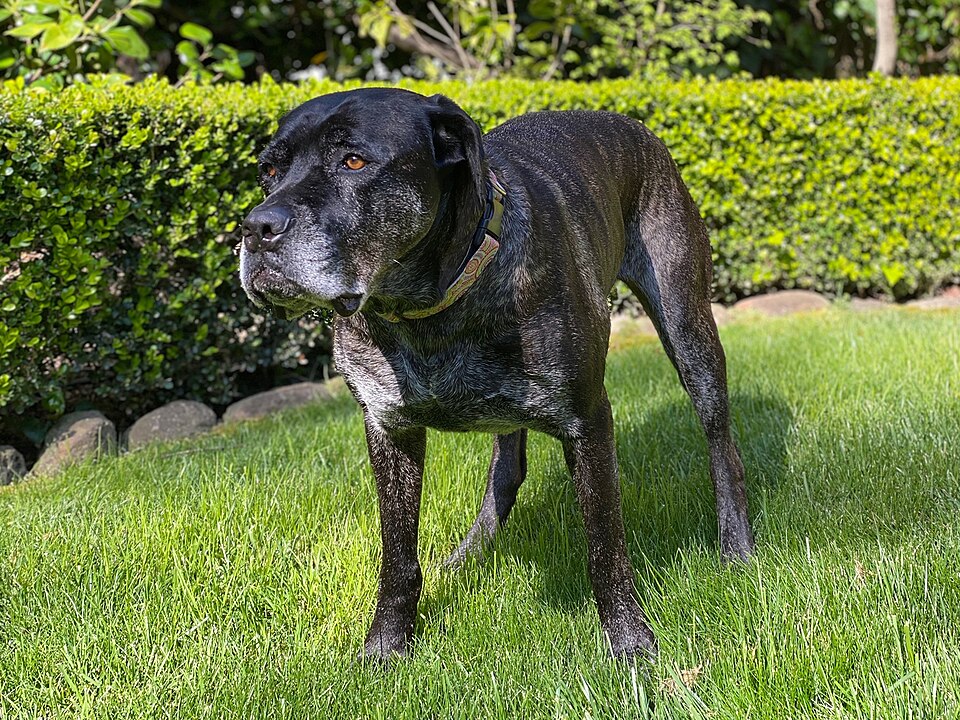
A strong, agile dog descended from the Roman molossers that guarded farms, livestock and families in southern Italy. Devoted to its family but assertive and protective, it needs an experienced owner, early socialization and reward-based training. Hip dysplasia is common and its lifespan is short.

 Lifespan≈ 8–9 yearsUK median 8.1; multi-country survey 9.3
 Weight88–110 lb (40–50 kg)FCI: males 99–110 lb, females 88–99 lb
 Height at shoulder23.5–27 in (60–68 cm)FCI: males 25–27 in, females 23.5–25 in
 OriginItaly (Apulia)descended from Roman molossers
 CoatShort, denseweekly; daily when shedding
 ExerciseHighAKC: brisk walks morning and evening
 With kidsDevoted to familybig and strong; always supervise
 TrainingEager to learnresponds to rewards, not harshness
With its big head, muscular body and watchful gaze, the Cane Corso is an Italian dog that looks imposing at first sight. For centuries it guarded farms, animals and families in southern Italy, and today it's still a deeply devoted, agile and protective dog. That kind of power calls for an experienced, responsible owner. We built this page from breed registry standards, scientific studies and Turkish legislation.
- Temperament: Very devoted to its family, agile and protective; according to the AKC it can also be assertive and willful.
- Owner: Not suited to first-time dog owners; it needs experience, time and consistent, reward-based training.
- Health: X-ray screening in France found hip dysplasia in 51.9% of Cane Corsos, and bloat is also a risk. Always ask for the parents' hip X-rays.
- Lifespan: A large UK study found a median of 8.1 years, among the breeds at highest risk of early death.
- Ears and tail: In Türkiye, cutting the ears or tail for looks is banned, and the FCI's 2023 standard describes uncropped ears and a natural tail.
What to know
 What is the Cane Corso like?
The FCI standard describes the Cane Corso as a guardian of property, family and livestock, and an extremely agile and responsive dog. In the past it was also used to herd cattle and hunt big game. The standard disqualifies dogs that are aggressive or overly shy; the ideal Cane Corso is a balanced dog.
According to the AKC, the Cane Corso is intelligent, loyal, eager to please, versatile and intensely devoted to its people. But the same source says plainly that the breed can be assertive and willful and can easily end up running the show with an inexperienced owner. The AKC notes that its imposing appearance is its first line of defense against intruders, and stresses that, as with any big guardian dog, responsible breeding and early socialization with people and other dogs are vital.
Every dog is an individual. A 2022 study of more than 18,000 dogs (Morrill et al., Science) found that breed explains only about 9% of the behavioral differences between individual dogs. The parents' temperament, early experiences and training matter at least as much as breed.
 Who is it a good fit for?
The Cane Corso suits calm, consistent people who have experience with large, protective dogs and can make time for exercise and training every day. The dog should live indoors with its family; the yard is just a place to exercise.
| Situation | Good fit? |
|---|---|
| Apartment | Not recommended; a big, strong dog that needs lots of exercise |
| House with a yard | Good; the fence must be tall and solid |
| Family with kids | Devoted to its family; the AKC rates it average with kids, so always supervise |
| Other dogs | Average; early and ongoing socialization is a must |
| Home with frequent guests | Take care; the dog needs a quiet space of its own |
| First-time dog owners | Not recommended; needs experience and consistent handling |
Where does it come from?
According to the FCI, the Cane Corso's direct ancestor is the old Roman molosser. The breed was once found all over Italy, but in recent times it survived mainly in Apulia (Puglia) and the neighboring regions of southern Italy. The FCI says the name comes from the Latin "cohors," meaning protector or guardian of the farmyard.
The AKC explains that Roman legions brought large molossers back from the Greek islands and crossed them with Italian dogs; these dogs were the ancestors of both the Cane Corso and its larger relative, the Neapolitan Mastiff. After the fall of Rome, Corsos worked as boar hunters, farm dogs and cattle drovers and, above all, as farm guardians. Wars, economic upheaval and mechanized farming cut their numbers so sharply that by the mid-20th century the breed was nearly extinct. In the 1970s a group of Italian enthusiasts revived it, starting from dogs that had survived in the countryside.
The Cane Corso is a recently recognized breed: according to a 2017 study, the FCI gave it full recognition in 2007; the UKC recognized it in 2008 and the AKC granted full status in 2010.
Appearance and colors
According to the FCI, the Cane Corso is a medium-to-large, robust and sturdy dog with a certain elegance, and lean, powerful muscles. Its body is about 11% longer than its height at the shoulder, so it's slightly rectangular. The head is large, and the muzzle is about half the length of the skull. The lower jaw sits slightly forward.
- Height: 25–27 in (64–68 cm) for males and 23.5–25 in (60–64 cm) for females, with a tolerance of about 1 in (2 cm) (FCI).
- Weight: 99–110 lb (45–50 kg) for males and 88–99 lb (40–45 kg) for females (FCI).
- Coat: Short, shiny and very dense, with a light undercoat.
- Color: Black, lead gray, slate gray, light gray, light and dark fawn, stag red, dark wheaten, and black or gray brindle. In fawn and brindle dogs the mask shouldn't go beyond the eyes; a small white patch on the chest, toe tips and bridge of the nose is acceptable.
- Ears and tail: Under the FCI's 2023 standard, the ears are triangular, drooping and uncropped; the tail is natural, set fairly high and carried high in motion, but never upright or curled.
In Türkiye, article 8 of Animal Protection Law no. 5199 bans cutting a pet's tail or ears to change its appearance or for any other non-therapeutic reason; if there's a medical reason, the decision belongs to a veterinarian. Violations carry an administrative fine per animal (article 28). The FCI's current standard describes uncropped ears and a natural tail, and the UKC in the United States, noting that these practices are banned in many countries, says natural ears and a full tail will not be penalized at any of its events. Rules vary by country.
Daily care
According to the AKC, the Cane Corso's coat is short but double; the thickness of the undercoat depends on the climate, and the dog sheds year-round, especially in spring. Brushing once a week, and daily during shedding season, removes dead hair before it ends up on your furniture. See our dog grooming guide for details.
- Nails: Long nails can be painful and affect how the dog walks and runs; trim them regularly.
- Ears: The AKC recommends checking the ears regularly for signs of infection.
- Teeth: Brush often with a toothpaste made for dogs.
- Hot weather: In a 2020 UK study, dogs weighing 50 kg (110 lb) or more had more than three times the odds of heatstroke of dogs under 10 kg (22 lb). Keep a big Corso in the shade in summer and exercise it during the cooler hours; our article on dogs in hot weather covers the warning signs.
Training and exercise
The AKC recommends early socialization and puppy classes for all dogs, but stresses they're a must for a breed as big and strong as the Cane Corso. According to the AKC, some Corsos can be dominant and protective, and socialization and obedience training help them grow into well-adjusted adults. Because the breed is intelligent and eager to please, it's generally easy to train. The AKC makes a point worth underlining: despite its looks, the Cane Corso responds far better to affection and rewards than to harsh corrections or harsh training methods.
According to the AKC, the Cane Corso is a working dog with serious exercise needs: a brisk walk, or better yet a run, of at least a mile (1.6 km) in the morning and again in the evening keeps it healthy and well-muscled. It's happiest with a job to do, and without mental stimulation it may develop unwanted behaviors. Sports such as agility, obedience and tracking are good outlets. Don't push a growing puppy into long runs; talk to your vet about exercise that suits its age.
- Early socialization: As a puppy, give it short, positive experiences with different people, children, sounds, vehicles and calm dogs, and keep this up throughout the first year.
- Basic cues: Coming when called, waiting and walking without pulling are the foundation of life with a 100–110 lb (45–50 kg) dog. Our guide to loose-leash walking explains it step by step.
- A routine for visitors: Use rewards to teach it to go to a calm spot when the doorbell rings.
- Vet prep: Use rewards early on to get it comfortable with being handled, having its mouth and paws checked and, if needed, wearing a muzzle.
Steer clear of puppies marketed as "tough," "man-stopping" or "protection-trained," and of anyone who suggests "toughening up" a dog by provoking it. In Türkiye, Law no. 5199 bans training methods that injure an animal, cause it needless suffering or encourage bad habits (article 11), and dog fighting is a crime punishable by prison (article 28/A). If you run into behavior problems, get help from your vet and a trainer who uses positive methods.
 Diet and weight
Cane Corsos don't need a special food; a complete, balanced dog food suited to their life stage (puppy, adult, senior) and activity level is enough. The AKC notes that some dogs gain weight easily, and extra weight also strains the joints.
- Controlled growth in puppyhood: The Merck Veterinary Manual notes that too much calcium (for example, from unnecessary supplements) can harm bone and joint development in fast-growing large-breed puppies. In a breed where hip dysplasia is this common, raising your puppy lean and steady matters; make a growth plan with your vet covering the type of food, the amount and weight checks.
- Lower the risk of bloat: For dogs at risk, the Merck Veterinary Manual recommends splitting the daily food into several small meals, limiting exercise before and after meals and keeping mealtimes calm.
- Ideal weight: If you can feel the ribs under a thin layer of fat and see a waist from above, the weight is about right.
Also check our list of foods that are dangerous for dogs.
 Health issues to know about
According to the AKC, responsible breeders screen Cane Corsos for hip dysplasia, idiopathic epilepsy, demodectic mange and eyelid abnormalities. The information below is for awareness only; ask your vet about diagnosis and treatment.
Hip dysplasia
The hip joint doesn't develop properly during growth, which leads to painful arthritis over time. In a study of 10 breeds X-rayed in France between 1997 and 2017 (Baldinger et al., 2020), the highest rate was in the Cane Corso, with 1,338 dogs: 51.9%. The good news is that the rate fell from 72.7% to 49.9% over those years, and the researchers believe screening-based breeding is working. Limping, trouble getting up, and avoiding stairs or jumping can be signs. When choosing a puppy, always ask for the parents' hip X-ray results.
Bloat
In bloat (gastric dilatation-volvulus, or GDV), the stomach fills with gas and twists on itself. The AKC stresses that large, deep-chested breeds are prone to it and that Cane Corso owners should know the signs. According to the Merck Veterinary Manual, it's a life-threatening emergency that needs immediate care; retching without bringing anything up, heavy drooling, restlessness and a swollen belly are the main signs.
Eyelid problems
An eyelid that rolls inward (entropion) lets lashes irritate the eye, while one that sags outward (ectropion) leaves the eye exposed to irritants (Merck). The FCI standard calls for close-fitting eyelids in the Cane Corso. If you notice watering, redness or squinting, show your vet.
Epilepsy and demodex
Idiopathic epilepsy means recurring seizures with no identifiable cause. Demodectic mange is a skin disease in which a tiny mite that lives in the skin multiplies too much, causing hair loss and skin problems. Both are on the AKC's list of things to screen for.
- Retching without bringing anything up, a swollen belly, heavy drooling, restlessness
- Pale gums, weakness or collapse
- A seizure
- Limping or obvious trouble getting up
- Fast, labored breathing or stumbling in the heat
How long does it live?
A 2024 study using data on about 585,000 dogs in the UK (McMillan et al.) found a median lifespan of 8.1 years for 303 Cane Corsos and listed the breed among those at highest risk of early death. Because the sample was small, the estimate's range is wide (6.5 to 9.5 years). Mixed-breed dogs in the same study had a median of 12 years. A 2017 survey that gathered data on 232 dogs from 25 countries, Türkiye among them (Korec et al.), found a median lifespan of 9.29 years. The AKC gives 9–12 years.
That means the Cane Corso lives several years less than the average mixed-breed dog. A puppy from screened parents, a healthy weight, regular checkups and knowing the signs of bloat are the most concrete steps.
 Before you get one
- Consider a shelter: Purebred dogs end up in shelters and rescues too. With a large breed, being able to see an adult dog's temperament up front is a big advantage. Our guide to adopting a dog from a shelter walks you through it.
- If you buy from a breeder: Meet the parents in person and make sure they're calm and steady. Ask for hip and elbow X-ray results and an eye exam, and check that the puppies are raised in a home with people around.
- Red flags: Dogs sold as "tough," "guard" or "fighting" dogs; puppies with cropped ears or docked tails; sellers who won't show you the mother or can't provide paperwork.
- Time and budget: Be ready for daily exercise, training classes and the vet bills that come with a big dog.
- Registration: Rules vary by country. In Türkiye, owned dogs must be microchipped and registered in the PETVET system.
Frequently asked questions
Is the Cane Corso banned in Türkiye?
No. Law no. 5199 bans breeding, selling and owning animals the Ministry has designated as "posing a danger" (article 14/l), and the Cane Corso isn't on the list in the Ministry's 2021 circular. Rules can change, so check the current situation with your provincial or district agriculture directorate. Rules vary by country.
Should a Cane Corso's ears be cropped?
No. The FCI's 2023 standard describes uncropped ears and a natural tail, and in Türkiye cutting the ears or tail for looks is against the law. If there's a medical reason, that's a decision for a veterinarian.
Is the Cane Corso a good family dog?
It's a very devoted, loyal dog, but also protective, assertive and very strong. With early socialization, consistent reward-based training and plenty of exercise, it can be a balanced family dog. Always supervise it around children; our article on kids and dogs at home covers the ground rules.
Can a Cane Corso be my first dog?
That's not recommended. The AKC writes that the breed can be assertive and willful and can end up running the show with an inexperienced owner. If you don't have experience with large, protective dogs, consider an easier breed, or an adult shelter dog whose temperament is known.
Is the Cane Corso related to the Neapolitan Mastiff?
According to the AKC, both descend from the molossers the Romans brought to Italy; the Neapolitan Mastiff is its larger, heavier relative.
Sources
- FCI · Cane Corso Italiano breed standard (No. 343, 2023)
- AKC (American Kennel Club) · Cane Corso breed profile
- UKC (United Kennel Club) · Cane Corso Italiano breed standard
- Korec et al. · Longevity of Cane Corso Italiano dog breed and its relationship with hair colour, Open Veterinary Journal (2017)
- McMillan et al. · Longevity of companion dog breeds: those at risk from early death, Scientific Reports (2024)
- Baldinger et al. · Prevalence of canine hip dysplasia in 10 breeds in France (1997–2017), PLOS ONE (2020)
- Hall et al. · Incidence and risk factors for heat-related illness (heatstroke) in UK dogs under primary veterinary care in 2016, Scientific Reports (2020)
- Merck Veterinary Manual · Gastric dilation and volvulus in small animals
- Merck Veterinary Manual · Eyelids in animals
- Merck Veterinary Manual · Nutritional requirements of small animals
- Morrill et al. · Ancestry-inclusive dog genomics challenges popular breed stereotypes, Science (2022)
- Türkiye legislation database · Animal Protection Law no. 5199, current text (in Turkish)
- Türkiye Ministry of Agriculture and Forestry · Circular on animals posing a danger (2021/48, in Turkish)
- Resmî Gazete (Türkiye) · Regulation on the identification and registration of cats, dogs and ferrets (February 26, 2018)
By Tüylüm · Last checked: November 3, 2026. Compiled from the sources above and written in our own words. Spotted a mistake? Write to [email protected] and we'll fix it right away. Photo from Wikimedia Commons, used under the license shown below it.