 Tüylüm
Rottweiler
A strong, calm working dog that drove and guarded cattle around the German town of Rottweil, deeply devoted to its family. To become a balanced family dog it needs early socialization, reward-based training and plenty of exercise; bone cancer and joint problems are the breed's main health concerns.

 Lifespan≈ 9–10.6 yearsUK data: medians of 9.0 and 10.6 years
 Weight93–110 lb (42–50 kg)FCI: males ≈110 lb, females ≈93 lb
 Height at shoulder22–27 in (56–68 cm)FCI: males 24–27 in, females 22–25 in
 OriginGermany (Rottweil)cattle-driving butcher's dogs
 CoatShort, coarseundercoat; brush once a week
 Exercise2+ hours a dayRoyal Kennel Club guidance
 With kidsDevoted to familybig and strong; always supervise
 TrainingQuick learnerearly socialization is a must
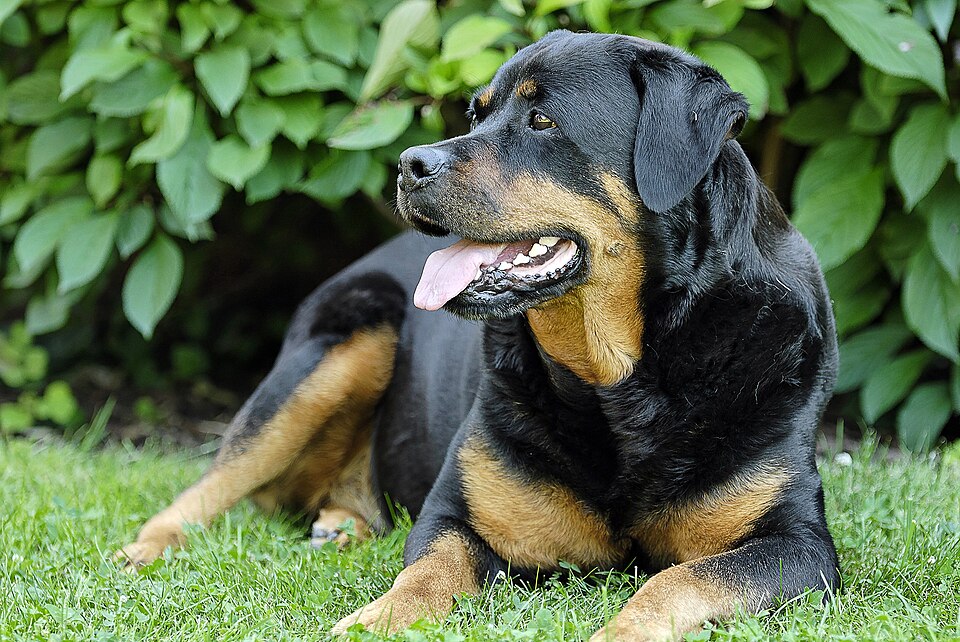
The Rottweiler is a big, powerful working dog you can spot instantly by its black coat and rich tan markings. Bred for centuries to drive and guard cattle, and later put to work as a police dog, it becomes a calm, self-assured and deeply devoted companion when it's raised well; but its strength and protective nature put real responsibility on its owner. We built this page from breed registry standards, animal welfare resources, scientific studies and Turkish legislation.
- Temperament: Calm, self-assured and very devoted to its family; reserved and protective with strangers.
- Training: Smart and eager to learn; early socialization and consistent, reward-based training are non-negotiable with this breed.
- Exercise: The Royal Kennel Club recommends more than two hours a day; a large home with a yard suits it best.
- Health: Bone cancer (osteosarcoma), elbow and hip dysplasia and torn knee ligaments are common; ask for the parents' hip and elbow X-ray results.
- Lifespan: In UK data the median lifespan falls between 9 and 10.6 years, shorter than for mixed-breed dogs.
What to know
 What is the Rottweiler like?
The FCI breed standard describes the Rottweiler as good-natured, placid at heart, very devoted, obedient and eager to work. It should be self-assured, steady and fearless; it watches its surroundings closely but doesn't rattle easily. The standard disqualifies dogs that are aggressive or overly shy. In other words, the breed ideal isn't a "tough" dog, it's a calm and balanced one.
According to the AKC, the Rottweiler is a gentle, even playful companion within the family and confident and aloof toward the outside world. The Royal Kennel Club also notes the breed's territorial instinct and its protectiveness toward its owner and property.
This is a dog that wants to live with people. The AKC stresses that Rottweilers kept isolated from people and everyday life don't do well. A dog that lives indoors as part of the family, rather than waiting alone in the yard, tends to be both more balanced and safer.
Every dog is an individual. A 2022 study of more than 18,000 dogs (Morrill et al., Science) found that breed explains only about 9% of the behavioral differences between individual dogs. The parents' temperament, early experiences and training matter at least as much as breed.
 Who is it a good fit for?
The Rottweiler suits people who have experience with large, powerful dogs, can make time every day for training and exercise, and will keep their dog indoors as part of the family. The Royal Kennel Club recommends a large house and a large yard, and it says plainly that the breed needs responsible owners who can channel its intelligence and energy.
| Situation | Good fit? |
|---|---|
| Apartment | Hard; not recommended without daily long walks, training and play |
| House with a yard | Good; the fence must be solid, and the dog should still live indoors with the family |
| Family with kids | Devoted to its family, but its size and strength mean constant supervision |
| Other dogs | Average; early socialization and calm introductions matter |
| First-time dog owners | Not recommended; needs experience, time and consistent training |
| Long hours alone | Struggles; wants to be with its people |
Where does it come from?
According to the FCI, the Rottweiler is considered one of the oldest dog breeds, with roots going back to Roman times. Roman legions crossing the Alps brought dogs that drove and guarded their herds, and in the Rottweil area of southwest Germany these dogs mixed with local dogs. The Royal Kennel Club explains that Rottweil was a livestock market for centuries, and cattle dealers and farmers wanted a strong dog that could both drive the herd and guard against robbers on the road.
The breed is named after the town, and the FCI and AKC both note that it was long known as the "Rottweil butcher's dog." The Royal Kennel Club tells how farmers heading home from market tied their money pouches to the dog's collar so they wouldn't be stolen. According to the AKC, this work faded in the 1800s once cattle began moving by rail; the FCI says the breed was tested as a police dog in the early 1900s and officially recognized as one in 1910. The AKC adds that Rottweilers were among the first guide dogs.
The Royal Kennel Club doesn't hide the fact that when the breed was at its most popular it attracted people looking for a "macho" image, which earned it a bad reputation.
Appearance and colors
According to the FCI standard, the Rottweiler is a medium-to-large, powerful and compact dog that should look neither heavy nor light, neither leggy nor weedy. Body length exceeds height at the shoulder by no more than 15%, and the chest is broad and deep.
- Height: 24–27 in (61–68 cm) for males and 22–25 in (56–63 cm) for females (FCI).
- Weight: The FCI gives 110 lb (50 kg) for males and about 93 lb (42 kg) for females.
- Color: Black with clearly defined rich tan markings on the cheeks, muzzle, throat, chest and legs, above the eyes and under the tail. Black and tan is the only standard color on the Royal Kennel Club's list.
- Coat: A coarse, dense, flat-lying topcoat of medium length, with an undercoat that shouldn't show through.
- Ears and tail: The ears are medium-sized, triangular and hanging. The FCI standard describes the tail in its natural state; in Türkiye, cutting the tail or ears for looks is banned under Animal Protection Law no. 5199.
Daily care
The Rottweiler's coat is easy to look after. The Royal Kennel Club considers grooming once a week enough; the AKC also recommends weekly brushing and notes that the breed sheds moderately most of the year and more heavily in spring and fall.
- Brushing: Once a week with a rubber or bristle brush; more often during shedding season. See our dog grooming guide for details.
- Nails and teeth: The AKC recommends regular nail trims and tooth brushing; getting your puppy used to both makes life much easier once it's a big adult.
- Ears: Check those hanging ears once a week. In UK data, outer ear infection was the third most commonly recorded problem in the breed; show your vet any odor, redness or itching.
- Hot weather: Provide shade and fresh water in summer and save long walks for the cooler hours. Our article on dogs in hot weather covers the signs of heatstroke.
Training and exercise
The Rottweiler is smart, quick to learn and eager to please its people, but because it's big and strong, training and socialization aren't optional, they're essential. The AKC lists early training, puppy socialization, basic obedience classes and living in the home with its family as the keys to raising a well-mannered Rottweiler. Discipline should be consistent and fair, never rough. The AKC also advises against wrestling and other roughhousing, since it can encourage aggression.
In a 2017 study of the veterinary records of 5,321 Rottweilers in the UK (O'Neill et al.), the most commonly recorded problem was aggression: 7.5% of dogs, more often in males than females. The authors stress that aggression comes from a complex interplay between genetics and the social environment a dog experiences. That shows how much good puppy socialization and fear-free training matter with this breed.
- Early socialization: As a puppy, give it short, positive experiences with different people, children, sounds, vehicles and calm dogs.
- Basic cues: Coming when called, waiting, letting go and walking without pulling are the foundation of life with a 90–110 lb (40–50 kg) dog. Our guides to loose-leash walking and recall explain them step by step.
- Vet prep: Use rewards early on to get it comfortable with being handled, having its mouth and paws checked and, if needed, wearing a muzzle.
The Royal Kennel Club recommends more than two hours of exercise a day. Long walks, sniffing games and structured play work well, and according to the AKC the breed also picks up jobs like tracking, obedience and carting easily. Don't push a growing puppy into long runs; talk to your vet about exercise that suits its age.
Steer clear of puppies marketed as "tough," "man-stopping" or "protection-trained," and of anyone who suggests "toughening up" a dog by provoking it. In Türkiye, Animal Protection Law no. 5199 bans training methods that injure an animal, cause it needless suffering or encourage bad habits (article 11), and dog fighting is a crime punishable by prison (article 28/A). If you run into behavior problems, get help from your vet and a trainer who uses positive methods.
 Diet and weight
Rottweilers don't need a special food; a complete, balanced dog food suited to their life stage (puppy, adult, senior) and activity level is enough. The AKC notes that some Rottweilers gain weight easily, and in UK data overweight and obesity was the second most commonly recorded problem in the breed (7.1%).
- Controlled growth in puppyhood: The Merck Veterinary Manual notes that too much calcium (for example, from unnecessary supplements) can harm bone and joint development in fast-growing large-breed puppies. Raise your puppy lean rather than chubby; make a growth plan with your vet covering the type of food, the amount and weight checks, and don't add supplements your vet hasn't recommended.
- Measure meals: Measure food instead of eyeballing it, and count training treats as part of the daily amount.
- Lower the risk of bloat: For dogs at risk of bloat, the Merck Veterinary Manual recommends splitting the daily food into several small meals instead of one large one, limiting exercise before and after meals and keeping mealtimes calm.
- Ideal weight: If you can feel the ribs under a thin layer of fat and see a waist when you look from above, the weight is about right.
Some human foods are toxic to dogs; check our list of foods you should never give your dog. Fresh water should always be available.
 Health issues to know about
A few serious problems stand out as known predispositions in the Rottweiler. The information below is for awareness only; ask your vet about diagnosis and treatment.
Bone cancer (osteosarcoma)
This is the most common bone tumor in dogs, and a very painful one. According to UFAW's animal welfare resource, Rottweilers are about five times more likely than the average dog to develop it; an estimated 5% to 12% of the breed is affected, and diagnosis usually comes at around 8 years of age. The front legs are affected more often. In the 2017 UK study, cancer accounted for a third of deaths. If you notice lameness that doesn't go away or keeps getting worse, a swelling on a leg, or pain when the leg is touched, see your vet without waiting. UFAW also cites studies suggesting neutered dogs may be at higher risk; talk to your vet about the timing of spay or neuter.
Elbow and hip dysplasia
Dysplasia means a joint doesn't develop properly during growth. According to UFAW, fragmentation of a bony process in the elbow (FMCP) is common in Rottweilers and may affect a third to a half of the breed, with arthritis usually starting in the first year. Hip dysplasia also occurs: in France, among Rottweilers X-rayed between 1997 and 2017, the rate fell from 23.9% to 17%, a sign that screening-based breeding works. The Royal Kennel Club asks breeders, at a minimum, to hip and elbow score dogs before breeding.
Torn knee ligament
This is wear and eventual rupture of the cranial cruciate ligament in the knee; according to UFAW it's several times more common in Rottweilers than in other breeds. It causes hind-leg lameness and pain and leads to arthritis over time.
Bloat
In bloat (gastric dilatation-volvulus, or GDV), the stomach fills with gas and twists on itself. The Merck Veterinary Manual describes it as a life-threatening emergency of large and giant breeds that needs immediate care, often surgery. A US study that followed 11 large and giant breeds (Glickman et al., 2000) included the Rottweiler; 28.6% of the dogs that developed bloat died.
Other screening
The Royal Kennel Club lists a DNA test for JLPP, which causes laryngeal paralysis and nerve disease in young dogs, among its core recommendations, and a DNA test for LEMP-2, which affects the brain and spinal cord, plus an eye exam among its additional ones.
- Retching without bringing anything up, a swollen belly, heavy drooling, restlessness
- Pale gums, weakness or collapse
- Lameness that won't go away, a swelling on a leg, or obvious pain when it's touched
- Fast, labored breathing or stumbling in the heat
How long does it live?
A 2024 study using data on about 585,000 dogs in the UK (McMillan et al.) found a median lifespan of 10.6 years for 9,717 Rottweilers; mixed-breed dogs in the same study had a median of 12 years. A smaller 2017 VetCompass study found a median of 9.0 years, with females (9.5 years) outliving males (8.7 years). The AKC gives 9–10 years.
Regular checkups, a healthy weight, getting lameness checked early and knowing the signs of bloat are the most concrete ways to protect this breed's lifespan.
 Before you get one
- Consider a shelter: Purebred dogs end up in shelters and rescues too. With a large breed, being able to see an adult dog's temperament up front is a big advantage. Our guide to adopting a dog from a shelter walks you through it.
- If you buy from a breeder: Meet the parents in person and make sure they're calm and steady. Ask for hip and elbow X-ray results, the JLPP DNA test and an eye exam, and check that the puppies are raised in a home with people around.
- Red flags: Dogs sold as "tough," "guard" or "fighting" dogs; sellers who won't show you the mother, can't provide paperwork or rush you to "buy now."
- Docked tails and cropped ears: In Türkiye, cutting the tail or ears for looks is banned (Law no. 5199, article 8); avoid sellers offering puppies with docked tails or cropped ears. Rules vary by country.
- Registration: Rules vary by country. In Türkiye, owned dogs must be microchipped and registered in the PETVET system.
- The first days: See our guide to the first week with a new puppy.
Frequently asked questions
Is the Rottweiler banned in Türkiye?
No. Law no. 5199 bans breeding, selling and owning animals the Ministry has designated as "posing a danger" (article 14/l), and the Rottweiler isn't on the list in the Ministry's 2021 circular. Rules can change, so check the current situation with your provincial or district agriculture directorate. Microchipping and PETVET registration are mandatory for every dog. Rules vary by country.
Are Rottweilers aggressive?
The FCI standard disqualifies dogs that are aggressive or overly shy; the breed ideal is a calm, good-natured and self-assured dog. But because it's strong, protective and big, poor socialization and training can have serious consequences. Early socialization, positive training and living with its family are the most important protective factors.
Are Rottweilers good with kids?
It's very devoted to its family, and the AKC describes it as a gentle playmate within the family circle. Still, a 90–110 lb (40–50 kg) dog can knock a child over even in play. Always supervise, and give the dog a quiet place to rest; our article on kids and dogs at home covers the ground rules.
Should a Rottweiler's tail be docked?
No. The FCI standard describes the natural tail, and in Türkiye cutting the tail or ears for looks is against the law. If there's a medical reason, that's a decision for a veterinarian.
Sources
- FCI · Rottweiler breed standard (No. 147, 2018)
- The Royal Kennel Club · Rottweiler: breed profile and health screening
- AKC (American Kennel Club) · Rottweiler breed profile
- O'Neill et al. · Rottweilers under primary veterinary care in the UK: demography, mortality and disorders, Canine Genetics and Epidemiology (2017)
- McMillan et al. · Longevity of companion dog breeds: those at risk from early death, Scientific Reports (2024)
- Science for Animal Welfare (UFAW) · Rottweiler: Osteosarcoma
- Science for Animal Welfare (UFAW) · Rottweiler: Elbow dysplasia (FMCP)
- Science for Animal Welfare (UFAW) · Rottweiler: Cranial cruciate ligament rupture
- Baldinger et al. · Prevalence of canine hip dysplasia in 10 breeds in France (1997–2017), PLOS ONE (2020)
- Glickman et al. · Incidence of and breed-related risk factors for gastric dilatation-volvulus in dogs, JAVMA (2000)
- Merck Veterinary Manual · Gastric dilation and volvulus in small animals
- Merck Veterinary Manual · Nutritional requirements of small animals
- Morrill et al. · Ancestry-inclusive dog genomics challenges popular breed stereotypes, Science (2022)
- Türkiye legislation database · Animal Protection Law no. 5199, current text (in Turkish)
- Türkiye Ministry of Agriculture and Forestry · Circular on animals posing a danger (2021/48, in Turkish)
- Resmî Gazete (Türkiye) · Regulation on the identification and registration of cats, dogs and ferrets (February 26, 2018)
By Tüylüm · Last checked: November 3, 2026. Compiled from the sources above and written in our own words. Spotted a mistake? Write to [email protected] and we'll fix it right away. Photo from Wikimedia Commons, used under the license shown below it.