 Tüylüm
Doberman
A fast, intelligent, deeply devoted dog first bred in Germany by a tax collector who wanted protection on his rounds. It's easy to train but needs lots of exercise. A heart muscle disease (DCM) is the breed's biggest health problem; regular heart screening helps catch it early.

 Lifespan≈ 11.2 yearsmedian, 2024 UK study
 Weight71–99 lb (32–45 kg)FCI: males 88–99 lb, females 71–77 lb
 Height at shoulder25–28 in (63–72 cm)FCI: males 27–28 in, females 25–27 in
 OriginGermany (Apolda)Louis Dobermann's dogs
 CoatShort, no undercoatbrushing once a week is enough
 Exercise2+ hours a dayRoyal Kennel Club guidance
 With kidsAffectionatestrong and fast; supervise
 TrainingQuick learnersocialization and obedience a must
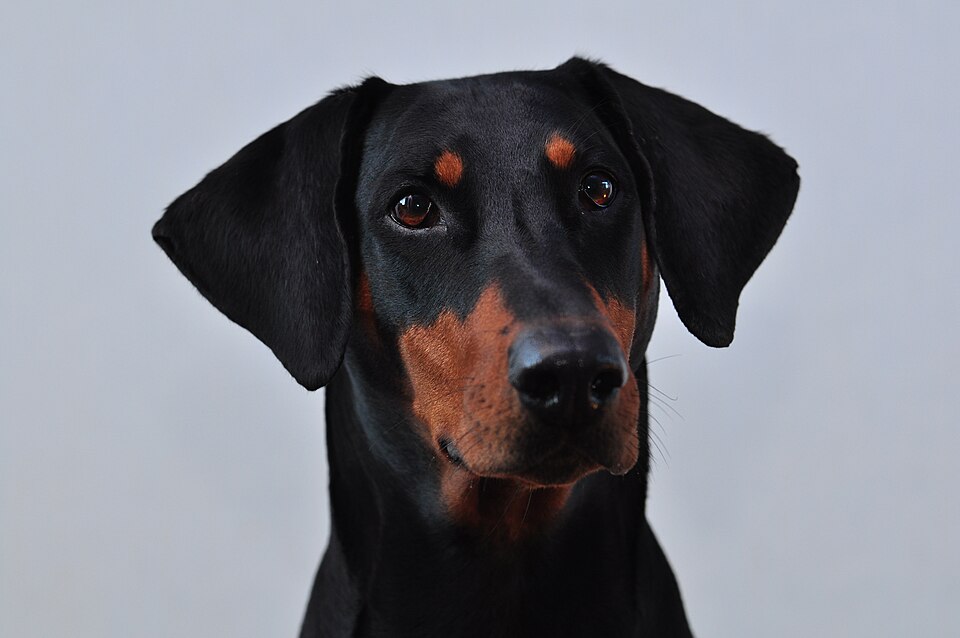
The Doberman is a German-born guardian and family dog known for its sleek lines, glossy black or brown coat and watchful expression. It's fast, intelligent and very eager to learn, and when it's raised well it becomes a calm housemate who is deeply devoted to its family. The most important thing to know before you get one is how common a serious heart muscle disease is in this breed. We built this page from breed registry standards, animal welfare resources, scientific studies and Turkish legislation.
- Temperament: Friendly, calm and very devoted to its family; alert and protective when needed.
- Exercise: The Royal Kennel Club recommends more than two hours a day; it needs a safe place to run.
- Training: Smart and quick to learn, but a poorly raised Doberman can become a strong dog that's hard to manage.
- Health: A European study found heart muscle disease (DCM) in more than half of Dobermans; yearly heart screening from age 2 is recommended.
- Ears and tail: In Türkiye, cutting the ears or tail for looks is banned, and the FCI standard describes both in their natural state.
What to know
 What is the Doberman like?
According to the FCI standard, the Doberman is friendly and calm and very devoted to its family. The standard calls for a medium level of energy and alertness, a temperament that isn't easily provoked and a strong bond with its owner; it's easy to train, enjoys working, and should be courageous and self-confident. Aggressive or overly shy dogs are disqualified under the standard.
The AKC describes the Doberman as intelligent, quick to learn and quick to respond, and a loving, fun companion. But the same source says plainly that a Doberman that isn't raised properly can become pushy, destructive and hard to manage, and it stresses that Dobermans should live inside the home with their people rather than outdoors. The Royal Kennel Club also notes that the breed's loyal, obedient nature makes it a good family dog.
Every dog is an individual. Breed traits describe general tendencies; the parents' temperament, how a puppy was socialized and the training it gets shape its personality as much as its breed.
 Who is it a good fit for?
The Doberman suits active people who can spend a lot of time with their dog every day, enjoy training and will keep their dog indoors. The Royal Kennel Club recommends a large house and a large yard, and the AKC stresses that a big fenced area to run in is vital for the breed's physical and mental well-being.
| Situation | Good fit? |
|---|---|
| Apartment | Hard; not recommended without daily long walks, running and mental work |
| House with a yard | Good; the fence must be tall and solid, and the dog should still live indoors |
| Family with kids | The AKC rates it highly with kids; strong and fast, so supervise |
| Other dogs | Average; early, calm introductions matter |
| First-time dog owners | Hard; its energy and strength call for experience and time |
| Cold, wet weather | No undercoat; shouldn't live outdoors and may need protection in the cold |
Where does it come from?
According to the FCI, the Doberman is the only German breed named after its original breeder: Friedrich Louis Dobermann (1834–1894). Dobermann lived in Apolda in Thuringia and is believed to have been a tax collector, a knacker's yard manager and a part-time dog catcher; he bred from the especially sharp dogs among those he caught. The FCI writes that "butcher's dogs," an early type of Rottweiler, together with a black dog with rust-red markings that was a type of shepherd dog in Thuringia, formed the foundation of the breed; in the 1870s this mix produced an alert and highly protective working and house dog.
According to the Royal Kennel Club, Dobermann wanted a fierce-looking dog that would deter robbers on his rounds and have the courage to defend him; Weimaraner, Greyhound, Manchester Terrier, Rottweiler and German Shepherd blood are said to have been added to a pinscher foundation. Sources don't fully agree on which breeds went in, and the AKC lists several theories. The German Kennel Club recognized the breed in 1899. Heavy use in police work earned it the nickname "gendarme dog" (FCI), and according to the AKC, the Dobermans that served with the US Marines in World War II made the breed famous.
Appearance and colors
According to the FCI, the Doberman is a medium-sized, strong and muscular dog with elegant lines; the body looks almost square, especially in males.
- Height: 27–28 in (68–72 cm) at the shoulder for males and 25–27 in (63–68 cm) for females; medium size is preferred (FCI).
- Weight: About 88–99 lb (40–45 kg) for males and 71–77 lb (32–35 kg) for females (FCI).
- Coat: Short, hard, dense and glossy; the FCI standard doesn't allow an undercoat.
- Color: The FCI recognizes two colors: black or brown with clearly defined rust-red markings. The AKC also accepts blue and fawn.
- Ears and tail: Under the FCI standard, the ears and tail are left natural; the ears lie close to the cheeks and the tail is carried high in a slight curve.
In Türkiye, article 8 of Animal Protection Law no. 5199 bans cutting a pet's tail or ears to change its appearance or for any other non-therapeutic reason; if there's a medical reason, the decision belongs to a veterinarian. Violations carry an administrative fine per animal (article 28). Upright, pointed ears aren't a breed trait but the result of cropping: a natural Doberman has drop ears. Rules vary by country.
Daily care
The Doberman's short coat needs very little care. The Royal Kennel Club considers grooming once a week enough, and the AKC suggests frequent quick once-overs with a short-bristled brush or grooming mitt. It doesn't need frequent baths. See our dog grooming guide for details.
- Nails: Trim at least once a month, according to the AKC.
- Teeth: Brush regularly; starting in puppyhood makes it easier.
- Ears: Check every few days, and have your vet show you how to clean them.
- Cold weather: This is a short-coated dog with no undercoat; the tips in our article on dogs in cold weather will come in handy when it's cold and wet.
Training and exercise
The Doberman is very smart and loves to work, so training it the right way is usually a pleasure. The AKC calls socialization and obedience training from puppyhood essential and strongly recommends puppy classes. Harsh methods aren't needed; short, consistent, reward-based sessions work best.
According to the AKC, the Doberman is an energetic athlete: long daily walks, hikes and free running in a large fenced area matter for both body and mind. Dog sports such as obedience, tracking and agility give it a good outlet. The Royal Kennel Club recommends more than two hours of exercise a day.
- Early socialization: As a puppy, give it short, positive experiences with different people, children, sounds, vehicles and calm dogs.
- Basic cues: Coming when called, waiting and walking without pulling are the foundation of life with a fast, strong dog. Our guides to loose-leash walking and recall explain them step by step.
- Mental work: Sniffing games, hidden treats and short learning sessions tire it out and help it settle.
- Vet prep: Use rewards early on to get it comfortable with being handled, having its mouth and paws checked and, if needed, wearing a muzzle.
Steer clear of puppies marketed as "tough," "man-stopping" or "protection-trained," and of anyone who suggests "toughening up" a dog by provoking it. In Türkiye, Law no. 5199 bans training methods that injure an animal, cause it needless suffering or encourage bad habits (article 11). If you run into behavior problems, get help from your vet and a trainer who uses positive methods.
 Diet and weight
Dobermans don't need a special food; the AKC recommends a quality dog food suited to the dog's age and, for puppies, a diet approved by the breeder or vet. Treats are great for training, but too many lead to weight gain.
- Controlled growth in puppyhood: The Merck Veterinary Manual notes that too much calcium (for example, from unnecessary supplements) can harm bone and joint development in fast-growing large-breed puppies. Make a growth plan with your vet covering the type of food, the amount and weight checks, and don't add supplements your vet hasn't recommended.
- Lower the risk of bloat: Cornell lists the Doberman among the large, deep-chested breeds in which bloat is far more common. Risk factors Cornell names include eating too fast, one large meal a day, exercising soon after eating and raised food bowls. Split food into at least two meals, use a slow-feeder bowl if your dog gulps, and don't let it run right after eating.
- Ideal weight: If you can feel the ribs under a thin layer of fat and see a waist from above, the weight is about right.
Also check our list of foods that are dangerous for dogs.
 Health issues to know about
Some inherited diseases are very common in Dobermans. The information below is for awareness only; ask your vet about diagnosis and treatment.
Dilated cardiomyopathy (DCM)
In this progressive disease, the heart muscle weakens and the heart enlarges. In a European study that followed 412 Dobermans for years with heart ultrasound (echocardiography) and 24-hour ECG (Holter) monitoring (Wess et al., 2010), the overall prevalence was 58.2%. It rose steeply with age: 3.3% between 1 and 2 years, but 43.6% between 6 and 8 years. According to UFAW, dogs may show no signs for years before developing heart failure or dying suddenly. These two exams can detect the disease early, and the study's authors recommend yearly screening starting at age 2. UFAW also notes that a DNA test is available for one gene change. Plan the screening schedule and next steps with your vet.
Von Willebrand disease
An inherited disorder that impairs blood clotting. According to UFAW, about a quarter of Dobermans are at risk of abnormal bleeding, though the form seen in this breed is usually mild. A DNA test is available, and the Royal Kennel Club asks breeders to do it, at a minimum, before breeding. Before any surgery, such as a spay or neuter, tell your vet your dog's test result.
Wobbler syndrome
Malformed neck vertebrae put pressure on the spinal cord. According to UFAW, about 5% of Dobermans were affected in one survey. Signs can include neck pain and a wobbly, unsteady gait, starting in the hind legs.
Doberman hepatitis
According to UFAW, this is a progressive inflammation of the liver seen in the breed, especially in middle-aged and older females; it's thought to be linked to copper building up in the liver. Early signs are vague: weight loss, weakness, vomiting, diarrhea.
Others
The Royal Kennel Club also recommends hip screening and an eye exam, and the AKC lists an underactive thyroid and progressive retinal atrophy (PRA) among conditions seen in the breed. According to Cornell, bloat is also an important emergency in Dobermans.
- Fainting, sudden weakness or tiring quickly during exercise
- Coughing, or fast or labored breathing
- Bleeding that won't stop, or unexplained bruising
- A wobbly gait or neck pain
- Retching without bringing anything up, a swollen belly, pale gums
How long does it live?
A 2024 study using data on about 585,000 dogs in the UK (McMillan et al.) found a median lifespan of 11.2 years for 5,154 Dobermans; mixed-breed dogs in the same study had a median of 12 years. The AKC gives 10–12 years.
Because heart muscle disease is so common in this breed and can cause sudden death, regular heart screening, a healthy weight and getting new symptoms checked right away are the most concrete ways to protect a Doberman's lifespan.
 Before you get one
- Consider a shelter: Purebred dogs end up in shelters and rescues too. Our guide to adopting a dog from a shelter walks you through it.
- If you buy from a breeder: Meet the parents in person. Ask for heart screening results (echocardiography and Holter), the von Willebrand DNA test, hip X-rays and an eye exam. The AKC advises never buying a puppy from a breeder who hasn't tested their breeding dogs.
- Cropped ears and docked tails: In Türkiye, cutting the ears or tail for looks is banned; avoid sellers offering puppies with cropped ears or docked tails. Rules vary by country.
- Red flags: Dogs sold as "tough" or "guard" dogs; sellers who won't show you the mother, can't provide paperwork or rush you.
- Registration: Rules vary by country. In Türkiye, owned dogs must be microchipped and registered in the PETVET system.
- The first days: See our guide to the first week with a new puppy.
Frequently asked questions
Is the Doberman banned in Türkiye?
No. Law no. 5199 bans breeding, selling and owning animals the Ministry has designated as "posing a danger" (article 14/l), and the Doberman isn't on the list in the Ministry's 2021 circular. Rules can change, so check the current situation with your provincial or district agriculture directorate. Rules vary by country.
Why do some Dobermans have upright ears?
A natural Doberman has drop ears; upright, pointed ears are the result of cropping. The FCI standard describes natural ears and a natural tail, and in Türkiye cutting the ears or tail for looks is against the law.
Is the Doberman a good family dog?
The FCI standard describes the breed as friendly, calm and very devoted to its family, and the Royal Kennel Club says it can make a good family dog. The conditions: early socialization, regular training, plenty of exercise and living indoors with its family.
When should heart screening start?
The authors of the large European study recommend yearly screening with ultrasound and 24-hour ECG starting at age 2. Work out the right plan for your dog with your vet, and if you see fainting, coughing or unusual tiredness, don't wait for the next screening.
Can a Doberman live outdoors?
That's not recommended. The AKC stresses that Dobermans should live inside with their people, and under the FCI standard they have no undercoat. A yard is good for exercise, but home should be indoors.
Sources
- FCI · Dobermann breed standard (No. 143, 2015)
- The Royal Kennel Club · Dobermann: breed profile and health screening
- AKC (American Kennel Club) · Doberman Pinscher breed profile
- Wess et al. · Prevalence of dilated cardiomyopathy in Doberman Pinschers in various age groups, Journal of Veterinary Internal Medicine (2010)
- Science for Animal Welfare (UFAW) · Doberman: Dilated cardiomyopathy
- Science for Animal Welfare (UFAW) · Doberman: Von Willebrand disease
- Science for Animal Welfare (UFAW) · Doberman: Cervical vertebral malformation syndrome (wobbler)
- Science for Animal Welfare (UFAW) · Doberman: Doberman hepatitis
- McMillan et al. · Longevity of companion dog breeds: those at risk from early death, Scientific Reports (2024)
- Cornell Riney Canine Health Center · Gastric dilatation-volvulus (GDV) or bloat
- Merck Veterinary Manual · Nutritional requirements of small animals
- Türkiye legislation database · Animal Protection Law no. 5199, current text (in Turkish)
- Türkiye Ministry of Agriculture and Forestry · Circular on animals posing a danger (2021/48, in Turkish)
- Resmî Gazete (Türkiye) · Regulation on the identification and registration of cats, dogs and ferrets (February 26, 2018)
By Tüylüm · Last checked: November 3, 2026. Compiled from the sources above and written in our own words. Spotted a mistake? Write to [email protected] and we'll fix it right away. Photo from Wikimedia Commons, used under the license shown below it.