 Tüylüm
Great Dane
Developed in Germany to hunt wild boar, it's one of the world's tallest dogs: a gentle, affectionate giant devoted to its family. Its size magnifies everything, from space and costs to health risks. Bloat is common and life-threatening here, and heart muscle disease (DCM) also matters.

 Lifespan≈ 10.6 yearsmedian, 2024 UK study; AKC says 7–10
 Weight110–175 lb (50–79 kg)AKC: males 140–175 lb, females 110–140 lb
 Height at shoulder28–35 in (72–90 cm)FCI: males at least 31.5 in, females 28 in
 OriginGermanythe boar-hunting "Deutsche Dogge"
 CoatVery short, glossybrush once a week
 Exercise2+ hours a dayRKC guidance; no running until age 2
 With kidsPatientits giant size means constant supervision
 TrainingEager to pleaseearly socialization and obedience a must
The Great Dane is an elegant, imposing dog that stands taller than most people when it rears up on its hind legs. Beneath that giant frame there's usually a gentle, affectionate temperament and a deep attachment to its people. But living with a dog like this magnifies everything: the space it needs, the costs, the importance of training and some serious health risks. We built this page from breed registry standards, animal welfare resources and scientific studies.
- Temperament: Friendly, affectionate and devoted to its family; may be reserved with strangers but should never be aggressive.
- Size: According to the FCI, males stand at least 31.5 in (80 cm) at the shoulder; the AKC says they can weigh up to 175 lb (79 kg). Plan your home, car and budget accordingly.
- Bloat: The AKC calls bloat the breed's number-one killer; knowing the signs by heart can save a life.
- Heart: More than a third of Great Danes screened in the UK had heart muscle disease (DCM).
- Lifespan: A median of 10.6 years in the UK; the AKC gives 7–10 years.
What to know
 What is the Great Dane like?
The FCI standard describes the Great Dane as friendly, loving and devoted to its owners. It may be reserved with strangers, but the standard calls for a confident, fearless, easily guided and docile family dog with a high tolerance for provocation and no aggression. The standard considers socially acceptable behavior to be of the utmost importance, and it disqualifies dogs that are aggressive, overly shy, fear-biting or easily provoked.
The AKC describes the Great Dane as easygoing and a joy to live with, then immediately adds a warning: owning a dog of this size, weight and strength is not a decision to take lightly. According to the AKC, Danes are sweet-natured people pleasers who make friends easily and are patient with kids, while also being alert guardians of their home. The Royal Kennel Club also notes that despite its size the breed is kind and loyal to its family and makes a good family dog.
Every dog is an individual. Breed traits describe general tendencies; the parents' temperament, how a puppy was socialized and the training it gets shape its personality as much as its breed.
 Who is it a good fit for?
The Great Dane suits people with a roomy home and yard who can handle the costs and care of a giant dog and will keep it indoors as part of the family. The Royal Kennel Club recommends a large house and a large yard.
| Situation | Good fit? |
|---|---|
| Apartment | Hard; it may be calm indoors, but its giant size is a problem in tight spaces |
| House with a yard | Good; the AKC says it may follow its nose, so the fence must be tall |
| Family with kids | Patient with kids, but its size means constant supervision around little ones |
| Other dogs | Average; early, calm introductions matter |
| Hot climate | Take care; dogs over 50 kg (110 lb) have a higher risk of heatstroke |
| First-time dog owners | Think carefully; its giant size makes training and care a serious job |
In homes with kids, it's important that nobody bothers the dog while it eats or sleeps and that the dog has a quiet spot to rest; our article on kids and dogs at home covers the ground rules.
Where does it come from?
Despite its name, the Great Dane is a German breed. According to the FCI, its ancestors include the old Bullenbeisser and boar-hunting hounds that sat somewhere between the powerful English Mastiff and the swift Greyhound. The word "Dogge" originally meant any large, powerful dog rather than a particular breed, and these dogs went by different names, such as Ulmer Dogge, Hatzrüde and Saupacker, depending on their color and size. In 1878 a seven-member committee of breeders and judges in Berlin grouped all these types under the name "Deutsche Dogge"; the first standard was written at a Berlin show in 1880, and the German Great Dane club has looked after the standard since 1888.
According to the Royal Kennel Club, the breed's heavier ancestors hunted wild boar in packs, while today's Great Dane is taller and more elegant. The AKC explains that nobody knows why the breed came to be linked with Denmark: the English name is a translation of the French "grand Danois" (big Dane), while Germans call it the "German dog." Over time the Great Dane also became known as a guardian of home and family, and the FCI standard calls it "the Apollo amongst all breeds."
Appearance and colors
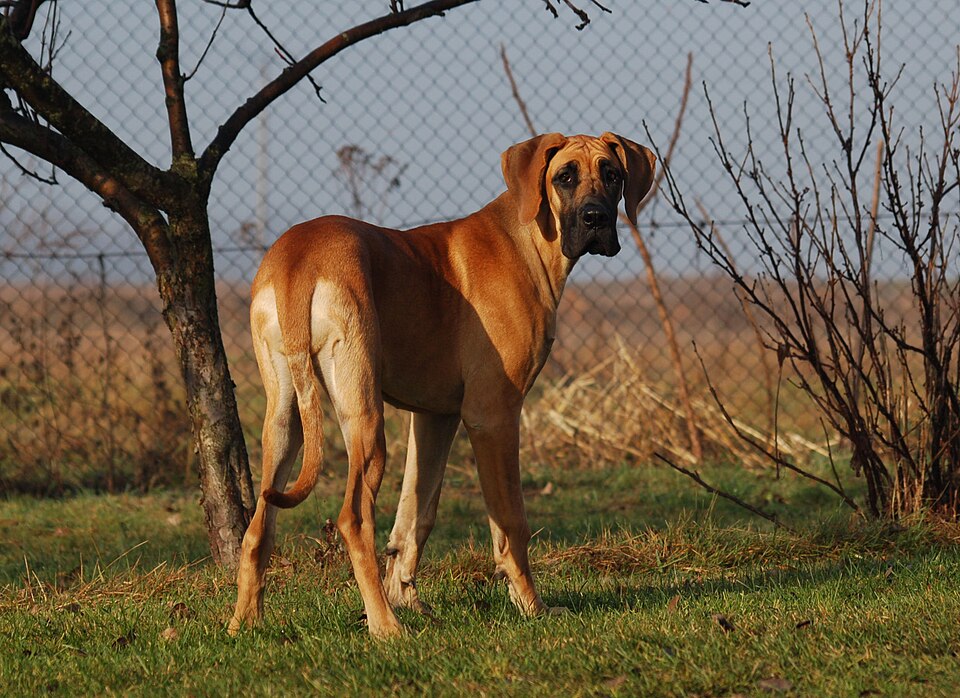
According to the FCI, the Great Dane combines a large, powerful, well-built body with pride, strength and elegance; it's almost square in build, especially in males. The head is long and narrow, with a striking expression.
- Height: At least 31.5 in (80 cm) at the shoulder for males, not exceeding 35.5 in (90 cm), and at least 28 in (72 cm) for females, not exceeding 33 in (84 cm) (FCI).
- Weight: According to the AKC, males weigh 140–175 lb (64–79 kg) and females 110–140 lb (50–64 kg).
- Coat: Very short, dense, smooth-lying and glossy, with no double coat.
- Color: The FCI recognizes three color varieties: fawn and brindle; harlequin (white with black patches), merle (gray with black spots) and black; and blue.
- Ears and tail: According to the FCI, the ears hang naturally, and the tail reaches to the hocks. Although Great Danes' ears are cropped in some countries, in Türkiye cutting the ears or tail for looks is banned under article 8 of Animal Protection Law no. 5199.
Daily care
According to the AKC, the Great Dane's short, smooth coat doesn't shed much for most of the year, but the dog is so big that it still adds up to a fair bit of hair. Weekly brushing is enough, and during the shedding season that comes once or twice a year, daily brushing is best. It doesn't need frequent baths. See our dog grooming guide for details.
- Nails: Long nails cause pain and walking problems; trim them regularly. With a giant dog, getting it used to this as a puppy is essential.
- Eyes: According to the Merck Veterinary Manual, an outward-sagging eyelid (ectropion) is common in Great Danes. Show your vet any redness or discharge.
- Drool: The AKC rates its drooling at 4 out of 5; keeping a towel handy is a good idea.
- Hot weather: In a 2020 UK study, dogs weighing 50 kg (110 lb) or more had more than three times the odds of heatstroke of dogs under 10 kg (22 lb). In summer, shade, water and walks during the cooler hours are a must; our article on dogs in hot weather covers the warning signs.
Training and exercise
The AKC recommends early socialization and puppy classes, and calls obedience training a must for a breed this big and powerful. Great Danes are sociable, friendly and eager to please, and they respond well to firm, consistent methods. They need human contact, affection and socialization with other people and animals. Remember: a jump that looks cute today means a 150 lb (70 kg) dog knocking you over a year from now.
According to the AKC, the Great Dane may seem sedate but needs daily exercise suited to its age; two or three brisk walks a day can be enough. The Royal Kennel Club recommends more than two hours of activity a day. For jogging or long hikes, the AKC advises waiting until the dog is 2 years old to avoid damaging growing joints, and because of the bloat risk, vigorous exercise around mealtimes should be avoided.
- Leash training: Teach it to walk without pulling while it's small; an adult Great Dane that pulls is very hard to hold. Our guide to loose-leash walking explains it step by step.
- No jumping: Reward sitting instead of jumping on people.
- Early socialization: Give it positive experiences with different people, children, sounds and calm dogs.
- Vet prep: You may not be able to lift a giant dog; use rewards early on to get it comfortable with being handled, examined, getting in and out of the car and, if needed, wearing a muzzle.
 Diet and weight
The AKC recommends a quality dog food suited to the Great Dane's life stage (puppy, adult, senior), few or no table scraps, and especially avoiding cooked bones and high-fat foods. According to the AKC, Danes put weight on easily but take it off with difficulty; an overweight Dane has a shorter life and more trouble moving as a senior.
- Controlled growth in puppyhood: Great Danes grow very fast. The Merck Veterinary Manual notes that too much calcium (for example, from unnecessary supplements) can harm bone and joint development in fast-growing large and giant breed puppies. Raise your puppy lean rather than chubby; make a growth plan with your vet covering the type of food, the amount and the weight curve, and don't add supplements your vet hasn't recommended.
- Lower the risk of bloat: The AKC and the Merck Veterinary Manual recommend splitting the daily food into several small meals instead of one large one and preventing vigorous activity before and after meals. For dogs at risk, Merck also advises avoiding raised food bowls and keeping mealtimes calm.
- Ideal weight: If you can feel the ribs under a thin layer of fat and see a waist from above, the weight is about right.
Also check our list of foods that are dangerous for dogs.
 Health issues to know about
The Great Dane's size brings some serious health risks with it. The information below is for awareness only; ask your vet about diagnosis and treatment.
Bloat (GDV)
In bloat, the stomach fills with gas, fluid or food and twists on itself; it's a life-threatening emergency that gets worse fast. The AKC calls bloat the Great Dane's number-one killer. In a 2017 study of 77,000 dogs seen at UK emergency vet clinics (O'Neill et al.), Great Danes had 114 times the odds of a bloat diagnosis compared with mixed-breed dogs, the highest figure in the study. In a US study that followed large and giant breeds (Glickman et al., 2000), 28.6% of the dogs that developed bloat died. According to Cornell, more than 80% of dogs survive with treatment, so catching it early is everything.
Cornell explains that surgically tacking the stomach to the body wall (gastropexy) greatly reduces the risk of the stomach twisting, though it doesn't prevent bloating; in at-risk breeds it can be done preventively during a spay or neuter, and the AKC notes that many breeders and owners consider it. Talk with your vet about whether it's right for your dog. Cornell also advises against breeding dogs that have had bloat or have a first-degree relative that did.
Dilated cardiomyopathy (DCM)
The heart muscle weakens and the heart enlarges. According to UFAW, the Great Dane is one of the breeds most often affected, and males are more likely to be affected. In a study that screened 107 Great Danes in the UK with heart ultrasound and ECG (Stephenson et al., 2012), the prevalence was 35.6%, rising to 47% when breed-specific measurements were used. Dogs may show no signs for a long time; UFAW notes the disease can be picked up early with ultrasound and 24-hour ECG (Holter) monitoring. Talk to your vet about a screening plan.
Wobbler syndrome
Malformed neck vertebrae put pressure on the spinal cord. According to UFAW, about 4% of Great Danes were affected in one survey; it can cause neck pain and loss of function, first in the hind legs and later in the front legs.
Bone cancer and others
UFAW's resource lists the Great Dane among the large breeds predisposed to bone cancer (osteosarcoma); lameness that won't go away or a swelling on a leg should be checked right away. The Royal Kennel Club recommends hip, elbow and eye screening and a DNA test for an inherited muscle disease specific to the breed (IMGD), and the AKC also lists thyroid problems.
- Retching without bringing anything up, heavy drooling, restlessness, a swollen or painful belly
- A "praying" stance (front legs stretched forward, chest close to the ground), pale gums, collapse
- Fainting, coughing, or fast or labored breathing
- A wobbly gait, neck pain or lameness that won't go away
How long does it live?
A 2024 study using data on about 585,000 dogs in the UK (McMillan et al.) found a median lifespan of 10.6 years for 2,850 Great Danes; mixed-breed dogs in the same study had a median of 12 years. The AKC gives 7–10 years, and the Royal Kennel Club lists the breed as living under 10 years.
Like most giant breeds, the Great Dane lives shorter than medium-sized dogs. Knowing the signs of bloat, a healthy weight, regular heart checks and getting new symptoms checked early are the most concrete steps.
 Before you get one
- Consider a shelter: Purebred dogs end up in shelters and rescues too. Our guide to adopting a dog from a shelter walks you through it.
- If you buy from a breeder: Meet the parents in person. Ask for hip and elbow X-rays, an eye exam, the IMGD DNA test and heart screening results, and find out whether any dogs in the family have had bloat.
- Space and budget: Food, medication, bedding, transport and vet bills are all noticeably higher with a giant dog, and you'll need a vehicle that can carry it.
- Cropped ears: In Türkiye, cutting the ears or tail for looks is banned; avoid sellers offering puppies with cropped ears. Rules vary by country.
- Red flags: Sellers who won't show you the mother, always have puppies available, can't provide paperwork or rush you.
- Registration: Rules vary by country. In Türkiye, owned dogs must be microchipped and registered in the PETVET system.
Frequently asked questions
How big do Great Danes get?
Under the FCI standard, males stand at least 31.5 in (80 cm) at the shoulder and females at least 28 in (72 cm). According to the AKC, males weigh 140–175 lb (64–79 kg) and females 110–140 lb (50–64 kg). Great Danes grow very fast, so track your puppy's weight with your vet.
Can a Great Dane live in an apartment?
It's hard. It can be calm indoors, but its giant size is a problem in tight spaces, and the Royal Kennel Club recommends a large house and yard. Regular daily walks are a must, too.
How do I recognize bloat?
According to Cornell, the most common signs are retching without bringing anything up, excessive drooling, panting, a swollen and painful belly, restlessness and pacing, pale gums and weakness. If you see these signs, get to the nearest vet without delay.
Are a Great Dane's ears cropped?
They shouldn't be. The FCI standard describes natural, hanging ears, and in Türkiye cutting the ears or tail for looks is against the law.
Why is it called a "Great Dane"?
According to the AKC, there's no known reason to connect the breed with Denmark; it was developed in Germany. The English name is a translation of the French "grand Danois," while Germans call it the "Deutsche Dogge."
Sources
- FCI · Deutsche Dogge (Great Dane) breed standard (No. 235, 2024)
- The Royal Kennel Club · Great Dane: breed profile and health screening
- AKC (American Kennel Club) · Great Dane breed profile
- O'Neill et al. · Gastric dilation-volvulus in dogs attending UK emergency-care veterinary practices: prevalence, risk factors and survival, Journal of Small Animal Practice (2017)
- Glickman et al. · Incidence of and breed-related risk factors for gastric dilatation-volvulus in dogs, JAVMA (2000)
- Cornell Riney Canine Health Center · Gastric dilatation-volvulus (GDV) or bloat
- Merck Veterinary Manual · Gastric dilation and volvulus in small animals
- Stephenson et al. · Screening for dilated cardiomyopathy in Great Danes in the United Kingdom, Journal of Veterinary Internal Medicine (2012)
- Science for Animal Welfare (UFAW) · Great Dane: Dilated cardiomyopathy
- Science for Animal Welfare (UFAW) · Great Dane: Cervical vertebral malformation syndrome (wobbler)
- Science for Animal Welfare (UFAW) · Osteosarcoma and predisposed large breeds
- Merck Veterinary Manual · Eyelids in animals
- Merck Veterinary Manual · Nutritional requirements of small animals
- Hall et al. · Incidence and risk factors for heat-related illness (heatstroke) in UK dogs under primary veterinary care in 2016, Scientific Reports (2020)
- McMillan et al. · Longevity of companion dog breeds: those at risk from early death, Scientific Reports (2024)
- Resmî Gazete (Türkiye) · Regulation on the identification and registration of cats, dogs and ferrets (February 26, 2018)
By Tüylüm · Last checked: November 3, 2026. Compiled from the sources above and written in our own words. Spotted a mistake? Write to [email protected] and we'll fix it right away. Photo from Wikimedia Commons, used under the license shown below it.