 Tüylüm
Dogue de Bordeaux
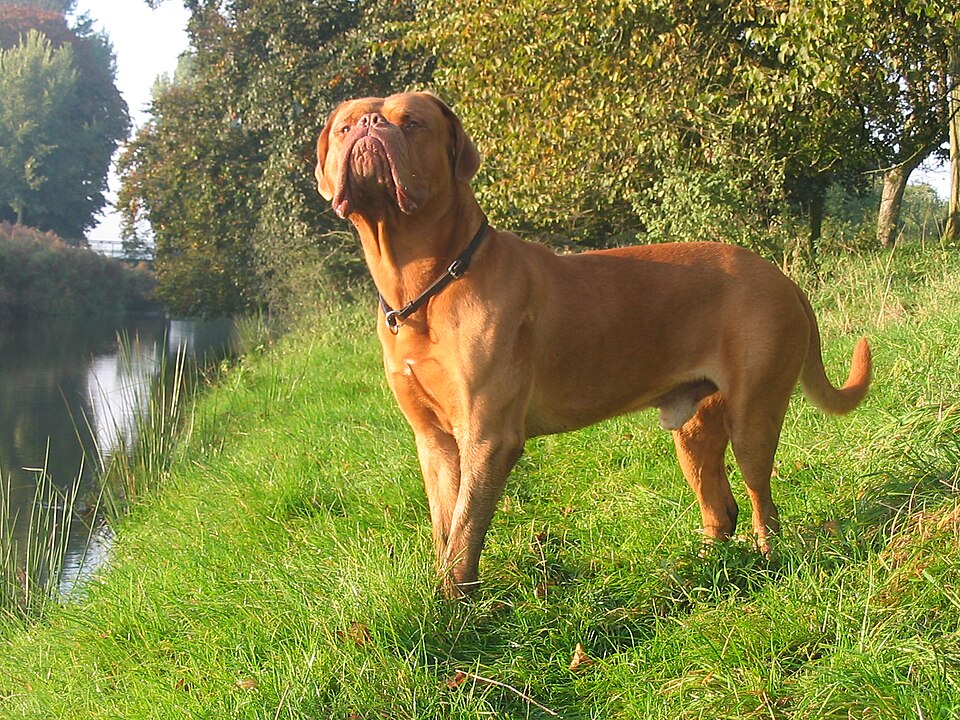
An old French mastiff-type guardian: short-coated, wrinkle-faced, very strong and attached to its family. It can be calm and affectionate, but it drools heavily, struggles in the heat and has a short lifespan (AKC: 5–8 years). It needs early socialization and gentle, consistent training.

 Lifespan≈ 5–8 yearsAKC; UK dogs that died: median 7.7
 WeightMales ≥ 110 lb (50 kg)FCI: males 50 kg+, females 45 kg+
 Height at shoulder23–27 in (58–68 cm)FCI: males 23.5–27 in, females 23–26 in
 OriginFranceone of France's oldest breeds; Bordeaux region
 SheddingModerateshort coat, year-round; drool is its own job
 ExerciseModeratelow-impact until 18 months as a puppy
 With kidsAlways supervisedevoted to family of all ages but huge and strong
 TrainingGentle and consistentAKC: sensitive; avoid harsh methods
The Dogue de Bordeaux is counted among France's oldest dog breeds, known for its short red coat, wrinkled face, huge head and powerful body. In the past it was used for guarding, droving and fighting; today it's mostly a family dog. Its calm, affectionate side is real, but on this page we also spell out the other part plainly: the breed's lifespan is short, its health problems are those of giant breeds, and its face structure adds extra burdens in heat and in daily care. Our sources are the FCI standard, the AKC, UK VetCompass data and Turkish legislation.
- Temperament: According to the FCI, a guardian that works with vigilance and great courage but without aggressiveness, very attached to its family, affectionate, calm and balanced. The AKC adds that it can be stubborn and needs consistent training in puppyhood.
- Lifespan: The AKC says 5–8 years. In UK data from 2019, the median age of 229 Dogues de Bordeaux that died was 7.7 years, against 8.9 years across giant breeds overall.
- Health: Bloat, heart disease, cancer, joint problems and epilepsy are the AKC's listed concerns; the risk of heatstroke is also high.
- Care: It drools heavily; facial wrinkles should be cleaned and dried at least weekly, sometimes daily.
- Owner: Not recommended for first-time owners; it takes someone patient, consistent and willing to use gentle methods.
What to know
 What is the Dogue de Bordeaux like?
The FCI standard calls the Dogue de Bordeaux an ancient fighting dog gifted for guarding, which it does with vigilance and great courage but without aggressiveness. It's a good companion, very attached to its master and very affectionate, calm and balanced with a high stimulus threshold. Males normally show a more dominant character. The standard disqualifies aggressive or overly shy dogs.
The AKC writes that the breed is courageous, loyal, affectionate and protective, but that it "can be stubborn and will dominate those who fail to apply firm training in puppyhood," and it stresses that the breed is sensitive, needs trust, and that a rough trainer or heavy-handed approach should be avoided. That means gentle but clear management: rewards, consistency and a calm voice.
Every dog is an individual. Breed describes what a dog was bred for; it can't tell you how a particular dog will turn out. The parents' temperament, early experiences and training matter at least as much as breed.
 Who is it a good fit for?
The Dogue de Bordeaux suits patient, consistent people who have experience with large breeds, who can put up with drool and a heavy grooming load, and who can keep the dog cool in hot weather. It's a dog that lives indoors with its family, but it has a strong protective instinct as well.
| Situation | Good fit? |
|---|---|
| Apartment | Hard; very large, drooly and struggles in the heat; think about elevators, stairs and summers |
| House with a yard | Good; cool shade and a solid fence are a must |
| Family with kids | The AKC says it's devoted to family of all ages; but it's huge and strong, so always supervise |
| Other dogs | Careful introductions and early socialization are needed |
| Home with frequent guests | Take care; the dog needs a quiet space of its own |
| First-time dog owners | Not recommended; its lifespan can be short and health costs are heavy |
| People in hot climates | Hard; without air conditioning and shade, summer risk is high |
Where does it come from?
According to the FCI, the Dogue de Bordeaux is of French origin. The AKC presents the breed as the oldest French dog breed, writes that it existed before France was France, and says the name means "Mastiff of Bordeaux." One theory holds that it's an indigenous French breed developed over thousands of years; another tale has its ancestors arriving in Gaul with Julius Caesar's legions.
According to the AKC, over its long history the dog worked as a fighting dog, hunter, drafter, drover and guardian; after the French Revolution it spent time as a livestock drover and earned the nickname "Butcher's Dog." The breed was largely unknown outside France until the 1989 film "Turner & Hooch." In the AKC, the breed has competed in the Working Group since 2008.
Appearance and colors
According to the FCI, the Dogue de Bordeaux is a short, thick and muscular dog whose head is so large that its circumference roughly matches its height at the shoulder. The skin is thick and sufficiently loose, but shouldn't have excessive wrinkles. The standard explicitly treats a "bulldoggy hypertype" as a serious fault: a flat skull, a muzzle shorter than a quarter of the head's length, a swollen fold behind the nose, and prominent folds around the head. The haw (the third eyelid) shouldn't be visible.
- Height: 23.5–27 in (60–68 cm) for males and 23–26 in (58–66 cm) for females (FCI; 0.4 in / 1 cm under and 0.8 in / 2 cm over are tolerated).
- Weight: At least 110 lb (50 kg) for males and 99 lb (45 kg) for females (FCI). In the UK, the median adult weight of 5,156 Dogues de Bordeaux was 113 lb (51.2 kg) (O'Neill et al., 2026).
- Coat: Fine, short and soft.
- Color: Solid, in all shades of fawn from mahogany to isabella; limited white on the forechest and the ends of the limbs is allowed. There may be a black or brown mask.
- Ears and tail: The ears are relatively small and drop down; the tail is very thick at the base, carried low and not curled. The tip should reach the hock at most.
In Türkiye, article 8 of Animal Protection Law no. 5199 bans cutting a pet's tail or ears to change its appearance or for any other non-therapeutic reason; if there's a medical reason, the decision belongs to a veterinarian. The FCI standard describes drooping ears and a natural tail. Rules vary by country.
 Daily care
The AKC says the Dogue de Bordeaux is well known for how much it drools, and that the wrinkles on its face need attention at least weekly, sometimes daily, to keep them clean and dry. If moisture is trapped in the folds, the skin can get irritated. The short coat sheds year-round; a rubber curry or shedding blade keeps loose hair down. The AKC recommends a full bath about every four weeks. Keep a drool cloth within reach at home. See our dog grooming guide for general methods.
- Ears: The AKC recommends checking the ears regularly for signs of infection.
- Teeth: Brush often with a toothpaste made for dogs.
- Nails: Long nails throw off the gait of a heavy dog; trim them regularly.
- Hot weather: A short coat doesn't help much in summer: in UK data, the Dogue de Bordeaux had about 5.3 times the odds of heatstroke compared with the Labrador Retriever (figure cited in a 2026 review in Animals). Shade, air conditioning, plenty of water and walks in the cool hours are a must; our article on dogs in hot weather covers the warning signs.
Training and exercise
The AKC calls early socialization and basic obedience training an absolute must for this breed. It describes the breed as sensitive, needing trust and not suited to a rough trainer, and says that firm, positive training produces a sweet, calm and loyal family member. The same source says the Dogue de Bordeaux can be stubborn and may end up dominating its owner if firm training isn't applied in puppyhood.
For exercise, the AKC has a warning: to avoid strain on developing bones and joints, a young Bordeaux should be limited to low-impact exercise until at least 18 months old. Adults can do heavier jobs, such as pulling carts. Agility, obedience and cart-pulling sports also suit it.
- Early socialization: As a puppy, give it short, positive meetings with different people, children, sounds, vehicles and calm dogs, and keep this up for the first two years.
- Basic cues: Come, wait, drop it and walking without pulling are the foundation of safe life with a dog that can top 110 lb (50 kg). Our guide to loose-leash walking explains it step by step.
- Low-impact movement: Limit stairs and jumping from heights while it's a puppy; go for short, frequent walks on flat ground.
- A routine for visitors: Use rewards to teach it to go to a calm spot when the doorbell rings.
- Vet prep: Use rewards early on to get it comfortable with being handled and having its mouth, ears and facial wrinkles checked.
Steer clear of puppies marketed as "tough," "man-stopping" or "protection-trained," and of anyone who suggests "toughening up" a dog by provoking it. The Dogue de Bordeaux already leans toward guarding; what it needs is trust and calm.
 Diet and weight
The Dogue de Bordeaux doesn't need a special food; a complete, balanced, good-quality dog food suited to its life stage (puppy, adult, senior) and activity level is enough. The AKC notes that some dogs gain weight easily, and extra weight also strains the joints. In the UK, among the most commonly recorded problems in giant breeds were ear infections and excess weight (O'Neill et al., 2026).
- Controlled growth in puppyhood: Large-breed puppies grow very fast; extra weight and unnecessary supplements strain the joints. Make a growth plan with your vet covering the type of food, the amount and weight checks.
- Lower the risk of bloat: Splitting the daily food into several small meals and keeping things calm right before and after eating is commonly advised for large, deep-chested dogs; talk through the details with your vet.
- Ideal weight: If you can feel the ribs under a thin layer of fat and see a waist from above, the weight is about right.
Also check our list of foods that are dangerous for dogs.
 Health issues to know about
According to the AKC, most Dogues de Bordeaux are healthy, but certain problems stand out: bloat (GDV), heart disease, cancer, orthopedic problems (hips and elbows) and epilepsy. Responsible breeders screen their stock for these. The information below is for awareness only; ask your vet about diagnosis and treatment.
Bloat
The stomach can fill with gas and fluid and twist on itself (gastric dilatation-volvulus, or GDV). The AKC calls it a serious concern in the Dogue de Bordeaux and wants owners to know the signs. The Merck Veterinary Manual describes it as an acute, life-threatening emergency that affects large and giant breeds, needing immediate care, with a mortality rate around 20% even in treated animals. Retching without bringing anything up, heavy drooling, restlessness and a swollen belly are the main signs.
Heart, cancer and joints
The AKC lists heart disease, cancer, and hip and elbow problems. In the UK giant-breed study, the most common causes of death among giant breeds that died were tumors (12.4%), collapse and heart disease. When choosing a puppy, ask for the parents' hip and elbow X-rays and heart exam results.
Heatstroke
According to UK data, the Dogue de Bordeaux was among the breeds with the highest odds of heatstroke compared with the Labrador Retriever (about 5.3 times). Fast, labored breathing, heavy drooling, stumbling and collapse are emergency signs.
Skin and ears
If moisture stays in the facial wrinkles, skin infections can develop; the ears also need regular checks. If you notice a smelly discharge, redness or heavy scratching, show your vet.
- Retching without bringing anything up, a swollen belly, heavy drooling, restlessness
- Pale gums, weakness or collapse
- Fast, labored breathing or stumbling in the heat
- Coughing, tiring quickly or trouble breathing
- A seizure
How long does it live?
The Dogue de Bordeaux is among the short-lived breeds. The AKC says 5–8 years. In the giant-breed study using UK data from 2019 (O'Neill et al., 2026), the median age of 229 Dogues de Bordeaux that died was 7.71 years; across all 29 giant breeds, the median age at death was 8.94 years. One important detail: this is the age at death, not life expectancy at birth, and the age makeup of the population affects the result. Even so, the picture isn't optimistic.
That's no reason not to love a Dogue de Bordeaux, but it's something you should know before you get one. A short lifespan means forming an intense bond and being ready for the goodbye. A puppy from screened parents, a healthy weight, regular checkups, care in the heat and knowing the signs of bloat are the most concrete steps.
 Before you get one
- Consider a shelter: Purebred and large dogs end up in shelters and rescues too. Seeing an adult dog's temperament and health up front is a big advantage with this breed. Our guide to adopting a dog from a shelter walks you through it.
- If you buy from a breeder: Meet the parents in person and make sure they're calm and steady. Ask for hip and elbow X-ray results, a heart exam and an eye exam. Don't pick a dog with an extremely wrinkled face and a very short muzzle; the FCI standard treats that as a fault.
- Red flags: Dogs sold as "tough," "guard" or "fighting" dogs; promises of a very wrinkly "show-style" head; puppies with cropped ears or docked tails; sellers who won't show you the mother or can't provide paperwork.
- Time and budget: Be ready for drool, grooming, the vet bills that come with a big dog and possibly high health costs.
- Registration: Rules vary by country. In Türkiye, owned dogs must be microchipped and registered in the PETVET system. Details are in our article on PETVET registration and microchips.
Frequently asked questions
Is the Dogue de Bordeaux banned in Türkiye?
No. Law no. 5199 bans breeding and owning animals the Ministry has designated as "posing a danger" (article 14/l), and the Dogue de Bordeaux isn't on the list in the Ministry's 2021 circular. Rules can change, so check the current situation with your provincial or district agriculture directorate. Rules vary by country.
Why is the Dogue de Bordeaux's lifespan so short?
There's no single clear cause; large, heavy breeds generally live shorter lives, and the breed also faces serious risks such as cancer, heart disease and bloat. The AKC gives 5–8 years.
Does it drool a lot?
Yes. The AKC writes that the breed is known for its drool. Keeping the facial wrinkles clean and dry is part of the care.
Is it a good family dog?
The AKC says it's devoted and affectionate; but it's very big and strong. Children and dogs should never be left unsupervised together; our article on kids and dogs at home covers the ground rules.
Should its ears be cropped?
No. In Türkiye, cutting the ears or tail for looks is against the law.
Sources
- FCI · Dogue de Bordeaux breed standard (No. 116)
- AKC (American Kennel Club) · Dogue de Bordeaux breed profile
- O'Neill et al. · Giant dog breeds under primary veterinary care in the UK: demography, common disorders and mortality, Companion Animal Health and Genetics (2026)
- Bell and Hesketh · Mastiff breed mortality: a study of owner experience, dog age and longevity, Veterinary and Animal Science (2021)
- Merck Veterinary Manual · Gastric dilation and volvulus in small animals
- McGreevy et al. · Teleonomes in Tatters: The Welfare Costs of Selecting Dogs for Extreme Phenotypes, and the Case for Change, Animals (2026)
- Türkiye legislation database · Animal Protection Law no. 5199, current text (in Turkish)
- Türkiye Ministry of Agriculture and Forestry · Circular on animals posing a danger (2021/48, in Turkish)
- Resmî Gazete (Türkiye) · Regulation on the identification and registration of cats, dogs and ferrets (February 26, 2018)
By Tüylüm · Last checked: November 10, 2026. Compiled from the sources above and written in our own words. Spotted a mistake? Write to [email protected] and we'll fix it right away. Photo from Wikimedia Commons, used under the license shown below it.