 Tüylüm
Neapolitan Mastiff
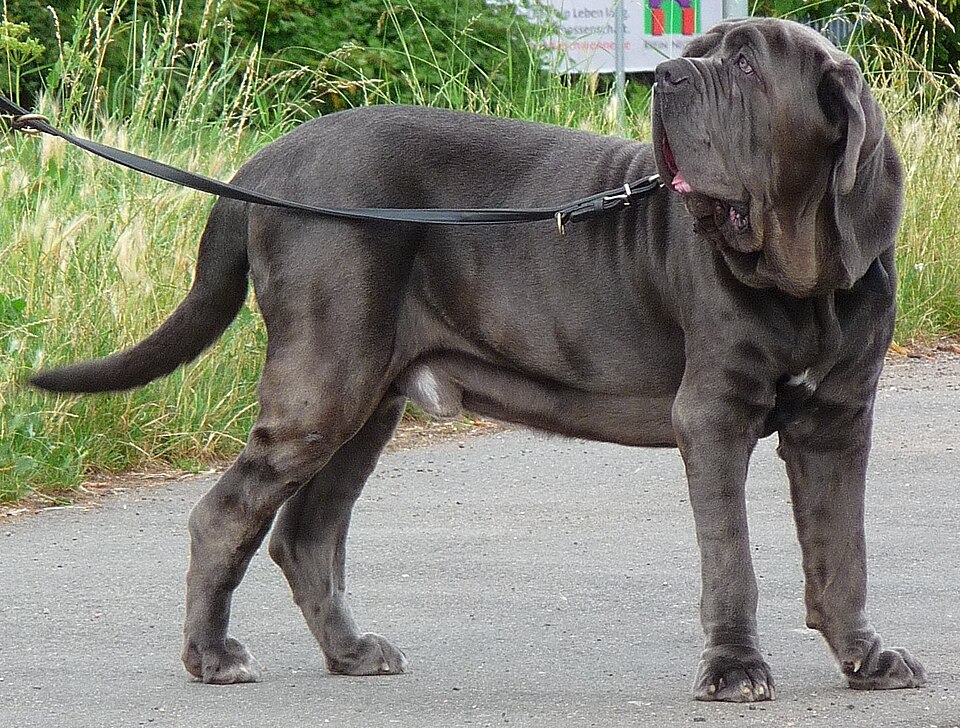
Italy's wrinkle-faced, massive guardian: gentle and calm with its family, reserved with strangers. Loose skin and eyelid structure make eye problems very common in the breed, and lifespan is around 7–9 years. It takes a big budget, a cool home and an experienced, patient owner.

 Lifespan≈ 7–9 yearsAKC 7–9; UK median 9.3 (few dogs)
 Weight110–154 lb (50–70 kg)FCI: males 60–70, females 50–60 kg
 Height at shoulder23.5–29.5 in (60–75 cm)FCI: males 25.5–29.5, females 23.5–26.5 in
 OriginItalyan ancient breed; rediscovered in the 1940s
 CoatShort, hard0.6 in (1.5 cm) at most; easy, but the folds are a job
 ExerciseMeasuredAKC: skip running and sharp turns; overheats
 With kidsAlways superviseAKC: may not suit families with small children
 TrainingEarly and gentleAKC: doesn't respond well to harsh training
The Neapolitan Mastiff is the kind of dog you won't forget once you've seen it: a huge body, a drooping face, deep folds and a heavy gaze. It's a guardian that can be gentle and calm with its family and reserved with strangers. But on this page we also spell out the breed's hardest side: the abundant skin and folds in the breed standard turn, in some dogs, into a structure that bothers the eyes and skin, and eyelid problems in this breed are among the highest rates known. Our sources are the FCI standard, the AKC and VetCompass studies in the UK.
- Temperament: According to the FCI, steady and loyal, not aggressive; a vigilant, intelligent, noble guardian of property and its inhabitants. The AKC says it's wary with strangers and sweet and placid with loved ones.
- Eyes: In the UK, 9.45% of Neapolitan Mastiffs had an eyelid conformation disorder in a single year; the breed is among those with the highest rates of both inward- and outward-rolling eyelids anywhere.
- Lifespan: The AKC says 7–9 years; in the UK a median of 9.3 years was found, but the breed is among those at high risk of early death.
- Owner: The AKC doesn't consider it right for first-time owners or families with small children; it takes a big budget, a cool living space and patient training.
- Folds: Facial and neck folds need regular cleaning and drying; even the standard says excess skin shouldn't harm health.
What to know
 What is the Neapolitan Mastiff like?
The FCI standard describes the Neapolitan Mastiff's behavior as steady and loyal, not aggressive: a guardian of property and the people who live there, always vigilant, intelligent, noble and majestic. Its use is protection and guarding. Aggressive or overly shy dogs are disqualified.
The AKC paints a similar picture: wary with strangers, and sweet, placid and steady among loved ones. It says most adults are calm animals that sleep a lot, but that Neapolitan puppies are as active, curious and cuddly as a toy-breed puppy. In adolescence, many owners find the dog energetic and powerful when awake. According to the AKC, most Neapolitans reach the desirable laid-back adult behavior by age 3 or 4.
The AKC also has a warning: because of its size and temperament, this breed may not be the right one for families with small children or first-time dog owners.
Every dog is an individual. Breed describes what a dog was bred for; it can't tell you how a particular dog will turn out. The parents' temperament, early experiences and training matter at least as much as breed.
 Who is it a good fit for?
The Neapolitan Mastiff suits calm, patient people who have experience with giant breeds, can cover high vet costs and can keep the dog cool in hot weather. It lives indoors with its family but has a strong protective instinct.
| Situation | Good fit? |
|---|---|
| Apartment | Hard; very big and heavy, and stairs or elevators can be a problem |
| House with a yard | Good; cool shade and a solid fence are a must |
| Family with kids | The AKC says it may not suit families with small children; always supervise |
| Other dogs | Careful introductions and early socialization are needed |
| Home with frequent guests | Take care; a dog that's wary of strangers needs a quiet space of its own |
| First-time dog owners | Not recommended (AKC) |
| People in hot climates | Hard; the AKC says it overheats easily |
Where does it come from?
According to the FCI, the Neapolitan Mastiff comes from Italy, and its use is protection and guarding. The AKC calls the breed ancient and writes that it was rediscovered in Italy in the 1940s. It was the AKC's 152nd breed. It's often mentioned alongside Italy's other big guardian breed, the Cane Corso; the Neapolitan Mastiff (110–154 lb / 50–70 kg) is bigger and heavier.
Its relatives from the same mastiff family, the Mastiff, the Bullmastiff and the Dogue de Bordeaux, are breeds of other countries, with different sizes and fold structures too.
Appearance and colors
According to the FCI, the head is short and massive, with a skull that's wide at the cheekbones. There's ample skin with wrinkles and folds on the head; the most typical and best marked runs from the outer corner of the eyelid down to the corner of the lip. The muzzle is very broad and short; the lower neck forms a "double dewlap" of loose skin, but not exaggerated. The body is 15% longer than the height at the withers.
The standard sets an important limit on the abundance of skin: it should never be "in abundance to the extent to interfere with the dog's health and well-being," and skin folds should never interfere with the eyes. In other words, the folds are breed type, but exaggeration that harms eye and skin health is outside the standard too.
- Height: 25.5–29.5 in (65–75 cm) for males and 23.5–26.5 in (60–68 cm) for females (FCI).
- Weight: 132–154 lb (60–70 kg) for males and 110–132 lb (50–60 kg) for females (FCI). In the UK, the median adult weight of 308 dogs was 132 lb (59.8 kg) (O'Neill et al., 2026).
- Coat: Short, hard and dense, the same length all over, 0.6 in (1.5 cm) at most; there should be no fringing.
- Color: Gray, lead gray and black are preferred; brown, fawn and deep fawn (red deer) also occur. All may be brindled. A small white patch on the chest and the tips of the toes is permitted.
- Ears and tail: Under the FCI standard, the ears are small, triangular, flat and close to the cheeks, and natural. The tail is thick at the base and reaches the hocks.
In Türkiye, article 8 of Animal Protection Law no. 5199 bans cutting a pet's tail or ears to change its appearance or for any other non-therapeutic reason; if there's a medical reason, the decision belongs to a veterinarian. The FCI standard also says the ears are natural. Rules vary by country.
Daily care
According to the AKC, the Neapolitan Mastiff is a short-coated breed, so in general a bath now and again is about all it needs. The eyes and ears should be checked and gently cleaned with a damp cloth when needed. The folds are a separate job: drool, moisture and dirt collect in the folds on the face, neck and dewlap, and if left wet the skin gets irritated and can become infected and smelly. Clean between the folds regularly with a soft cloth and dry them. See our dog grooming guide for general methods.
- Eyes: If you see watering, redness, discharge or the dog holding an eye shut, don't wait to show your vet.
- Ears: Check them regularly.
- Teeth: Brush often with a toothpaste made for dogs.
- Nails: Long nails throw off the gait of a heavy dog; trim them regularly.
- Hot weather: The AKC writes that this big, heavily built breed overheats easily and that you should take care in warm weather. Shade, air conditioning, plenty of water and exercise during cool hours are a must; our article on dogs in hot weather covers the warning signs.
Training and exercise
According to the AKC, it's important to teach basic obedience while the puppy is still a manageable 40–60 lb (18–27 kg). Neapolitan Mastiffs don't respond well to harsh training and need an encouraging, rewarding atmosphere. When the strong, stubborn teenage stage arrives, the order should already be in place. Watch stairs: the AKC notes that many an exuberant puppy has injured a knee leaping off a porch.
On exercise, the AKC has a warning: every dog should have the chance to run and romp, but don't emphasize running and quick turning, because joints are easily damaged. It's a big, heavily built breed that overheats.
- Early socialization: As a puppy, give it short, positive meetings with different people, children, sounds, vehicles and calm dogs, and keep this up for the first two years.
- Basic cues: Come, wait, drop it and walking without pulling are the foundation of safe life with a dog that can top 110 lb (50 kg). Our guide to loose-leash walking explains it step by step.
- Joint-friendly movement: Limit stairs and jumping from heights; go for short, frequent walks on flat ground.
- A routine for visitors: Use rewards to teach it to go to a calm spot when the doorbell rings; never leave guests alone with the dog.
- Vet prep: Use rewards early on to get it comfortable with being handled and having its mouth, eyes and folds checked.
Steer clear of puppies marketed as "tough," "man-stopping" or "protection-trained," and of anyone who suggests "toughening up" a dog by provoking it. What this breed needs is calm and trust.
 Diet and weight
The Neapolitan Mastiff doesn't need a special food; a complete, balanced, good-quality dog food suited to its life stage (puppy, adult, senior) is enough. The AKC writes that experienced breeders recommend food that's slightly higher in fat and lower in protein, especially when the dog is young, because the dogs grow so fast. Make a growth plan with your vet covering the type of food and the amount.
- Controlled growth in puppyhood: Large-breed puppies grow very fast; extra weight and unnecessary supplements strain the joints.
- Lower the risk of bloat: Splitting the daily food into several small meals and keeping things calm right before and after eating is commonly advised for large, deep-chested dogs; talk through the details with your vet.
- Ideal weight: If you can feel the ribs under a thin layer of fat and see a waist from above, the weight is about right.
Also check our list of foods that are dangerous for dogs.
 Health issues to know about
According to the AKC, the breed is prone to hip and elbow dysplasia, eye disease and heart disease, and it isn't immune to the problems common in giant dogs. The information below is for awareness only; ask your vet about diagnosis and treatment.
Eyelid problems
An eyelid that rolls inward (entropion) lets lashes rub and irritate the eye, while one that sags outward (ectropion) leaves the eye dry and exposed to irritants (Merck). In a large VetCompass study using UK data from 2019 (O'Neill et al., 2025), the annual rate of eyelid conformation disorders was 0.36% in dogs overall but 9.45% in the Neapolitan Mastiff; 6.88% for inward-rolling and 4.30% for outward-rolling eyelids alone. The Neapolitan Mastiff was among the highest breeds for both, and for outward-rolling eyelids it had the highest odds ratio of any breed. The study also refers to an earlier study of 152 Neapolitan Mastiffs that found inward rolling in 24.3% and outward rolling in 23.4%. The message is clear: in this breed, eyelid trouble isn't the exception, it's common.
Prolapsed third eyelid gland ("cherry eye")
The AKC writes that this is a minor problem that often occurs in the breed: the tissue in the corner of the eye looks red and swollen. A review in the UK (McGreevy et al., 2026) cites about 34 times the odds of this prolapse for the Neapolitan Mastiff compared with crossbred dogs. If you see a red bulge in the corner of your dog's eye, show your vet.
Hips and elbows, heart
In big, heavy breeds, joints that don't develop properly can lead to painful arthritis. Limping, trouble getting up, and avoiding stairs can be signs. When choosing a puppy, ask for the parents' hip and elbow X-rays and heart and eye exam results.
Bloat and heatstroke
The AKC writes that bloat is a sudden, life-threatening condition that can affect all deep-chested dogs. The Merck Veterinary Manual describes it as an emergency needing immediate care, with a mortality rate around 20% even in treated animals. Retching without bringing anything up, heavy drooling, restlessness and a swollen belly are the main signs. Heatstroke is also a serious risk in this big breed.
- Severe watering or redness in the eye, an eye held shut, or a red swelling in the corner of the eye
- Retching without bringing anything up, a swollen belly, heavy drooling, restlessness
- Pale gums, weakness or collapse
- Fast, labored breathing or stumbling in the heat
- Limping or obvious trouble getting up
How long does it live?
The AKC gives 7–9 years for the Neapolitan Mastiff. A 2024 study using data on about 585,000 dogs in the UK (McMillan et al.) found a median lifespan of 9.3 years and listed the breed among those at highest risk of early death (hazard ratio 1.8). In the giant-breed study using UK data from 2019 (O'Neill et al., 2026), only 7 Neapolitan Mastiffs had died (median 6.77 years), which is too few to draw a conclusion. In the same study, the median age at death across 29 giant breeds was 8.94 years.
The honest summary: the numbers vary by study, but the breed lives shorter than the average mixed-breed dog (a median of 12 years in the same study). A puppy from screened parents, a healthy weight, regular checkups, eye exams and knowing the signs of bloat are the most concrete steps.
 Before you get one
- Consider a shelter: Purebred and large dogs end up in shelters and rescues too. With this breed, seeing an adult dog's temperament and health up front is a big advantage. Our guide to adopting a dog from a shelter walks you through it.
- If you buy from a breeder: Meet the parents in person and make sure they're calm and steady. Look at whether the eyes are healthy and whether the folds touch the eyes; ask for hip and elbow X-ray results and heart and eye exams. Choose dogs with fewer folds and open, comfortable eyes.
- Red flags: Sellers who say "the more folds the more valuable"; dogs sold as "tough" or "guard" dogs; sellers who won't show you the mother or can't provide paperwork.
- Time and budget: Be ready for possibly high vet costs, including eye surgery, and the food and transport costs of a giant dog.
- Registration: Rules vary by country. In Türkiye, owned dogs must be microchipped and registered in the PETVET system. Details are in our article on PETVET registration and microchips.
Frequently asked questions
Is the Neapolitan Mastiff banned in Türkiye?
No. Law no. 5199 bans breeding and owning animals the Ministry has designated as "posing a danger" (article 14/l), and the Neapolitan Mastiff isn't on the list in the Ministry's 2021 circular. Rules can change, so check the current situation with your provincial or district agriculture directorate. Rules vary by country.
Are that many folds unhealthy?
The folds are breed type, but even the FCI standard says the skin shouldn't be so abundant that it harms the dog's health and that folds should never interfere with the eyes. Folds hold moisture and dirt, so they need care; eyelid problems are also very common in this breed.
Is it good with kids?
The AKC says it may not be the right breed for families with small children. The dog is very big and strong; children and dogs should never be left unsupervised together. Our article on kids and dogs at home covers the ground rules.
Is it related to the Cane Corso?
Both are Italian mastiff-type guardian dogs; the Neapolitan Mastiff is bigger and heavier, and its folds and eyelid structure are far more pronounced. See the Cane Corso page.
Should its ears be cropped?
No. The FCI standard says the ears are natural, and in Türkiye cutting the ears or tail for looks is against the law.
Sources
- FCI · Neapolitan Mastiff breed standard (No. 197)
- AKC (American Kennel Club) · Neapolitan Mastiff breed profile
- McMillan et al. · Longevity of companion dog breeds: those at risk from early death, Scientific Reports (2024)
- O'Neill et al. · Conformational eyelid disorders in dogs under primary veterinary care in the UK: epidemiology and clinical management, PLOS ONE (2025)
- O'Neill et al. · Giant dog breeds under primary veterinary care in the UK: demography, common disorders and mortality, Companion Animal Health and Genetics (2026)
- McGreevy et al. · Teleonomes in Tatters: The Welfare Costs of Selecting Dogs for Extreme Phenotypes, and the Case for Change, Animals (2026)
- Merck Veterinary Manual · Gastric dilation and volvulus in small animals
- Merck Veterinary Manual · Eyelids in animals
- Türkiye legislation database · Animal Protection Law no. 5199, current text (in Turkish)
- Türkiye Ministry of Agriculture and Forestry · Circular on animals posing a danger (2021/48, in Turkish)
- Resmî Gazete (Türkiye) · Regulation on the identification and registration of cats, dogs and ferrets (February 26, 2018)
By Tüylüm · Last checked: November 10, 2026. Compiled from the sources above and written in our own words. Spotted a mistake? Write to [email protected] and we'll fix it right away. Photo from Wikimedia Commons, used under the license shown below it.