 Tüylüm
Mastiff (English Mastiff)
One of the heaviest dog breeds in the world: far over 150 lb (70 kg), calm, noble and affectionate with its family. Usually indifferent to strangers, and it wants gentle training. Lifespan is short (median 8–9 years); cancer, bloat and eyelid problems stand out. It takes the budget, space and effort of a giant dog.

 Lifespan≈ 8–9 yearsUK median 9.0; AKC 6–10
 Weight160–230 lb (73–104 kg)AKC range
 Height at shoulderMales ≥ 30 in (76 cm)AKC: males at least 30 in
 OriginEnglandan ancient breed; took shape in medieval England
 CoatShort, densequick brushing every few days; more when shedding
 ExerciseLowAKC: a mile or two a day; don't overtax puppies
 With kidsAlways supervisedocile but huge; can knock a child over by accident
 TrainingGentle methodsAKC: repetition bores it; love works
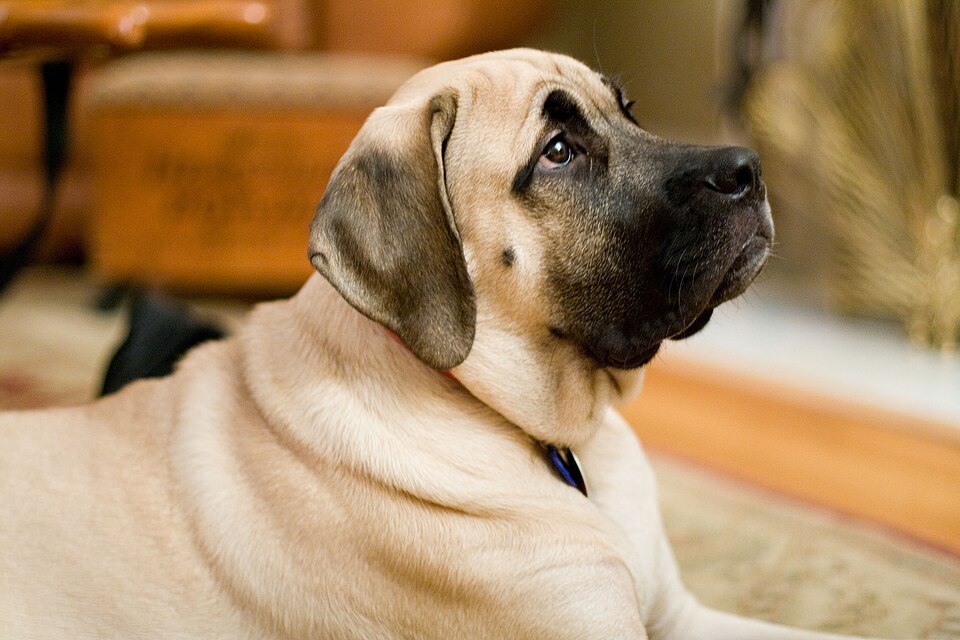
The Mastiff, or English Mastiff, is one of the largest and heaviest dog breeds in the world. According to the AKC, males stand at least 30 in (about 76 cm) at the shoulder and weigh 160–230 lb (about 73–104 kg); in other words, more than many people. With its broad black-masked face, calm gaze and slow, heavy stride, it's known as a "gentle giant." On this page we write about that gentleness and also about the breed's lifespan and health realities. Our sources are the FCI standard, the AKC and lifespan and health studies in the UK.
- Temperament: According to the FCI, a combination of grandeur and courage: calm, affectionate to owners, capable of guarding, usually indifferent with strangers; timidity isn't acceptable.
- Size: Giant: according to the AKC, males are at least 30 in (76 cm) and 160–230 lb (73–104 kg).
- Lifespan: A UK study found a median of 9.0 years and listed the breed among those at highest risk of early death; an owner survey found 8 years, and the AKC says 6–10.
- Health: Cancer (especially bone cancer and lymphoma), bloat, joint disease and eyelid problems stand out in the AKC and in studies.
- Training: Gentle and reward-based; according to the AKC, with love and respect it can do well in almost any area, but repetition bores it.
What to know
 What is the Mastiff (English Mastiff) like?
The FCI standard describes the Mastiff's behavior as "a combination of grandeur and courage": calm, affectionate to its owners, but capable of guarding; usually indifferent with strangers. Timidity isn't acceptable. Aggressive or overly shy dogs are disqualified. Its use is as a watch and security dog.
The AKC describes the breed as docile and dignified, but also a formidable protector of those it holds dear. It writes that Mastiffs are eternally loyal and protective of family, and that a natural wariness of strangers makes early training and socialization essential. It adds that Mastiffs communicate a great deal with their eyes and are excellent at reading their owner's expressions and body language.
Every dog is an individual. Breed describes what a dog was bred for; it can't tell you how a particular dog will turn out. The parents' temperament, early experiences and training matter at least as much as breed.
 Who is it a good fit for?
The Mastiff suits calm, patient people who have experience with giant breeds and the space and strength to carry, wash and house a dog this size. The AKC writes that its exercise needs are comparatively low and that it can live happily in an apartment; but at this size, stairs, elevators, vet visits and car transport are a serious logistical job.
| Situation | Good fit? |
|---|---|
| Apartment | The AKC says it's possible given its low exercise needs; but stairs, elevators and summer heat are hard at this size |
| House with a yard | Good; cool shade and a solid fence are a must |
| Family with kids | Docile but huge; it can knock a child over by accident while moving; always supervise |
| Other dogs | Careful introductions and early socialization are needed |
| Home with frequent guests | Take care; indifferent with strangers but with a protective streak, it needs a quiet space of its own |
| First-time dog owners | Not recommended; size, budget and health burden are heavy |
| People in hot climates | Hard; the AKC says they're known to plop down on walks when tired or overheated |
Where does it come from?
According to the FCI, the Mastiff comes from Great Britain, and its use is as a watch and security dog. The AKC writes that mastiff-type dogs have been known around the world for thousands of years, with examples on Egyptian monuments dating to about 3000 BC. For the British type, the AKC describes Julius Caesar noting in his journal the mastiffs that helped defend Britain when he invaded in 55 BC; the Mastiff as we know it took shape in medieval England, working as a big-game hunter, nighttime guardian of estates and war dog. According to the AKC, the breed once dwindled to very few dogs in England (an estimated 14 survived) and was rebuilt with dogs exported back from other countries. The AKC says today's Mastiff is more docile and friendly than its ancient forebears, but no less courageous.
Its close relatives the Bullmastiff, the Dogue de Bordeaux and the Neapolitan Mastiff come from the same mastiff family and from other countries. If you're considering a mastiff-type dog, compare them all.
Appearance and colors
According to the FCI, the Mastiff is a large, heavy-boned dog with a broad, deep body, full of substance; its head gives a square appearance, and the breadth is in a 2:3 ratio to the length of the head and face. The muscles are sharply defined. The standard says size is desirable only when it's combined with quality and soundness: being big isn't a goal by itself. The eyes are moderate in size, wide apart, hazel brown; loose eyelids are "highly undesirable," and the dog should be free from obvious eye problems.
- Height: According to the AKC, males are at least 30 in (about 76 cm). The current text of the FCI standard gives no numeric height.
- Weight: The AKC gives 160–230 lb (about 73–104 kg).
- Coat: Short and close-lying, coarser over the neck and shoulders.
- Color: Apricot, fawn or brindle; in every case, the muzzle, ears and nose are black, with black around the eye rims. Excessive white on the body, chest or feet is highly undesirable.
- Ears and tail: The ears are small, thin, wide apart and lie flat against the cheeks; the tail is set high, reaches the hocks or a little below, and hangs straight in repose.
In Türkiye, article 8 of Animal Protection Law no. 5199 bans cutting a pet's tail or ears to change its appearance or for any other non-therapeutic reason; if there's a medical reason, the decision belongs to a veterinarian. The FCI standard describes ears and tail in their natural form. Rules vary by country.
Daily care
The AKC says the Mastiff's short, dense coat is easy to groom, usually needing only a quick brushing every few days. During heavy shedding once or twice a year, more frequent sessions with a strong, toothed comb remove dead hair. The deep wrinkles around the head, eyes and muzzle and the ears should be checked and cleaned regularly, and the nails kept short. On drool, the AKC offers a tip: owners keep cloths at hand to wipe the slobber off the dog's face. See our dog grooming guide for general methods.
- Elbows: The AKC writes that hygromas (harmless natural "cushions" over the elbows) are common when the dog lies on hard surfaces. Put a soft bed over hard floors.
- Teeth: Brush often with a toothpaste made for dogs.
- Hot weather: A big, heavy dog struggles easily in the heat. Shade, air conditioning, plenty of water and walks in the cool hours are a must; our article on dogs in hot weather covers the warning signs.
Training and exercise
The AKC calls obedience training and early socialization "musts" for Mastiffs. But it says the repetitions in a typical training class quickly bore them, at which point they may lie down, snoring. It writes that when treated with love, inclusion and respect, Mastiffs can be trained to excel in almost any sphere, and they respond best to gentle training. Eye contact matters in training too: Mastiffs communicate a lot with their eyes.
On exercise, the AKC says they benefit from free play and a daily walk of a mile or two (1.6–3.2 km). Take care not to overtax growing puppies and young adults: don't let them run up and down stairs, jump from heights or take long walks. The AKC suggests starting with no more than half a block for a 2- to 3-month-old puppy. Mastiffs are notorious for plopping down on walks when they're tired or overheated; since you can't carry a 175 lb (80 kg) dog, plan your route accordingly.
- Early socialization: As a puppy, give it short, positive meetings with different people, children, sounds, vehicles and calm dogs, and keep this up for the first two years.
- Basic cues: Come, wait, drop it and walking without pulling are the foundation of safe life with a dog that can top 150 lb (70 kg). Our guide to loose-leash walking explains it step by step.
- Joint-friendly movement: Limit stairs and jumping from heights while it's a puppy; go for short, frequent walks on flat ground.
- A routine for visitors: Use rewards to teach it to go to a calm spot when the doorbell rings; never leave guests alone with the dog.
- Vet prep: Use rewards early on to get it comfortable with being handled and having its mouth, ears and folds checked; at this size, a dog is hard to hold at the vet.
Steer clear of puppies marketed as "tough," "man-stopping" or "protection-trained," and of anyone who suggests "toughening up" a dog by provoking it. The Mastiff is heavy and powerful; what it needs is calm, trust and gentle training.
 Diet and weight
The AKC writes that for rapidly growing giant breeds such as the Mastiff, proper nutrition is critical through puppyhood and up to 2 years of age. If fed a densely caloric diet lacking an appropriate calcium-to-phosphorus ratio, Mastiff puppies and young adults are prone to skeletal disorders. Most breed experts recommend starting puppies on an adult dog food formulation; make a growth plan with your vet and breeder covering the type of food, the protein level and the amount. The AKC also recommends scheduled meals rather than free-feeding, which is how you avoid excess weight.
- Controlled growth in puppyhood: Fast growth strains the joints; raising the puppy lean and steady matters.
- Lower the risk of bloat: Splitting the daily food into several small meals and keeping things calm right before and after eating is commonly advised for large, deep-chested dogs; talk through the details with your vet.
- Ideal weight: If you can feel the ribs under a thin layer of fat and see a waist from above, the weight is about right.
Also check our list of foods that are dangerous for dogs.
 Health issues to know about
According to the AKC, responsible breeders screen the Mastiff for seasonal allergies, eye anomalies, heart disease, cancer, hip and elbow dysplasia, von Willebrand's disease (a blood clotting disorder), degenerative myelopathy (a progressive spinal cord disease) and epilepsy. The AKC also lists bone cancer, lymphoma, canine multifocal retinopathy (retinal folds), cystinuria, which can cause kidney stones, and progressive retinal atrophy. The information below is for awareness only; ask your vet about diagnosis and treatment.
Cancer
In the owner-survey study of mastiff-type dogs (Bell and Hesketh, 2021), the most common cause of death was cancer (47%); the most commonly recorded type was bone cancer. If you notice a new lump, limping, loss of appetite or weight loss, show your vet.
Bloat
The stomach can fill with gas and fluid and twist on itself (gastric dilatation-volvulus, or GDV). The AKC writes that Mastiffs can experience it too. The Merck Veterinary Manual describes it as an acute, life-threatening emergency that affects large and giant breeds, needing immediate care, with a mortality rate around 20% even in treated animals. Retching without bringing anything up, heavy drooling, restlessness and a swollen belly are the main signs.
Eyelids and eyes
A UK study of eyelid conformation disorders (O'Neill et al., 2025) reported that, even though breed standards were updated more than three decades ago to improve eyelid conformation, the reported incidence of inward- and outward-rolling eyelids in the Mastiff has still increased in the last decade. The FCI standard calls loose eyelids "highly undesirable." If you notice watering, redness or squinting, show your vet.
Joints and heart
In hip and elbow dysplasia, the joints don't develop properly and painful arthritis can follow. Limping and trouble getting up can be signs. When choosing a puppy, ask for the parents' hip and elbow X-rays and heart and eye exam results.
- Retching without bringing anything up, a swollen belly, heavy drooling, restlessness
- Pale gums, weakness or collapse
- Fast, labored breathing or stumbling in the heat
- A rapidly growing lump or limping on one leg that persists
- Severe watering, squinting or redness in the eye
- A seizure
How long does it live?
A 2024 study using data on about 585,000 dogs in the UK (McMillan et al.) found a median lifespan of 9.0 years for the Mastiff and listed the breed among those at highest risk of early death (hazard ratio 2.3). In the giant-breed study using UK data from 2019 (O'Neill et al., 2026), the median age of 56 Mastiffs that died was 9.64 years. In the owner-survey study of mastiff-type dogs (Bell and Hesketh, 2021), the median age at death was 8 years. The AKC gives 6–10 years.
Mixed-breed dogs in the same study had a median of 12 years, so the Mastiff lives several years less than the average mixed-breed dog. A puppy from screened parents, a healthy weight, regular checkups and knowing the signs of bloat are the most concrete steps.
 Before you get one
- Consider a shelter: Purebred and large dogs end up in shelters and rescues too. With a dog this size, seeing an adult's temperament and health up front is a big advantage. Our guide to adopting a dog from a shelter walks you through it.
- If you buy from a breeder: Meet the parents in person and make sure they're calm and steady. Ask for hip and elbow X-ray results and heart and eye exams, and ask about cancer in the family. See that the puppies are raised in a home around people.
- Red flags: Promises of an extra-large puppy ("record size"); dogs sold as "guard" or "tough" dogs; sellers who won't show you the mother or can't provide paperwork.
- Time and budget: Food, vet care, medication and transport costs are serious; make sure the dog will fit in your car and that your vet will take a dog this size.
- Registration: Rules vary by country. In Türkiye, owned dogs must be microchipped and registered in the PETVET system. Details are in our article on PETVET registration and microchips.
Frequently asked questions
Is the Mastiff banned in Türkiye?
No. Law no. 5199 bans breeding and owning animals the Ministry has designated as "posing a danger" (article 14/l), and the Mastiff isn't on the list in the Ministry's 2021 circular. Rules can change, so check the current situation with your provincial or district agriculture directorate. Rules vary by country.
Are the Mastiff and the Bullmastiff the same?
No. The AKC writes that the Bullmastiff is a little smaller than its close cousin the Mastiff; they're separate breeds. See the Bullmastiff page.
Can it live in an apartment?
The AKC says it can live happily in an apartment given its low exercise needs. But at this size, stairs, elevators and summer heat are serious problems; either way, it needs shade, a cool room and a large living space.
Is it good with kids?
The AKC describes it as a docile, good-natured family dog; but it's huge. Children and dogs should never be left unsupervised together; our article on kids and dogs at home covers the ground rules.
Does it drool a lot?
The AKC writes that Mastiff owners keep cloths at hand to wipe slobber off the dog's face. So yes, drool comes with the breed.
Sources
- FCI · Mastiff breed standard (No. 264)
- AKC (American Kennel Club) · Mastiff breed profile
- McMillan et al. · Longevity of companion dog breeds: those at risk from early death, Scientific Reports (2024)
- Bell and Hesketh · Mastiff breed mortality: a study of owner experience, dog age and longevity, Veterinary and Animal Science (2021)
- O'Neill et al. · Giant dog breeds under primary veterinary care in the UK: demography, common disorders and mortality, Companion Animal Health and Genetics (2026)
- O'Neill et al. · Conformational eyelid disorders in dogs under primary veterinary care in the UK: epidemiology and clinical management, PLOS ONE (2025)
- Merck Veterinary Manual · Gastric dilation and volvulus in small animals
- Türkiye legislation database · Animal Protection Law no. 5199, current text (in Turkish)
- Türkiye Ministry of Agriculture and Forestry · Circular on animals posing a danger (2021/48, in Turkish)
- Resmî Gazete (Türkiye) · Regulation on the identification and registration of cats, dogs and ferrets (February 26, 2018)
By Tüylüm · Last checked: November 10, 2026. Compiled from the sources above and written in our own words. Spotted a mistake? Write to [email protected] and we'll fix it right away. Photo from Wikimedia Commons, used under the license shown below it.