 Tüylüm
English Springer Spaniel
The longest-legged of the land spaniels, a tough, cheerful gundog and the spaniel most often worked in the field in Britain. It needs more than two hours of activity and mental work a day and gets bored without it. Ear care and the breeder's DNA testing matter for its health.

 Lifespan≈ 12–13.5 yearsUK data; varies by study
 Weight40–50 lb (18–23 kg)AKC: males ~50 lb, females ~40 lb
 Height≈ 19–20 in (48–51 cm)RKC ≈ 20 in; AKC females ≈ 19 in
 OriginEnglandthe spaniel that "springs" game
 CoatMedium, featheredbrush several times a week
 Exercise2+ hours a dayRoyal Kennel Club guidance
 With kidsGood matchenergetic; supervise, set rules
 TrainingWillingneeds a job and mental work
The English Springer Spaniel is a versatile gundog that dives into cover to flush a bird, then brings back the shot game. According to the Royal Kennel Club, it's the spaniel most often worked in the field, and it's also a cheerful, easygoing family dog. On this page we've pulled together its temperament, care needs and health issues from breed registry standards, breed club health resources and scientific studies.
- Temperament: Friendly, happy and biddable; per the standard, timidity or aggression is out of character for the breed.
- Activity: The Royal Kennel Club recommends more than two hours of exercise a day; this breed wants to use both its body and its nose.
- Grooming: The medium-length, feathered coat needs brushing several times a week, and the long ears need regular checks.
- Health: Ask the breeder for hip, elbow and eye screening and for fucosidosis, PFK deficiency and PRA DNA tests.
- Lifespan: About 12 to 13.5 years in UK studies.
What to know
 What is the English Springer Spaniel like?
The Royal Kennel Club's standard describes the Springer as friendly, happy and biddable; timidity or aggression is unacceptable under the standard. The AKC also highlights the breed's great energy, stamina and brains, noting that hunters find in it both an easygoing family dog at home and a reliable hunting partner in the field.
Springers are attached to their people and want to be part of everything the family does. But their defining trait is the desire to work: putting the nose down to follow a trail, diving into cover, finding something and bringing it back come naturally. If that energy and curiosity aren't channeled into a job, a bored Springer will find its own at home, such as chewing, digging, constant pacing or barking.
The breed clubs' health resources note that Springers in Britain come from "field trial," "working," "show" and "pet" lines. When getting a puppy, ask which line the parents come from and what kind of life they lead; it helps you choose a dog that fits your lifestyle.
Every dog is an individual. Breed traits describe general tendencies; the parents' temperament, how a puppy was socialized and the training it gets shape its personality as much as its breed.
 Who is it a good fit for?
The Springer is a good companion for families who love being outdoors, will spend a long time with their dog every day and can give it a regular "job." It can be a challenge for people looking for a calm dog that's content to stay home.
| Situation | Good fit? |
|---|---|
| Apartment | Hard; possible only with long daily exercise and activities |
| Family with kids | Usually a good match; it's energetic, so supervise young children and set rules |
| Other dogs | Most get along; early socialization matters |
| Cats and small pets | It has a hunting instinct; introduce carefully and supervise |
| Long hours alone | Struggles; a Springer left alone and inactive gets bored |
| First-time dog owners | Can work for an active person with time for training; don't underestimate its energy |
Children should be taught not to touch a dog's food, bed or sleep, and the dog needs a corner where it can retreat and rest. Our article on kids and dogs at home goes into detail.
Where does it come from?
The Springer comes from the same ancestors as the other land spaniels. According to the Royal Kennel Club, it takes its name from the way it "springs" forward to flush game into nets; after the invention of guns, it was used to flush game from the undergrowth. The standard describes the breed's original purpose as finding and springing game for the net, falcon or greyhound, and its current role as finding, flushing and retrieving game for the gun.
Once spaniels began to be classified by size and color, selective breeding settled the Springer type. At one point it was also called the "Norfolk Spaniel," since the Duke of Norfolk was reputed to have developed it. Today, according to the Royal Kennel Club, it's the spaniel most often worked in the field.
Appearance and colors
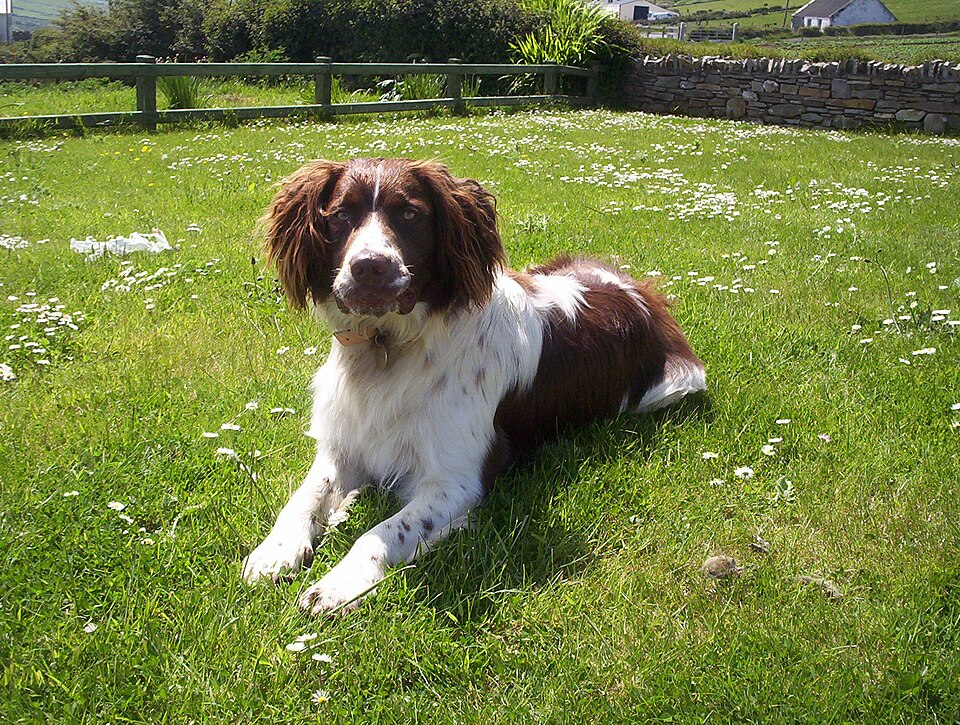
The Springer is a symmetrical, compact, strong and active dog; per the standard, it's the highest on the leg and raciest in build of the British land spaniels. Its ears are long and wide, set level with the eyes and nicely feathered.
- Height: Per the Royal Kennel Club standard, about 20 in (51 cm). The AKC gives about 20 in for males and about 19 in (48 cm) for females.
- Weight: According to the AKC, males weigh about 50 lb (23 kg) and females about 40 lb (18 kg).
- Coat: Close, straight and weather-resistant, never coarse. Moderate feathering on the ears, forelegs, body and hindquarters.
- Colors: Liver and white, black and white, or either of these with tan markings (tricolor). According to the Royal Kennel Club, liver and white is the most popular.
Daily care
The Royal Kennel Club recommends grooming more than once a week. The coat is medium length, but the feathering on the ears, legs and chest tangles easily in brush and mud.
- Brushing: Several times a week; after walks in the countryside, pick burrs and seeds out of the feathering.
- Ears: Check at least once a week. In a Finnish study based on veterinary records, 19.6% of English Springers had outer ear inflammation. Dry the ears after swimming and baths, and show your vet any odor, discharge, redness or head shaking.
- Paws: Keep the hair between the toes short and check for grass seeds and thorns.
- Nails and teeth: Check nails regularly and get your puppy used to toothbrushing early.
For more, see our dog grooming guide.
Training and exercise
Springers are smart and willing to learn; with consistent, reward-based training they learn a lot. But their daily need for exercise and mental work is high: the Royal Kennel Club recommends more than two hours of exercise a day. Short on-leash walks alone aren't enough for this breed.
- Sniffing and searching: Hiding treats or toys for it to find and scent-trail games are this breed's favorite jobs. Our sniffing games article has ideas.
- Fetch: Retrieving a ball, dummy or toy tires both body and mind.
- Recall: Once it's caught up in a scent, it can range far quickly; work on coming when called before letting it off leash. Our recall training article walks you through it.
- Leash manners: It's a strong, eager dog; teach loose-leash walking while it's small. Our loose-leash training article can help.
- Dog sports: Agility, tracking and obedience work channel its energy into something positive.
- Water: For a Springer that likes water, swimming is great exercise; dry the ears afterward.
In hot weather, move intense exercise to the cooler hours and take frequent breaks. Our article on dogs in hot weather covers the signs of heatstroke.
 Diet and weight
Springers don't need a special food; a complete, balanced dog food that suits their age and activity level is enough. A hard-working Springer and one that's less active at home can have very different needs, so adjust the amount to your dog's actual activity.
- Measure food instead of eyeballing it, and count training treats as part of the daily amount.
- If you can feel the ribs under a thin layer of fat and see a waist when you look from above, the weight is about right.
- Weigh your dog once a month, and revisit the amount with your vet after spaying or neutering or if activity drops.
- Ask your vet for advice on avoiding large meals right before or right after long, intense exercise.
Some human foods are toxic to dogs; take a look at our list of foods you should never give a dog.
 Health issues to know about
The information below is for awareness only; ask your vet about diagnosis and treatment.
Hip, elbow and eye screening
The Royal Kennel Club recommends hip and elbow X-ray screening, an eye exam and an assessment of the drainage angle inside the eye (gonioscopy) before breeding. Glaucoma is also on the breed clubs' health list. Show your vet if you notice limping, eye redness or squinting.
Fucosidosis
According to the UK Springer breed clubs' health resource, fucosidosis is a severe, progressive and fatal inherited disease of the nervous system. Because an enzyme that breaks down certain compounds is missing, these substances build up in cells, above all in the brain and nerves. Signs usually begin between 18 months and 4 years of age: loss of balance and coordination, changes in temperament, forgetting learned behavior, hearing and vision loss, weight loss and trouble swallowing. According to the resource, the disease is now very uncommon in the UK Springer population and can be completely prevented with a DNA test: if at least one parent is "clear," no affected puppies can be born. The Royal Kennel Club has had an official screening scheme for it since 2005.
Phosphofructokinase (PFK) deficiency
According to the same resource, PFK deficiency is an inherited enzyme disorder that disrupts energy production in red blood cells and muscle cells. The hallmark sign is urine that ranges from orange to dark coffee-brown after strenuous exercise, prolonged barking or heavy panting; in severe cases there can be pale gums, jaundice, fever and poor appetite. Working dogs may show weakness, exercise intolerance and muscle cramps. The condition is recessive and uncommon in the UK, and a DNA test identifies carriers. In affected dogs, avoiding strenuous exercise and stress, with veterinary follow-up, can allow a near-normal life.
Others
The Royal Kennel Club also recommends DNA tests for the inherited retinal disease PRA (the cord1 type), acral mutilation syndrome (AMS) and dyserythropoietic anemia and myopathy syndrome (DAMS). UFAW's list also includes idiopathic epilepsy, meaning seizures with no identifiable cause: affected dogs behave normally between seizures, and seizures often happen while the dog is resting, frequently at night. If you see a seizure, note how long it lasts and contact your vet.
- Dark, brown or reddish urine after exercise
- Pale or yellowish gums, or weakness
- A seizure (convulsions, loss of consciousness), especially one lasting more than a few minutes or seizures coming in clusters
- Loss of balance, a change in temperament or forgetting learned behavior in a young dog
How long does it live?
A 2024 study using data on about 585,000 dogs from 18 UK sources found a median lifespan of 13.5 years for the English Springer; crossbreeds in the same study had a median of 12.0 years. A 2022 study based on veterinary clinic records (VetCompass) found a life expectancy at birth of 11.92 years for the Springer Spaniel, the fourth-highest value among the 18 breeds in that study. The AKC gives 12 to 14 years.
The two studies give different numbers because they cover different dogs and use different methods, but both show the Springer is one of the relatively long-lived breeds. Enough exercise, a healthy weight, ear care and regular vet checkups help it enjoy those years.
 Before you get one
- Consider a shelter: Purebred dogs end up in shelters and rescues too. Our guide to adopting a shelter dog covers the first steps.
- If you buy from a breeder: Ask to meet the parents, and ask whether they come from working, show or pet lines. Ask for hip and elbow X-ray results, an eye exam and fucosidosis, PFK and PRA DNA tests.
- Red flags: Steer clear of sellers who won't show you the mother, always have puppies available, can't provide paperwork or rush you.
- Time: Think honestly about whether you really have time for more than two hours of activity and regular training every day.
- Registration: Rules vary by country; many places require or recommend microchipping. In Türkiye, owned dogs must be microchipped and registered in the PETVET system.
- The first days: Our guide to the first week with a new puppy covers the first night and first week.
Frequently asked questions
What's the difference between a Springer and a Cocker Spaniel?
Both come from the British land spaniels. The Springer is bigger and longer-legged (about 20 in, or 51 cm), while the English Cocker is smaller (15.5–16 in, or 39–41 cm). The Springer's exercise needs are usually higher too. See our English Cocker Spaniel page for details.
Can a Springer live in an apartment?
It's hard but not impossible. What matters isn't the size of your home but how much exercise and activity the dog gets each day. If you can't provide more than two hours of walks, runs and sniffing games, consider another breed.
Do Springers shed a lot?
Moderately. Brushing several times a week cuts down shedding and keeps the feathering from tangling.
Why are the fucosidosis and PFK tests so important?
Both are inherited, recessive diseases; if at least one parent is clear, the puppies won't be affected. That's why a simple DNA test can prevent them entirely.
Is the Springer a good family dog?
With its friendly, easygoing nature it can be a great family dog, but only if it gets enough exercise and activity for its energy. Otherwise, a bored Springer can be a handful at home.
Sources
- The Royal Kennel Club (UK) · Spaniel (English Springer): breed profile and health screening
- The Royal Kennel Club · Spaniel (English Springer) breed standard
- AKC (American Kennel Club) · English Springer Spaniel breed profile
- UK English Springer Spaniel breed clubs · English Springer Spaniel Health: Fucosidosis
- UK English Springer Spaniel breed clubs · English Springer Spaniel Health: PFK Deficiency
- Science for Animal Welfare (UFAW) · English Springer Spaniel: Idiopathic epilepsy
- Kaimio et al. · Survey of otitis externa in American Cocker Spaniels in Finland, Acta Veterinaria Scandinavica (2017)
- McMillan et al. · Longevity of companion dog breeds: those at risk from early death, Scientific Reports (2024)
- Teng et al. · Life tables of annual life expectancy and mortality for companion dogs in the United Kingdom, Scientific Reports (2022)
- Resmî Gazete (Türkiye) · Regulation on the identification and registration of cats, dogs and ferrets (February 26, 2018)
By Tüylüm · Last checked: November 3, 2026. Compiled from the sources above and written in our own words. Spotted a mistake? Write to [email protected] and we'll fix it right away. Photo from Wikimedia Commons, used under the license shown below it.