 Tüylüm
Leonberger
A very large, long-coated, gentle giant developed in Germany as a lion-looking family and farm dog. Friendly with children and eager to learn; but it sheds heavily, its genetic diversity is low, cancer and nervous system diseases are common, and lifespan is around 7–9 years.

 Lifespan≈ 7–9 yearsAKC 7; UK dogs that died: median 9.3
 Weight110–170 lb (50–77 kg)AKC range
 Height at shoulder25.5–31.5 in (65–80 cm)FCI: males 28.5–31.5, females 25.5–29.5 in
 OriginGermanydeveloped in Leonberg in the 1840s
 SheddingHeavyAKC: sheds a lot, more twice a year
 ExerciseModerateAKC: vigorous activity once a day; cart pulling, agility
 With kidsFriendlyFCI: marked friendliness to children; huge, so supervise
 TrainingWillingFCI: good capacity for learning and remembering
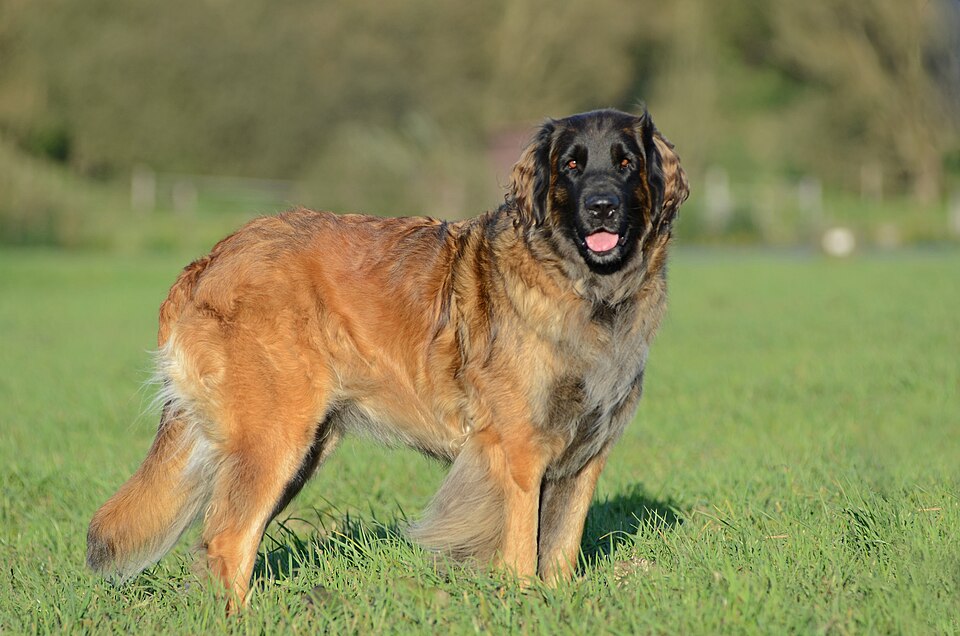
The Leonberger takes its name from the town of Leonberg in Germany and was deliberately developed to look like a lion: its long, thick red and sandy coat, mane and black mask really do recall one. Compared with the other big breeds in this guide, its temperament is softer: the FCI standard describes it as a family dog distinguished by marked friendliness toward children, neither shy nor aggressive. But it's a dog well over 100 lb (45 kg), it sheds heavily, and the breed has lost much of its genetic diversity. We built this page from the FCI standard, the AKC, a genomic study of the breed and giant-breed data from the UK.
- Temperament: According to the FCI, a family dog distinguished by marked friendliness toward children, neither shy nor aggressive, agreeable, obedient and fearless in every situation. Its guarding drive is milder than the other breeds in this guide; it's still very big and strong.
- Size: Males stand 28.5–31.5 in (72–80 cm) and females 25.5–29.5 in (65–75 cm) (FCI); 110–170 lb (50–77 kg) according to the AKC.
- Coat: Long and abundant; the AKC says it sheds a lot, more heavily twice a year, and needs brushing every day.
- Health: A genomic study found that cancer and nervous system diseases are common in the breed and that genetic diversity has dropped sharply; the AKC also mentions bloat.
- Lifespan: The AKC says 7 years; average lifespan in the breed fell from 9.4 years in 1989 to 7.7 in 2004; in the UK, the median for 28 dogs that died was 9.25 years.
What to know
 What is the Leonberger like?
The FCI standard describes the Leonberger as an agreeable partner for present-day living conditions, a dog that can be taken anywhere without difficulty and is distinguished by marked friendliness toward children: neither shy nor aggressive. As a companion, it should be agreeable, obedient and fearless in all situations of life. The standard lists these requirements of a steady temperament: self-assurance and superior composure, medium temperament (including playfulness), willingness to be submissive, good capacity for learning and remembering, and insensitivity to noise.
The AKC calls the breed "a big bundle of love": developed as a farm dog and family companion, responsive to training, relishing the companionship of the whole family, gentle and patient. That's also why it makes an excellent therapy dog. The AKC also says puppies and adolescents have loads of energy and are extremely enthusiastic, and that a Leo is probably stronger than, and may even outweigh, its owner, so learning to do what you ask is a must.
Every dog is an individual. Breed describes what a dog was bred for; it can't tell you how a particular dog will turn out. The parents' temperament, early experiences and training matter at least as much as breed.
 Who is it a good fit for?
The Leonberger suits people who have a large living space, can exercise the dog every day, can put up with brushing a long coat and hair everywhere, and have the budget and time. The AKC says plainly that this may not be the breed for a city apartment or a house on a small suburban lot.
| Situation | Good fit? |
|---|---|
| Apartment | The AKC says it may not be right for small spaces; it's very big and sheds heavily |
| House with a yard | Good; cool shade, a solid fence and daily activity |
| Family with kids | The FCI mentions marked friendliness to children; but it's very big and energetic as a puppy, so always supervise |
| Other dogs | Careful introductions and early socialization are needed |
| Home with frequent guests | Can be a fit; the FCI wants a dog that's neither shy nor aggressive |
| First-time dog owners | Possible but not recommended; the size, grooming and health burden are heavy |
| People in hot climates | Hard; a big dog with a thick, long coat |
Where does it come from?
According to the FCI, the Leonberger comes from Germany, and its use is as a watch, companion and family dog. In the history section, the standard says that in the first half of the 19th century, Heinrich Essig, a town councillor in Leonberg near Stuttgart, crossed a black and white Newfoundland female with a male called "Barry" from the Grand St. Bernard monastery hospice, and later a Pyrenean Mountain Dog was added. The result was very large dogs with predominantly long, white coats. Essig's aim was a lion-like dog; the lion is the heraldic animal of the city of Leonberg. The first dogs really called "Leonbergers" were born in 1846. Soon after, many were sold around the world as status symbols; by the end of the 19th century, the Leonberger was the preferred farm dog in Baden-Württemberg, praised for its watch and draft abilities. In both World Wars and the needy postwar years, the number of breeding stock fell dramatically.
A genomic study shows how that bottleneck still shows today. According to the 2020 study (Letko et al.), the breed formed in the 1850s, there are now about 30,000 dogs worldwide, and the population traces to 22 founder animals. The average inbreeding coefficient is 0.29 and the average kinship 0.31, which the study describes as a dramatic loss of genetic diversity. Its relatives the Newfoundland, the Saint Bernard and the Bernese Mountain Dog are giant breeds too; it's worth comparing them all.
Appearance and colors
According to the FCI, in line with its original purpose, the Leonberger is a large, strong, muscular yet elegant dog; it's distinguished by its balanced build and confident calmness, with quite a lively temperament. Males in particular are powerful. The neck runs in a slight curve to the withers and has no dewlap. The black mask is always present.
- Height: 28.5–31.5 in (72–80 cm) for males (recommended average 30 in / 76 cm) and 25.5–29.5 in (65–75 cm) for females (recommended average 27.5 in / 70 cm) (FCI). The AKC says males can stand over 31 in (79 cm).
- Weight: The FCI standard gives no weight; the AKC gives 110–170 lb (50–77 kg). In the UK, the median adult weight of 706 Leonbergers was 125 lb (56.9 kg) (O'Neill et al., 2026).
- Coat: Medium soft to coarse, long and abundant, close-fitting, with a thick undercoat. There's a mane on the neck and chest (more pronounced in males), distinct feathering on the front legs and ample breeches on the hind legs.
- Color: Lion yellow, red, reddish brown, sandy (pale yellow to cream) and all combinations in between, always with a black mask. Black hair tips are permitted, but black must not determine the basic color.
- Ears and tail: The ears are set high, pendant, medium-sized and fleshy; the tail is very well furnished and hangs straight when standing.
In Türkiye, article 8 of Animal Protection Law no. 5199 bans cutting a pet's tail or ears to change its appearance or for any other non-therapeutic reason; if there's a medical reason, the decision belongs to a veterinarian. The FCI standard describes pendant ears and a natural tail. Rules vary by country.
 Daily care
The AKC says the Leonberger sheds a lot, and twice a year it sheds even more. It recommends brushing every day, especially in the areas that tend to mat, such as behind the ears and on the backs of the legs, and a more thorough grooming once a week; given the dog's size, that takes a fair amount of time. See our dog grooming guide for general methods.
- Nails: Long nails throw off the gait of a heavy dog; trim them regularly.
- Ears: Pendant, hairy ears hold moisture; check them regularly.
- Teeth: Brush often with a toothpaste made for dogs.
- Hot weather: A big dog with a thick, long coat struggles in the heat. Shade, plenty of water and exercise during cool hours are a must; our article on dogs in hot weather covers the warning signs.
Training and exercise
The AKC recommends socializing Leo puppies by gently exposing them to a wide range of people, animals and settings before the age of 20 weeks. It writes that a Leo is probably stronger than and may even outweigh its owner, and that it's imperative it learns to do what you want. The breed responds well to training; the FCI also lists a good capacity for learning and remembering, and willingness to be submissive.
On exercise, the AKC says adult Leonbergers are generally calm and subdued but need some vigorous exercise once a day. Drafting (pulling a cart) and agility are two good ways. Avoid long runs and strenuous movement in a growing puppy; talk to your vet about exercise that suits its age.
- Early socialization: As a puppy, before 20 weeks, give it short, positive meetings with different people, children, animals, sounds, vehicles and calm dogs, and keep this up through the first year.
- Basic cues: Come, wait, drop it and walking without pulling are the foundation of safe life with a dog that can top 130 lb (60 kg). Our guide to loose-leash walking explains it step by step.
- Joint-friendly movement: Limit stairs and jumping from heights while it's a puppy; go for short, frequent walks on flat ground.
- Rules around children: Puppy and adolescent Leos are energetic and eager; keep play calm and supervised so the dog doesn't knock a child over.
- Vet prep: Use rewards early on to get it comfortable with being handled and having its mouth, ears and paws checked.
 Diet and weight
The Leonberger doesn't need a special food; the AKC says a high-quality dog food suited to its age (puppy, adult, senior) is enough. It reminds owners that some dogs gain weight easily and that too many treats given in training can cause obesity.
- Controlled growth in puppyhood: Large-breed puppies grow very fast; extra weight and unnecessary supplements strain the joints. Make a growth plan with your vet covering the type of food, the amount and weight checks.
- Lower the risk of bloat: Splitting the daily food into several small meals and keeping things calm right before and after eating is commonly advised for large, deep-chested dogs; talk through the details with your vet.
- Ideal weight: If you can feel the ribs under a thin layer of fat and see a waist from above, the weight is about right.
Also check our list of foods that are dangerous for dogs.
 Health issues to know about
For the Leonberger, we have a good breed-specific study. The genomic study (Letko et al., 2020) reports that the breed is predisposed to neurodegenerative disorders (diseases that wear down the nervous system) and cancer, likely due in large part to limited genetic diversity; a global health survey confirmed a high prevalence of cancer and neurological disorders. The AKC also mentions hip dysplasia and eye disease, and bloat. The information below is for awareness only; ask your vet about diagnosis and treatment.
Cancer and nervous system diseases
The genomic study says cancer and neurological disorders are common in the breed, including polyneuropathy (a nerve disease), and that some candidate genetic variants need further evaluation. To preserve genetic diversity, the researchers suggest increasing the number of individuals used for breeding while restricting the number of litters per sire and dam, and note that outcrossing would help. What you can do as an owner is ask for health records when choosing a puppy and look into health problems in the pedigree. If you notice an unsteady gait, weakness in the legs, a change in breathing, a new lump or weight loss, show your vet.
Bloat
The stomach can fill with gas and fluid and twist on itself (gastric dilatation-volvulus, or GDV). The AKC writes that large dogs such as Leos can experience it and that owners should know the signs: drooling, restlessness, an enlarged abdomen and attempts to vomit. The Merck Veterinary Manual describes it as an emergency needing immediate care, with a mortality rate around 20% even in treated animals.
Hips and eyes
The AKC mentions hip dysplasia and eye disease. Limping, trouble getting up and avoiding stairs can be signs. If you notice watering, redness or squinting, show your vet. When choosing a puppy, ask for the parents' hip and elbow X-ray results and eye exam results.
- Retching without bringing anything up, a swollen belly, heavy drooling, restlessness
- Pale gums, weakness or collapse
- Fast, labored breathing or stumbling in the heat
- Sudden weakness in the hind legs, stumbling or an obvious change in gait
- A rapidly growing lump or limping
- Severe watering, squinting or redness in the eye
How long does it live?
The AKC says 7 years for the Leonberger. The genomic study (Letko et al., 2020) reported that the observed average lifespan fell from 9.4 years in 1989 to 7.7 years in 2004. In the giant-breed study using UK data from 2019 (O'Neill et al., 2026), the median age of 28 Leonbergers that died was 9.25 years; in the same study, the median age at death across 29 giant breeds was 8.94 years.
The honest summary: the numbers vary by study, but as a large, heavy dog the breed lives shorter lives than mixed-breed dogs, and very low genetic diversity adds to the risk. A puppy from screened parents, a healthy weight, regular checkups and knowing the signs of bloat are the most concrete steps.
 Before you get one
- Consider a shelter: Purebred and large dogs end up in shelters and rescues too. With a dog this size, seeing an adult's temperament and health up front is a big advantage. Our guide to adopting a dog from a shelter walks you through it.
- If you buy from a breeder: Meet the parents in person and make sure they're calm and steady. Ask for health records, the inbreeding coefficient (how diverse the pedigree is), hip and elbow X-rays and screening results for eye and nervous system health. Look for a breeder who cares about genetic diversity and doesn't overuse the same sire or dam.
- Red flags: Sellers who show no health records; promises of "giant size" or a "rare color"; sellers who won't show you the mother.
- Time and budget: Grooming, food, vet care and transport costs are serious; make sure it fits in your car.
- Registration: Rules vary by country. In Türkiye, owned dogs must be microchipped and registered in the PETVET system. Details are in our article on PETVET registration and microchips.
Frequently asked questions
Is the Leonberger banned in Türkiye?
No. Law no. 5199 bans breeding and owning animals the Ministry has designated as "posing a danger" (article 14/l), and the Leonberger isn't on the list in the Ministry's 2021 circular. Rules can change, so check the current situation with your provincial or district agriculture directorate. Rules vary by country.
Is it a good family dog?
The FCI standard mentions its marked friendliness toward children, and the AKC says it's a gentle dog that loves being with its family. But it's very big and energetic as a puppy; children and dogs should never be left unsupervised together. Our article on kids and dogs at home covers the ground rules.
Does it shed a lot?
Yes. The AKC writes that it sheds a lot, even more twice a year, and should be brushed every day.
Can it live in an apartment?
The AKC says this may not be the breed for a city apartment or a small yard. It needs daily activity and a large space.
Why is its lifespan so short?
There's no single clear cause; large breeds generally live shorter lives, and in this breed genetic diversity is very low and cancer and neurological diseases are common. The genomic study says this bottleneck has affected the breed's health.
Sources
- FCI · Leonberger breed standard (No. 145)
- AKC (American Kennel Club) · Leonberger breed profile
- Letko et al. · Genomic diversity and population structure of the Leonberger dog breed, Genetics Selection Evolution (2020)
- O'Neill et al. · Giant dog breeds under primary veterinary care in the UK: demography, common disorders and mortality, Companion Animal Health and Genetics (2026)
- Merck Veterinary Manual · Gastric dilation and volvulus in small animals
- Türkiye legislation database · Animal Protection Law no. 5199, current text (in Turkish)
- Türkiye Ministry of Agriculture and Forestry · Circular on animals posing a danger (2021/48, in Turkish)
- Resmî Gazete (Türkiye) · Regulation on the identification and registration of cats, dogs and ferrets (February 26, 2018)
By Tüylüm · Last checked: November 10, 2026. Compiled from the sources above and written in our own words. Spotted a mistake? Write to [email protected] and we'll fix it right away. Photo from Wikimedia Commons, used under the license shown below it.