 Tüylüm
Yorkshire Terrier
A small terrier with a silky steel-blue and gold coat, born as a ratter in the mining and mill towns of northern England. Lively, confident and long-lived, but gum disease, retained baby teeth, slipping kneecaps and tracheal collapse are the things to know about most in this breed.

 Lifespan≈ 13.3 yearsmedian, 2024 UK study
 Weightup to 7 lb (3.2 kg)standard; real-life median about 11 lb (5 kg)
 Height7–8 in (18–20 cm)AKC
 OriginYorkshire, Englandmid-1800s
 SheddingLowbut the long coat needs daily combing
 Exercise~30 minutes a dayRoyal Kennel Club guidance
 With kidsWith supervisionsmall and fragile
 TrainingSmartneeds rewards and patience
The Yorkshire Terrier, or Yorkie for short, is a small terrier known for its silky coat that parts down the middle and falls straight on both sides. In the AKC's words, it earned its living as a ratter in mines and mills before it became the beribboned lapdog of Victorian ladies, and it still carries that terrier spirit today. On this page we've pulled together its temperament, care needs and health issues from breed registry standards, animal welfare resources and scientific studies.
- Temperament: According to breed standards, an alert, intelligent toy terrier that is spirited but even-tempered.
- Coat: It sheds little, but according to the Royal Kennel Club its long, fine coat needs daily care.
- Health: In a large UK study, gum disease was the most common problem (21%). Retained baby teeth, slipping kneecaps, tracheal collapse and a congenital liver blood vessel defect (portosystemic shunt) are worth knowing about in this breed.
- Size: The standard sets 3.2 kg (7 lb) as the upper limit; in real life, the median weight of Yorkies is around 5 kg (11 lb). Smaller is not healthier.
- Lifespan: A long-lived breed; a 2024 study found a median lifespan of 13.3 years.
What to know
 What is the Yorkshire Terrier like?
The Royal Kennel Club and FCI standards describe the Yorkshire Terrier as an alert, intelligent toy terrier and ask for a spirited but even disposition. According to the Royal Kennel Club, although the breed is much loved as a house pet, it keeps some of its terrier background and can still deal with any rodent in the house.
That means a Yorkie is a small dog with plenty of curiosity, self-confidence and get-up-and-go. It may enjoy sitting in a lap, but sniffing, exploring and playing matter to it just as much. Its alert nature means it keeps a close eye on everything going on at home.
Every dog is an individual. Breed traits describe general tendencies; the parents' temperament, how a puppy was socialized and the training it gets shape its personality as much as its breed.
 Who is it a good fit for?
The Yorkie is a good choice for people living in apartments who will walk their dog every day, even if only briefly, and can make regular time for coat and dental care.
| Situation | Good fit? |
|---|---|
| Apartment | Excellent; the Royal Kennel Club says a small home and garden are enough |
| Family with kids | With supervision; it's small and fragile, and a fall from someone's arms is a serious accident |
| Other dogs and cats | Introduce slowly; its instinct to hunt rodents lives on, so take care with small pets |
| Long hours alone | May struggle; being alone needs to be taught gradually |
| First-time dog owners | Good, as long as you're ready for daily coat and dental care |
Young children carrying the dog, squeezing it or holding it while standing up raise the risk of falls. According to UFAW, the most common cause of foreleg fractures in toy breeds is falling from someone's arms or jumping down from a height. It's best to teach kids to pet the dog while sitting on the floor. Our article on kids and dogs at home has more tips.
Where does it come from?
According to the FCI, the Yorkshire Terrier comes from the same area as the Airedale Terrier and was first seen in the 1850s; its current name was accepted in 1870. According to the Royal Kennel Club, the breed is founded on the old working Black and Tan Terrier, with Maltese and Skye Terrier blood added. It is thought that workers who traveled from Scotland to the mines and cotton mills of Yorkshire brought their terriers with them, and that the breed grew out of these dogs.
A dog named Huddersfield Ben, born in 1865, is considered the breed's foundation sire. The Yorkie soon became a favorite house pet among ladies. The Royal Kennel Club notes that the breed, first exhibited on a silk cloth or cushion, is still the only breed shown on a decorative box in the show ring.
Appearance and colors
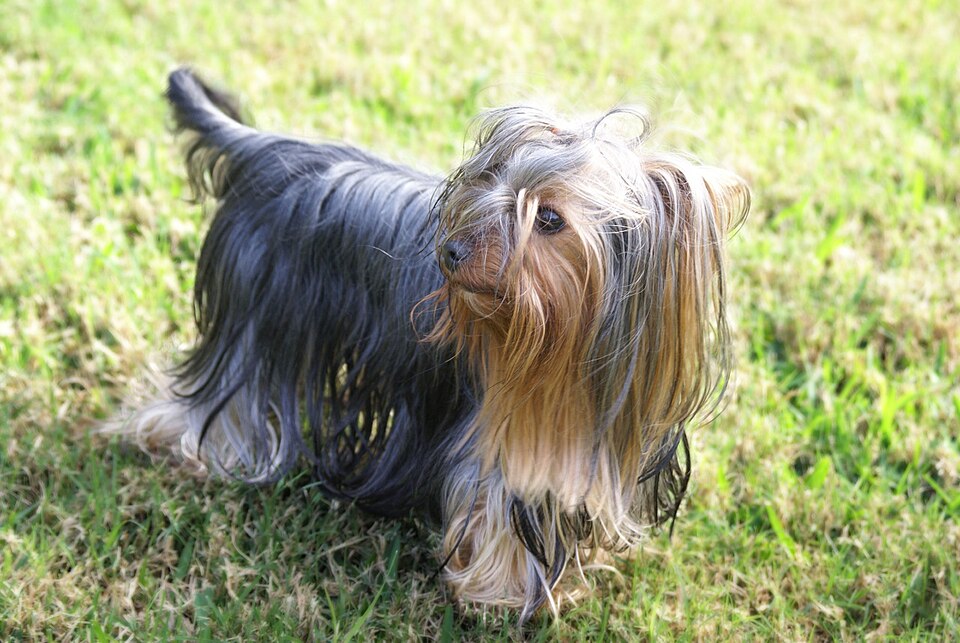
A compact, neat little dog with an upright, confident carriage. Its most striking feature is the coat: long, glossy, silky hair that parts from nose to tail and falls perfectly straight on both sides.
- Weight: The Royal Kennel Club and FCI call for up to 3.2 kg; the AKC says 7 pounds.
- Real life: In a 2025 study of more than 28,000 Yorkies seen at UK veterinary clinics, the median adult weight was 5.06 kg (about 11 lb), ranging from 1 to 15 kg. A Yorkie that's bigger than the standard is perfectly fine.
- Height: According to the AKC, 7–8 inches (18–20 cm) at the shoulder.
- Color: Dark steel blue on the body, with rich golden tan on the head, chest and legs. According to the Royal Kennel Club, puppies are born black and tan, and the coat turns steel blue as they mature.
 Daily care
The Royal Kennel Club recommends daily grooming for this breed. Long, fine hair tangles easily, especially behind the ears, in the armpits and between the legs. Show dogs wear their coats floor-length; a pet Yorkie's coat can also be clipped short to make care easier.
- Combing: Comb down to the skin every day if the coat is long; with a short clip, a few times a week may be enough.
- Groomer: Have the coat cut by an experienced groomer who uses rewards. The RSPCA suggests introducing a puppy to the groomer as a positive place as soon as it's fully vaccinated, and avoiding enclosed drying boxes in which a dog can't control its body temperature.
- Nails: In the UK study, overgrown nails were the second most common problem after gum disease (6.5%). The nails of small indoor dogs don't wear down enough on their own; trim them regularly.
- Teeth: Get your puppy used to tooth brushing early. According to the same study, dogs start losing their baby teeth at about three months, and the full set of adult teeth is in by seven months; have your vet check during this period that the baby teeth have fallen out.
- Ears and eyes: Check weekly and see your vet about any bad smell, redness, discharge or watery eyes. Tie up or trim the long hair around the eyes so it doesn't poke them.
- Cold: If the coat is clipped short, a coat may be needed in winter; our article on dogs in cold weather explains how to choose one.
Our dog grooming guide walks you through a combing and bathing routine step by step.
Training and exercise
The Royal Kennel Club recommends up to 30 minutes of exercise a day for the Yorkie. Given its terrier past, sniffing, searching and chasing games are especially valuable. Our article on sniffing games has ideas you can try at home.
- Reward-based training: A smart dog with a mind of its own; short, rewarding and consistent sessions work best.
- Harness: UFAW recommends avoiding collars that press on the neck in dogs with tracheal collapse. Using a harness that holds the chest from the start is a good habit with a Yorkie. Our loose-leash training guide teaches walking without pulling.
- Recall: It may take off after a bird or a cat; practice coming when called thoroughly before letting it off leash in open spaces. Our recall training guide explains how, step by step.
- Fewer jumps: Put a ramp or steps by the sofa and bed, and hold the dog securely with both hands when you carry it.
- Hot weather: Walk during the cooler hours in summer; hot, humid weather can make breathing problems worse.
 Diet and weight
A Yorkie doesn't need a special food; a complete, balanced dog food suited to its age and size is enough. In the UK study, being overweight was among the five most common problems (3.7%). UFAW also notes that extra weight makes the signs of tracheal collapse worse.
- Measure food and count treats as part of the daily amount.
- If you can feel the ribs under a thin layer of fat and see a waist from above, the weight is about right.
- Don't leave a puppy without food for long; plan the number and timing of meals with your vet. If a puppy seems weak, trembles or behaves oddly after eating, contact your vet right away.
- Some human foods are toxic to dogs; check our list of foods dogs should never eat.
 Health issues to know about
The authors of the 2025 UK study see the Yorkie's long lifespan as a sign of generally robust health; still, some problems are common or have been reported as predispositions in this breed. The information below is for awareness only; ask your vet about diagnosis and treatment.
Gum disease and baby teeth
In the study, 21.1% of Yorkies were diagnosed with gum disease within a year, making it the most common problem. In a large 2021 UK study, the Yorkie's risk was also more than twice that of crossbred dogs. Baby teeth that don't fall out after the adult teeth come in are also common in this breed (3.6%); they trap food and bacteria and make gum disease more likely. The authors recommend watching closely while the teeth come in and acting early if there's a problem.
Slipping kneecaps
In patellar luxation, the kneecap slides out of place; over time it can lead to arthritis. In a 2016 English study, Yorkies had about 5.5 times the odds of this diagnosis compared with crossbred dogs, and it was recorded in 3.4% of Yorkies in the 2025 study. If you see your dog skipping a hind leg now and then or limping, see your vet.
Tracheal collapse
The cartilage rings that hold the windpipe open soften, and the windpipe collapses. According to UFAW, this happens almost exclusively in small breeds, and Yorkies make up far more of the cases than expected. A dry cough that sounds like a goose honk and noisy breathing are typical signs; excitement, exercise, hot humid weather and extra weight make them worse. It usually appears in middle-aged and older dogs: in a 2026 study of records from 11,000 Yorkies at a US referral hospital, severe tracheal collapse was seen in 6.7% of dogs, with a median age at diagnosis of 10.
Portosystemic shunt (liver blood vessel defect)
An inborn blood vessel defect that lets blood from the intestines bypass the liver and go straight into the circulation. Toxins the liver should filter out reach the brain. According to UFAW, affected puppies usually stay smaller than their littermates and fail to thrive, and signs are often worse after eating: weakness, trembling, drooling, pressing the head against walls, loss of vision and seizures. UFAW cites a study reporting that about 3% of Yorkies in the US are affected; in the 2026 hospital study, the figure was 0.8%, with a median age at diagnosis of 2.7 years. UFAW notes that a bile acid test can screen puppies before they're sold.
Legg-Calvé-Perthes disease
During growth, the blood supply to the top of the thigh bone is temporarily disrupted; that part of the bone collapses and the hip joint becomes painfully damaged. According to UFAW, it is considered a significant problem in the Yorkie, and signs begin in puppyhood, often with pain so severe that the dog holds one hind leg off the ground. If your puppy limps on a hind leg, see your vet.
- A honking cough, trouble breathing or bluish gums
- Weakness, trembling, drooling or head pressing after meals in a puppy
- Seizures or a sudden change in behavior
- Limping or not putting weight on a leg at all
How long does it live?
The Yorkie is one of the longer-lived small breeds:
- A 2024 UK study using data from about 585,000 dogs found a median lifespan of 13.3 years; for crossbred dogs, the figure was 12.0 years.
- In 2022 UK life tables, the Yorkie's life expectancy at birth was 12.54 years, second only to the Jack Russell Terrier among 18 breeds.
- In the 2025 veterinary clinic study, the median age at death of Yorkies was 13.56 years; the most common groups of causes were brain and kidney disorders.
The AKC gives 11–15 years for the breed. Dental care, a healthy weight, a home that's safe from falls and regular vet checkups are the most practical ways to help a Yorkie enjoy that long life in comfort.
 Before you get one
- Consider a shelter: Purebred dogs end up in shelters and rescues too. Our article on adopting a shelter dog covers the first steps.
- If you buy from a breeder: The Royal Kennel Club currently recommends no screening tests for this breed, so ask openly about the parents' health history, including knee and dental problems. Find out whether the bile acid test UFAW recommends has been done, and have your vet examine the puppy before you take it home.
- "Teacup," "mini" or "pocket" ads: The Royal Kennel Club doesn't recognize any teacup breed and names the Yorkshire Terrier among the breeds often used to produce such dogs. It notes that these dogs are often bred from the smallest, weakest puppies of litters, and that some sellers let puppies go before 8 weeks to make them look smaller; breathing, bone, joint, heart and stomach problems are more likely, and their lives can be significantly shorter.
- Red flags: Steer clear of sellers who won't show you the mother, always have puppies available, can't provide paperwork or rush you to "buy now."
- Registration: Rules vary by country; many places require or recommend microchipping. In Türkiye, owned dogs must be microchipped and registered in the PETVET system.
- The first days: Our guide to bringing a puppy home walks you through the first night and first week.
Frequently asked questions
Do Yorkshire Terriers shed?
According to the Royal Kennel Club, they don't shed noticeably. But that doesn't mean they won't trigger allergies: research has found no evidence for calling any breed "hypoallergenic." If you have allergies, talk to your doctor and spend time around the breed before deciding.
Why is my Yorkie puppy black?
According to the Royal Kennel Club, Yorkies are born black and tan, and the coat turns steel blue as they mature. This is a normal change.
Is a "teacup" or "mini" Yorkie a separate breed?
No. The Royal Kennel Club doesn't recognize any teacup breed; the word just describes a dog that's smaller than average, and health problems are more likely in extremely small dogs. In real life, many healthy Yorkies are even bigger than the standard.
Why does my Yorkie cough like a goose?
That sound can be a typical sign of tracheal collapse, but there are other causes too. If the cough keeps coming back, your dog struggles to breathe or its gums turn bluish, see your vet right away. Preventing weight gain and using a harness that doesn't press on the neck are good habits with this breed.
Can a Yorkie live in an apartment?
Yes; the Royal Kennel Club considers it suitable for apartment life. It still needs daily walks, sniffing and play; being small doesn't mean it has no need to move.
Sources
- The Royal Kennel Club · Yorkshire Terrier: ırk tanıtımı
- The Royal Kennel Club · Yorkshire Terrier ırk standardı
- FCI · Yorkshire Terrier ırk standardı No. 86
- AKC (American Kennel Club) · Yorkshire Terrier ırk tanıtımı
- O'Neill ve ark. · Yorkshire Terriers under primary veterinary care in the UK: demography and disorders, Companion Animal Health and Genetics (2025)
- McMillan ve ark. · Longevity of companion dog breeds: those at risk from early death, Scientific Reports (2024)
- Teng ve ark. · Life tables of annual life expectancy and mortality for companion dogs in the United Kingdom, Scientific Reports (2022)
- Science for Animal Welfare (UFAW) · Yorkshire Terrier: Portosistemik şant
- Science for Animal Welfare (UFAW) · Yorkshire Terrier: Nefes borusu çökmesi
- Science for Animal Welfare (UFAW) · Yorkshire Terrier: Femur başının kansız kalması (Legg-Calvé-Perthes)
- Science for Animal Welfare (UFAW) · Oyuncak ırklarda ön bacak (radius ve ulna) kırıkları
- Weisse ve ark. · Prevalence of tracheal collapse syndrome, congenital portosystemic shunts, or both in Yorkshire Terriers at one veterinary hospital, Journal of Veterinary Internal Medicine (2026)
- O'Neill ve ark. · The epidemiology of patellar luxation in dogs attending primary-care veterinary practices in England, Canine Genetics and Epidemiology (2016)
- O'Neill ve ark. · Epidemiology of periodontal disease in dogs in the UK primary-care veterinary setting, Journal of Small Animal Practice (2021)
- Vredegoor ve ark. · Can f 1 levels in hair and homes of different dog breeds: lack of evidence to describe any dog breed as hypoallergenic, Journal of Allergy and Clinical Immunology (2012)
- RSPCA · Choosing the right dog groomer
- The Royal Kennel Club · Buying a teacup dog
- Resmî Gazete · Kedi, Köpek ve Gelinciklerin Kimliklendirilmesi ve Kayıt Altına Alınmasına Dair Yönetmelik (26 Şubat 2018)
By Tüylüm · Last checked: November 3, 2026. Compiled from the sources above and written in our own words. Spotted a mistake? Write to [email protected] and we'll fix it right away. Photo from Wikimedia Commons, used under the license shown below it.