 Tüylüm
Rough Collie
A graceful, richly maned long-coated collie descended from Scotland's sheepdogs. A friendly family dog that gets along with children and other dogs; but collie eye anomaly (CEA) is a known problem in the breed and drug sensitivity (MDR1) is very common, so it matters that your vet knows the breed.

 Lifespan≈ 12+ yearsRKC: over 12 years; no breed-specific study found
 Height at shoulder20–24 in (51–61 cm)FCI: males 22–24, females 20–22 in
 OriginScotland / Britainrefined from the shepherd's working collie
 CoatLong, full maneFCI: very dense harsh outer coat; soft undercoat
 SheddingShedsRKC: sheds; needs daily grooming
 ExerciseModerateRKC: up to 1 hour a day
 Kids and dogsVery goodFCI: good with children and other dogs
 Eye healthScreening a mustRKC: eye exam + CEA DNA test
The Rough Collie, with its full mane, long slim muzzle and graceful carriage, is one of the most recognizable breeds in the world. Under that majestic coat is a herding dog: the FCI standard says plainly that for all his beauty, the Collie is a worker. It also gives a clear description of the temperament: friendly, happy and active, good with children and other dogs. On the health side, two topics stand out: collie eye anomaly (CEA) and the MDR1 gene change that causes extreme sensitivity to some drugs; there are DNA tests for both. We built this page from the FCI standard, the Royal Kennel Club, Washington State University's MDR1 page and a study on eye disease.
- Temperament: According to the FCI, friendly, happy and active, with no trace of nervousness or aggression; good with children and other dogs.
- Size: Males stand 22–24 in (56–61 cm), females 20–22 in (51–56 cm) (FCI).
- Coat: Very dense, long, with a full mane; the Royal Kennel Club says it sheds and needs grooming every day.
- Health: Collie eye anomaly (CEA), sensitivity to some drugs (MDR1) and progressive retinal disease are known problems in the breed; DNA tests exist.
- Lifespan: The Royal Kennel Club says over 12 years; we couldn't find a solid breed-specific lifespan study.
What to know
 What is the Rough Collie like?
The FCI standard describes the Collie as friendly, with no trace of nervousness or aggression: a great companion dog, friendly, happy and active, good with children and other dogs. The same standard sums up the breed's history this way: for all his beauty, the Collie is a worker. In other words, the herding dog is still in there; it wants movement, mental work and attention.
Some behaviors seen in herding breeds, such as trying to round up moving things (children, bikes, cars) or barking a lot when excited, can show up in this breed too. Early training and socialization can manage them; our article on why dogs bark explains the causes.
Every dog is an individual. Breed describes what a dog was bred for; it can't tell you how a particular dog will turn out. The parents' temperament, early experiences and training matter at least as much as breed.
 Who is it a good fit for?
The Collie suits families who can give regular exercise every day, set aside time to brush a long coat and spend lots of time with their dog. The Royal Kennel Club lists it as a dog that can live in a small house but likes a large garden, with up to an hour of exercise a day.
| Situation | Good fit? |
|---|---|
| Apartment | Possible; regular daily exercise and grooming are a must |
| House with a yard | Good |
| Family with kids | The FCI says it's good with children; children and dogs should still never be left unsupervised together |
| Home with other dogs | The FCI says it's good with other dogs |
| First-time dog owners | Possible; but the grooming and health follow-up are serious |
| People who are away for long hours | Hard; a people-bonded herding dog |
| Hot climates | Hard; a very dense, long coat |
Where does it come from?
According to the FCI, the breed comes from Great Britain. Its history section says the breed is thought to have evolved from dogs brought to Scotland by the Romans that mated with native types; that the rough and smooth Collie are the same apart from coat length; and that the Rough Collie is a somewhat refined version of the Scottish shepherd's working collie, selected over at least a hundred years. The Royal Kennel Club says the earliest Collies were smaller than today's dogs and mostly black and white or tricolor; that the first sable, "Old Cockie," born in 1868, caused a sensation and made that color popular; that separate classes for rough and smooth sheepdogs began in 1870; and that Queen Victoria brought some dogs from Balmoral to her royal estates.
The smooth variety (Smooth Collie), according to the FCI standard, is the same breed apart from coat length; the Royal Kennel Club says smooth puppies can appear in litters from rough-coated parents. Other collie types, such as the Border Collie and the Shetland Sheepdog, are separate breeds; see our Border Collie and Sheltie pages to compare.
Appearance and colors
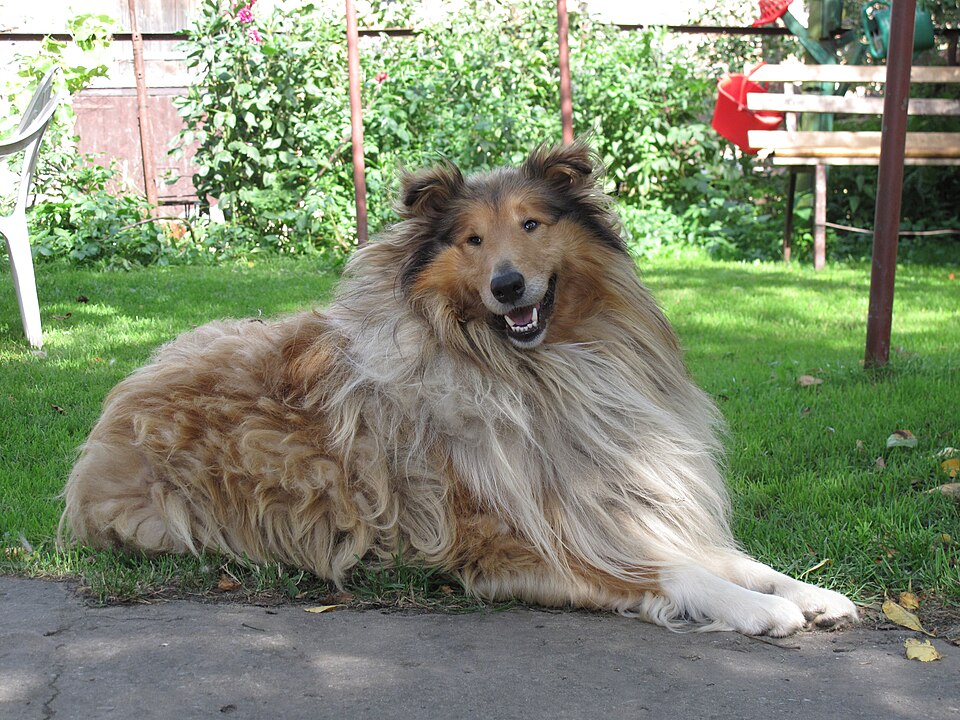
According to the FCI, it's a dog of great beauty with no part out of proportion, and expression is very important. The head, from the front or side, looks like a well-blunted, clean wedge with a black nose. The eyes are almond-shaped and dark brown (they can be blue in blue merles). The ears are small, carried thrown back at rest and semi-erect when alert.
- Height: Males 22–24 in (56–61 cm), females 20–22 in (51–56 cm) (FCI). The standard gives no weight.
- Coat: Fits the outline of the body and is very dense; the outer coat is straight and harsh, the undercoat soft and furry. The mane and frill are very abundant; there's feathering on the front legs, profuse feathering above the hocks on the hind legs, and a very bushy tail.
- Color: Sable (light gold to rich mahogany), tricolor (mainly black with rich tan markings on the legs and head) and blue merle (silvery blue splashed with black). All may carry the typical white Collie markings.
- Merle-to-merle rule: Since 2013 the Royal Kennel Club hasn't registered puppies from merle-to-merle matings, because of the risk of impaired vision and hearing.
Daily care
The Royal Kennel Club says the breed needs grooming every day and sheds. In a long, dense coat, tangles form most behind the ears, in the armpits and on the backs of the legs; combing and brushing every day makes the job easier. See our dog grooming guide for general methods.
- Nails: Trim them regularly.
- Ears: Check the hair in and around the ears; look for dirt and redness.
- Teeth: Brush often with a toothpaste made for dogs.
- Hot weather: A dog with a very dense coat needs shade, plenty of water and exercise during cool hours in summer. Ask your vet or a groomer before shaving the coat. Our article on dogs in hot weather covers the warning signs.
 Training and exercise
The Royal Kennel Club says up to an hour of exercise a day. Given its herding background, let part of it be sniffing, short cue games and mental work. The FCI standard doesn't look for nervousness or aggression in the Collie's temperament, so socialization and calm, consistent training work with the dog's natural makeup.
- Early socialization: As a puppy, give it short, positive meetings with different people, children, sounds, vehicles and calm dogs, and keep this up through the first year.
- Herding instinct: If it tries to round up moving things, calmly redirect it to another job; use a leash when working around running children or bikes.
- Barking: For a dog that barks with excitement, finding the cause comes first. See our article on why dogs bark.
- Mind games: Sniffing games, reward-based trick training and agility meet the need.
- Vet prep: Use rewards early on to get it comfortable with being handled and having its mouth, ears and paws checked.
 Diet and weight
We have no source saying the Collie needs a special food; a balanced dog food suited to its age is the basis. Talk with your vet about the type of food and the amount.
- Watch the weight: Weight hides easily under a thick coat; if you can feel the ribs under a thin layer of fat and see a waist from above, the weight is about right.
- Lower the risk of bloat: The Merck Veterinary Manual says deep, narrow-chested dogs are at higher risk of bloat. Splitting the daily food into several meals and keeping things calm after eating are commonly advised; talk through the details with your vet.
Also check our list of foods that are dangerous for dogs.
 Health issues to know about
Two topics come first in the Collie: the eyes and sensitivity to some drugs. The information below is for awareness only; ask your vet about diagnosis and treatment.
MDR1: sensitivity to some drugs
Dogs carrying a change in the MDR1 (multidrug resistance 1) gene can become seriously ill, or even die, when given certain medications. Washington State University's page says the change is most common in herding breeds, long-haired whippets and silken windhounds, and about 70% in Collies (roughly three of four U.S. Collies carry it). The only way to know whether a dog carries the change is to test. The Royal Kennel Club also lists the MDR1 DNA test among the best-practice tests for breeders. What you can do as an owner: have the test done, tell your vet the result, and say "Collie, know the MDR1 status" at every new vet. Only a veterinarian can decide which drug is safe; never give any medication, parasite product or anti-diarrhea product on your own.
Collie eye anomaly (CEA)
CEA arises from a congenital difference in the development of the layer at the back of the eye (the choroid). It's inherited and common in the breed; the gene change involved is known, so a DNA test exists (Bučan et al., 2025). The Royal Kennel Club lists an eye exam for breeders (the BVA/KC/ISDS eye scheme, including litter screening) plus a DNA test for CEA. When choosing a puppy, ask for both the parents' eye exam and DNA results.
Progressive retinal disease and degenerative myelopathy
The Royal Kennel Club also lists DNA tests for progressive retinal atrophy (PRA, gradual loss of vision from the retina) and degenerative myelopathy (a spinal cord disease) for the breed. If you notice cloudiness in the eye, timidity in the dark, bumping into things or weakness in the hind legs, show your vet.
Hips and bloat
The Royal Kennel Club also recommends hip dysplasia screening. Bloat (GDV) is an emergency needing immediate care; the Merck Veterinary Manual gives a mortality rate around 20% even in treated animals.
- Retching without bringing anything up, a swollen belly, heavy drooling, restlessness
- After any medication: stumbling, heavy drooling, tremors, seizures, vomiting or weakness (remind the vet about the Collie's MDR1 status)
- Cloudiness, redness, squinting or sudden vision trouble in the eye
- Bumping into things or timidity in the dark
- Weakness or stumbling in the hind legs
- Fast, labored breathing or stumbling in the heat
How long does it live?
The Royal Kennel Club says "over 12 years" for the Rough Collie. That's a broad range, and we couldn't find a solid breed-specific lifespan study, so we're not giving a single number.
The honest summary: a puppy from screened parents, a healthy weight, regular checkups and knowing the MDR1 status are the most concrete steps.
 Before you get one
- Consider a shelter: Purebred and collie-type mixes end up in shelters too. Our guide to adopting a dog from a shelter walks you through it.
- If you buy from a breeder: Meet the parents in person and make sure they're calm and steady. Ask for the eye exam (including litter screening), the CEA and MDR1 DNA test results and hip screening. Don't take a puppy from a merle-to-merle mating.
- Red flags: Sellers who show no health records or test results; promises of a "rare color"; sellers who won't show you the mother.
- Time: Daily coat care and exercise are a commitment of years.
- Registration: Rules vary by country. In Türkiye, owned dogs must be microchipped and registered; for puppies, a declaration is made within three months of birth. Details are in our article on PETVET registration and microchips.
Frequently asked questions
Is the Collie banned in Türkiye?
No. Law no. 5199 bans breeding and owning animals the Ministry has designated as "posing a danger" (article 14/l), and the Collie isn't among the six breeds named in the Ministry's 2021 circular. Rules can change, so check the current situation with your provincial or district agriculture directorate. Rules vary by country.
What is MDR1 and why does it matter?
A gene change found in some dogs; in these dogs, some medications can cause a serious, even fatal, reaction. It's very common in the Collie (Washington State University says about 70%). A test exists; share the result with your vet.
Is it good in a home with children?
The FCI says it's good with children and other dogs; children and dogs should still never be left unsupervised together. Our article on kids and dogs at home covers the ground rules.
Does it shed a lot?
The Royal Kennel Club says it sheds and needs grooming every day.
What's the difference between the rough and smooth Collie?
According to the FCI standard, they're the same breed apart from coat length; their history and bloodlines are closely shared.
Sources
- FCI · Collie (Rough) breed standard (No. 156)
- The Royal Kennel Club · Collie (Rough) breed page (history, care, health screening)
- AKC (American Kennel Club) · Collie breed profile
- Washington State University · MDR1 in dogs (WADDL)
- Bučan et al. · Analysis of Selected Eye Disorders in a Group of Predisposed Breeds of Dogs: Molecular Diagnostics of Collie Eye Anomaly and Progressive Retinal Atrophy, Genes (2025)
- Merck Veterinary Manual · Gastric dilation and volvulus in small animals
- Türkiye legislation database · Animal Protection Law no. 5199, current text (article 8, in Turkish)
- Türkiye Ministry of Agriculture and Forestry · Circular on animals posing a danger (2021/48, in Turkish)
- Resmî Gazete (Türkiye) · Regulation on the identification and registration of cats, dogs and ferrets (February 26, 2018)
By Tüylüm · Last checked: November 10, 2026. Compiled from the sources above and written in our own words. Spotted a mistake? Write to [email protected] and we'll fix it right away. Photo from Wikimedia Commons, used under the license shown below it.