 Tüylüm
Japanese Chin
A small companion dog with a long silky coat, an "astonished" look and cat-like cleanliness. It's a flat-faced breed: in a 2026 UK study, only 17.4% of 46 Japanese Chin examined had no breathing problem. It needs special care in the heat, with weight and with eye health.

 Lifespan10+ yearsRoyal Kennel Club: "over 10 years"
 Weight4–7 lb (1.8–3.2 kg)Royal Kennel Club: ideal range
 Height≈ 10 in (25 cm)FCI: males about 25 cm
 OriginChina / Japandeveloped in Japan
 CoatLong, silkyfeathered; brush several times a week
 ExerciseUp to 30 min a dayRoyal Kennel Club
 Heat and breathingSensitive17.4% of 46 Chin problem-free (2026)
 EyesNeeds monitoringcorneal ulcers common in flat-faced dogs
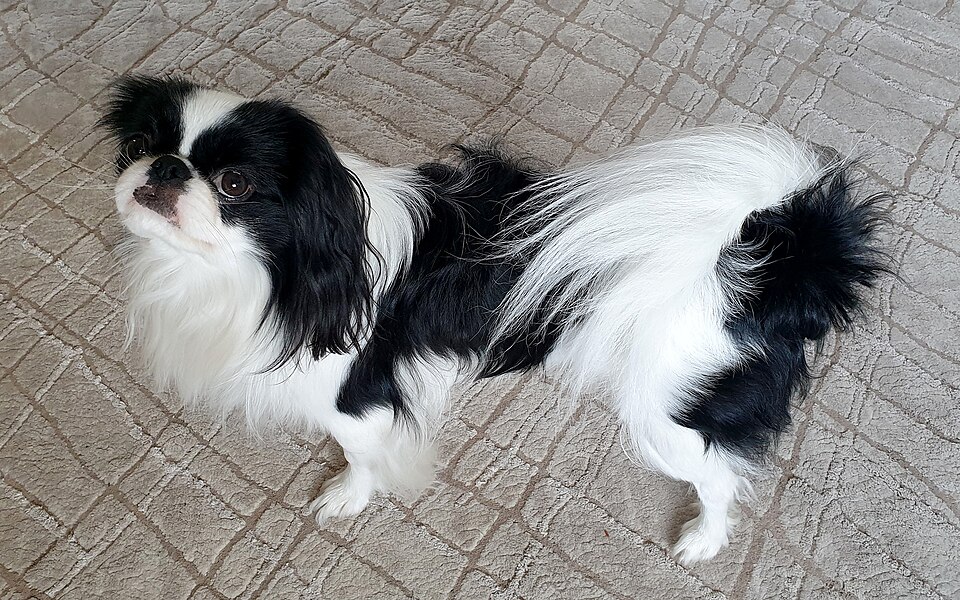
The Japanese Chin is a small companion dog that looks like a miniature aristocrat, with its short, broad nose, big round eyes and long silky coat. The Royal Kennel Club writes that "chin" means "catlike", perhaps from the shape of its head and its fastidious cleanliness, often wiping its face with its paws. Its temperament is gentle and affectionate; but the most important thing to know before getting one is the breathing and eye problems that come with its flat-faced structure. On this page we cover those openly, with sources.
- Size: The Royal Kennel Club gives an ideal weight of 1.8–3.2 kg (4–7 lb); the FCI gives about 25 cm (10 in) for males.
- Temperament: The FCI standard says "clever, mild and lovely"; the Royal Kennel Club standard says gay, happy, gentle and good-natured.
- Breathing: In a 2026 UK study, only 17.4% of the 46 Japanese Chin examined had no breathing problem (BOAS); the breed came out as one of the two highest-risk breeds, alongside the Pekingese.
- Heat: Flat-faced dogs struggle to cool down; the risk of heatstroke is high.
- Eyes: Corneal ulcers are common in flat-faced dogs; take eye signs seriously.
What to know
 What is the Japanese Chin like?
The FCI standard sums up the Japanese Chin's temperament as "clever, mild and lovely", while the Royal Kennel Club's standard says "gay, happy, gentle and good natured". The Royal Kennel Club's breed page mentions its fastidious cleanliness and how it often wipes its face with its paws. The "astonished" expression in the standard comes from a small amount of white showing in the inner corners of the eyes.
In practice that means a calm dog that's close to its person and likes sitting in a lap. It may struggle when left alone, so teach alone time gradually. See our article on separation anxiety in dogs for details.
Breed traits describe general tendencies. The parents' temperament, early socialization and training shape an individual dog's personality as much as its breed does.
 Who is it a good fit for?
The Japanese Chin suits people who want a calm companion, can manage the heat and will take vet checkups seriously. The Royal Kennel Club considers the breed suitable for flats and for homes with a small or medium garden.
| Situation | A good fit? |
|---|---|
| Apartment | Yes; daily exercise is up to 30 minutes |
| Hot climate | Needs care; being flat-faced, it struggles to cool down in the heat and may need an air-conditioned space |
| Family with kids | A small, delicate dog; teach children to pet it on the floor |
| Other dogs and cats | Early, calm introductions; play with large dogs should be supervised |
| Long hours alone | May struggle; teach alone time gradually |
| First-time dog owners | Possible, but you need knowledge of and budget for breathing and eye health |
See our article on kids and dogs at home.
Where does it come from?
According to the Royal Kennel Club, the breed's origins lie in China; a dog gifted by the Empress of China to her counterpart in Japan saw the breed introduced and developed in that country. The history in the FCI standard says it is assumed that the ancestors of the Chin were presented as a gift from the rulers of Korea (during the Silla Dynasty, 377–935) to the Japanese court in 732; for the following 100 years a large number of Chins came into Japan, and documents show envoys sent to China and North Korea brought back dogs of this breed directly. The same history says that during the reign of the Shogun Tsunayoshi Tokugawa (1680–1709) the breed was raised as an indoor toy dog in the Castle of Edo, that in 1613 a British captain brought a Chin to England, that in 1853 Commodore Perry brought several to the U.S., two of which were presented to Queen Victoria, and that since 1868 the Chin has been favored as a lapdog by ladies of the upper classes.
A word on names: the Japanese Chin can be confused with the Chinese Crested or with other small East Asian breeds such as the Pekingese. See our Pekingese page for more.
Appearance and colors
According to the FCI standard, the Japanese Chin has a broad, rounded skull and a deep, indented stop; the nasal bridge is very short and broad. The eyes are large without exaggeration, round and lustrous black, and the ears are long, triangular and hanging. The neck is rather short and held high.
- Height and weight: The FCI gives approximately 25 cm (10 in) for males, with females slightly smaller; the Royal Kennel Club gives an ideal weight of 1.8–3.2 kg (4–7 lb) and says the daintier the better as long as type, quality and soundness are not sacrificed.
- Coat: Silky, straight and long; the whole body except the face is covered with profuse hair, with plentiful feathering on the ears, neck, thighs and tail.
- Color: White with black or red markings; the Royal Kennel Club lists black and white, red and white and sable and white. A wide white blaze is desirable.
- Tail: Set high, curved over the back and profusely feathered.
Daily care
The Royal Kennel Club rates grooming as "more than once a week" and notes the breed sheds. Long silky hair mats if it isn't brushed regularly.
- Brushing: Catch tangles early in feathered areas such as behind the ears, under the legs, on the backs of the thighs and the tail. See our article on dog coat care for more.
- Facial folds and eyes: Keep the small folds around the nose and the area around the eyes clean and dry; show your vet any redness, discharge or constant watering.
- In hot weather: A flat-faced dog struggles to cool itself through its nose (see the health section below); more in our article on dogs in hot weather.
- Ears: Check once a week; show your vet any odor or redness.
- Teeth and nails: Brush teeth from puppyhood; check nails regularly.
 Training and exercise
The Royal Kennel Club recommends up to 30 minutes of exercise a day. For a flat-faced dog that should mean not a long, fast walk but short, easy outings spread over the cooler hours.
- Speed and heat: Avoid fast running and exercise in the hot hours; end the walk if the dog is breathing noisily or stopping to rest.
- Reward-based work: Being clever and gentle, it does well with short, rewarded and consistent training. There's no need for harsh methods.
- Leash: Choose a harness rather than a collar to avoid straining the neck and windpipe: loose-leash training.
- Mental work: Sniffing games and puzzle toys at home tire the mind without taxing the breathing: sniffing games.
 Diet and weight
The Japanese Chin doesn't need a special food; a complete and balanced small-breed food suited to its age and size is enough. Weight matters especially in flat-faced breeds: the Royal Kennel Club recommends keeping flat-faced dogs lean (limiting treats, regular exercise) to avoid making signs worse.
- If you can feel the ribs under a thin layer of fat, the weight is good; under a long coat weight is invisible, so check by hand.
- Subtract treats from the daily amount.
- Regular weigh-ins show weight changes early.
Be careful with table scraps; check our list of foods dogs should never eat.
 Health issues to know about
The Japanese Chin is one of the "brachycephalic" (flat-faced) breeds, with a short, broad skull. That structure can lead to breathing and eye problems. The following is for information only; ask your veterinarian for diagnosis and treatment.
Breathing problems (BOAS)
BOAS (brachycephalic obstructive airway syndrome) means air has trouble passing through the nose and throat because of narrowed nostrils and an elongated soft palate. The Royal Kennel Club describes it as a progressive, lifelong disorder that can impair a dog's ability to exercise, play, eat and sleep. In a UK study published in PLOS One in 2026, 898 dogs of 14 flat-faced breeds were assessed for respiratory function. Only 17.4% of the Japanese Chin (46 dogs) were "Grade 0", meaning free of signs; only the Pekingese did worse (10.9%). The researchers classed the two as "high risk" breeds, comparable to the Pug, French Bulldog and Bulldog, where the problem is well known. In the Japanese Chin only 5.8% of dogs had open nostrils, meaning that nearly all had narrowed nostrils. Across the study, nostril stenosis, a high body condition score and a shorter facial structure were associated with BOAS.
Signs: snoring, wheezing or snorting even at rest, excessive panting, resting often on walks, a blue or grey tinge to the gums. The Royal Kennel Club advises getting veterinary advice right away if a dog shows these signs, and says early intervention may slow progression. The Royal Kennel Club and University of Cambridge's Respiratory Function Grading Scheme (RFGS) offers an assessment by trained vets from 12 months of age, repeated every two years. In August 2026 the club recognized this test as a Best Practice test for the Japanese Chin; it will be formally added to the Health Standard from January 2027. So asking a breeder for the parents' breathing grades is now a reasonable expectation.
Heat and heatstroke
According to the Royal Kennel Club, the nose is the main area where a dog loses heat, and in flat-faced dogs the structures inside the nose restrict airflow, so cooling down is harder and the risk of heatstroke is high even in the UK. If you see excessive panting, a high body temperature, heavy drooling or staggering, move the dog to a cool, shady place, wet it down, offer a small amount of water and call your vet right away. For prevention, see our article on dogs in hot weather.
Eyes
The Royal Kennel Club writes that corneal ulcers are common in flat-faced dogs: shallow eye sockets leave the eyes prominent, the eyelids can't fully close and the cornea dries out, and nasal folds can rub the eye's surface. Because flat-faced dogs' eyes are less sensitive to touch, ulcers may not always give obvious signs. Signs: squinting or keeping an eye closed, excessive blinking, sensitivity to light, rubbing the eye with a paw, discharge, redness, cloudiness. The club says this is always serious and can progress quickly, and that you should seek veterinary advice right away if you notice signs. The BVA/KC/ISDS eye exam is also recommended for the breed.
Teeth
Gum disease is more common in flat-faced breeds: in a 2021 UK study, brachycephalic dogs had 1.25 times the odds of gum disease compared with dogs with a normal skull shape, and risk also rose in small dogs. Brush your dog's teeth from puppyhood and have regular checks.
- Fast or labored breathing, bluish or grey gums, fainting
- Heavy panting, drooling, staggering or collapse in the heat
- Squinting, keeping an eye closed, redness, cloudiness or discharge in an eye
- Refusing food, repeated vomiting or diarrhea
How long does it live?
The Royal Kennel Club lists the lifespan as "over 10 years", somewhat lower than the "over 12 years" the same club gives for most small breeds. We couldn't find a separate life table for the Japanese Chin. In a large UK study (McMillan et al., 2024), the median lifespan of flat-faced purebreds was 12.1 years and of normal-skulled purebreds 12.8 years; for small, long-nosed breeds it was 13.3 years.
Regular vet checks, a healthy weight, protection from the heat and catching breathing and eye signs early are the most concrete ways to help it live longer.
 Before you get one
- Consider a shelter too: Small-breed dogs also end up in shelters. Our article on adopting a dog from a shelter covers the first steps.
- If you buy from a breeder: See the parents with the puppies in a home environment. Ask for respiratory function grading (RFGS) results, eye exam results and a pedigree. A dog with a longer nose and more open nostrils helps reduce the risk of breathing problems.
- Hot summers and air conditioning: Think about whether you have an environment that can keep the dog cool in summer.
- Vet costs: You may need exams or surgery for breathing and eye problems later; plan your budget accordingly.
- Legal registration: In Türkiye, owned dogs must be microchipped and registered in the PETVET system. See our article on PETVET registration and microchips.
- First days: Our article a new puppy at home: the first week helps.
Frequently asked questions
Does the Japanese Chin snore or breathe noisily?
In flat-faced dogs, snoring or wheezing can be a sign of BOAS. The Royal Kennel Club advises getting veterinary advice if a dog snores even when asleep or breathes noisily at rest. Treating it as "normal for the breed" isn't right.
Can it go for walks in the heat?
The risk of heatstroke is high in heat; move walks to the early morning or cool evening hours, keep them short and carry water. More in our article on dogs in hot weather.
Is the Japanese Chin the same as the Pekingese or the Shih Tzu?
No. All three are small and flat-faced, but they're separate breeds. The Japanese Chin is lighter-built, longer-legged and fine silky-coated. In the 2026 study the Japanese Chin and the Pekingese were the two highest-risk breeds. See our Pekingese and Shih Tzu pages for details.
Does choosing a Japanese Chin with a longer nose reduce the risk?
The study found that a shorter facial structure and nostril stenosis were associated with BOAS. So dogs with more open nostrils and a longer face generally carry less risk, but it's no guarantee. The best route is asking for the parents' breathing grades.
How heavy does it get?
The Royal Kennel Club gives an ideal weight of 1.8–3.2 kg (4–7 lb).
Sources
- The Royal Kennel Club (UK) · Japanese Chin: breed profile and health screening
- The Royal Kennel Club · Japanese Chin breed standard
- FCI · Chin (Japanese Chin) breed standard No. 206
- Tomlinson et al. · A cross-sectional study into the prevalence and conformational risk factors of BOAS across fourteen brachycephalic dog breeds, PLOS One (2026)
- The Royal Kennel Club and University of Cambridge · Respiratory Function Grading Scheme (RFGS)
- The Royal Kennel Club · Brachycephalic obstructive airway syndrome (BOAS)
- The Royal Kennel Club · Brachycephalic eye problems
- McMillan et al. · Longevity of companion dog breeds: those at risk from early death, Scientific Reports (2024)
- O'Neill et al. · Epidemiology of periodontal disease in dogs in the UK primary-care veterinary setting, Journal of Small Animal Practice (2021)
- Resmî Gazete (Türkiye) · Regulation on the identification and registration of cats, dogs and ferrets (February 26, 2018)
By Tüylüm · Last checked: November 10, 2026. Compiled from the sources above and written in our own words. Spotted a mistake? Write to [email protected] and we'll fix it right away. Photo from Wikimedia Commons, used under the license shown below it.