 Tüylüm
Chinese Crested
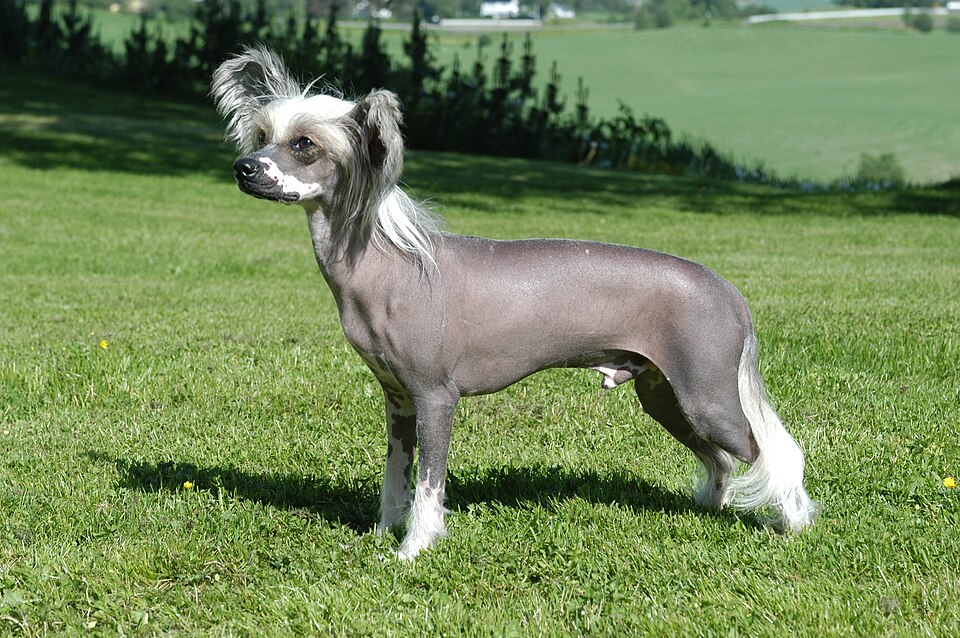
One breed in two varieties: the "hairless", with a crest on its head, socks on its feet and a plume on its tail but a bare body, and the "powderpuff", covered in a fine veil of hair. Small, graceful and cheerful; but the hairless variety's skin needs protection from sun and cold, and its mouth needs special attention.

 Lifespan12+ yearsRoyal Kennel Club: "over 12 years"
 WeightUp to 12 lb (5.4 kg)Royal Kennel Club standard
 Height9–13 in (23–33 cm)males 28–33, females 23–30 cm
 OriginChinarecords back to the Han Dynasty
 CoatHairless or powderpufftwo varieties, one breed
 ExerciseUp to 30 min a dayRoyal Kennel Club
 TeethMissing teeth possibletied to the hairless gene
 EyesDNA tests advisedPLL and prcd-PRA (KC)
The Chinese Crested comes in two very different-looking varieties of the same breed. The "hairless" has a long crest on its head and neck, "socks" on its feet and a plume on its tail, while its body is bare. The "powderpuff" is covered all over in a fine, long, soft veil of hair. On this page we cover both together; with the hairless variety we look closely at skin care and tooth structure.
- Two varieties, one breed: The hairless and the powderpuff are varieties of the same breed, under the same standard.
- Size: According to the Royal Kennel Club, males are 28–33 cm (11–13 in) and females 23–30 cm (9–12 in); weight no more than 5.4 kg (12 lb).
- Temperament: The FCI standard says "happy, never vicious"; the Royal Kennel Club recommends up to 30 minutes of exercise a day.
- Hairless variety: Its skin is exposed to sun, cold and friction; sun protection and clothing may be needed. Missing teeth are a feature of the breed in this variety.
- Health: The kennel club recommends DNA tests for PLL (inherited lens luxation) and prcd-PRA (inherited retinal disease).
What to know
 What is the Chinese Crested like?
The FCI standard sums up the Chinese Crested's temperament as "happy, never vicious", and the Royal Kennel Club's standard uses the same wording. It's a small, agile and graceful companion dog; the kennel club notes there are two distinct body types: the racy, fine-boned "deer" type and the heavier, thicker-boned "cobby" type.
In daily life that means an energetic dog attached to its people. It may struggle when left alone, so teach alone time gradually. Our article on separation anxiety in dogs walks through it step by step.
Breed traits describe general tendencies. The parents' temperament, early socialization and training shape an individual dog's personality as much as its breed does.
 Who is it a good fit for?
The Chinese Crested suits people who want a small companion and, especially for the hairless variety, can look after its skin. The Royal Kennel Club considers the breed suitable for flats and for homes with a small or medium garden.
| Situation | A good fit? |
|---|---|
| Apartment | Yes; daily exercise is up to 30 minutes |
| Family with kids | Needs care; a fine-boned little dog, so teach children to pet it on the floor |
| Other dogs and cats | Early, calm introductions matter; play with large dogs should be supervised |
| Long hours alone | May struggle; teach alone time gradually |
| Hot, sunny climate | The hairless variety must be protected from the sun (see below) |
| Cold climate | The hairless variety gets cold quickly; it needs clothing and a warm bed |
See our article on kids and dogs at home.
Where does it come from?
According to the Royal Kennel Club, there are records of the breed going back to the time of the Han Dynasty in China; larger types were used for hunting, and the breed is described as another example of the miniaturization of a sporting breed. The FCI's history says they were said to be owned by Han Dynasty families, developed as guardians of the treasure houses and, in a larger, heavier form, as hunting dogs. The same source notes that the breed was seen at shows in America from 1885 to 1926 but was then rarely seen for some fifty years. In the standard the country of origin is China and the patronage country is Great Britain.
The breed takes its name from the hairless variety's crest of hair on the head and neck. The two varieties are one breed; the Royal Kennel Club's litter registration offers a "Powder Puff" option.
Appearance and colors
The FCI standard describes the Chinese Crested as a small, active and graceful dog, medium- to fine-boned. The eyes are so dark as to appear black and almond-shaped, and the ears are large and erect; drop ears are also allowed in powderpuffs.
- Height and weight: According to the Royal Kennel Club, males are 28–33 cm (11–13 in) and females 23–30 cm (9–12 in); weight varies but shouldn't exceed 5.4 kg (12 lb).
- Hairless variety: A smooth, bare body with hair only on the head (the crest), feet (the socks) and tail (the plume). The FCI says the skin is fine-grained, smooth and warm to the touch.
- Powderpuff variety: An undercoat topped with a long, soft veil of hair; the body is fully coated.
- Color: The Royal Kennel Club's list includes black, blue, brown, cream, red, sable and many combinations; the FCI doesn't accept merle.
Daily care
The Royal Kennel Club rates grooming as "once a week" and notes the breed sheds. The workload looks very different in the two varieties.
Hairless variety
- Sun protection: Vetstreet says hairless breeds, naming the Chinese Crested, should wear sunscreen and not spend too much time in bright sunlight. According to the same source, products containing zinc oxide are toxic to dogs and can damage red blood cells. Ask your vet which protection is safe and how to use it.
- Cold and heat: Hairless skin has no coat to protect it from the cold. Dogs Trust says short-haired breeds and puppies may need a coat when it turns chilly; for a hairless dog this may apply even more. See our article on dogs in cold weather.
- Skin care: Ask your vet which products are right for cleaning and moisturizing the skin; human products may not suit dog skin. Show your vet any redness, blackheads or pimples, or itching.
- Friction: Bare skin is exposed to rubbing; watch for irritation on hard floors and at clothing edges.
Powderpuff variety
- Brushing: The fine, long hair is prone to tangling; brush friction areas such as behind the ears, under the legs and the inner thighs regularly. See our article on dog coat care.
- Bathing: When needed with a dog shampoo; dry the coat thoroughly.
For both varieties
- Teeth: Start dental care in puppyhood; see the health section below for missing teeth and caring for the remaining ones.
- Nails: Check regularly and handle the fine paws gently.
 Training and exercise
The Royal Kennel Club recommends up to 30 minutes of exercise a day; you can split it into two or three short walks plus play at home. Sniffing games tire the mind: sniffing games.
- Reward-based work: Short, rewarded and consistent training works best in small dogs, too. There's no need for harsh methods.
- Jumping: According to UFAW, the most common cause of front-leg fractures in toy breeds is jumping or falling from a height; in a fine-boned dog, don't let jumping off the sofa or bed become a habit, and provide steps.
- Weather: On cold, rainy or very sunny days you may need to shorten the walk or shift its timing.
- Leash: You can choose a harness to avoid straining the neck.
 Diet and weight
The Chinese Crested doesn't need a special food; a complete and balanced small-breed food suited to its age and size is enough. In a fine-boned dog even a small excess noticeably affects weight.
- If you can feel the ribs under a thin layer of fat, the weight is good; in the hairless variety you can also see it.
- Weigh the food and subtract treats from the daily amount.
- Regular weigh-ins show weight changes early.
For harmful foods, see foods dogs should never eat.
 Health issues to know about
The Royal Kennel Club monitors the breed in Category 2 of Breed Watch (conformational concerns); the recommended screening is the PLL and prcd-PRA DNA tests. The following is for information only; ask your veterinarian for diagnosis and treatment.
Missing teeth and dental care (hairless variety)
In all hairless dog breeds, a change in the FOXI3 gene causes both the lack of hair and a difference in tooth structure. A study published in Scientific Reports in 2017 showed that hairless dogs carrying this change had lost permanent canines, premolars and some incisors, and that the cusps of their molars developed differently. The FCI standard also says the hairless variety has forward-pointing canines and shouldn't be penalized for lacking a full set of teeth. So missing teeth are a feature of this variety, but caring for the remaining teeth is still important: in a 2021 UK study, 12.5% of dogs were diagnosed with gum disease within a year, and risk was higher in small dogs. Ask your vet about tooth brushing and regular dental checks.
Skin
The hairless variety's skin isn't protected by hair; Vetstreet lists hairless breeds among the dogs most affected by the sun. Show your vet any redness, scabbing, a new sore or a rapidly growing lump. Ask your vet what to use on the skin, and how often.
Eye disease
The Royal Kennel Club recommends two DNA tests. According to Cornell, PLL (primary lens luxation) happens when an inherited weakness in the fibers holding the lens lets it slip out of position; it can be painful and blinding, with signs such as a red, teary, cloudy and painful eye, and it most commonly develops between ages three and eight. Forward displacement is treated as an emergency. prcd-PRA is a form of progressive retinal atrophy: according to Cornell it's a painless, slowly progressing inherited disease that usually starts with weaker night vision and progresses to blindness. When buying a puppy, ask for the parents' DNA test results; if you see redness or squinting in the eye, go to your vet right away.
Fragile bones
According to UFAW, fractures of the lower part of the forearm (radius and ulna) are more common in toy breeds, can happen with only minor trauma and may be slow to heal. The Chinese Crested hasn't been studied specifically, but as a fine-boned toy-sized breed the same risk applies. The best prevention is avoiding falls.
- Redness, pain, cloudiness or squinting in an eye
- Sudden limping or swelling in a front leg
- A new sore, scab or rapidly growing lump on the skin
- Trouble breathing or fainting
- Refusing food, repeated vomiting or diarrhea
How long does it live?
The Royal Kennel Club lists the lifespan as "over 12 years". We couldn't find a separate life table for the Chinese Crested. A large UK study (McMillan et al., 2024) found that small dogs live longer than large ones, but that is a size result, not one for this breed.
Regular vet checks, a healthy weight, dental care, skin protection and preventing falls are the most concrete ways to help it live longer.
 Before you get one
- Consider a shelter too: Small-breed dogs and their mixes also end up in shelters. Our article on adopting a dog from a shelter covers the first steps.
- If you buy from a breeder: See the parents with the puppies in a home environment. Ask for PLL and prcd-PRA DNA test results and a pedigree. Talk about which variety (hairless or powderpuff) the puppy will be.
- Sun and cold: Think about your climate; for the hairless variety, sun protection and clothing are part of everyday life.
- Time and budget: Be ready for skin care, dental care and possible eye exams.
- Legal registration: In Türkiye, owned dogs must be microchipped and registered in the PETVET system. See our article on PETVET registration and microchips.
- First days: Our article a new puppy at home: the first week helps.
Frequently asked questions
Does the hairless variety really have no hair at all?
It does have some: a crest on the head and neck, socks on the feet and a plume on the tail; the body is bare. The FCI standard doesn't want large patches of hair on the body, so the breed type is no hair elsewhere.
Is the powderpuff the same breed?
Yes. The powderpuff is the variety of the same breed whose whole body is covered with a fine veil of hair. The Royal Kennel Club registers the two varieties as the same breed.
Is the hairless variety hypoallergenic?
No, it can't be called that. In a 2012 study, hair samples from breeds marketed as "hypoallergenic" had higher levels of the main dog allergen, Can f 1, than other dogs, and the researchers concluded that no breed can be called hypoallergenic. If you have allergies, spend time with the dog first and talk to your doctor.
Why are the hairless variety's teeth missing?
The FOXI3 gene change that causes hairlessness also affects tooth development; in a 2017 study, hairless dogs lacked canines, premolars and some incisors. The FCI standard doesn't count the hairless variety's lack of a full set of teeth as a fault.
Does it need sunscreen when it goes out in summer?
Vetstreet says hairless breeds should use sun protection, and that products containing zinc oxide can be toxic to dogs. Ask your vet which product is safe.
Sources
- The Royal Kennel Club (UK) · Chinese Crested: breed profile and health screening
- The Royal Kennel Club · Chinese Crested breed standard
- FCI · Chinese Crested Dog breed standard No. 288
- Kupczik et al. · The dental phenotype of hairless dogs with FOXI3 haploinsufficiency, Scientific Reports (2017)
- Cornell Riney Canine Health Center · Primary lens luxation
- Cornell Riney Canine Health Center · Progressive retinal atrophy
- Vetstreet · 5 Kinds of Dogs Who Are Most at Risk for Sun Damage
- Science for Animal Welfare (UFAW) · Distal fractures of the radius and ulna in toy breeds
- O'Neill et al. · Epidemiology of periodontal disease in dogs in the UK primary-care veterinary setting, Journal of Small Animal Practice (2021)
- Vredegoor et al. · Can f 1 levels in hair and homes of different dog breeds: lack of evidence to describe any dog breed as hypoallergenic, Journal of Allergy and Clinical Immunology (2012)
- Dogs Trust · How to keep your dog safe and warm in cold weather
- McMillan et al. · Longevity of companion dog breeds: those at risk from early death, Scientific Reports (2024)
- Resmî Gazete (Türkiye) · Regulation on the identification and registration of cats, dogs and ferrets (February 26, 2018)
By Tüylüm · Last checked: November 10, 2026. Compiled from the sources above and written in our own words. Spotted a mistake? Write to [email protected] and we'll fix it right away. Photo from Wikimedia Commons, used under the license shown below it.